The Hammer Candlestick Trading Strategy is one of the most effective price action methods used by traders to identify potential bullish reversals after a downtrend. Unlike lagging indicators that react after price has already moved, candlestick formations provide immediate insight into market sentiment. The hammer candlestick is especially valuable because it shows that sellers initially controlled the session but buyers stepped in aggressively, pushing prices back higher before the candle closed. This shift in momentum often signals that the existing bearish trend may be losing strength and that buyers are preparing to take control.
Professional traders across the forex, stock, cryptocurrency, and commodity markets rely on the Hammer Candlestick Trading Strategy because of its simplicity and reliability. However, like every trading method, it should never be traded in isolation. Combining the pattern with support zones, trend analysis, volume confirmation, and proper risk management significantly improves its success rate. Throughout this guide, you’ll learn how the hammer candlestick forms, why it works, how to execute the hammer candle strategy, and how to use this powerful bullish hammer as part of a complete reversal candlestick trading system.
What is the Hammer Candlestick Trading Strategy?
The Hammer Candlestick Trading Strategy is a bullish price action strategy designed to identify potential reversals after a sustained downtrend. It revolves around recognizing the hammer candlestick, which reflects the transition from seller dominance to increasing buying pressure.
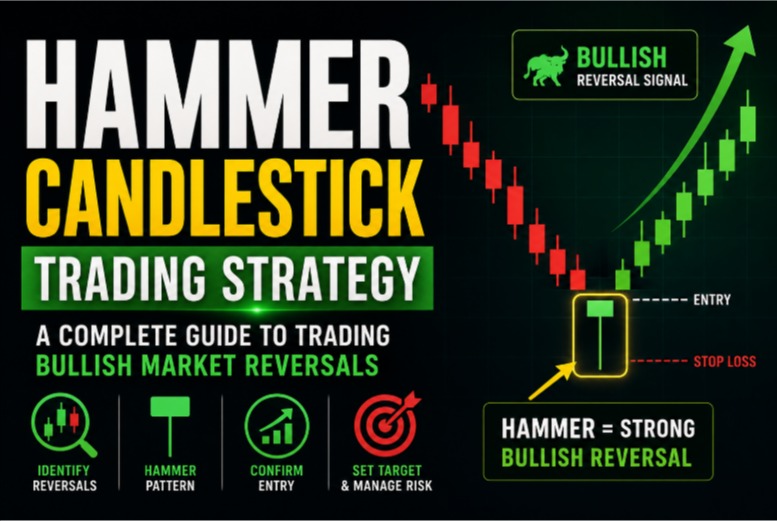
A valid hammer has a small real body near the top of the candle, a long lower shadow that is usually at least twice the size of the body, and little or no upper shadow. This unique structure demonstrates that sellers managed to push prices significantly lower during the trading session, but buyers regained control and forced the market to close near its opening price.
The Hammer Candlestick Trading Strategy is widely used because it provides early warning that bearish momentum may be ending. Traders generally wait for additional confirmation before entering a trade to reduce the risk of false signals.
Understanding the Hammer Candlestick
The hammer candlestick is one of the most recognizable candlestick formations in technical analysis. It appears after a decline and indicates that buyers have successfully rejected lower prices.
At the beginning of the trading session, sellers continue pushing the market downward. As prices fall, buyers enter aggressively, absorbing selling pressure and driving prices back toward the opening level. This creates the long lower shadow that defines the hammer candlestick.
The stronger the buying pressure during the recovery, the more reliable the pattern becomes. Although the hammer candlestick appears across every financial market, it is especially popular among forex traders because currency pairs often experience strong trending movements followed by sharp reversals.
Anatomy of a Bullish Hammer
A bullish hammer consists of several important characteristics that traders use to evaluate its strength. The real body should be relatively small and located near the upper end of the candle. The lower wick should be long, clearly showing that sellers attempted to continue the downtrend before buyers completely reversed the session.
The bullish hammer becomes even stronger when it develops after an extended decline or near major support levels where institutional buyers are likely to enter the market. The absence of a large upper wick further strengthens the signal because it indicates buyers maintained control until the candle closed.
Understanding the structure of the bullish hammer allows traders to distinguish high-quality reversal opportunities from ordinary market fluctuations.
Why the Hammer Candle Strategy Works
The hammer candle strategy works because it reflects changing market psychology rather than simply identifying a candle shape. Financial markets move according to supply and demand, and every candlestick tells the story of that battle.
During a downtrend, sellers dominate the market and continue pushing prices lower. Eventually, buying interest increases as traders recognize attractive prices or institutions begin accumulating positions. This sudden buying pressure creates the long lower shadow associated with the hammer and demonstrates that sellers are losing control.
The hammer candle strategy becomes even more reliable when combined with support levels, moving averages, or oversold momentum indicators. These additional confirmations increase the probability that the market is preparing for a genuine reversal instead of a temporary bounce.
Identifying a Reversal Candlestick
A reversal candlestick signals that the current market trend may be ending and a new trend could begin. While many reversal formations exist, the hammer remains one of the most dependable because it clearly demonstrates rejection of lower prices.
The effectiveness of any reversal candlestick depends on market context. Patterns that appear after prolonged downtrends generally provide stronger signals than those forming in sideways markets.
Professional traders rarely rely on a single reversal candlestick. Instead, they combine price action with trend analysis, volume, support and resistance, and momentum indicators before entering a trade.
Market Psychology Behind the Hammer Candlestick Trading Strategy
The real strength of the Hammer Candlestick Trading Strategy lies in understanding trader psychology.
At the beginning of the session, sellers appear to have complete control and continue driving prices lower. As the decline accelerates, buyers begin entering the market because they believe the asset has become undervalued. Their aggressive buying absorbs selling pressure and pushes prices back toward the opening level.
This psychological shift is what transforms the hammer candlestick into such a reliable reversal signal. Instead of reacting emotionally, disciplined traders wait for confirmation before entering positions, allowing the market to validate the potential reversal.
Best Timeframes for Trading the Hammer Candlestick
The hammer candlestick can appear on every timeframe, but higher timeframes generally provide more reliable signals.
Daily and four-hour charts are widely preferred because they contain more market information and reduce random price movements. Swing traders often use these timeframes to identify high-probability reversal opportunities.
Lower timeframes generate more frequent hammer formations, but they also produce more false signals. Traders should always analyze higher timeframe trends before making decisions based on lower timeframe price action.
Entry Rules for the Hammer Candle Strategy
A disciplined approach is essential when applying the hammer candle strategy.
Most traders wait for the next candle to close above the high of the hammer before entering a long position. This confirmation helps reduce the likelihood of entering a false reversal.
Stop-loss orders are commonly placed below the lowest point of the hammer because a break beneath that level invalidates the pattern. Profit targets may be determined using resistance levels, previous swing highs, or favorable risk-to-reward ratios.
Following structured entry rules helps traders execute the hammer candle strategy consistently while minimizing emotional decision-making.
Combining the Hammer Candlestick Trading Strategy with Technical Analysis
The Hammer Candlestick Trading Strategy becomes considerably stronger when combined with additional technical analysis tools.
Support levels often provide ideal locations for hammer formations because institutional buyers tend to accumulate positions in these areas. Moving averages help identify the overall trend, while RSI and Stochastic indicators can confirm oversold market conditions.
Instead of relying entirely on a single bullish hammer, experienced traders seek multiple confirmations before risking capital. This disciplined approach improves trade quality while filtering out weaker setups.
Common Mistakes Traders Make
Many beginners misuse the Hammer Candlestick Trading Strategy by trading every hammer they see regardless of market conditions.
Another common mistake is ignoring the overall trend. A hammer forming during a sideways market is generally less reliable than one developing after a strong decline.
Some traders enter immediately after spotting a hammer candlestick without waiting for confirmation. Others ignore risk management, believing every bullish hammer will produce a successful reversal.
Successful trading requires patience, confirmation, and disciplined execution rather than emotional decision-making.
Risk Management for Consistent Results
Even the strongest reversal candlestick cannot guarantee profitable trades every time. Risk management is therefore one of the most important aspects of long-term trading success.
Professional traders typically risk only a small percentage of their trading account on each position while maintaining consistent position sizing. They define stop-loss and take-profit levels before entering the market and avoid making emotional adjustments once the trade begins.
When combined with disciplined money management, the Hammer Candlestick Trading Strategy becomes a valuable long-term approach capable of delivering consistent performance over many trades.
Conclusion
The Hammer Candlestick Trading Strategy remains one of the most trusted reversal techniques in technical analysis because it clearly demonstrates the shift from selling pressure to buying strength. By understanding the structure of the hammer candlestick, recognizing the psychology behind the bullish hammer, and applying the hammer candle strategy alongside broader technical analysis, traders can significantly improve their decision-making.
Like every reversal candlestick, the hammer should never be traded on its own. The highest probability setups occur when the pattern appears after a strong downtrend, near important support levels, and receives confirmation from other technical tools. Patience, discipline, and sound risk management remain the keys to consistent trading success.
Frequently Asked Questions
What is the Hammer Candlestick Trading Strategy?
The Hammer Candlestick Trading Strategy is a bullish price action strategy that helps traders identify potential market reversals after a downtrend using the hammer candlestick pattern.
What makes a hammer candlestick valid?
A valid hammer candlestick has a small real body near the top of the candle, a long lower shadow that is at least twice the body size, and little or no upper shadow.
What is a bullish hammer?
A bullish hammer is a candlestick pattern that appears after a downtrend and signals that buyers have rejected lower prices, increasing the probability of a bullish reversal.
How does the hammer candle strategy work?
The hammer candle strategy works by waiting for confirmation after a hammer forms. Traders usually enter once price moves above the hammer’s high while placing a stop-loss below its low.
Is the hammer a reversal candlestick?
Yes. The hammer is one of the most reliable reversal candlestick patterns because it reflects a shift from seller dominance to buyer control.
Which timeframe is best for the Hammer Candlestick Trading Strategy?
The Hammer Candlestick Trading Strategy works on all timeframes, but four-hour and daily charts generally produce the most reliable signals.
Should I trade every bullish hammer I see?
No. Every bullish hammer should be evaluated within the overall market trend and confirmed using support levels, indicators, or other forms of technical analysis before entering a trade.