

Introduction
India has two main stock exchanges offering currency futures and options: the National Stock Exchange (NSE) and BSE. Both list USD/INR and other rupee pairs, both settle against the same reference rate, and both are regulated by SEBI and the RBI. Yet traders often find that one exchange shows tighter prices or more activity in a particular contract than the other.
This guide compares BSE currency derivatives with NSE across the things that matter to traders and hedgers: the contracts available, contract specifications, liquidity, transaction costs, settlement and practical choice. It also explains how to check liquidity yourself, because market share between the two exchanges has shifted over the years.
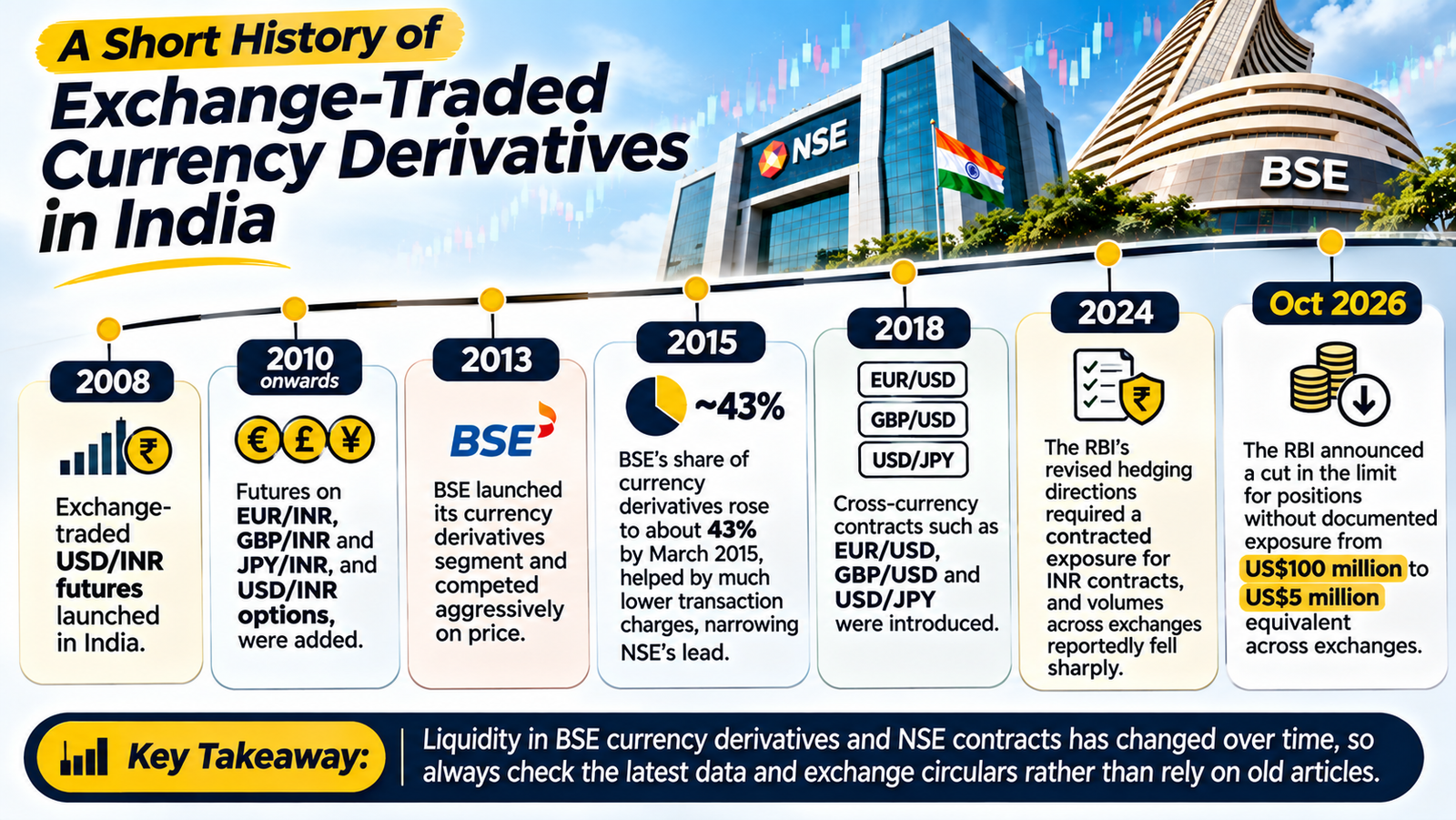
A Short History of Exchange-Traded Currency Derivatives in India
- 2008: exchange-traded USD/INR futures launched in India.
- 2010 onwards: futures on EUR/INR, GBP/INR and JPY/INR, and USD/INR options, were added.
- 2013: BSE launched its currency derivatives segment and competed aggressively on price.
- 2015: media reports showed BSE’s share of currency derivatives rising to about 43% by March 2015, helped by much lower transaction charges, narrowing NSE’s lead.
- 2018: cross-currency contracts such as EUR/USD, GBP/USD and USD/JPY were introduced.
- 2024: the RBI’s revised hedging directions required a contracted exposure for INR contracts, and volumes across exchanges reportedly fell sharply.
- October 2026: the RBI announced a cut in the limit for positions without documented exposure from US100milliontoUS5 million equivalent across exchanges.
Understanding this history explains why liquidity in BSE currency derivatives and NSE contracts has changed over time and why you should check current data rather than rely on old articles.
Contracts Available on Each Exchange
| Contract type | NSE | BSE |
|---|---|---|
| USD/INR futures (monthly) | Yes | Yes |
| USD/INR futures (weekly) | Yes | Yes |
| USD/INR options (monthly and weekly) | Yes | Yes |
| EUR/INR, GBP/INR, JPY/INR futures and options | Yes | Yes |
| Cross-currency futures and options (EUR/USD, GBP/USD, USD/JPY) | Yes | Yes |
The product lists are broadly similar, so the choice between BSE currency derivatives and NSE contracts usually comes down to liquidity and cost in the specific contract you want, rather than availability. Contract lists change, so confirm current listings on each exchange’s website and in your broker’s platform.
Contract Specifications Compared
Specifications are largely harmonised across exchanges:
| Feature | USD/INR on NSE | USD/INR on BSE |
|---|---|---|
| Lot size | $1,000 | $1,000 |
| Tick size | ₹0.0025 (0.25 paise) | ₹0.0025 (0.25 paise) |
| Value per paise per lot | ₹10 | ₹10 |
| Trading hours | 9:00am to 5:00pm IST | 9:00am to 5:00pm IST |
| Monthly expiry | Two working days before the last working day of the month, 12:30pm | Same |
| Weekly expiry | Friday (or earlier if a holiday) | Friday (or earlier if a holiday) |
| Options style | European | European |
| Settlement | Cash in INR against the FBIL reference rate | Cash in INR against the FBIL reference rate |
Because the contracts are economically identical, a USD/INR futures position on BSE behaves exactly like the same position on NSE. The differences are in who else is trading and what you pay. Note that a position bought on one exchange cannot be closed by selling on the other: you must exit on the same exchange.
Liquidity: Why It Matters Most
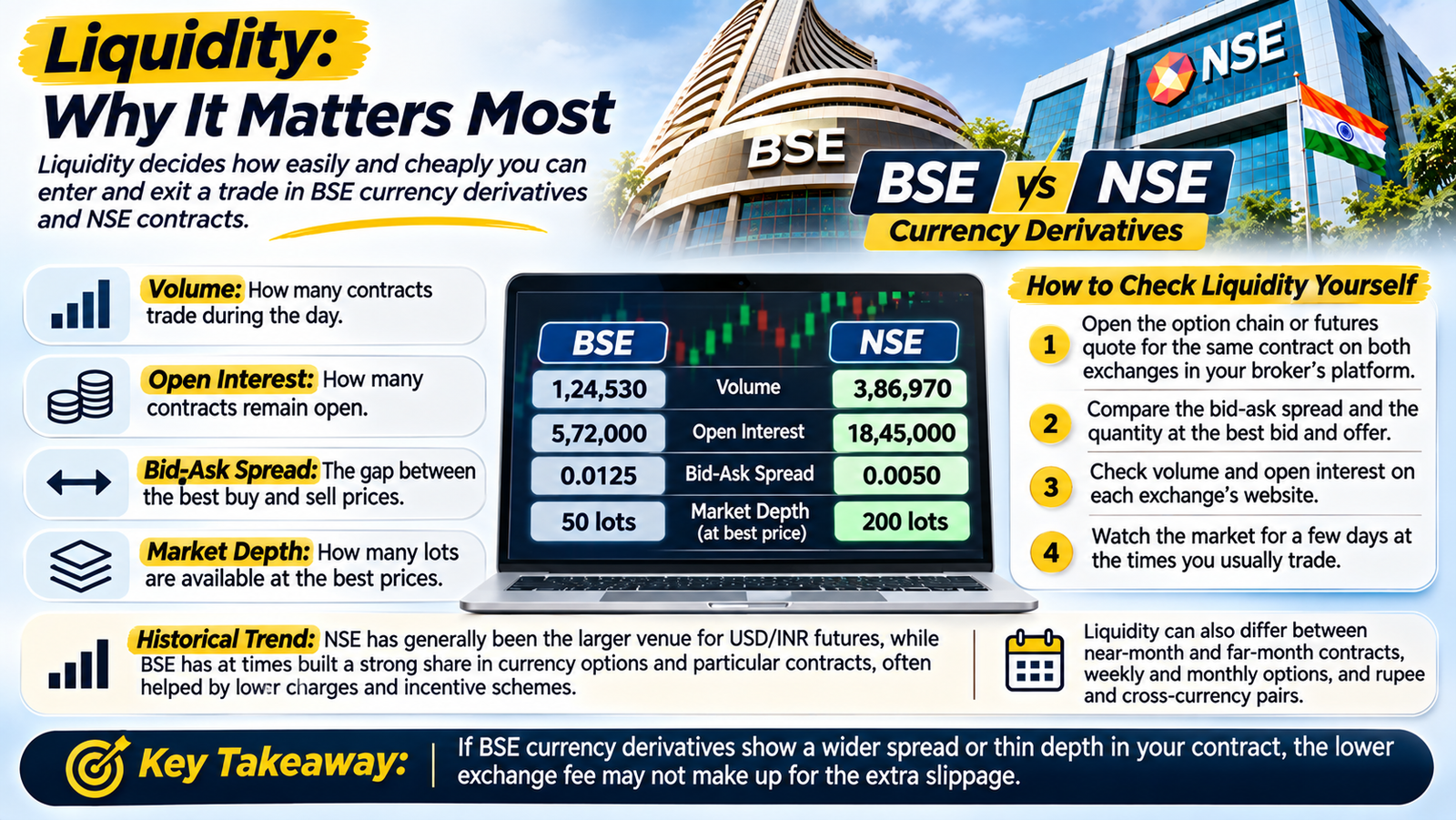
Liquidity decides how easily and cheaply you can enter and exit. For BSE currency derivatives and NSE contracts alike, check:
- Volume: how many contracts trade during the day.
- Open interest: how many contracts remain open.
- Bid-ask spread: the gap between the best buy and sell prices.
- Market depth: how many lots are available at the best prices.
Historically, NSE has generally been the larger venue for USD/INR futures, while BSE has at times built a strong share in currency options and particular contracts, often helped by lower charges and incentive schemes. Liquidity can also differ between near-month and far-month contracts, weekly and monthly options, and rupee and cross-currency pairs.
How to check liquidity yourself
- Open the option chain or futures quote for the same contract on both exchanges in your broker’s platform.
- Compare the bid-ask spread and the quantity at the best bid and offer.
- Check volume and open interest on each exchange’s website.
- Watch the market for a few days at the times you usually trade.
If BSE currency derivatives show a wider spread or thin depth in your contract, the lower exchange fee may not make up for the extra slippage.
Transaction Costs Compared
Using one discount broker’s published rate card at the time of writing, exchange transaction charges were:
| Charge | NSE | BSE |
|---|---|---|
| Currency futures transaction charge | 0.00035% of turnover | 0.00045% of turnover |
| Currency options transaction charge | 0.0311% of premium | 0.001% of premium |
Other charges, such as brokerage, SEBI turnover fees, stamp duty and GST, generally apply in the same way on both exchanges. There is no STT on currency derivatives on either exchange.
The biggest difference is in options: on these rates, BSE currency derivatives options carry a far lower exchange charge on premium than NSE. For futures, the charges are similar and very small.
Worked Example: Options Cost Comparison
This example is illustrative. It uses the rates above and ignores brokerage, which is usually the same on both exchanges.
A trader buys 50 lots of a USD/INR call at a premium of ₹0.40.
- Premium turnover: 50 × 1,000 × 0.40 = ₹20,000.
- NSE transaction charge: 0.0311% × ₹20,000 = ₹6.22, plus 18% GST = about ₹7.34.
- BSE transaction charge: 0.001% × ₹20,000 = ₹0.20, plus 18% GST = about ₹0.24.
The saving on BSE is about ₹7 per ₹20,000 of premium. That is small next to ₹20 brokerage, and it disappears if the BSE bid-ask spread is even 0.25 paise wider on 50 lots (worth ₹125). For BSE currency derivatives, the fee advantage matters most for active option traders when the spreads on both exchanges are similar.
Worked Example: Futures Cost Comparison
Illustrative. A round trip of 10 lots of USD/INR futures at about 88.60 creates turnover of roughly ₹17,72,000.
- NSE transaction charge: 0.00035% × ₹17,72,000 = about ₹6.20.
- BSE transaction charge: 0.00045% × ₹17,72,000 = about ₹7.97.
The difference is under ₹2. For futures, liquidity and spread matter far more than the exchange charge.
Settlement, Margins and Risk Management
- Both exchanges settle rupee contracts in cash against the FBIL reference rate on expiry.
- Both use clearing corporations (NSE Clearing for NSE, Indian Clearing Corporation for BSE) that guarantee settlement.
- Margin frameworks (SPAN and exposure margins) and peak margin rules apply on both exchanges.
- RBI rules on hedging contracted exposure and the declaration you sign apply across exchanges, and the position limit without documented exposure is calculated across all exchanges combined.
So there is no difference in safety or regulatory protection between trading BSE currency derivatives and NSE contracts.
Weekly Contracts on BSE Currency Derivatives
BSE lists weekly USD/INR futures and options alongside monthly contracts. According to BSE’s contract specifications, weekly contracts expire on Friday, or the previous trading day if Friday is a holiday. In the week when a monthly contract expires, the weekly contract expires on the monthly expiry day instead. Several serial weekly contracts are available at any time, and like monthly contracts, they are cash-settled in rupees against the reference rate.
Weekly options are popular with short-term traders because premiums are lower and time decay is faster. If you trade weekly BSE currency derivatives, pay close attention to liquidity in strikes away from the current price, which can be thin, and to the expiry-day cut-off time.
How to Place a Trade on BSE
- Make sure the currency segment is active in your trading account and that you have signed the RBI declaration.
- In your broker’s platform, search for the contract and select the BSE (often shown as BCD or BSE-CDS) listing rather than NSE (often shown as CDS).
- Check the bid, offer and depth on the BSE order book.
- Place a limit order rather than a market order, especially in less liquid contracts.
- Track the position on the same exchange, and exit there when you close.
Exchange codes and labels vary by broker, so confirm which listing you are trading before you place orders in BSE currency derivatives.

Broker Support
Most large brokers support both exchanges for currency derivatives, but platform features can differ. Some brokers may show only the NSE option chain by default, or may not list every BSE contract. Check:
- Whether your broker supports BSE currency derivatives at all
- Which pairs and expiries are available on each exchange
- Whether the broker charges the same brokerage on both
- How margin is shown when you hold positions on both exchanges
BSE Currency Derivatives vs NSE: Which Should You Choose?
| Your situation | Practical approach |
|---|---|
| Hedging a business exposure with futures | Use the exchange with tighter spreads and better depth in the expiry you need, usually checked at the time of hedging |
| Active option buyer or seller | Compare spreads; where similar, BSE’s lower options charge can help |
| Trading far-month or less common pairs | Choose whichever shows real volume and open interest; avoid illiquid contracts |
| Beginner | Start with the most liquid contract on either exchange and focus on learning, not fee savings |
Many traders simply check both quotes before each trade. BSE currency derivatives can be a useful alternative where liquidity is comparable, while NSE often offers more depth in core futures contracts.
BSE Currency Derivatives Checklist
- Is the contract I want listed on BSE, NSE or both?
- Which exchange shows tighter bid-ask spreads right now?
- Is there enough depth for my lot size?
- What are the current exchange charges on each exchange?
- Does my broker support both exchanges for this contract?
- Do I remember that I must exit on the same exchange where I entered?
- Am I within RBI limits and holding a genuine exposure for INR contracts?
Common Mistakes
- Choosing an exchange only on fees: a wider spread can wipe out the saving.
- Trying to exit on the other exchange: positions must be closed on the exchange where they were opened.
- Relying on old market share data: liquidity shifts over time.
- Ignoring far-month illiquidity: far contracts on either exchange can be thin.
- Forgetting combined RBI limits: the limit without documented exposure applies across exchanges.
FAQs
What are BSE currency derivatives?
Futures and options on currency pairs such as USD/INR, EUR/INR, GBP/INR, JPY/INR and cross-currency pairs, traded on BSE’s currency segment and cleared by Indian Clearing Corporation.
Are BSE and NSE currency contracts the same?
Specifications such as lot size, tick size, expiry and settlement are largely harmonised, but each exchange has its own order book.
Which exchange is more liquid?
It varies by contract and over time. NSE has generally been larger in core USD/INR futures; check current volume, open interest and spreads before trading.
Are BSE currency derivatives cheaper?
On the rates quoted above, BSE’s options transaction charge is much lower, while futures charges are similar. Brokerage and other charges usually match.
Can I buy on BSE and sell on NSE?
No. You must exit a position on the same exchange where you opened it.
Do RBI rules apply to BSE as well?
Yes. Hedging requirements, declarations and limits apply across all exchanges combined.
Conclusion
NSE and BSE offer nearly identical currency contracts, settled against the same reference rate and backed by clearing corporations under the same regulators. The real differences are liquidity and cost. NSE has often offered more depth in core USD/INR futures, while BSE currency derivatives have competed strongly on price, particularly for options.
The best approach is practical: check spreads, depth and open interest for the exact contract you want, compare total costs including slippage, and remember to exit on the same exchange. Whichever exchange you use, follow RBI hedging rules and manage your margin carefully.