
Introduction
Once you start trading futures and options, currency derivatives or intraday equity regularly, the tax department treats that activity as a business. And a business may need to keep proper books of accounts. Many traders do not realize this until they try to file ITR-3 and are asked for a balance sheet and profit and loss account.
The rule that decides this is section 44AA of the Income-tax Act, 1961, carried forward as section 62 in the Income-tax Act, 2025. This guide explains section 44AA traders rules in plain language: who must keep books, the income and turnover thresholds, how the presumptive scheme affects you, which books and records to maintain, how long to keep them, penalties for not doing so and how all this fits with tax audit and your return.
Why Traders Are Treated as Running a Business
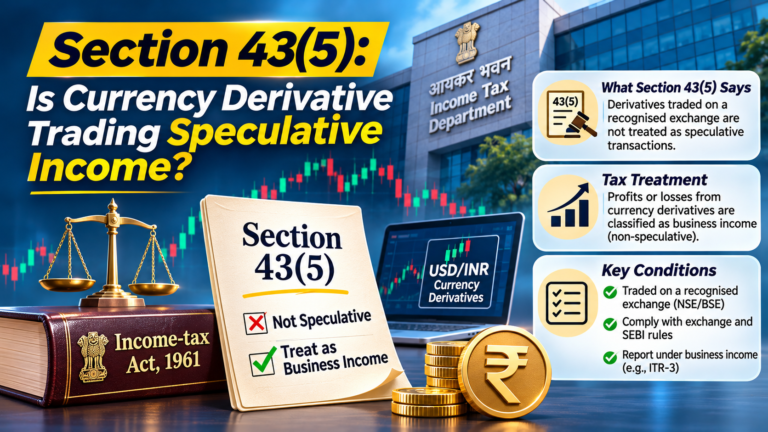
Income from trading derivatives on arecognised exchange, including equity F&O and currency futures and options, is generally taxed as non-speculative business income. Intraday equity trading is treated as speculative business income. Either way, it falls under the head “Profits and Gains of Business or Profession”, not capital gains.
Because it is business income, the books of account rules apply. That is the starting point for understanding section 44AA traders obligations.
What Section 44AA Requires
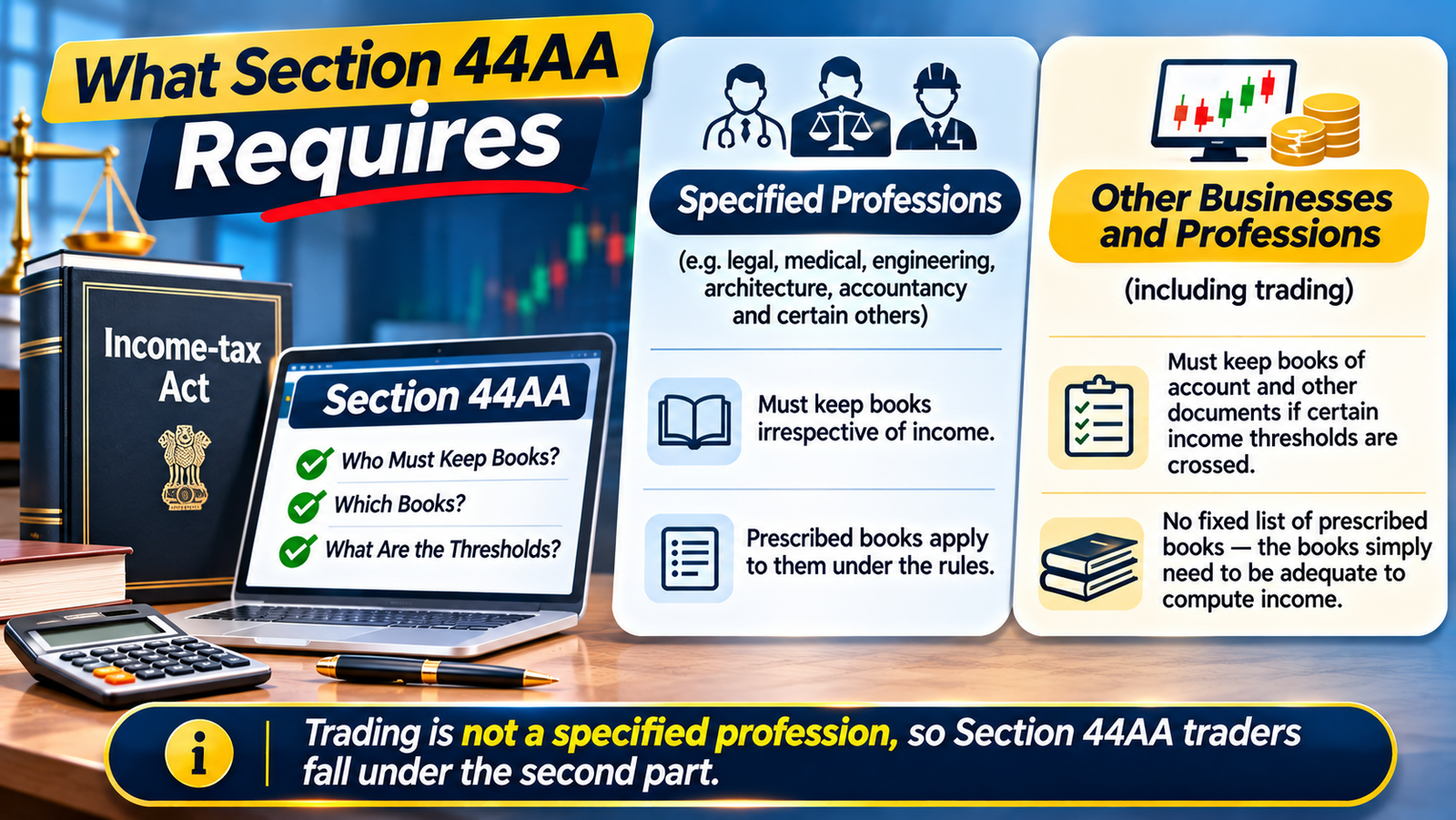
Section 44AA has two parts:
- Specified professions (such as legal, medical, engineering, architecture, accountancy and certain others) must keep books irrespective of income, and prescribed books apply to them under the rules.
- Other businesses and professions, which includes trading, must keep books of account and other documents that enable the Assessing Officer to compute total income, if certain thresholds are crossed.
Trading is not a specified profession, so section 44AA traders fall under the second part. There is no fixed list of prescribed books for them; the books simply need to be adequate to compute income.
Section 44AA Traders: The Thresholds
Under the Income Tax Department’s guidance, books must be maintained if either income or turnover exceeds the limits below in any one of the three preceding years:
| Taxpayer | Income from business exceeds | Or turnover / gross receipts exceed |
|---|---|---|
| Individuals and HUFs | ₹2,50,000 | ₹25,00,000 |
| Other persons (firms, companies and so on) | ₹1,20,000 | ₹10,00,000 |
For a business newly set up in the current year, the thresholds are applied to the current year’s expected income or turnover.
For most individual section 44AA traders, the income test is the one that usually triggers the requirement, because trading turnover, calculated the way tax law requires, is often much smaller than people expect.
How Trading Turnover Is Calculated
Turnover for derivatives is not the contract value of every trade. Under the ICAI Guidance Note on Tax Audit, it is generally:
- the total of the absolute values of profits and losses on each squared-off trade (favorable and unfavorable differences), plus
- premium received on the sale of options, where it is not already included in those differences.
Illustrative example: a currency trader makes 200 trades in a year, with profits totalling ₹6,00,000 on winning trades and losses totalling ₹4,50,000 on losing trades. Turnover is ₹6,00,000 + ₹4,50,000 = ₹10,50,000, even if the contract value traded ran into crores. Net income is ₹1,50,000.
In this example, turnover is below ₹25 lakh and income is below ₹2.5 lakh, so if the same was true for each of the previous three years, books may not be compulsory under the general test. If net income had been ₹3,00,000, the income test would have been crossed.
The Presumptive Scheme Link
The presumptive taxation scheme for small businesses (section 44AD of the 1961 Act) adds another trigger for section 44AA traders:
- A resident individual or HUF who opted for the presumptive scheme in any of the previous five years, then opts out in the current year, must keep books if income exceeds the basic exemption limit.
- A person who declares profit lower than the presumptive rate, with total income above the basic exemption limit, must also keep books and may need a tax audit.
Whether the presumptive scheme is suitable for derivatives trading at all is debated among professionals, and many advise against using it for trading losses. Discuss it with your chartered accountant before choosing it.
Section 44AA Traders Under the Income-tax Act, 2025
From 1 April 2026 (tax year 2026-27 onwards), the Income-tax Act, 2025 replaces the 1961 Act. According to professional commentary, the books of account requirement now sits in section 62, with the basic requirement and thresholds largely unchanged.
| Item | Income-tax Act, 1961 | Income-tax Act, 2025 (as reported) |
|---|---|---|
| Maintenance of books | Section 44AA | Section 62 |
| Penalty for failure | Section 271A, ₹25,000 | Section 441, ₹25,000 |
| Tax audit | Section 44AB | Renumbered under the new Act |
Since the term “section 44AA” is still what most people search for and what older guidance uses, the label section 44AA traders remains useful, but returns from tax year 2026-27 refer to the new section numbers. Verify the exact references against the official text.
Which Books and Records Should Traders Keep?
Because no specific books are prescribed for trading, section 44AA traders should keep records that let anyone compute income accurately:
| Record | Why it matters |
|---|---|
| Contract notes | Legal record of each trade, with charges |
| Broker ledger and tax P&L statement | Summary of realised profits, losses and charges |
| Bank statements | Proof of funds moved to and from the broker |
| Cash book and bank book | Record of receipts and payments for the trading business |
| Journal and ledger | Classify income and expenses into accounts |
| Expense bills and invoices | Support deductions for data feeds, software, internet, advisory fees and equipment |
| Profit and loss account | Shows net trading income for the year |
| Balance sheet | Shows capital, margin money with broker, bank balances and liabilities |
Many traders use simple accounting software or a spreadsheet maintained by their accountant. The aim is a clear trail from each trade to the figures in the return.
Retention Period
Books and documents must generally be kept for six years from the end of the relevant assessment year. If an assessment is reopened, they must be kept until the reassessment is completed. Most brokers let you download old contract notes, but do not rely on that: keep your own copies.
Penalty for Not Maintaining Books
Failure to keep or retain books when required can attract a penalty of ₹25,000 (section 271A of the 1961 Act; reported as section 441 in the 2025 Act). Beyond the penalty, poor records make it harder to support losses, claim expenses and respond to notices, and can lead the Assessing Officer to estimate income.
For section 44AA traders, the penalty is often less costly than the loss of credibility in a scrutiny case, where good records are your main defence.
Books of Accounts vs Tax Audit
Maintaining books and getting a tax audit are separate requirements:
| Requirement | Trigger (general position) |
|---|---|
| Books of accounts | Income or turnover above the thresholds in any of the three preceding years, or presumptive scheme conditions |
| Tax audit | Turnover above ₹1 crore, or ₹10 crore where cash receipts and payments are each within 5%; also certain presumptive scheme cases |
So you can be required to keep books without needing an audit. Check current thresholds each year, since they may change under the new Act.
Section 44AA Traders and ITR-3
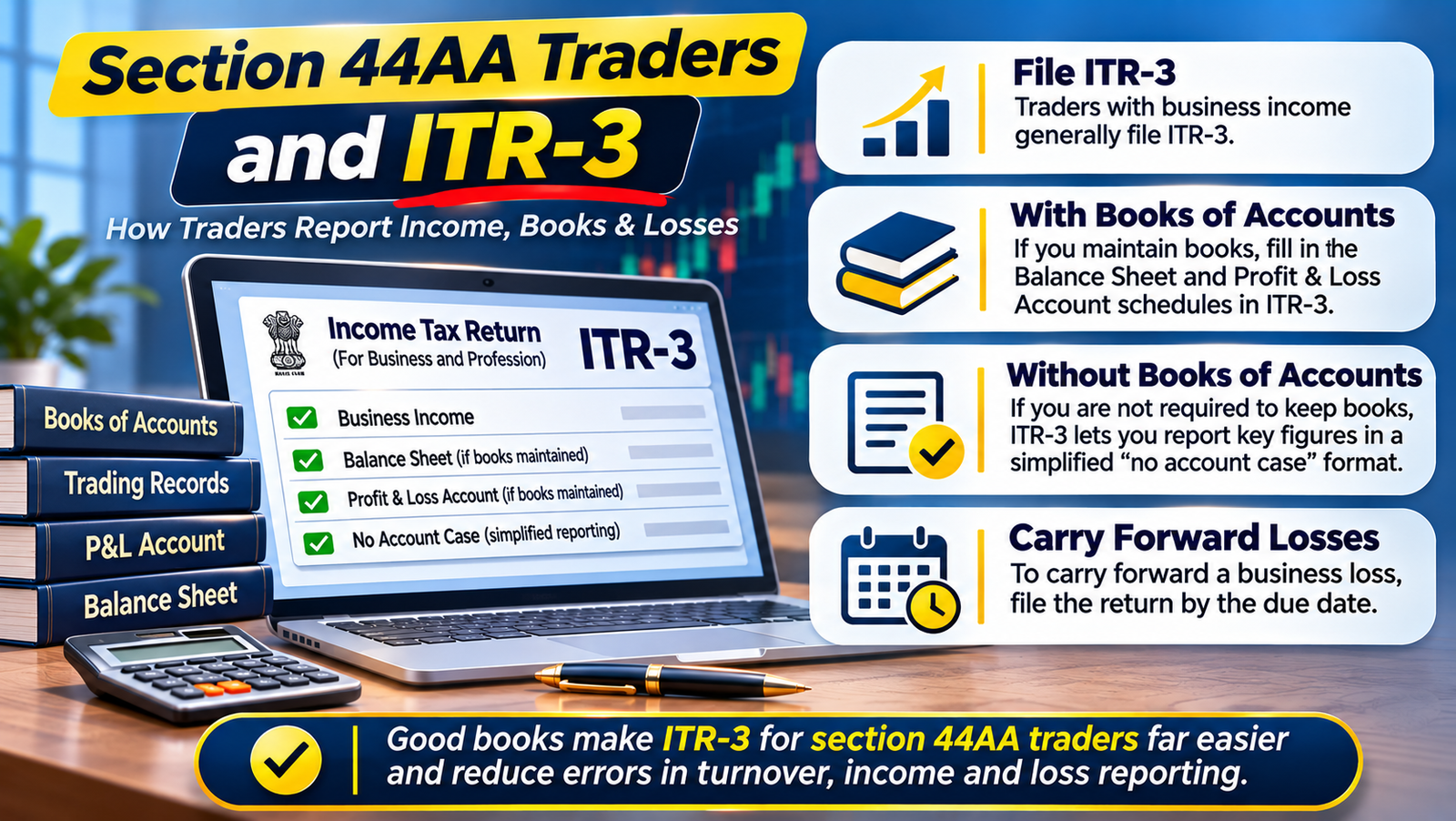
- Traders with business income generally file ITR-3.
- If you maintain books, you fill in the balance sheet and profit and loss account schedules.
- If you are not required to keep books, ITR-3 lets you report key figures in a simplified “no account case” format.
- To carry forward a business loss, file the return by the due date.
Good books make ITR-3 for section 44AA traders far easier and reduce errors in turnover, income and loss reporting.
Worked Example: Does This Trader Need Books?
This example is illustrative and simplified.
Rohan, an individual, trades USD/INR futures and equity options. His figures:
| Year | Trading turnover | Net trading income |
|---|---|---|
| Three years ago | ₹8,00,000 | ₹90,000 |
| Two years ago | ₹14,00,000 | ₹2,80,000 |
| Last year | ₹11,00,000 | Loss of ₹60,000 |
Two years ago, his income of ₹2,80,000 exceeded ₹2,50,000. Because the test looks at any of the three preceding years, Rohan should maintain books for the current year, even though last year was a loss. This is a common surprise for section 44AA traders.
Practical Tips
- Treat trading as a business from day one: separate bank account, organized records.
- Download contract notes and the broker’s tax P&L each month.
- Track expenses with bills, and keep a note of business use for shared items like internet.
- Check the three-year income and turnover test every year, not just when you make a profit.
- Work with a chartered accountant who understands trading turnover and ITR-3.
- Store everything for at least six years after the assessment year.
Section 44AA Traders Checklist
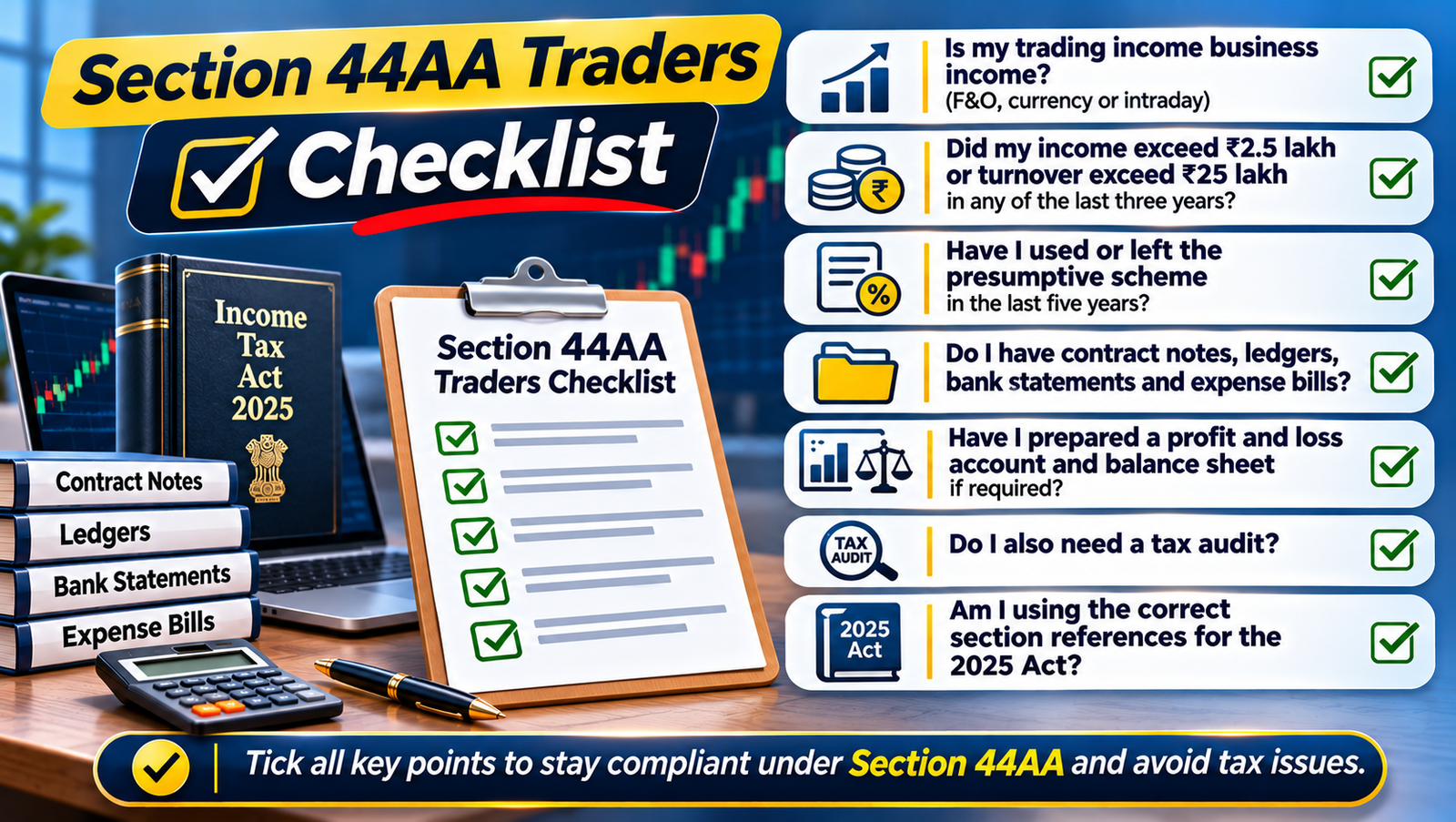
- Is my trading income business income (F&O, currency or intraday)?
- Did my income exceed ₹2.5 lakh or turnover exceed ₹25 lakh in any of the last three years?
- Have I used or left the presumptive scheme in the last five years?
- Do I have contract notes, ledgers, bank statements and expense bills?
- Have I prepared a profit and loss account and balance sheet if required?
- Do I also need a tax audit?
- Am I using the correct section references for the 2025 Act?
Common Mistakes
- Using contract value as turnover: trading turnover is based on absolute profits and losses.
- Looking only at the current year: the test covers any of the three preceding years.
- Assuming a loss year needs no books: an earlier year’s income can still trigger the requirement.
- Mixing personal and trading money: makes books harder to keep and defend.
- Not keeping expense bills: unsupported expenses may be disallowed.
- Deleting records too early: keep them for six years after the assessment year.
FAQs
What is section 44AA traders compliance?
It means keeping books of accounts for trading income when the income, turnover or presumptive scheme conditions in section 44AA (now section 62 of the 2025 Act) are met.
Do F&O traders need to maintain books?
If income exceeds ₹2.5 lakh or turnover exceeds ₹25 lakh in any of the three preceding years (for individuals), or presumptive scheme conditions apply, yes.
Are there prescribed books for section 44AA traders?
No specific list is prescribed for trading. Books must be enough for the Assessing Officer to compute income.
Is maintaining books the same as a tax audit?
No. They are separate requirements with different triggers.
What is the penalty for not keeping books?
₹25,000, under section 271A of the 1961 Act, reported as section 441 in the 2025 Act.
How long should traders keep records?
Generally six years from the end of the relevant assessment year, or longer if an assessment is reopened.
Can I use ITR-3 without a balance sheet?
If you are not required to keep books, ITR-3 offers a simplified “no account case” section. Otherwise, a balance sheet and P&L are needed.
Conclusion
Trading income is business income, and that brings record-keeping duties. Under section 44AA, now section 62 of the Income-tax Act, 2025, individual traders must maintain books if income exceeds ₹2.5 lakh or turnover exceeds ₹25 lakh in any of the three preceding years, or if presumptive scheme conditions apply. Trading turnover is based on absolute profits and losses, not contract value.
For section 44AA traders, good books are more than compliance: they make ITR-3 simpler, support loss carry forward and expense claims, and protect you in scrutiny. Keep contract notes, ledgers, bank records and bills, prepare a P&L and balance sheet where required, retain everything for six years, and work with a chartered accountant who understands trading.