
Introduction
If you trade currencies, you are really trading the decisions and expectations of central banks. Interest rates, money supply, inflation targets, balance sheet policy and even the way officials speak all influence exchange rates. That is why understanding central banks forex markets react to is one of the most important parts of fundamental analysis.
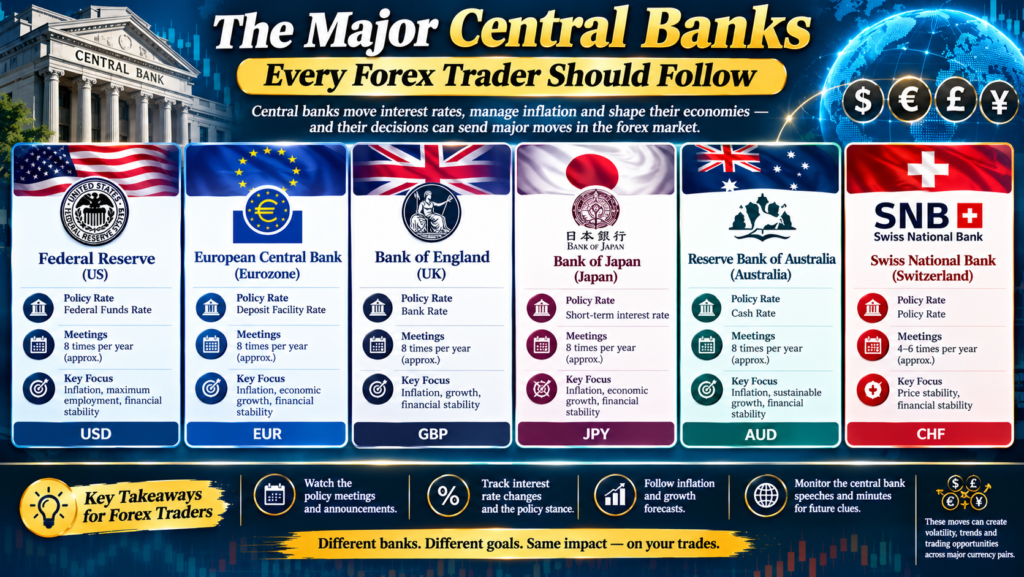
There are dozens of central banks in the world, but a small group drives most of the currency market. The US Federal Reserve alone influences the dollar, which sits on one side of almost 90% of all forex trades. The European Central Bank, Bank of Japan and Bank of England shape the euro, yen and pound, while the Reserve Bank of India manages the rupee.
This guide covers the major central banks forex traders should follow, what each one targets, how often it meets, the signals to watch and how its decisions move currencies.
Why Central Banks Matter in Forex
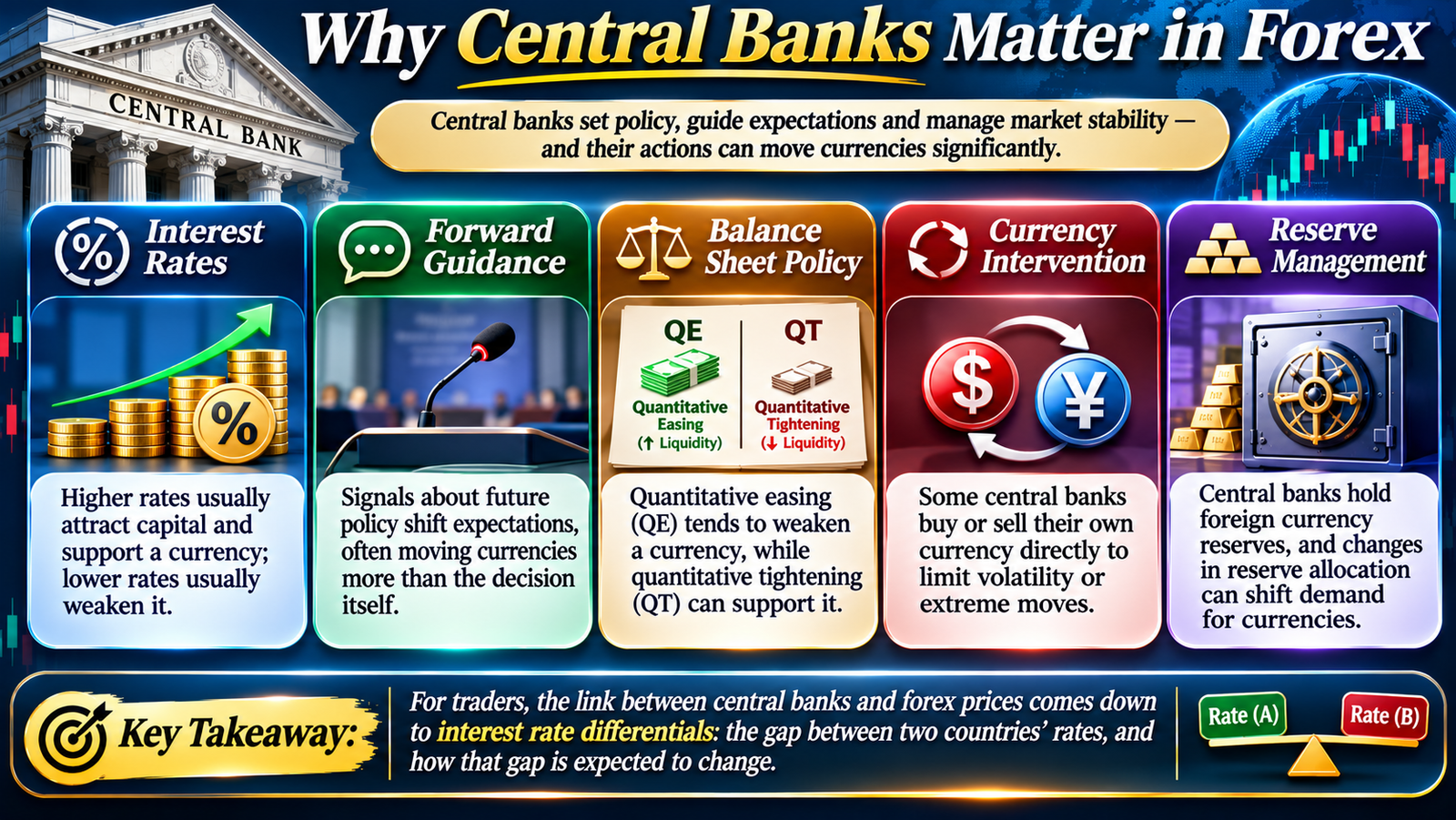
Central banks affect currencies in several ways:
- Interest rates: higher rates usually attract capital and support a currency; lower rates usually weaken it.
- Forward guidance: signals about future policy shift expectations, often moving currencies more than the decision itself.
- Balance sheet policy: quantitative easing tends to weaken a currency, while quantitative tightening can support it.
- Currency intervention: some central banks buy or sell their own currency directly to limit volatility or extreme moves.
- Reserve management: central banks hold foreign currency reserves, and changes in reserve allocation can shift demand.
For traders, the link between central banks and forex prices comes down to interest rate differentials: the gap between two countries’ rates, and how that gap is expected to change.
Central Banks Forex Traders Follow: At a Glance
| Central bank | Currency | Main inflation goal | Policy meetings per year | Key policy rate |
|---|---|---|---|---|
| Federal Reserve (Fed) | USD | 2% (PCE), plus maximum employment | 8 | Federal funds rate |
| European Central Bank (ECB) | EUR | 2% over the medium term | 8 | Deposit facility rate |
| Bank of Japan (BoJ) | JPY | 2% | 8 | Short-term policy rate |
| Bank of England (BoE) | GBP | 2% (CPI) | 8 | Bank Rate |
| Swiss National Bank (SNB) | CHF | Price stability, defined as inflation between 0% and 2% | 4 | SNB policy rate |
| Bank of Canada (BoC) | CAD | 2%, midpoint of a 1–3% range | 8 | Overnight rate |
| Reserve Bank of Australia (RBA) | AUD | 2–3% | 8 | Cash rate |
| Reserve Bank of New Zealand (RBNZ) | NZD | 1–3%, with a focus on 2% | 7 | Official cash rate |
| People’s Bank of China (PBoC) | CNY | Multiple objectives | No fixed schedule | Loan prime rate and other tools |
| Reserve Bank of India (RBI) | INR | 4% CPI, within a 2–6% band | Usually 6 | Repo rate |
Meeting frequencies are typical and can change. Always check each central bank’s published calendar.
1. The US Federal Reserve (Fed)
The Fed is the most important of all central banks forex traders follow, because the dollar is the world’s main reserve, funding and trading currency.
- Mandate: maximum employment and stable prices, often called the “dual mandate”. Its inflation goal is 2%, measured by the PCE price index.
- Decision-makers: the Federal Open Market Committee (FOMC), with 12 voting members drawn from the Board of Governors and regional Fed presidents.
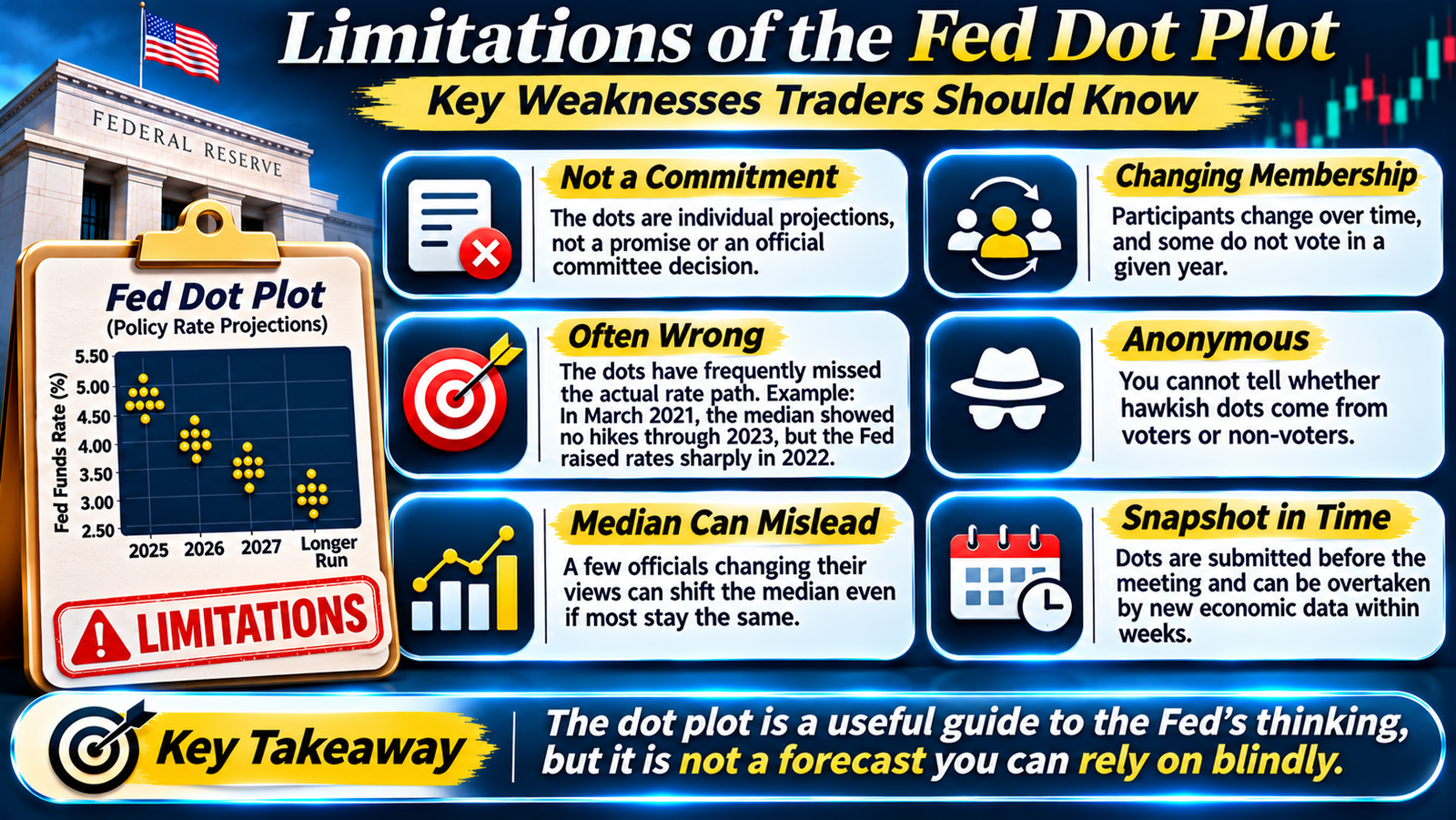
- Key releases: the policy statement, press conference, minutes three weeks later and the Summary of Economic Projections, including the dot plot, four times a year.
- Timing in India: decisions are released at 2:00pm US Eastern Time, which is 11:30pm IST during US daylight saving time and 12:30am IST in winter.
- Data to watch: nonfarm payrolls, CPI, PCE inflation and GDP.
Fed decisions affect almost every pair, including EUR/USD, USD/JPY, GBP/USD and USD/INR.
2. The European Central Bank (ECB)
- Mandate: price stability, defined as 2% inflation over the medium term, measured by the Harmonised Index of Consumer Prices (HICP).
- Decision-makers: the Governing Council, made up of the Executive Board and the governors of the euro area national central banks.
- Key rate: the deposit facility rate is the main policy signal.
- Key releases: the monetary policy statement, press conference and staff macroeconomic projections, which are published quarterly.
Among the central banks forex traders track, the ECB is usually second only to the Fed in importance. It shapes EUR/USD, the most traded pair in the world, as well as EUR/GBP, EUR/JPY and, for Indian traders, EUR/INR.
3. The Bank of Japan (BoJ)
- Mandate: price stability, with a 2% inflation target.
- History: the BoJ kept rates at or below zero for many years and ended its negative interest rate policy in March 2024.
- Key releases: policy statements, the Governor’s press conference and the quarterly Outlook Report.
- Intervention: Japan’s Ministry of Finance decides on currency intervention, and the BoJ carries it out.
Because the yen is a major funding currency for carry trades, any BoJ hint of higher rates can trigger sharp moves in USD/JPY and other yen pairs. Few central banks forex traders follow can move a currency as quickly when policy shifts.
4. The Bank of England (BoE)
- Mandate: 2% CPI inflation, set by the government.
- Decision-makers: the nine-member Monetary Policy Committee (MPC).
- Key releases: the decision with a published vote split, minutes released at the same time and the quarterly Monetary Policy Report.
Of the central banks forex traders monitor, the BoE is unusual in showing exactly how each member voted. The vote split is a key signal for GBP/USD and EUR/GBP. A shift in votes towards cuts or hikes often moves sterling more than the decision itself.
5. The Swiss National Bank (SNB)
- Mandate: price stability, defined as inflation between 0% and 2%.
- Schedule: quarterly monetary policy assessments.
- Special feature: the SNB is willing to intervene in currency markets to limit franc strength.
The SNB is famous among central banks forex traders watch for its January 2015 surprise, when it removed its minimum exchange rate of 1.20 francs per euro and the franc jumped sharply within minutes.
6. The Bank of Canada (BoC)
- Mandate: 2% inflation, the midpoint of a 1–3% target range.
- Schedule: eight fixed announcement dates a year, with a quarterly Monetary Policy Report.
- Linked factors: oil prices and the US economy strongly influence the Canadian dollar.
Among the smaller central banks forex traders monitor, the BoC is closely linked to the Fed, because the US is Canada’s largest trading partner. Differences between the two banks’ outlooks often drive USD/CAD.
7. The Reserve Bank of Australia (RBA)
- Mandate: inflation of 2–3%, alongside full employment.
- Schedule: eight meetings a year, with decisions made by the Monetary Policy Board.
- Linked factors: China’s economy, commodity prices and global risk sentiment.
The Australian dollar is also a key risk sentiment currency, so RBA policy interacts with global market mood.
8. The Reserve Bank of New Zealand (RBNZ)
- Mandate: inflation of 1–3%, with a focus on keeping it near 2%.
- Schedule: seven Monetary Policy Committee decisions a year.
- Linked factors: dairy prices, global demand and risk sentiment.
The RBNZ was one of the first central banks to adopt a formal inflation target, in 1990, and many other central banks later followed its approach.
9. The People’s Bank of China (PBoC)
- Exchange rate management: the PBoC sets a daily reference rate (the “fixing”) for USD/CNY, and the onshore rate can trade within a band of 2% on either side.
- Tools: the loan prime rate, reserve requirement ratio changes and liquidity operations.
- Why it matters: China’s currency policy affects Asian currencies, the Australian dollar and commodity prices.
For traders in Asia, the PBoC is one of the central banks forex markets in the region watch most closely, even though its currency is not freely traded.
10. The Reserve Bank of India (RBI)
For Indian traders, the RBI is the most important of the central banks forex markets at home respond to.
- Mandate: a flexible inflation target of 4% CPI, within a band of 2% to 6%.
- Decision-makers: the six-member Monetary Policy Committee (MPC), which usually meets six times a year and announces decisions at 10:00am IST.
- Key signals: the repo rate, the policy stance (such as “neutral” or “accommodative”), inflation and growth projections, liquidity measures and the vote split.
- Currency management: the RBI intervenes in the forex market to limit excessive volatility in the rupee, using its foreign exchange reserves. The IMF classifies India’s de facto exchange rate arrangement as a “crawl-like arrangement”.
- Reference rate: Financial Benchmarks India (FBIL) publishes the USD/INR reference rate, used to settle exchange-traded currency futures.
Ranking the Central Banks Forex Traders Watch
Not every central bank deserves the same attention. A practical way to prioritise the central banks forex markets react to is by tiers:
- Tier 1: the Fed, because it moves the dollar and global risk sentiment.
- Tier 2: the ECB, BoJ and BoE, which drive the other major currencies.
- Tier 3: the SNB, BoC, RBA and RBNZ, which matter most for their own currencies and for crosses.
- Local priority: the RBI for rupee pairs, and the PBoC for Asian currencies and commodity-linked pairs.
Most traders do not need to follow every central bank closely. Start with the Fed and the central banks behind the pairs you actually trade, and build from there.
How Central Banks Move Currencies: A Worked Example
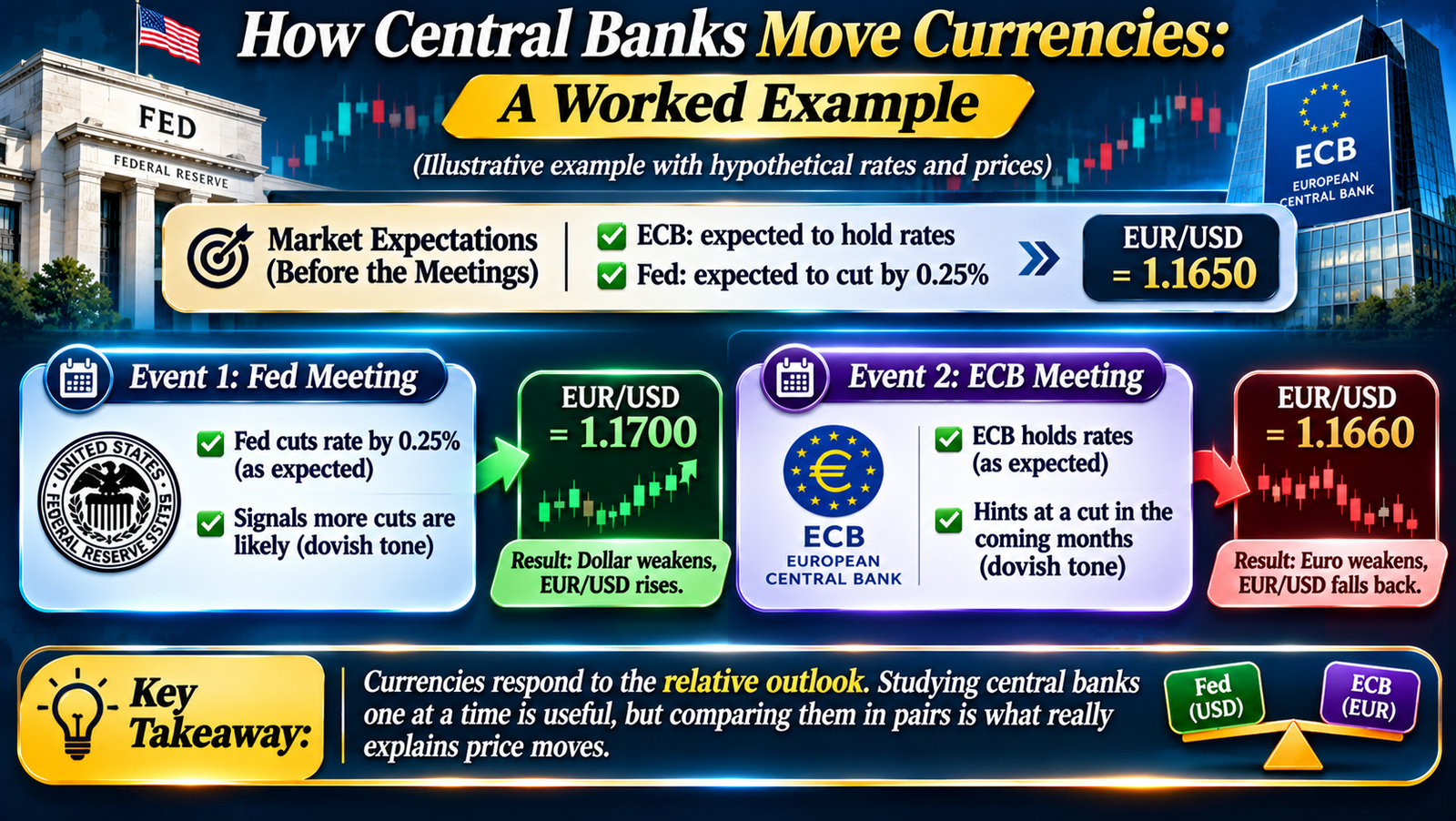
This example is illustrative and uses hypothetical rates and prices.
Suppose markets expect the ECB to hold rates and the Fed to cut by 0.25 percentage points at their next meetings. EUR/USD trades at 1.1650.
- The Fed cuts as expected but signals more cuts are likely. The dollar weakens and EUR/USD rises to 1.1700.
- The next week, the ECB holds rates but hints at a cut in the coming months. The euro weakens, and EUR/USD falls back to 1.1660.
The key lesson is that currencies respond to the relative outlook. Studying central banks forex traders follow one at a time is useful, but comparing them in pairs is what really explains price moves.
Building a Central Banks Forex Calendar
- List meeting dates for the Fed, ECB, BoJ, BoE, SNB, BoC, RBA, RBNZ and RBI at the start of each year.
- Add projection dates, such as the Fed’s dot plot and the BoE’s Monetary Policy Report.
- Add key data releases that feed into decisions, such as US payrolls and CPI.
- Convert times to IST and note which releases fall outside Indian trading hours.
- Check market pricing before each meeting using rate futures or analyst surveys.
- Plan your risk: reduce size or avoid new positions just before major decisions.
Trading Central Bank Policy from India
Indian residents can trade the effects of central banks on forex prices through exchange-traded currency derivatives on NSE and BSE, via SEBI-registered brokers. Available contracts include USD/INR, EUR/INR, GBP/INR and JPY/INR, along with EUR/USD, GBP/USD and USD/JPY. Leveraged forex through offshore brokers is not permitted for Indian residents under FEMA, and the RBI publishes an Alert List of unauthorised platforms.
Common Mistakes
When tracking central banks forex traders often fall into these traps:
- Watching only the Fed: both sides of a pair matter.
- Ignoring expectations: a widely expected decision may not move the currency.
- Overlooking intervention: the SNB, BoJ (via Japan’s Ministry of Finance) and RBI can act directly in currency markets.
- Trading the first spike: volatility and spreads jump around announcements.
- Forgetting time zones: many decisions land outside Indian trading hours.
FAQs
Which central banks forex traders should follow first?
Start with the Fed, ECB, BoJ and BoE, then add the central banks behind the currencies you trade. For Indian traders, the RBI is essential.
How many central banks forex traders follow is enough?
For most traders, the Fed plus the two or three central banks behind their main pairs is enough. Indian traders should always add the RBI.
Why do central banks move currencies?
Mainly through interest rates and expectations. Higher expected rates tend to attract capital and support a currency.
What is currency intervention?
When a central bank or government buys or sells its own currency to influence its value or reduce volatility.
Does the RBI fix the rupee?
No. The rupee’s value is market-determined, but the RBI intervenes to curb excessive volatility.
How often does the Fed meet?
Eight times a year, with projections published four times a year.
Can Indian residents trade EUR/USD legally?
Yes, through EUR/USD futures and options on NSE and BSE via SEBI-registered brokers.
Conclusion
Central banks are the most powerful players in the currency market. The Fed sets the tone for the dollar, the ECB, BoJ and BoE drive the other major currencies, the SNB, BoC, RBA and RBNZ shape the smaller majors, the PBoC influences Asia and commodities, and the RBI manages the rupee.
Follow the central banks forex pairs you trade depend on, track their meeting calendars, compare their outlooks and always ask how a decision changes expectations. Combine this with disciplined risk management and, for Indian traders, the regulated exchange route.