

Introduction
Most major currencies, such as the US dollar, euro and yen, float freely, with prices changing every second. But many currencies do not. The Hong Kong dollar, the Saudi riyal and the UAE dirham, for example, have barely moved against the US dollar for decades. That stability is no accident. It is the result of a currency peg.
A currency peg is a policy in which a country fixes the value of its currency to another currency, a basket of currencies or, historically, gold. Pegs can bring stability and trust, but they also require large reserves and can collapse dramatically when pressure becomes too great.
This guide explains what a currency peg is, how it works, the main types, real examples, famous de-pegs, the advantages and risks, and what pegged currencies mean for traders.
What Is a Currency Peg?
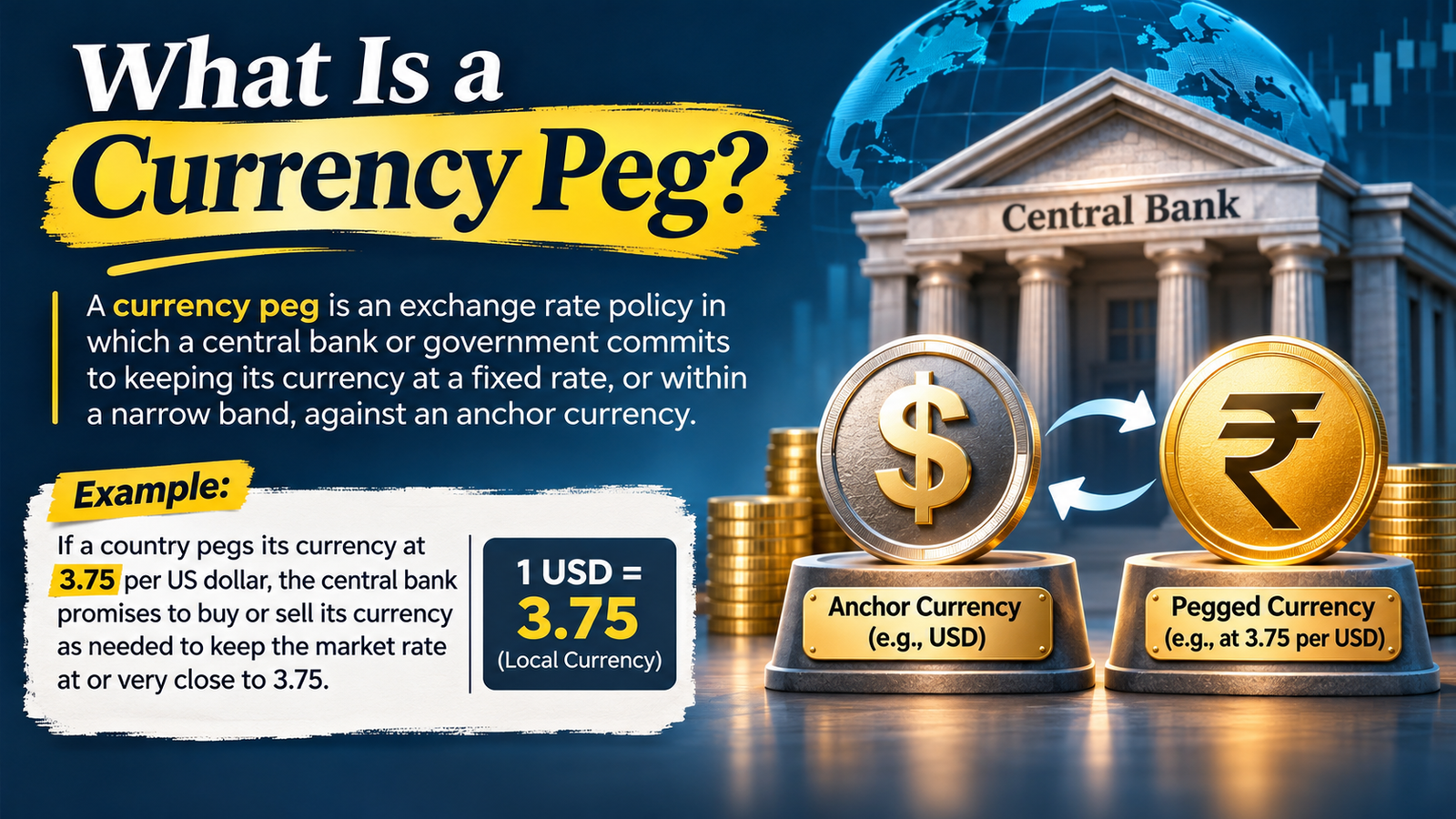
A currency peg is an exchange rate policy in which a central bank or government commits to keeping its currency at a fixed rate, or within a narrow band, against an anchor currency. The anchor is usually a major, stable currency such as the US dollar or the euro.
For example, if a country pegs its currency at 3.75 per US dollar, the central bank promises to buy or sell its currency as needed to keep the market rate at or very close to 3.75.
How a Currency Peg Works
Maintaining a peg requires active management. The main tools are:
- Foreign exchange
- reserves: the central bank holds large reserves of the anchor currency. If its own currency weakens, it sells reserves and buys its currency. If it strengthens, it sells its own currency and buys reserves.
- Interest rates: the central bank often keeps interest rates close to those of the anchor country. If rates differ too much, money flows in or out and puts pressure on the peg.
- Capital controls: some countries limit how freely money can move in and out, reducing pressure on the peg.
- Credibility: markets must believe the central bank will defend the peg. Strong reserves and a long track record build that confidence.
The impossible trinity
Economists describe a “trilemma” or “impossible trinity”: a country cannot have all three of a fixed exchange rate, free movement of capital and independent monetary policy at the same time. A country with a currency peg and open capital markets must largely follow the anchor country’s interest rate policy.Types of Currency Peg
| Type | How it works | Flexibility |
|---|---|---|
| Currency board | Local currency fully backed by reserves of the anchor currency, often set by law | Very low |
| Conventional fixed peg | Fixed rate against one currency or a basket, defended by the central bank | Low |
| Pegged within a band | Rate allowed to move within a set range around a central rate | Low to moderate |
| Crawling peg | Rate adjusted gradually in small, pre-set or rule-based steps | Moderate |
| Basket peg | Rate fixed against a weighted group of currencies | Low to moderate |
Real Examples of a Currency Peg
Hong Kong dollar
Hong Kong has operated a currency board, the Linked Exchange Rate System, since 1983. Since 2005, the Hong Kong dollar has been kept within a band of 7.75 to 7.85 per US dollar. The Hong Kong Monetary Authority buys Hong Kong dollars when the rate reaches the weak side (7.85) and sells them at the strong side (7.75).
Saudi riyal
The Saudi riyal has been pegged at 3.75 per US dollar since 1986. Because oil is priced in dollars, the currency peg gives stability to the country’s main source of income.
UAE dirham
The UAE dirham is pegged at about 3.6725 per US dollar, a rate that has been in place for decades. Several other Gulf states also peg their currencies to the dollar.
Danish krone
Denmark keeps its krone in the European Exchange Rate Mechanism (ERM II), with a central rate of 7.46038 kroner per euro. In practice, Denmarks National bank keeps the krone very close to that level.
CFA franc
Two CFA franc zones in West and Central Africa use currencies fixed to the euro at 655.957 francs per euro, an arrangement that dates back to the French franc.
Nepal and Bhutan: a peg to the Indian rupee
Closer to home, the Nepalese rupee is pegged to the Indian rupee at 1.60 Nepalese rupees per Indian rupee, and Bhutan’s Ngultrum is pegged one-to-one with the Indian rupee. These pegs reflect the deep trade and economic links between India and its neighbours.
Examples at a glance
| Currency | Anchor | Rate or band | Type |
|---|---|---|---|
| Hong Kong dollar | US dollar | 7.75 to 7.85 | Currency board with band |
| Saudi riyal | US dollar | 3.75 | Conventional peg |
| UAE dirham | US dollar | About 3.6725 | Conventional peg |
| Danish krone | Euro | Central rate 7.46038 | Peg within ERM II band |
| CFA franc | Euro | 655.957 | Conventional peg |
| Nepalese rupee | Indian rupee | 1.60 | Conventional peg |
| Bhutanese ngultrum | Indian rupee | 1.00 | Conventional peg |
Why Pegs Are Common in the Gulf
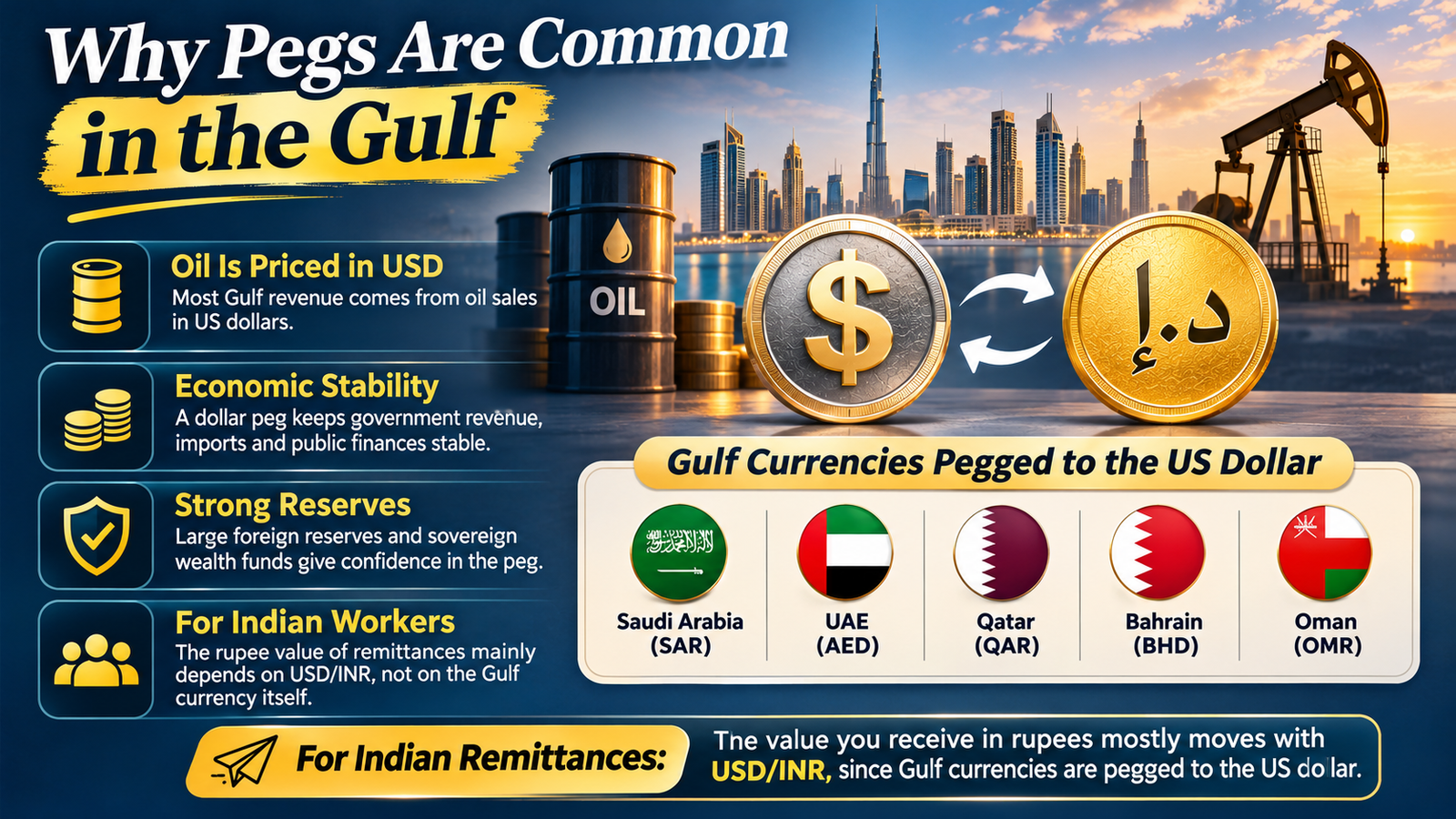
Several Gulf economies, including Saudi Arabia, the UAE, Qatar, Bahrain and Oman, keep their currencies pegged to the US dollar. The reason is simple: their main export, oil, is priced and sold in dollars. A currency peg to the dollar keeps government revenue, imports and public finances stable in local terms. These countries also hold large foreign reserves and sovereign wealth funds, which give markets confidence that the pegs can be defended. For the millions of Indian workers in the Gulf, these stable pegs mean that the rupee value of their remittances mostly depends on movements in USD/INR rather than on the Gulf currency itself.
Famous Currency Peg Breaks
A peg is only as strong as the reserves and credibility behind it. When markets doubt a peg, speculators may bet against it, and if reserves run low, the peg can break suddenly.
- Bretton Woods (1971): the global system of currencies pegged to the dollar, and the dollar to gold, ended when the US suspended gold convertibility.
- UK and the ERM (1992): on Black Wednesday, the pound was forced out of the European Exchange Rate Mechanism after heavy speculative selling.
- Thai baht (1997): Thailand abandoned its dollar peg in July 1997, triggering the Asian financial crisis.
- Argentina (2002): the one-to-one peg between the peso and the dollar, introduced in 1991, collapsed during a severe economic crisis.
- Swiss franc floor (2015): the Swiss National Bank ended its cap of 1.20 francs per euro in January 2015, causing one of the largest one-day moves in a major currency.
Each of these breaks caused huge losses for those who assumed the peg would hold forever.
Advantages of a Currency Peg
- Stability for trade and investment: businesses know what exchange rate to expect.
- Lower inflation: pegging to a stable currency can import the anchor country’s credibility.
- Lower transaction costs: stable rates reduce the need for hedging.
- Confidence: useful for smaller or commodity-based economies whose income is tied to the anchor currency.
Disadvantages and Risks
- Loss of monetary independence: interest rates must often follow the anchor country.
- Need for large reserves: defending the peg can drain reserves.
- Vulnerability to speculation: if markets doubt the peg, they may attack it.
- Sudden adjustments: when a peg breaks, the move can be very large and damaging.
- Imported problems: if the anchor currency strengthens, the pegged currency strengthens too, which can hurt exports.
Worked Example: How the Hong Kong Peg Is Defended
This example is illustrative and simplified.
Suppose investors start moving money out of Hong Kong, selling Hong Kong dollars and buying US dollars. USD/HKD rises towards the weak-side limit of 7.85.
- At 7.85, the Hong Kong Monetary Authority sells US dollars from its reserves and buys Hong Kong dollars.
- This reduces the supply of Hong Kong dollars in the banking system.
- Local interest rates tend to rise as Hong Kong dollar liquidity tightens.
- Higher rates make holding Hong Kong dollars more attractive, slowing the outflow.
If money flows the other way and USD/HKD falls to 7.75, the authority does the opposite: it sells Hong Kong dollars and buys US dollars, adding liquidity and easing rates. This automatic mechanism is what keeps the peg in place.
Is the Indian Rupee Pegged?
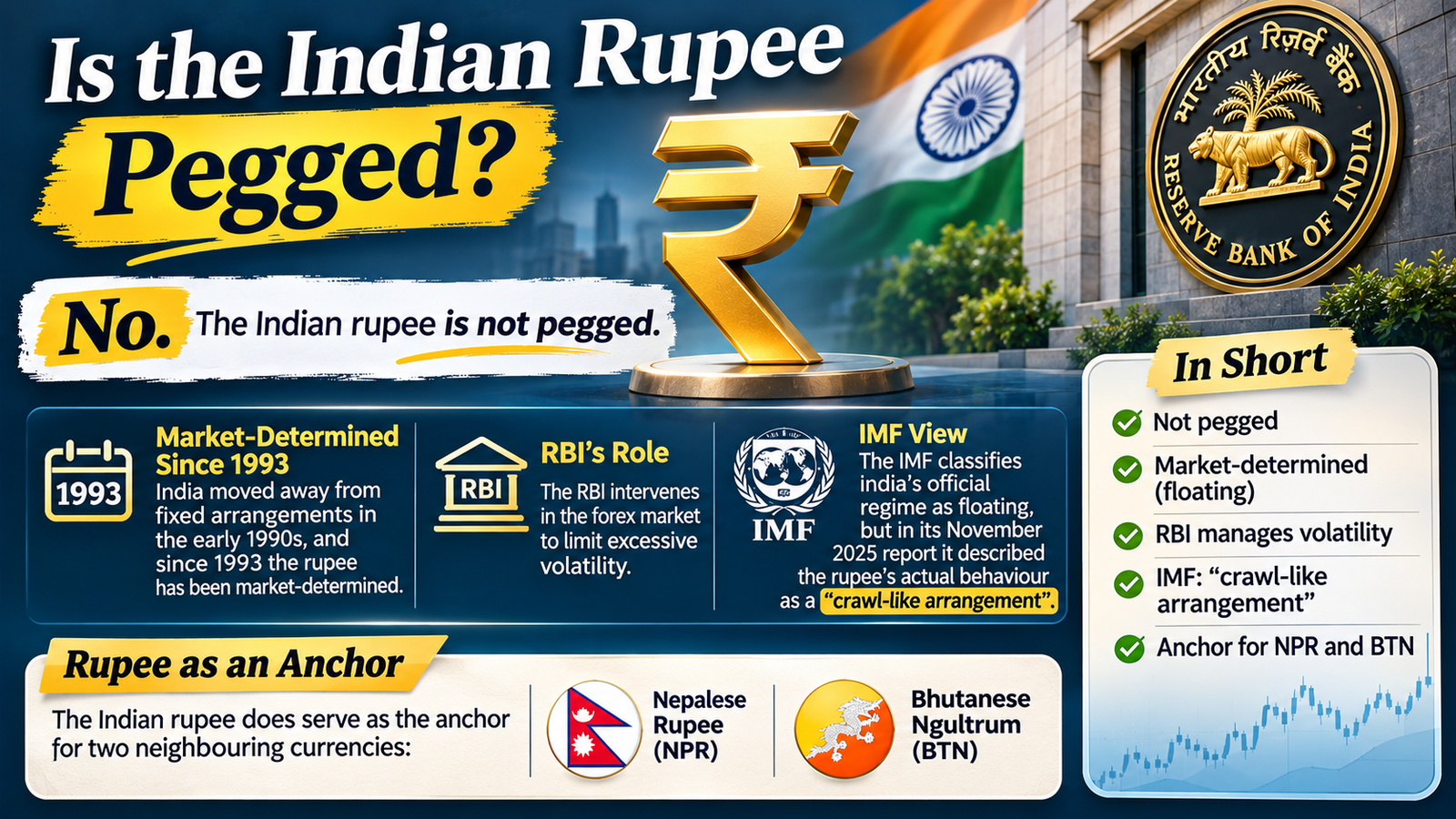
No. The Indian rupee is not pegged. India moved away from fixed arrangements in the early 1990s, and since 1993 the rupee has been market-determined, with the RBI intervening to limit excessive volatility. The IMF classifies India’s official regime as floating, although in its November 2025 report it described the rupee’s actual behaviour as a “crawl-like arrangement”. The rupee does, however, serve as the anchor for the Nepalese rupee and the Bhutanese Ngultrum.
What a Currency Peg Means for Traders
- Very low volatility: pegged pairs such as USD/HKD or USD/SAR move very little, offering few trading opportunities in normal times.
- Tail risk: when a peg breaks, the move can be sudden and large. Selling options or holding leveraged positions on pegged pairs can be dangerous.
- Carry trades: interest rate gaps between a pegged currency and its anchor can create carry opportunities, but they come with de-peg risk.
- Watch reserves and rates: falling reserves, widening interest rate gaps and rising forward premiums can signal stress.
- Policy announcements: central bank statements can shift expectations quickly.
Indian residents should note that leveraged forex trading on offshore platforms is not permitted under the Foreign Exchange Management Act (FEMA). Exchange-traded currency derivatives on NSE and BSE, through SEBI-registered brokers, are the legal route for currency trading.
How to Spot Pressure on a Currency Peg
- Falling foreign exchange reserves.
- Large current account deficits.
- Rising inflation compared with the anchor country.
- Growing gaps between official and black-market exchange rates.
- Rising forward premiums, which show markets expect devaluation.
- Increasing capital controls or emergency rate rises.
FAQs
What is a currency peg?
A policy in which a country fixes its currency’s value to another currency, a basket of currencies or a commodity, and defends that rate using reserves and interest rates.
Which currencies are pegged to the US dollar?
Examples include the Hong Kong dollar (within a 7.75 to 7.85 band), the Saudi riyal (3.75) and the UAE dirham (about 3.6725).
Why do countries use a currency peg?
To provide stability for trade and investment, control inflation and build confidence, especially in smaller or commodity-exporting economies.
Can a currency peg fail?
Yes. If reserves run low or confidence falls, a peg can break, as happened in the UK in 1992, Thailand in 1997 and Argentina in 2002.
Is the Indian rupee pegged?
No. The rupee is market-determined with RBI intervention, but it serves as the anchor for the Nepalese rupee and the Bhutanese ngultrum.
Conclusion
A currency peg offers stability by fixing a currency’s value to a strong anchor, usually the US dollar or the euro. It works through reserves, interest rate policy and credibility, and real examples from Hong Kong, Saudi Arabia, the UAE, Denmark and Nepal show that pegs can last for decades.
But history also shows that a currency peg can break suddenly when pressure builds, causing large and painful moves. For traders, pegged currencies mean low volatility most of the time and significant tail risk when policy changes. Understanding how a peg works, and how to spot pressure on it, is essential for anyone trading or hedging these currencies.