
Introduction
When you trade a USD/INR futures contract, you do not pay the full value of the contract. Instead, you deposit a margin, a fraction of the contract value that acts as a security deposit against possible losses. Understanding how that margin is calculated is essential for planning position sizes, avoiding margin shortfalls and managing risk.
On Indian exchanges, currency derivatives margin is made up of two main parts: the SPAN margin (also called initial margin) and the exposure margin (formally the extreme loss margin). On top of that, there are daily mark-to-market settlements, special treatment for calendar spreads and different rules for option buyers and sellers.
This guide explains each component, how they add up, how options margins differ, how calendar spread benefits work, the peak margin rules that apply to every client, a worked example and practical tips for managing your margin.
What Is Currency Derivatives Margin?
Margin is the amount of money (or approved collateral) you must keep with your broker to open and hold a futures or short options position. It is collected by your broker and passed to the clearing corporation, which guarantees settlement of every trade.
Margin protects the system. If a trader’s position moves sharply against them, the margin already collected covers the loss until more funds are added or the position is closed. Because only a fraction of the contract value is required, currency derivatives are leveraged: a small price move can create a large profit or loss relative to the money deposited.
The Components of Currency Derivatives Margin
| Component | What it covers | When it applies |
|---|---|---|
| SPAN (initial) margin | The likely worst one-day loss on your portfolio under a range of scenarios | When you open a futures or short options position |
| Exposure (extreme loss) margin | An extra buffer for losses beyond those SPAN models | Charged together with SPAN |
| Mark-to-market (MTM) | Daily profits and losses on futures | Settled in cash every trading day |
| Premium | The price paid by an option buyer | Paid upfront when buying options |
| Additional margins | Extra protection during unusual volatility | Imposed by the exchange when needed |
The figure most brokers show as “required margin” is usually SPAN plus exposure margin, plus any broker buffer.
SPAN Margin Explained
SPAN stands for Standard Portfolio Analysis of Risk. It is a risk model, originally developed by the Chicago Mercantile Exchange (CME), that is used under licence by Indian clearing corporations.
SPAN works by simulating a series of scenarios, including different price moves and changes in volatility, and calculating the loss your entire portfolio would suffer in each. The largest likely loss becomes your SPAN margin.
- Portfolio-based: SPAN looks at all your positions together, so offsetting positions, such as a long future and a long put, can reduce the total margin.
- Volatility-sensitive: When the market becomes more volatile, SPAN requirements rise.
- Updated during the day: The clearing corporation issues updated risk parameters several times during the trading day, so the requirement can change while you hold a position.
For USD/INR futures, SPAN is typically a small percentage of the contract value, because the rupee usually moves less than equity indices. Rates for EUR/INR, GBP/INR, JPY/INR and the cross-currency pairs differ according to their volatility.
Exposure Margin (Extreme Loss Margin) Explained
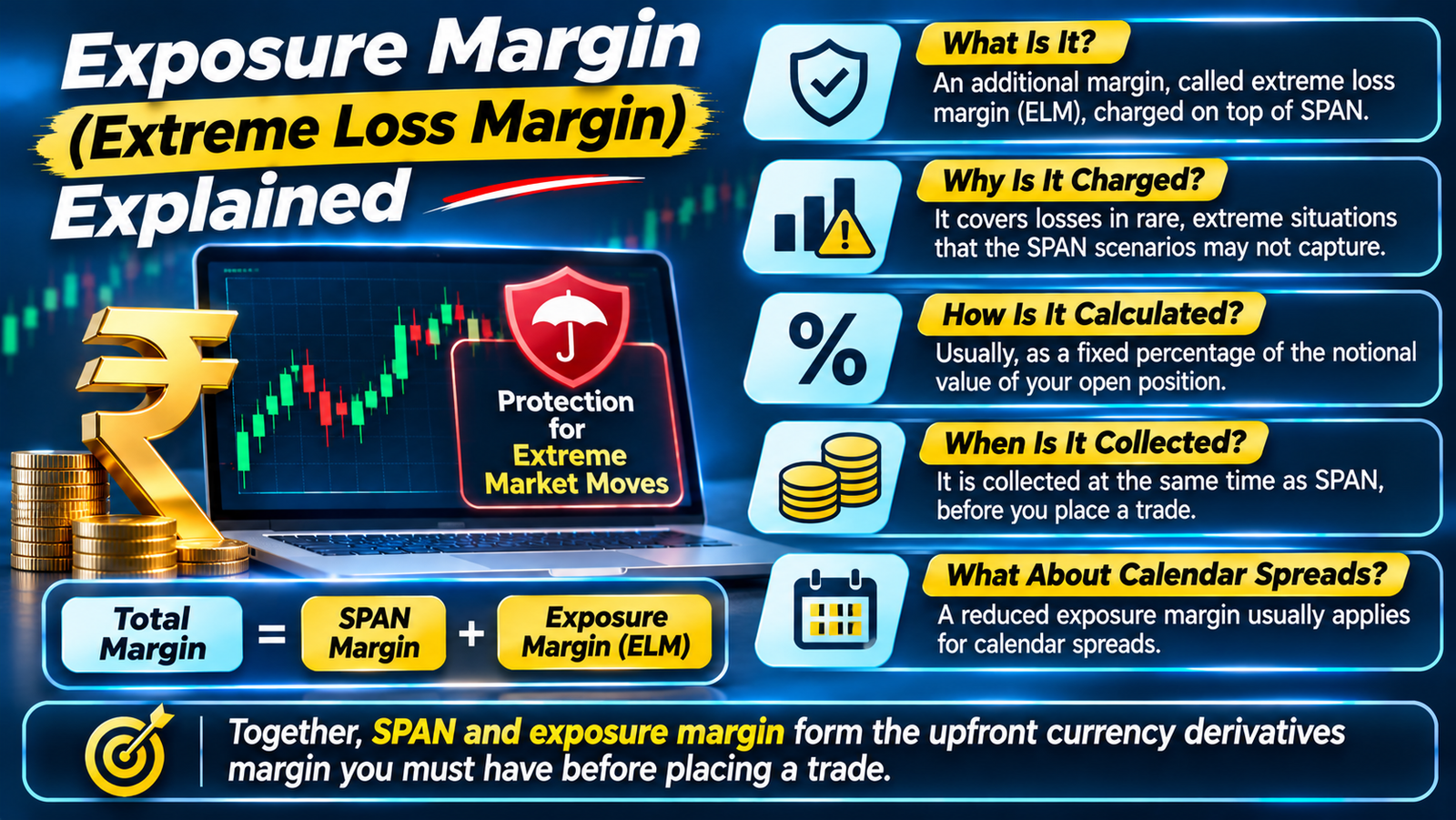
Exposure margin, called extreme loss margin (ELM) by the clearing corporation, is charged on top of SPAN. It covers losses in rare, extreme situations that the SPAN scenarios may not capture.
- It is usually calculated as a fixed percentage of the notional value of your open position.
- It is collected at the same time as SPAN.
- For calendar spreads, a reduced exposure margin usually applies.
Together, SPAN and exposure margin form the upfront currency derivatives margin you must have before placing a trade.
Mark-to-Market and Your Currency Derivatives Margin
Futures positions are marked to the day’s settlement price at the end of each trading day.
- If the price moved in your favour, the profit is credited to your account.
- If it moved against you, the loss is debited, and you must have enough funds to cover it.
- MTM is settled on a T+1 basis, the next working day.
MTM losses are separate from the initial margin. If losses reduce your free balance below the required margin, you face a margin shortfall and must add funds or reduce positions.
Currency Derivatives Margin for Options
| Position | Margin required |
|---|---|
| Buying a call or put | Only the premium, paid upfront. No SPAN or exposure margin. |
| Selling (writing) a call or put | SPAN plus exposure margin, because losses can be large. |
| Hedged option positions | Often lower, because SPAN recognises offsetting risk. |
Option buyers know their maximum loss in advance: the premium paid. Option sellers carry open-ended risk, which is why their currency derivatives margin is similar to, or higher than, that for futures.
Calendar Spread Benefits on Currency Derivatives Margin
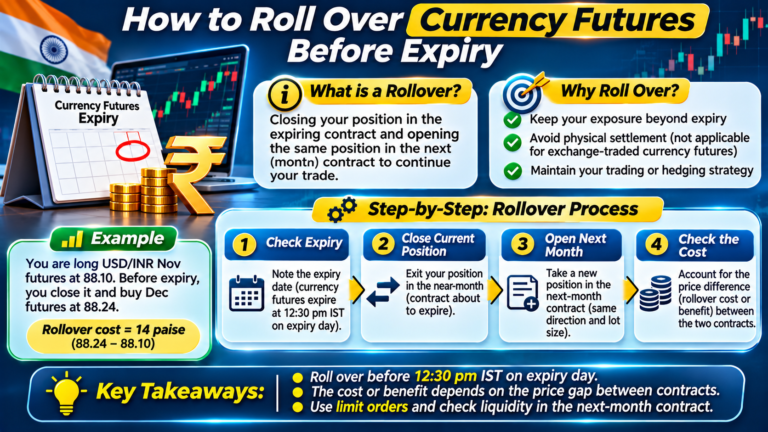
A calendar spread is a long position in one contract month and a short position in another, for example long the November USD/INR future and short the December future. Because the two legs largely offset each other, the risk is much lower than holding either leg alone.
- The clearing corporation usually charges a lower SPAN for calendar spreads.
- Exposure margin on spreads is also reduced.
- On expiry day, the spread benefit may be removed for the expiring leg, so margin on the remaining leg can jump. Check your broker’s expiry-day rules.
Hedgers who roll positions from one month to the next often benefit from these lower spread margins.
Peak Margin Rules for Currency Derivatives Margin
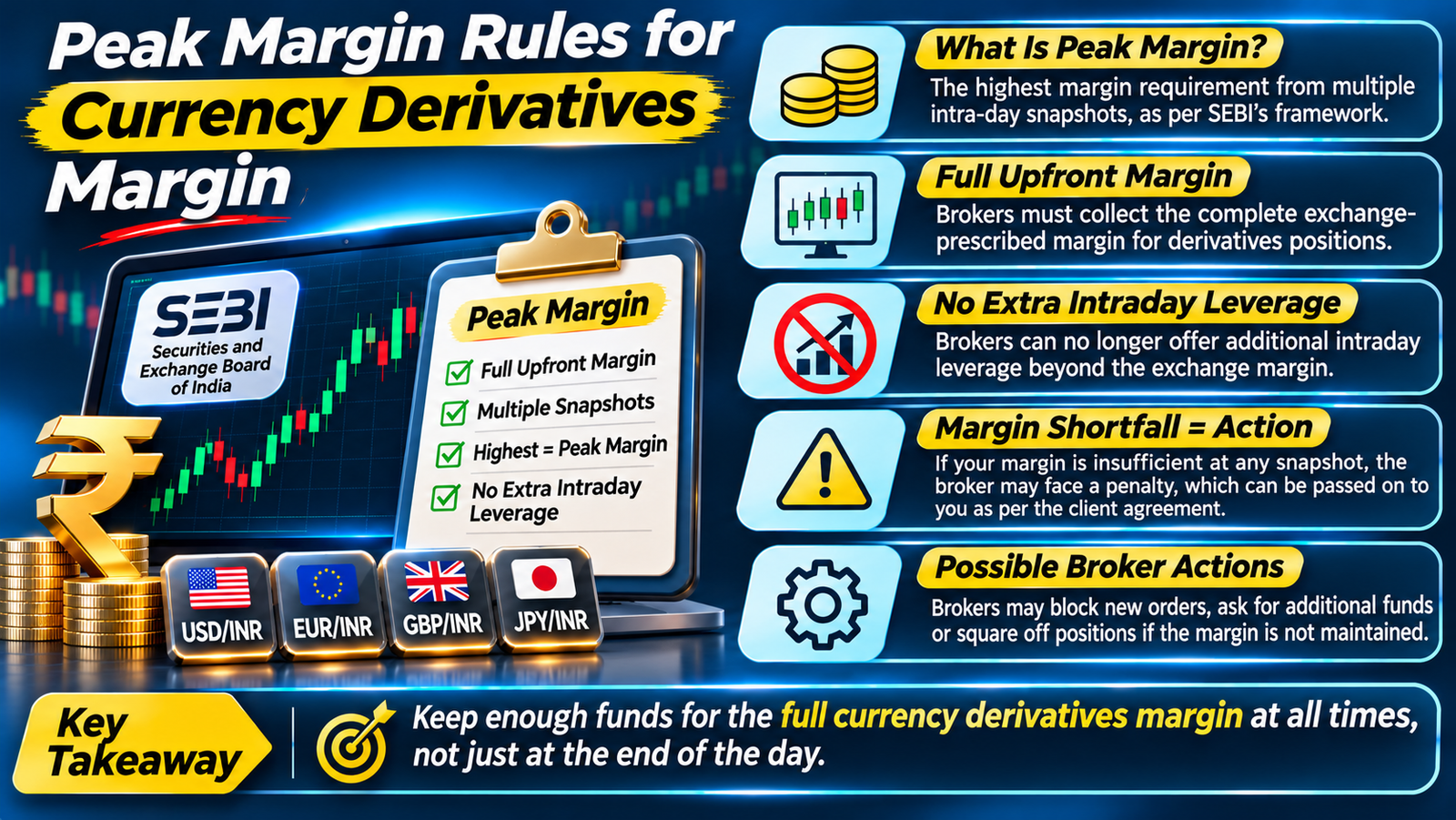
Under SEBI’s peak margin framework, brokers must collect the full upfront margin from clients for derivatives positions, and the clearing corporation checks client margins using several snapshots taken during the day. The highest requirement in those snapshots is treated as the peak margin.
- Brokers can no longer offer extra intraday leverage beyond the exchange-prescribed margin for derivatives.
- If a client’s margin falls short at any snapshot, the broker may face a penalty, which can be passed on to the client depending on the circumstances and the client agreement.
- Brokers may block new orders, ask for funds or square off positions if margin is insufficient.
In practice, this means you should keep enough funds for the full currency derivatives margin at all times, not just at the end of the day.
Worked Example: Currency Derivatives Margin on USD/INR Futures
This example is illustrative. The SPAN and exposure percentages are hypothetical and chosen only to show the calculation. Actual rates are set by the clearing corporation and change over time.
A trader wants to buy 10 lots of USD/INR futures at 88.80.
- Contract value per lot: $1,000 × 88.80 = ₹88,800.
- Total contract value: 10 × ₹88,800 = ₹8,88,000.
- Illustrative SPAN at 2%: ₹17,760.
- Illustrative exposure margin at 1%: ₹8,880.
- Total upfront margin: ₹26,640, or about 3% of contract value.
Now suppose USD/INR falls by 50 paise to 88.30 by the end of the day:
- MTM loss: 50 paise × ₹10 per paise per lot × 10 lots = ₹5,000.
- If the trader deposited exactly ₹26,640, the balance falls to ₹21,640, below the required margin, creating a shortfall of about ₹5,000.
- If volatility rises and SPAN increases at the same time, the shortfall grows further.
The lesson is clear: deposit more than the minimum currency derivatives margin. A buffer of 50% to 100% above the requirement helps absorb MTM losses and intraday changes in SPAN.
Leverage and Risk
In the example above, a margin of about 3% means leverage of roughly 33 times. A 1% move in USD/INR, about 89 paise, would create a profit or loss of about ₹8,900 on a deposit of ₹26,640, roughly a third of the margin.
- Size positions based on the money you are willing to lose, not on the maximum the margin allows.
- Risk 1% to 2% of your total trading capital per trade.
- Use stop-losses, especially around RBI policy decisions and major US data.
How to Check Current Currency Derivatives Margin
- Broker margin calculators: Most Indian brokers offer a calculator showing SPAN, exposure and total margin for any contract and quantity.
- Order window: Many platforms show the margin required before you place an order.
- Clearing corporation: NSE Clearing publishes risk parameters and margin files for currency derivatives.
- Daily margin statement: Your broker sends a statement showing margins collected and any shortfall.
Tips for Managing Currency Derivatives Margin
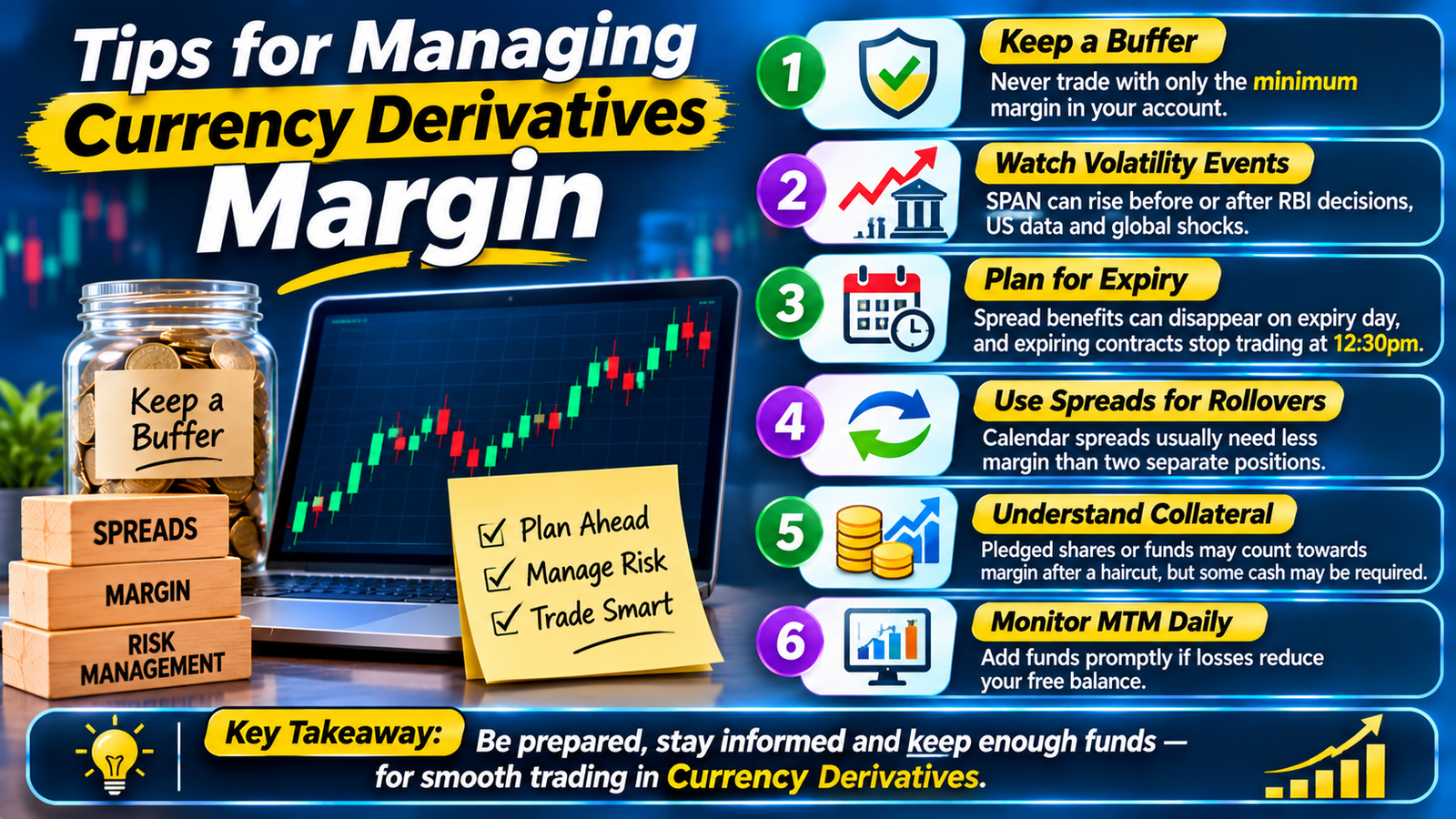
- Keep a buffer. Never trade with only the minimum margin in your account.
- Watch volatility events. SPAN can rise before or after RBI decisions, US data and global shocks.
- Plan for expiry. Spread benefits can disappear on expiry day, and expiring contracts stop trading at 12:30pm.
- Use spreads for rollovers. Calendar spreads usually need less margin than two separate positions.
- Understand collateral. Pledged shares or funds may count towards margin after a haircut, but some cash component may be required.
- Monitor MTM daily. Add funds promptly if losses reduce your free balance.
 Common Currency Derivatives Margin Mistakes
- Trading the maximum number of lots the margin allows.
- Forgetting that SPAN can change during the day.
- Ignoring MTM losses until a shortfall notice arrives.
- Selling options without understanding the margin and risk involved.
- Assuming calendar spread benefits continue on expiry day.
A Note on Rules
Indian residents can trade currency futures and options on NSE and BSE through SEBI-registered brokers. Leveraged forex trading on offshore platforms is not permitted under the Foreign Exchange Management Act (FEMA), and the RBI publishes an Alert List of unauthorized platforms. Exchange-traded currency derivatives margin rules, set by the clearing corporation and SEBI, are part of what makes the regulated route safer.
Currency Derivatives Margin Checklist
- Have I checked the current SPAN and exposure margin for my contract?
- Do I have a buffer of at least 50% above the required margin?
- Have I sized my position based on risk, not maximum leverage?
- Am I aware of events that could raise SPAN?
- Do I understand how expiry affects my margin?
- Am I monitoring daily MTM?
FAQs
What is currency derivatives margin?
It is the deposit required to open and hold currency futures or short options positions, made up mainly of SPAN margin and exposure margin.
What is the difference between SPAN and exposure margin?
SPAN covers the likely worst one-day loss based on risk scenarios. Exposure margin is an extra buffer for extreme losses, charged as a percentage of contract value.
Do option buyers need to pay margin?
No. Option buyers pay only the premium. Option sellers must pay SPAN and exposure margin.
Why did my margin requirement increase while I held a position?
SPAN parameters are updated during the day and rise with volatility. MTM losses also reduce your free balance.
Where can I check the current currency derivatives margin?
Use your broker’s margin calculator or order window, or check the risk parameters published by NSE Clearing.
Conclusion
Currency derivatives margin is made up of SPAN margin, which covers the likely worst-case daily loss, and exposure margin, which adds a buffer for extreme moves. Daily mark-to-market settlement, peak margin rules and calendar spread benefits complete the picture.
Because margins are only a small fraction of contract value, currency derivatives are highly leveraged. Check current margins before every trade, keep a healthy buffer, size positions according to risk rather than maximum leverage, and monitor your account daily to avoid shortfalls and forced square-offs.