Introduction of AUD USD Trading
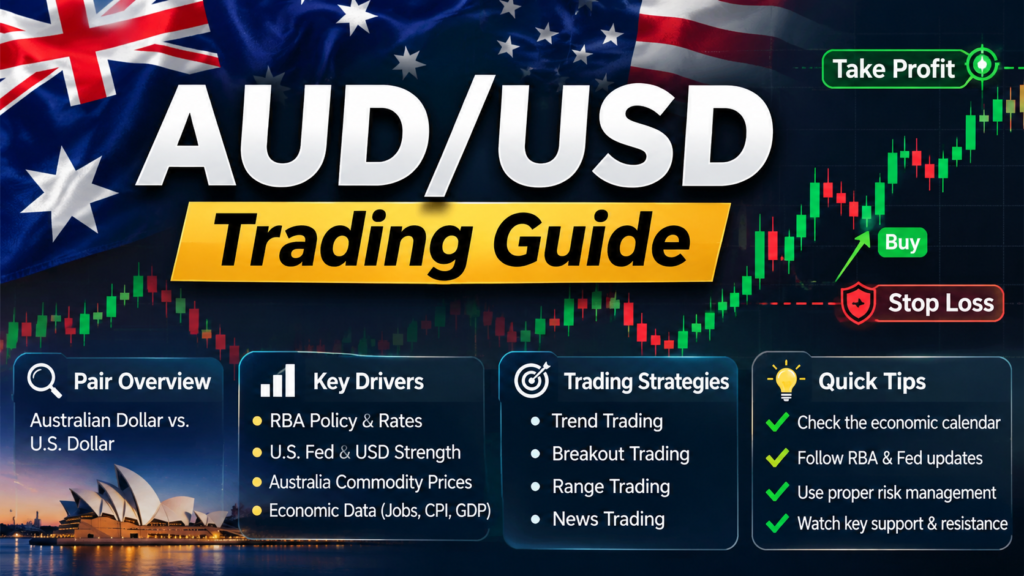
The Australian dollar is one of the most actively traded currencies in the world, and its pairing with the US dollar, AUD/USD, is one of the major forex pairs. Traders often call it the “Aussie”.
AUD/USD trading is popular because the pair has clear, understandable drivers: Australian and US interest rates, commodity prices, China’s economy and global risk sentiment. It is liquid, has relatively tight spreads with most global brokers and often trends well.
This guide covers:
- What AUD/USD is and how it is quoted
- The key factors that move the pair
- The best times to trade it in Indian time
- Pip values and position sizing
- Practical strategies and a worked example
- Points Indian traders need to know
What Is AUD/USD?
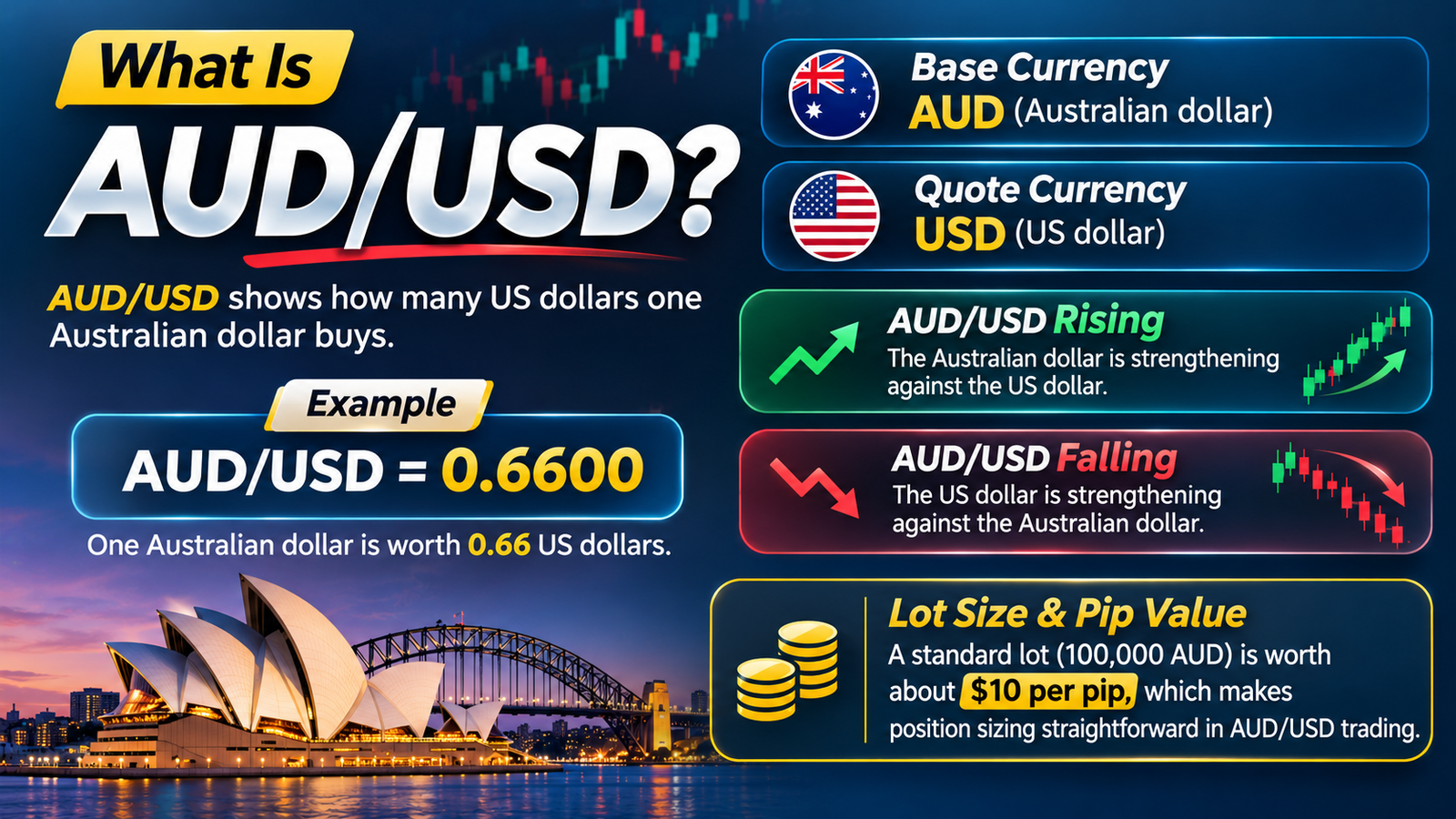
AUD/USD shows how many US dollars one Australian dollar buys. If AUD/USD is 0.6600, one Australian dollar is worth 0.66 US dollars.
- Base currency: AUD (Australian dollar)
- Quote currency: USD (US dollar)
- AUD/USD rising: The Australian dollar is strengthening against the US dollar.
- AUD/USD falling: The US dollar is strengthening against the Australian dollar.
Because the US dollar is the quote currency, a standard lot (100,000 AUD) is worth about $10 per pip, which makes position sizing straightforward in AUD/USD trading.
What Moves AUD/USD? Key Factors in AUD/USD Trading
1. Reserve Bank of Australia (RBA) policy
The RBA sets Australia’s cash rate. Higher rates, or expectations of hikes, tend to support the Australian dollar. Cuts or dovish guidance tend to weaken it. RBA statements and press conferences are major events for the pair.
2. US Federal Reserve policy
The other side of the pair matters just as much. A hawkish Fed and rising US yields usually strengthen the US dollar and push AUD/USD lower, while a dovish Fed tends to lift it.
3. Interest rate differentials
The gap between Australian and US rates influences capital flows and carry trades. When Australian rates rise relative to US rates, the Aussie tends to benefit.
4. Commodity prices
Australia is a major exporter of iron ore, coal, natural gas and gold. Rising commodity prices often support the Australian dollar, which is why it is known as a “commodity currency”. Iron ore is particularly important.
5. China’s economy
China is Australia’s largest trading partner and the biggest buyer of its iron ore. Chinese growth data, industrial production, property sector news and stimulus announcements can all move AUD/USD.
6. Global risk sentiment
The Aussie is considered a “risk-on” currency. When investors are optimistic and stock markets rise, AUD/USD often strengthens. In risk-off periods, money flows into safe havens such as the US dollar and yen, and AUD/USD usually falls.
7. Australian economic data
Key releases include employment figures, inflation (CPI), GDP, retail sales and trade balance data. Strong numbers can raise expectations of RBA tightening and support the currency. Keep an economic calendar for both countries, because successful AUD/USD trading depends on knowing when these releases are due.
AUD/USD Trading Drivers at a Glance
| Factor | Bullish for AUD/USD | Bearish for AUD/USD |
|---|---|---|
| RBA policy | Rate hikes or hawkish tone | Rate cuts or dovish tone |
| Fed policy | Rate cuts or dovish tone | Rate hikes or hawkish tone |
| Commodities | Rising iron ore and metals prices | Falling commodity prices |
| China | Strong growth, stimulus | Slowdown, property stress |
| Risk sentiment | Rising stocks, risk-on | Market sell-offs, risk-off |
| Australian data | Strong jobs and inflation | Weak data |
Best Times for AUD/USD Trading in IST
AUD/USD trades 24 hours a day on weekdays, but activity varies by session. In winter (after Europe and the US move their clocks back), approximate times in IST are:
| Session | Approximate time (IST, winter) | What to expect |
|---|---|---|
| Sydney | 1:30am – 10:30am | Australian data and RBA news; moderate activity |
| Tokyo | 5:30am – 2:30pm | Good liquidity; reactions to Chinese data |
| London | 1:30pm – 10:30pm | Higher volume; European flows |
| New York | 6:30pm – 3:30am | US data and Fed news; often the biggest moves |
For Indian traders, two windows stand out:
- Morning (about 6:00am to 11:00am IST): Australian and Chinese data releases and RBA announcements. RBA decisions are typically released in the Indian morning.
- Evening (about 6:30pm to 10:30pm IST): The London–New York overlap, when US data and Fed-related news can drive large moves.
Australian daylight saving runs in the opposite part of the year to Europe and the US, so check session times whenever clocks change.
AUD/USD Pip Value and Position Sizing
| Lot size | Units of AUD | Approximate pip value |
|---|---|---|
| Standard | 100,000 | $10 |
| Mini | 10,000 | $1 |
| Micro | 1,000 | $0.10 |
Position size = Risk amount ÷ (Stop distance in pips × Pip value)
For example, with a 5,000accountrisking1%(50) on a 25-pip stop, position size is $50 ÷ (25 × $10) = 0.2 standard lots.
AUD/USD Trading Strategies
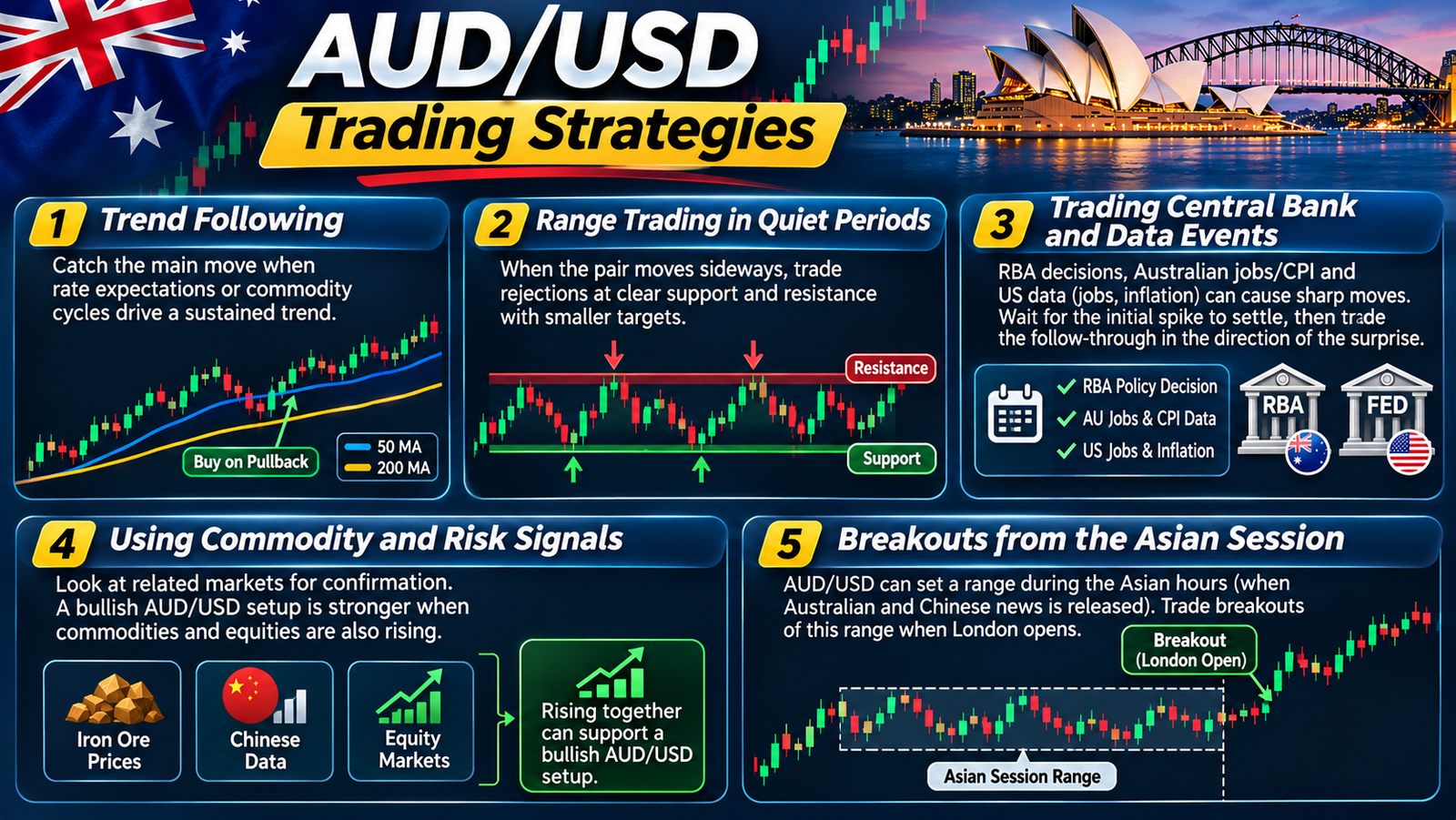
1. Trend following
AUD/USD often trends for weeks when interest rate expectations or commodity cycles shift. Use the 50 and 200-period moving averages on the daily or 4-hour chart to define direction, and buy pullbacks in uptrends or sell rallies in downtrends.
2. Range trading in quiet periods
Between major events, the pair can move sideways. Mark clear support and resistance and trade rejections at the edges of the range, using smaller targets.
3. Trading central bank and data events
RBA decisions, Australian jobs and CPI data, and US data such as jobs and inflation reports can cause sharp moves. Rather than trading the initial spike, wait for spreads to normalise and trade the follow-through in the direction of the surprise.
4. Using commodity and risk signals
Some traders watch iron ore prices, Chinese data and equity markets as confirmation. A bullish AUD/USD setup is stronger when commodities and stocks are also rising.
5. Breakouts from the Asian session
Because Australian and Chinese news arrives during Asian hours, AUD/USD can set a range early in the day. Some traders trade breakouts of that range when London opens.
Worked Example of AUD/USD Trading
Suppose AUD/USD is in an uptrend on the daily chart, with price above the 50-day moving average. Iron ore prices have been firm and global stocks are rising.
- On the 4-hour chart, price pulls back to a support zone near 0.6550, which was previous resistance.
- A bullish engulfing candle forms at support during the Asian session.
- The trader buys at 0.6560.
- The stop goes below support at 0.6530 (30 pips of risk).
- The target is the recent swing high at 0.6630 (70 pips).
- Over the next two sessions, supported by positive risk sentiment, price reaches 0.6630.
The trade gains 70 pips on 30 pips of risk, about 2.3 times the risk. With 0.2 standard lots, that is a $140 profit on $60 of risk.
This example is illustrative and uses hypothetical prices.
Correlations That Matter in AUD/USD Trading
- NZD/USD: Usually strongly positive, as both are commodity and risk-sensitive currencies.
- Iron ore and metals: Often positive, especially over longer periods.
- Global equities: Often positive, reflecting risk sentiment.
- US dollar index: AUD/USD often moves opposite to the broad US dollar.
Watch correlations to avoid doubling your risk. Buying AUD/USD and NZD/USD at the same time is close to taking one larger trade.
Building an AUD/USD Trading Routine
Because the pair responds to news from three regions, a simple routine keeps AUD/USD trading organised:
- Weekly: Note RBA and Fed meeting dates, major Australian, Chinese and US data, and the trend on the daily chart.
- Daily, morning IST: Review overnight US moves, iron ore and equity futures, and any Australian or Chinese data released in the Asian session.
- Before each trade: Confirm the trend, key levels, upcoming news and correlated positions.
- After each trade: Record the setup, session and outcome in your journal.
Over a few months, your journal will show which sessions and setups give you the best results, so you can focus your AUD/USD trading on what works for you.

Risk Management for AUD/USD Trading
- Risk no more than 1% of your account per trade.
- Use stops beyond logical levels, not arbitrary pip counts.
- Reduce size before RBA decisions, Australian jobs data and major US releases.
- Be aware of weekend gaps after major Chinese or global news.
- Check swap rates if holding positions overnight, as interest differentials affect costs.
- Keep a trading journal to track which setups and sessions work best for you.
Common AUD/USD Trading Mistakes
- Ignoring China: Chinese data and policy often move the Aussie more than traders expect.
- Focusing only on Australia: Fed policy and US data drive the other half of the pair.
- Fighting risk sentiment: Buying AUD/USD during a global sell-off is usually low probability.
- Trading in thin hours: Liquidity is lower late in the New York session and before Sydney opens.
- Overleveraging around news: RBA and US data can cause sharp spikes and slippage.
- Holding correlated positions: Long AUD/USD and long NZD/USD at full size each doubles exposure.
AUD/USD Trading for Indian Traders
An important point for Indian residents: AUD/USD is not available as an exchange-traded currency derivative on NSE or BSE. Under FEMA and RBI rules, resident Indians can trade currency derivatives only on recognised Indian exchanges through SEBI-registered brokers, and the permitted pairs are USD/INR, EUR/INR, GBP/INR, JPY/INR, EUR/USD, GBP/USD and USD/JPY. Trading AUD/USD on offshore leveraged forex or CFD platforms is not permitted, and the RBI maintains an Alert List of unauthorised platforms.
That does not make AUD/USD irrelevant to Indian traders:
- Risk barometer: Because AUD/USD reacts strongly to global risk sentiment and China, it can help you read the backdrop for USD/INR and other pairs.
- Learning tool: Studying AUD/USD trading on charts can help you understand how commodity prices and central bank policy drive currencies.
- Related legal pairs: EUR/USD and GBP/USD futures on NSE share the same US dollar side and often respond to the same US data.
Anyone outside India, or Indian traders studying markets for analysis, can apply the strategies above, but should always follow local regulations.
AUD/USD Trading Checklist
- What is the RBA’s current stance, and when is the next meeting?
- What is the Fed’s stance, and is major US data due?
- Are iron ore prices and Chinese data supportive?
- Is global risk sentiment positive or negative?
- What is the trend on the daily and 4-hour charts?
- Is my stop at a logical level, with at least 1:2 reward-to-risk?
- Am I avoiding correlated positions and trading through a legal channel?
FAQs
What is AUD/USD trading?
It is buying or selling the Australian dollar against the US dollar to profit from changes in their exchange rate.
Is AUD/USD trading good for beginners?
It is one of the more beginner-friendly majors because its drivers are clear and its spreads are usually tight, but beginners should still use small positions and strict stops.
What moves AUD/USD the most?
RBA and Fed policy, interest rate differentials, commodity prices (especially iron ore), China’s economy and global risk sentiment.
What is the best time to trade AUD/USD in India?
The Indian morning, when Australian and Chinese news is released, and the evening London–New York overlap, when US data hits.
Why is AUD called a commodity currency?
Australia’s economy relies heavily on exports of iron ore, coal, gas and other commodities, so the currency often moves with commodity prices.
Can Indian residents trade AUD/USD?
Not legally through offshore leveraged platforms, and AUD/USD is not listed on NSE or BSE. Indian residents can trade permitted pairs such as USD/INR, EUR/USD and GBP/USD on Indian exchanges.
Conclusion
AUD/USD is a liquid, widely followed major pair with clear drivers: RBA and Fed policy, commodity prices, China and global risk sentiment. Successful AUD/USD trading comes from understanding both sides of the pair, trading at the right times, following the trend and managing risk carefully around major events.
For Indian residents, the pair is best used as a market indicator and learning tool, while actual trading should be done in permitted pairs on NSE and BSE through SEBI-registered brokers.