Introduction
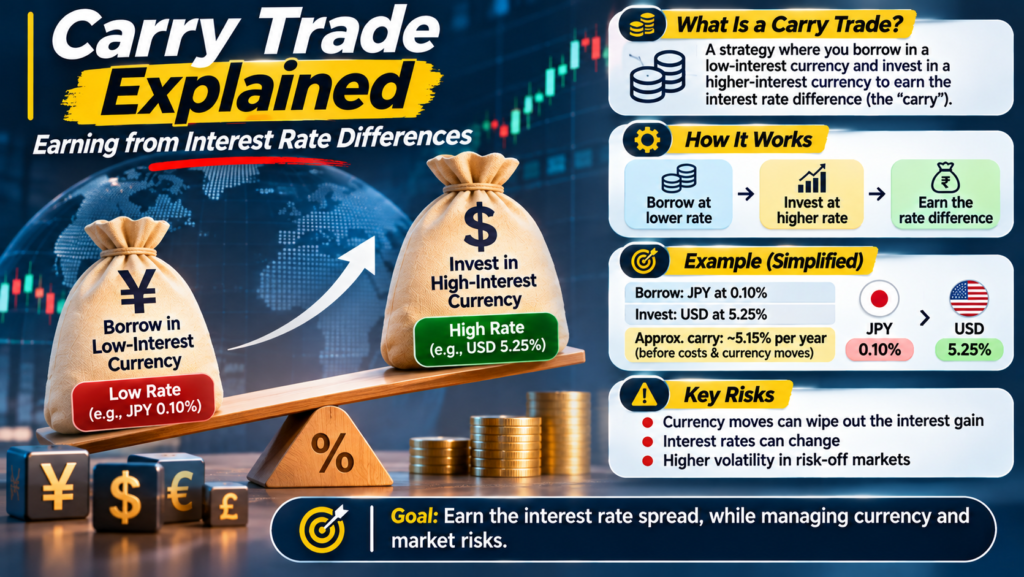
Most forex strategies try to profit from price movement. The carry trade adds another source of return: interest. By borrowing in a low-interest currency and holding a higher-interest currency, traders aim to earn the difference between the two rates, day after day, for as long as the position stays open.
A carry trade forex strategy has been used for decades by banks, hedge funds and individual traders. It can produce steady income in calm markets, but it can also unwind violently when sentiment turns, wiping out months of interest gains in a few days.
This guide explains:
- What a carry trade is and how it works
- Interest rate differentials, swaps and rollover
- Popular carry pairs and what drives them
- A worked example with numbers
- The risks, including carry trade unwinds
- How carry shows up in Indian currency futures
What Is a Carry Trade?
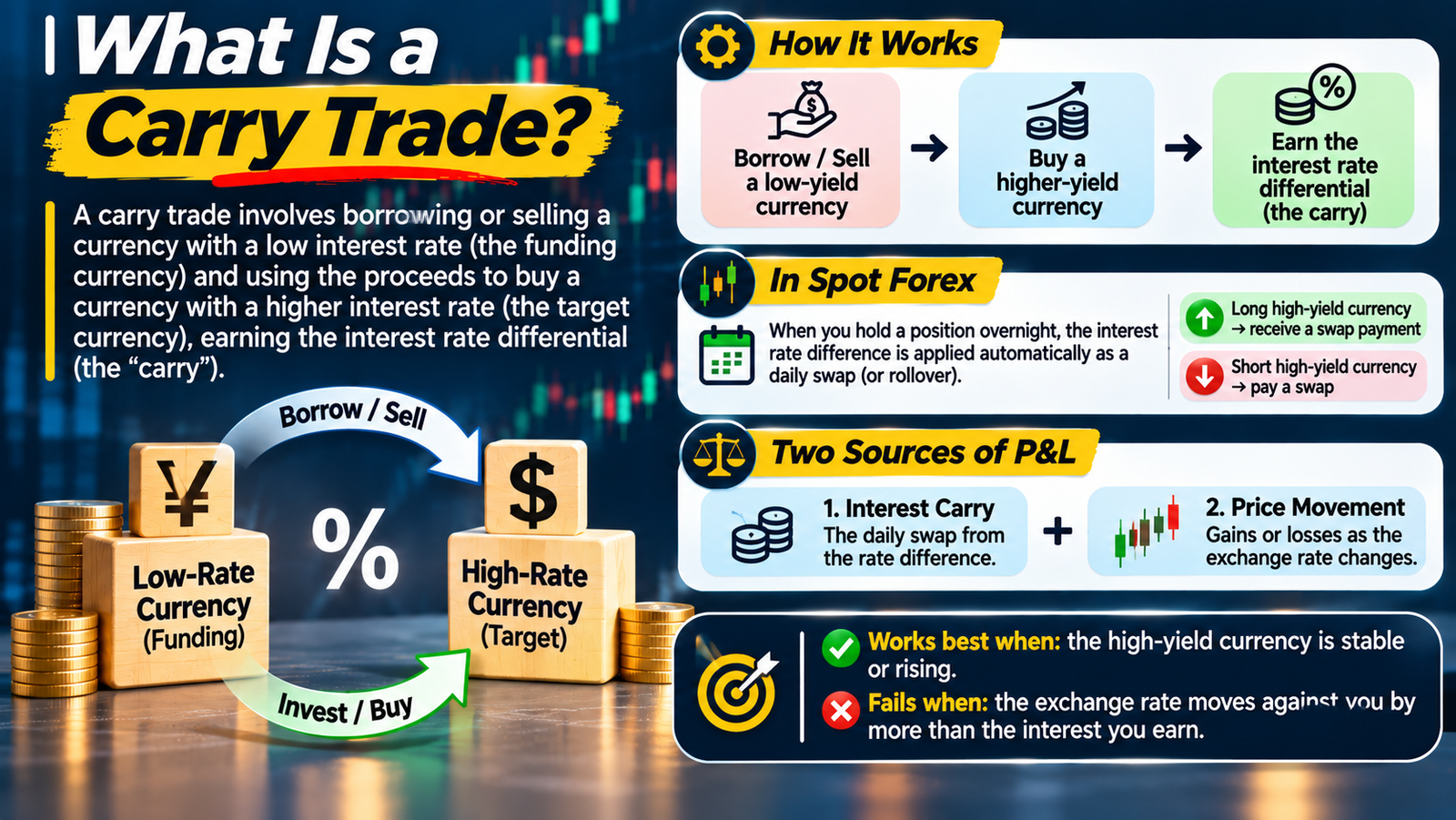
A carry trade involves borrowing or selling a currency with a low interest rate (the funding currency) and using the proceeds to buy a currency with a higher interest rate (the target or high-yield currency). The trader earns the interest rate differential between the two, known as the carry.
In the spot forex market, this happens automatically when you hold a position overnight. If you are long the higher-yielding currency, you typically receive a daily interest payment called a swap or rollover. If you are short it, you typically pay.
A carry trade forex position therefore has two sources of profit or loss:
- Interest carry: The daily swap from the rate difference.
- Price movement: Gains or losses as the exchange rate changes.
The strategy works best when the high-yield currency is stable or rising. It fails when the exchange rate moves against you by more than the interest you earn.
How the Interest Rate Differential Drives a Carry Trade Forex Position
Each currency has an interest rate set largely by its central bank. The difference between two rates is the interest rate differential.
| Currency | Illustrative policy rate | Role |
|---|---|---|
| High-yield currency | 5.0% | Buy (target) |
| Low-yield currency | 0.5% | Sell (funding) |
| Differential | 4.5% | Annual carry before costs |
In practice, brokers calculate swaps using short-term market rates and add their own markup, so the carry you actually receive is usually less than the headline differential. Always check your broker’s published swap rates.
Positive and Negative Carry in Carry Trade Forex
- Positive carry: You are long the higher-yielding currency and short the lower-yielding one, so you receive daily swap.
- Negative carry: You are long the lower-yielding currency and short the higher-yielding one, so you pay daily swap.
Negative carry does not make a trade impossible, but it adds a daily cost. For swing and position traders who hold for weeks, carry can make a noticeable difference to results.
Popular Carry Trade Forex Pairs
The best carry pairs change as central banks raise and cut rates, but some have been popular historically:
| Pair | Typical role | Why traders use it |
|---|---|---|
| AUD/JPY | Long AUD, short JPY | Australian rates have often been well above Japanese rates |
| NZD/JPY | Long NZD, short JPY | Similar logic to AUD/JPY |
| USD/JPY | Long USD, short JPY | Wide US–Japan rate gap in periods of higher US rates |
| GBP/JPY | Long GBP, short JPY | Higher UK rates against low Japanese rates, but very volatile |
| Emerging market pairs | Long high-yield EM currency, short USD, EUR or JPY | Very high rates, but also high currency risk |
The Japanese yen and, at times, the Swiss franc and euro have been popular funding currencies because of their low interest rates. The famous “yen carry trade” refers to borrowing in yen to invest in higher-yielding assets worldwide.
Worked Example of a Carry Trade Forex Position
Suppose a trader buys AUD/JPY when the illustrative Australian rate is 4.0% and the Japanese rate is 0.5%.
- Position size: A$100,000 notional.
- Margin used: About A$10,000 (10:1 leverage).
- Gross differential: 3.5% a year.
- Annual carry before broker markup: 3.5% × A100,000=A3,500.
- Daily carry: About A$9.60.
On the A10,000margin,A3,500 of carry is a 35% annual return from interest alone, which explains the strategy’s appeal.
Now consider the price risk. If AUD/JPY falls 5%, the position loses about A5,000, wiping out more than a year of carry. If it falls10%, the loss is about A10,000, the entire margin.
The carry is small and steady; the price risk is large and sudden. That asymmetry is the core challenge of any carry trade forex strategy.
This example is illustrative. Rates, swap markups and leverage vary, and figures ignore compounding and costs.
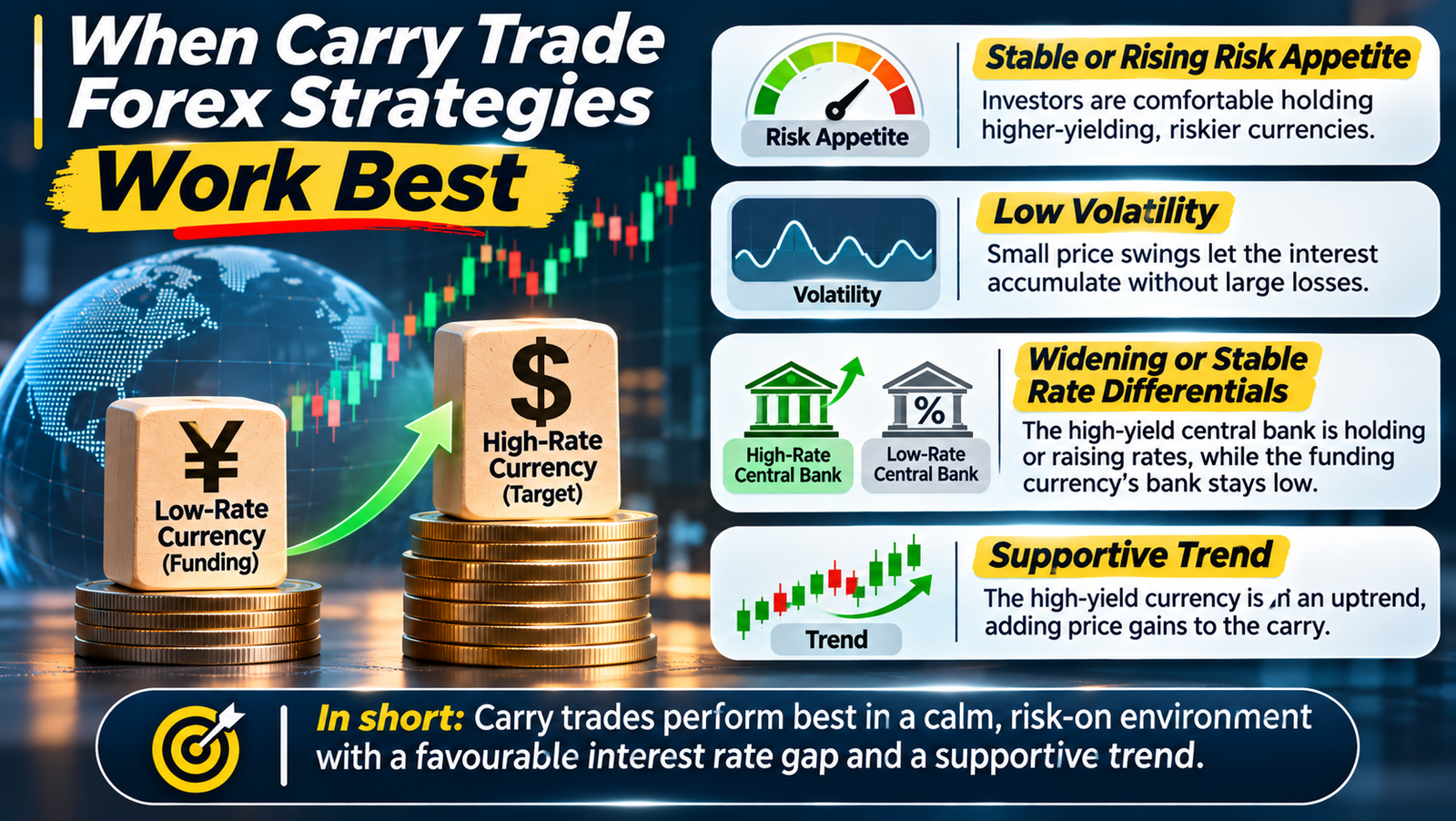
When Carry Trade Forex Strategies Work Best
- Stable or rising risk appetite: Investors are comfortable holding higher-yielding, riskier currencies.
- Low volatility: Small price swings let the interest accumulate without large losses.
- Widening or stable rate differentials: The high-yield central bank is holding or raising rates, while the funding currency’s bank stays low.
- Supportive trend: The high-yield currency is in an uptrend, adding price gains to carry.
How Central Bank Decisions Affect Carry Trade Forex Returns
Because the carry comes from interest rates, central bank policy is the single most important fundamental driver of a carry trade forex position. Traders watch not only rate decisions but also the guidance about where rates are heading.
- Rate hikes in the high-yield currency: Widen the differential and usually support the currency, increasing both carry and price gains.
- Rate cuts in the high-yield currency: Narrow the differential and often weaken the currency, hurting both sources of return.
- Rate hikes in the funding currency: Can be the most damaging change of all, because they reduce the carry and can trigger a rush to close positions, as seen with the yen in 2024.
- Forward guidance and inflation data: Markets move on expectations, so a hint of future changes can affect prices before any decision is made.
Keep an economic calendar for both central banks in your chosen pair, and note inflation, employment and growth data that could shift policy. A carry trade forex position that looked attractive last quarter may no longer make sense if the rate outlook has changed. Review the differential at least monthly and after every major policy meeting.
The Biggest Carry Trade Forex Risk: Unwinds
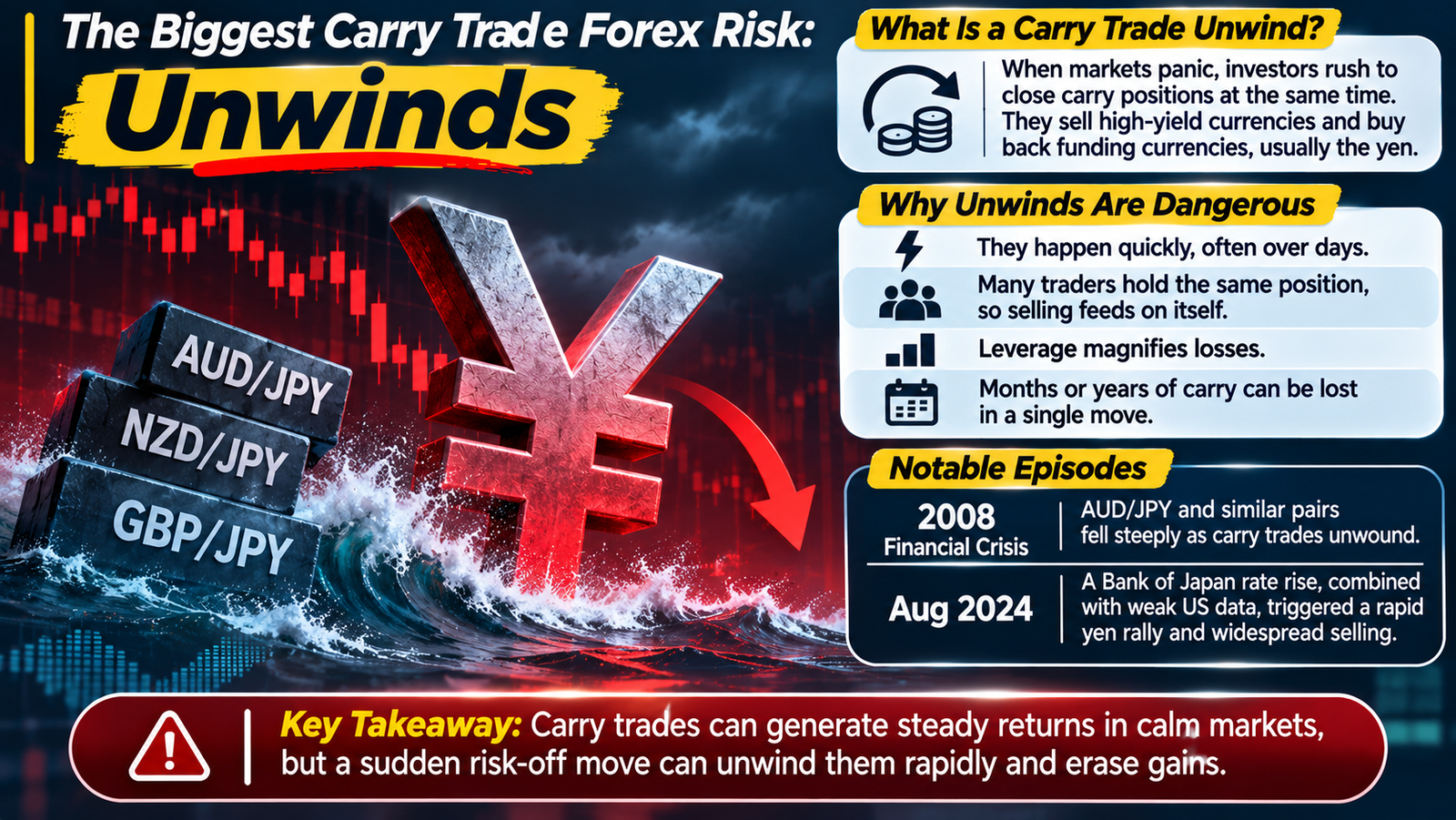
When markets panic, investors rush to close carry positions at the same time. They sell high-yield currencies and buy back funding currencies, usually the yen. This can cause sharp, fast moves known as carry trade unwinds.
Notable episodes include the 2008 financial crisis, when AUD/JPY and similar pairs fell steeply, and early August 2024, when a Bank of Japan rate rise combined with weak US data triggered a rapid yen rally and widespread selling across global markets.
Unwinds are dangerous because:
- They happen quickly, often over days.
- Many traders hold the same position, so selling feeds on itself.
- Leverage magnifies losses.
- Months or years of carry can be lost in a single move.
 Other Risks of Carry Trade Forex Strategies
- Rate changes: If the high-yield central bank cuts rates or the funding currency’s bank raises them, the differential narrows or disappears.
- Broker swap markups: Brokers may pay less than the true differential on long positions and charge more on short ones.
- Gap risk: Weekend news can cause prices to open far from Friday’s close.
- Emerging market risk: Very high-yield currencies can suffer devaluations, capital controls or political shocks.
- Leverage: High leverage turns small adverse moves into large account losses.
How to Manage a Carry Trade Forex Position
- Use modest leverage: Lower leverage gives the position room to survive normal volatility.
- Trade with the trend: Combine carry with technical analysis. Avoid buying a high-yield currency that is in a clear downtrend.
- Use stop-losses: Decide in advance how much price risk you will accept relative to expected carry.
- Watch risk sentiment: Rising volatility, falling stock markets and a strengthening yen are early warning signs.
- Monitor central banks: Track rate decisions and guidance for both currencies.
- Diversify: Spreading exposure across a few pairs reduces dependence on one currency.
- Check swap rates regularly: Brokers update them, and changes affect your returns.
Carry Trade Forex vs Other Forex Strategies
| Feature | Carry trade | Trend following | Day trading |
|---|---|---|---|
| Main source of profit | Interest differential plus price | Price trends | Short-term price moves |
| Holding period | Weeks to months | Days to months | Minutes to hours |
| Typical return pattern | Steady gains, occasional sharp losses | Many small losses, some big wins | Frequent small wins and losses |
| Key risk | Sudden unwinds | Choppy markets | Costs and noise |
Many traders blend carry with trend following, holding positive-carry positions only when the trend supports them.
Carry in Indian Currency Futures
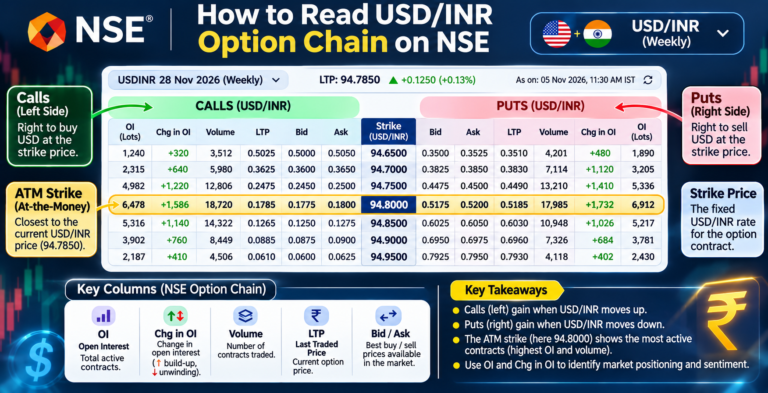
Indian residents cannot legally trade leveraged spot forex or CFDs through offshore platforms under FEMA, so they do not receive daily swaps in the way described above. However, the interest rate differential still matters in exchange-traded currency futures on NSE and BSE.
In futures, the differential is built into the price. Because Indian interest rates have generally been higher than US rates, USD/INR futures usually trade at a premium to the spot rate, and the premium is larger for later expiries. This forward premium reflects the interest rate difference between the two currencies.
What this means for traders:
- A long USD/INR futures position effectively pays the premium, which tends to shrink towards expiry, all else being equal.
- A short USD/INR futures position benefits from that convergence, all else being equal.
- Exporters and importers use these futures to hedge, and the premium is part of their hedging cost or benefit.
So while a classic carry trade forex strategy with daily swaps is not available to Indian residents, understanding carry helps explain futures pricing and the cost of holding positions. Trade only through SEBI-registered brokers on recognised exchanges.
Carry Trade Forex Checklist
- What is the current interest rate differential between the two currencies?
- What swap will my broker actually pay or charge?
- Is the high-yield currency in an uptrend?
- Is market volatility low and risk appetite stable?
- Are central banks likely to change rates soon?
- Is my leverage modest enough to survive a sharp move?
- Where is my stop-loss, and how many months of carry would it cost?
- Am I trading through a legal, regulated channel?
FAQs
What is a carry trade forex strategy?
It is a strategy where you buy a higher-interest currency and sell a lower-interest one to earn the interest rate differential, while also gaining or losing from exchange rate moves.
Is carry trade forex suitable for beginners?
It is simple in concept, but the risk of sudden unwinds and the use of leverage make it challenging. Beginners should use low leverage, small positions and strict stops, or study the strategy on a demo account first.
What is a funding currency?
It is the low-interest currency you sell or borrow, such as the Japanese yen in the classic yen carry trade.
How do I earn interest in forex?
Spot forex brokers pay or charge daily swap (rollover) on positions held overnight, based on the interest rate difference and the broker’s markup.
Why do carry trades unwind suddenly?
When risk sentiment turns negative, many investors close the same positions at once, causing sharp moves in high-yield and funding currencies.
Can Indian traders use carry trades?
Not through offshore spot forex platforms. However, interest differentials are reflected in NSE and BSE currency futures pricing, such as the USD/INR futures premium.
Conclusion
The carry trade is one of the oldest ideas in currency markets: earn the interest rate difference between two currencies while holding a position over time. In calm, trending markets, a carry trade forex strategy can deliver steady returns from interest alone.
But carry is a slow, steady gain set against a sudden, potentially large price risk. Use modest leverage, trade with the trend, watch risk sentiment and central bank policy closely, and always know how much price movement it would take to erase months of carry.