Quick answer
Leverage lets you control a large position with a small deposit – 1:100 means Rs 1 controls Rs 100. It magnifies both gains and losses. On leverage in forex India is far more conservative than offshore 1:500 offers: leverage is set by mandatory exchange margins, collected fully upfront under SEBI’s Peak Margin rules.
Introduction
Leverage is the feature that makes forex feel exciting – and the one that empties the most accounts. It’s why offshore ads scream ‘1:500 leverage!’ and why India, deliberately, does nothing of the sort. Understanding leverage in forex India applies its own rules to is essential, because the gap between what offshore platforms offer and what’s actually sensible – or legal – is enormous.
This guide explains what leverage is, the simple math behind it, and how it cuts both ways, before covering India’s specific limits in detail. Figures were verified against current 2026 sources, but rules and margins change, so confirm the latest before trading. This is educational information, not investment advice.
What Is Leverage in Forex?
Leverage is borrowed exposure – it lets you control a position far larger than the money you put up. It’s expressed as a ratio: 1:100 leverage means that for every 1 rupee of your own capital, you can control 100 rupees of position. The deposit you put up is called margin. So leverage and margin are two sides of the same coin: higher leverage means lower margin, and vice versa.
The appeal is obvious – a small amount of capital can command a large trade, so even modest price moves can produce meaningful profits. The danger is the mirror image: the same modest moves can produce meaningful, or total, losses.
The Math: Leverage and Margin
The relationship between leverage and margin is a simple inverse:
Margin % = 1 / Leverage
1:50 leverage -> 2% margin
1:100 leverage -> 1% margin
1:500 leverage -> 0.2% margin
Effective leverage = Position size / Your account equity
So at 1:100, a margin of just Rs 1,000 controls a Rs 1,00,000 position. That 100x exposure is what makes leverage powerful – and perilous.
The Double-Edged Sword (a Worked Example)
Leverage magnifies the percentage move on your capital, not on the market. Consider a Rs 1,00,000 position controlled with Rs 1,000 of margin (1:100):
Position: Rs 1,00,000 Margin: Rs 1,000 (1:100)
Market moves +1% -> +Rs 1,000 -> +100% of your margin
Market moves -1% -> -Rs 1,000 -> your margin is wiped out
A mere 1% move against you erases your entire deposit. At 1:500, it takes only a 0.2% move to do the same. This is why high leverage is not a bigger opportunity – it’s a shorter fuse. (Illustrative example.)
Leverage Limits in India: No 1:500 Here
This is where leverage in forex India diverges sharply from the offshore world. India does not let brokers offer arbitrary leverage like 1:500. Instead, leverage is set by mandatory exchange margins, and enforced far more strictly than it once was.
Leverage = exchange margins, not a broker’s offer
For exchange-traded currency derivatives on the NSE and BSE, you must post an initial margin (a SPAN margin covering worst-case risk, plus an exposure margin) set by the exchange’s risk model. You cannot get extra leverage on top of it. Because pairs like USD/INR are low-volatility, their margins are modest and the effective leverage is meaningful – but it is a fraction of offshore levels, and it is the exchange, not a broker, that sets it.
The Peak Margin Rule ended the intraday leverage game
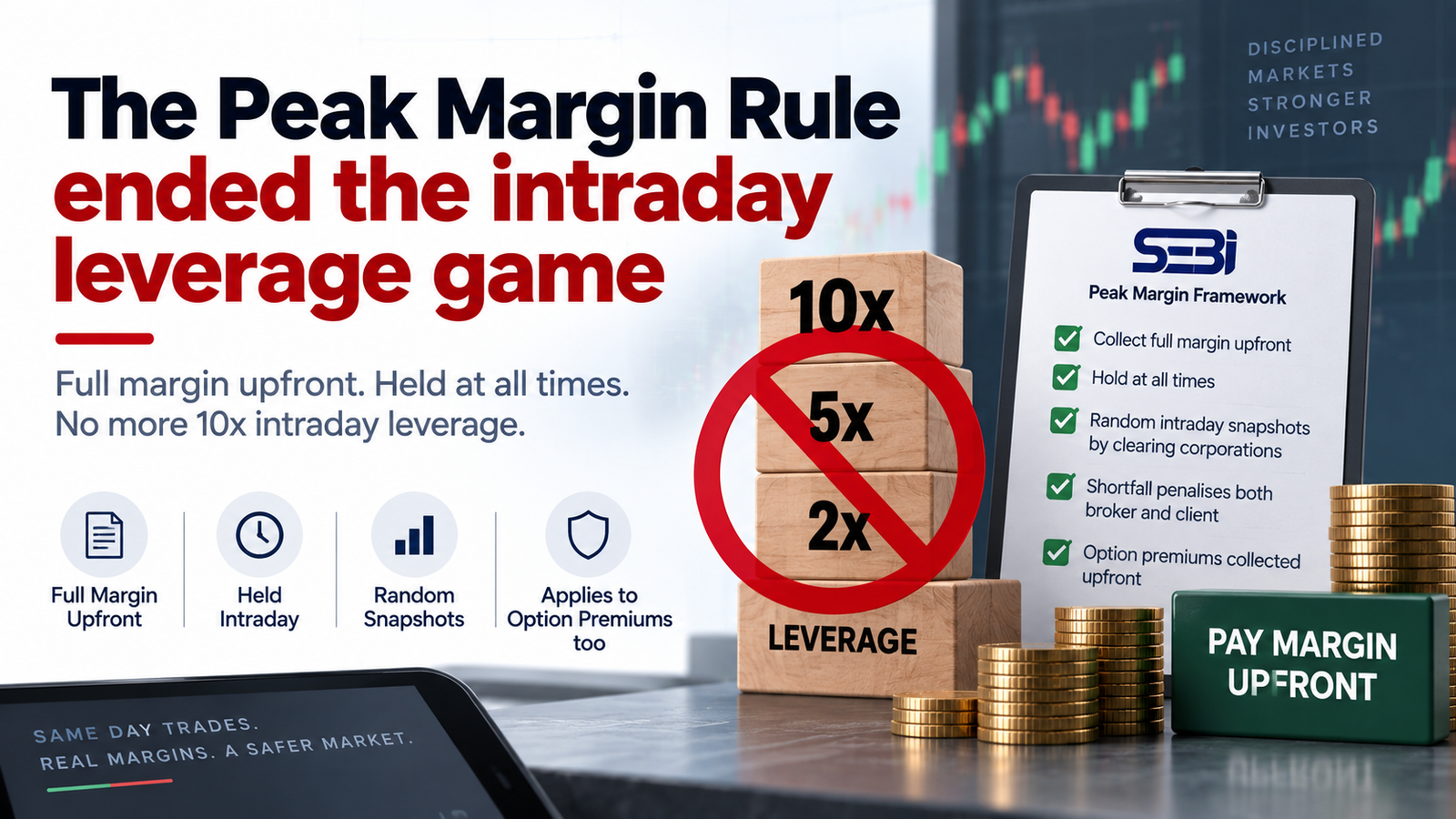
Under SEBI’s Peak Margin framework (fully in force since 2021), brokers must collect the full margin upfront and hold it at all times – not just at end of day. Clearing corporations take random intraday snapshots to check, and any shortfall penalises both broker and client. The practical effect, in the words of the market: no more 10x intraday leverage. Whatever margin is required, you pay it upfront and hold it until you close. Option premiums, too, must now be collected upfront – another curb on leverage.
India vs Offshore vs Global Regulated Caps
Seeing the three side by side makes the picture clear:
| Regime | Typical retail forex leverage | Legal for Indian residents? |
|---|---|---|
| India (exchange-traded) | Set by exchange margins; conservative, upfront | Yes – the legal route |
| Offshore brokers | 1:100 to 1:500 or more | No – breaches FEMA |
| Global regulated caps (FCA/ESMA/ASIC) | About 1:30 majors, 1:20 minors | Not applicable to residents in India |
Notice that even strict global regulators cap retail forex leverage around 1:30 – a world away from the 1:500 offshore platforms dangle. India’s exchange-margin approach lands in similarly conservative territory, by design.
Why SEBI Limits Leverage
The tight approach isn’t bureaucratic caution – it’s a response to hard evidence. High leverage lets small, under-funded traders build oversized positions, which creates both personal ruin and systemic risk when many blow up at once. SEBI’s own findings underline the human cost: in its August 2026 review, roughly 87.7% of individual equity-derivatives traders lost money in the FY2026 period, with aggregate losses running into tens of thousands of crores. That data – from India’s own regulator – is the clearest argument that generous leverage is not a gift to retail traders but a trap. (These figures relate to the equity-derivatives segment; the leverage lesson applies broadly.)
The Offshore ‘High Leverage’ Trap
Offshore brokers advertise 1:500 leverage as a headline benefit, but for an Indian resident it’s doubly bad. First, using those brokers is illegal – it breaches FEMA regardless of the leverage. Second, the leverage itself is the fastest way to lose everything: at 1:500, a fifth of a percent move wipes your margin, and currencies move that much routinely. The ‘benefit’ is really the mechanism by which these platforms convert your deposit into their revenue. Treat any pitch centred on huge leverage as a warning label, not a feature.

How to Use Leverage Safely
The professional approach flips the beginner’s instinct. Instead of asking ‘how much leverage can I get?’, ask ‘how little risk can I take per trade?’
- Risk a fixed small percentage per trade – many traders cap it at 1-2% of the account, regardless of available leverage.
- Size to your stop, not to your margin – use a position-size calculation, not the maximum the platform allows.
- Treat available leverage as a ceiling, not a target – you rarely need most of it.
- Keep spare margin – trading at the edge of your margin invites forced liquidation on normal volatility.
- Remember: leverage doesn’t change your edge – it only changes how fast you win or lose.
Common Mistakes
- Treating high leverage as more opportunity rather than more risk.
- Sizing positions to the maximum leverage available.
- Chasing offshore brokers for 1:500 – illegal and account-destroying.
- Trading with no spare margin, inviting liquidation.
- Confusing leverage with skill – it magnifies results, it doesn’t create an edge.
Myths vs Facts
| Myth | Fact |
|---|---|
| Higher leverage means more profit. | It magnifies losses just as much; it’s a shorter fuse, not a bigger edge. |
| India offers 1:500 like offshore brokers. | No; leverage is set by conservative exchange margins, collected upfront. |
| You can add broker leverage intraday. | SEBI’s Peak Margin rules ended the intraday leverage game. |
| Offshore 1:500 is a great deal. | It’s illegal for residents and the fastest way to lose your capital. |
Risk disclaimer
This article is for educational purposes only and is not investment advice. Leverage greatly increases the risk of loss, and most retail derivatives traders lose money. Margin and leverage rules are set by SEBI and the exchanges and change over time; figures here were checked against 2026 sources but may since have changed. Verify current margins with your broker and the exchange, and consult a qualified professional before trading.
Expert Analysis
The most important reframe about leverage is that it is neutral about direction but ruthless about size. It does not make you more likely to be right; it only multiplies the consequence of being right or wrong. Beginners consistently misread this, treating a 1:500 offer as five times the opportunity of 1:100, when it is really five times the speed of ruin for the same edge. Once you see leverage as a magnifier of variance rather than of returns, the appeal of extreme leverage collapses – and India’s conservative, margin-based approach starts to look less like a restriction and more like a guardrail that keeps the game survivable.
India’s regulators arrived at that guardrail the hard way, through data rather than theory. The Peak Margin reforms deliberately dismantled the old intraday-leverage culture, forcing traders to fund positions fully and upfront, precisely because thinly margined bets were producing defaults and devastating retail losses. The regulator’s own figures – the overwhelming majority of derivatives traders losing money – are the strongest possible endorsement of that stance. For the individual, the practical wisdom is to internalise the same discipline the rules impose: decide your risk per trade first, size to a stop rather than to a margin limit, and treat whatever leverage is available as a boundary you stay well inside. The traders who last are almost never the ones using the most leverage; they are the ones who respect it most.
Key Takeaways
- Leverage lets a small margin control a large position – 1:100 means Rs 1 controls Rs 100.
- It magnifies gains and losses equally; at 1:100 a 1% adverse move wipes your margin.
- India doesn’t allow 1:500 – leverage is set by mandatory exchange margins (SPAN + exposure).
- SEBI’s Peak Margin rules require full margin upfront, ending high intraday leverage.
- Use leverage as a ceiling, not a target – risk a small fixed percentage per trade.
Frequently Asked Questions (FAQ)
Q: What is leverage in forex?
A: Leverage lets you control a large position with a small deposit (margin). 1:100 means one rupee of your capital controls 100 rupees of position.
Q: What leverage is allowed in India?
A: There’s no offshore-style 1:500. For exchange-traded currency derivatives, leverage is set by mandatory exchange margins (SPAN plus exposure), collected fully upfront.
Q: Does India allow 1:500 leverage?
A: No. That level is offered only by offshore brokers, which are illegal for residents. India’s exchange margins produce far more conservative leverage.
Q: What is the relationship between leverage and margin?
A: They’re inversely related: margin percentage equals one divided by leverage. 1:50 leverage means 2% margin; 1:100 means 1%.
Q: How does leverage magnify losses?
A: It magnifies the percentage move on your capital. At 1:100, a 1% adverse market move equals a 100% loss of your margin.
Q: What is SEBI’s Peak Margin rule?
A: A framework requiring brokers to collect full margin upfront and hold it all day, checked via random snapshots – which ended high intraday leverage.
Q: What is SPAN and exposure margin?
A: Together they form the initial margin the exchange requires – SPAN covers worst-case risk and exposure margin adds a buffer.
Q: Is high leverage good for beginners?
A: No. High leverage is the fastest way for beginners to lose capital; small, fixed risk per trade is far safer.
Q: Why does SEBI limit leverage?
A: To reduce personal ruin and systemic risk; regulator data shows the large majority of retail derivatives traders lose money.
Q: Can my broker give me extra intraday leverage?
A: Not beyond exchange margins for derivatives; Peak Margin rules require full upfront margin, so old intraday-leverage offers are gone.
Q: What’s the effective leverage on USD/INR futures?
A: It’s set by the exchange’s margin for the pair – modest and conservative compared with offshore, and it varies with the risk model.
Q: How do global regulators cap leverage?
A: Strict regulators like the FCA and ESMA cap retail forex leverage around 1:30 for majors and 1:20 for minors.
Q: How should I use leverage safely?
A: Risk only a small fixed percentage per trade, size to your stop-loss rather than your margin, and keep spare margin.
Q: Does leverage improve my chances of winning?
A: No. It doesn’t change your edge – it only changes how fast you win or lose.
Q: Is offshore high leverage worth the risk?
A: No. It’s illegal for residents and financially dangerous; the leverage is the mechanism that most often wipes out accounts.