
Quick Summary
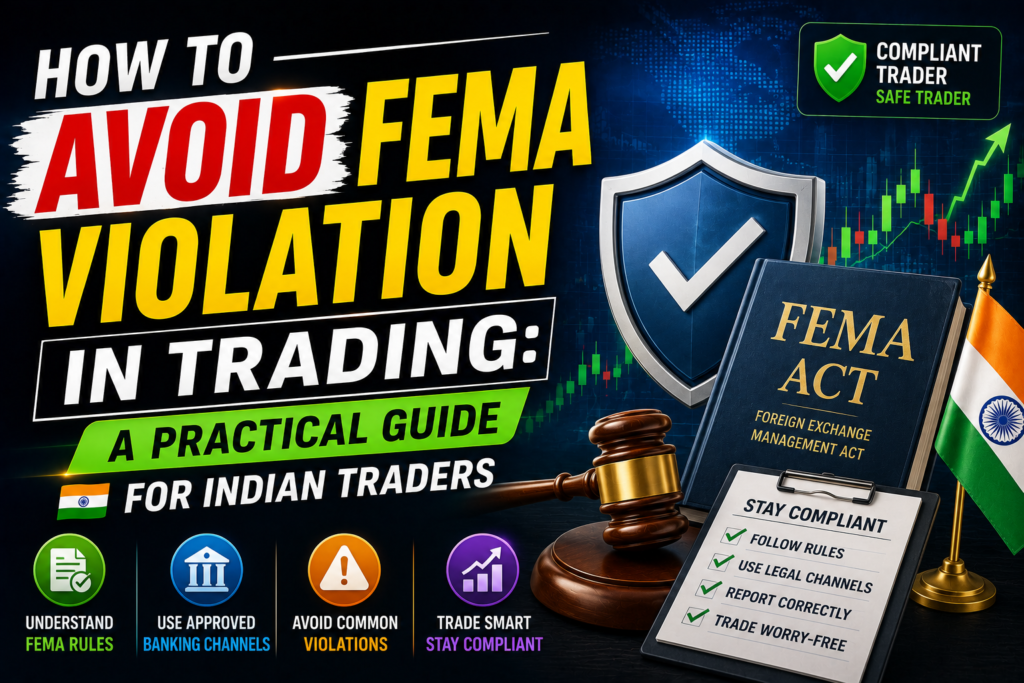
It’s easy for traders from India to enter into global markets like forex or crypto. But while the opportunities are huge, there’s one big thing you can’t afford to ignore: FEMA. There are rules set to govern the flow of money across the borders, and forgetting about them could lead to serious legal and financial trouble. In this blog, we’ll help you stay safe and avoid FEMA violation in trading. It explains why these rules exist, where most traders accidentally trip, and how you can grow your account without ending up on the wrong side of the law.
FEMA Compliance Snapshot for Indian Traders
| Area | FEMA-Compliant Approach | High-Risk Behavior |
| Forex Trading | INR pairs on Indian exchanges | Margin trading with offshore brokers |
| Fund Transfers | Approved banking channels | Unreported foreign remittances |
| Crypto Activity | Proper disclosure & taxation | Unregulated foreign platforms |
| Derivatives | Exchange-traded instruments | Overseas speculative accounts |
| Reporting | Transparent records | No documentation |
The Core Problem: Trading Globally, Regulated Locally
The biggest challenge for traders in India is the massive gap between what you can do globally and what the law actually allows. Modern apps make trading across the globe feel as easy as a simple click, but here’s the reality: no matter where your broker is based, whether it’s London, New York, or Dubai, as an Indian resident, you still have to follow the Indian rulebook.
FEMA is essentially that rulebook; it’s there to watch every rupee that crosses the border. Many traders violate it unintentionally, not due to fraud, but due to lack of awareness. Understanding how FEMA applies to trading is essential to avoid FEMA violation in trading in the long run.
What Is FEMA and Why Does It Matter to Traders?
The Foreign Exchange Management Act (FEMA) is essentially the rulebook that governs:
- Foreign exchange transactions
- Cross-border fund movement
- Capital account and current account activities
For you as a trader, it’s a guide that tells you which assets are allowed to trade, how you’re allowed to move your funds and most importantly how to bring back your hard earned profit back home legally. It doesn’t mean to stop your trading, it’s just there to keep the country’s economy stable and transparent.
How Traders Commonly Violate FEMA Without Realizing It
1. Trading Forex with International Brokers
Even if a foreign broker looks super professional, using them to trade forex with borrowed money from India is usually against the rules.
2. Unreported Foreign Remittances
Sending money to a trading account abroad without being 100% clear with your bank can lead to serious compliance issues.
3. Assuming “Everyone Is Doing It”
It’s easy to assume that it’s legal and great just because thousands of people are doing it. But popularity isn’t the same as legality.
Why Offshore Platforms Create FEMA Risks
Offshore brokers don’t need to answer Indian authorities. Even if they are perfectly legal and regulated in their own country, they usually don’t follow the specific FEMA rules required here in India.
This creates risk because:
- Indian laws still apply to Indian residents
- Enforcement may occur years later
- Penalties can be retroactive
Understanding this risk in the first step is making sure your trading stays safe and within the law.
Practical Example: A Typical FEMA Risk Scenario
Imagine an Indian trader opens a foreign account to trade EUR/USD with leverage. Send over using some cash using a generic transfer code from your bank and then withdraw their profit a few months later.
From the trader’s perspective, everything seems normal. However:
- Margin forex trading abroad may violate FEMA
- Purpose of remittance may be questioned
- Profit reporting becomes complex
This is a perfect example of how you can end up in a massive legal mess without even intending to break the law.
What Trading Activities Are FEMA-Compliant?
To maintain FEMA compliance trading India, traders should focus on:
- INR-based forex pairs on Indian exchanges
- Exchange-traded derivatives approved by regulators
- Transparent fund transfers through authorized dealers
- Proper disclosure of foreign income
Compliance begins with choosing the right instruments.
The Role of RBI and Authorized Dealers
Under the FEMA rules, the banks aren’t just to process your transaction, they’re actually legally required to act as first line of defence:
- Monitor foreign remittances
- Flag suspicious transactions
- Report inconsistencies to regulators
This is why using an official and authorised bank is the smartest move you can make to avoid FEMA Violation in Trading.
Taxation and FEMA: Often Confused but Connected
Think of Tax and FEMA as two different bosses, with different sets of rules. Both need to be followed, if you think you paid tax, you’re clear. Here’s the reality:
- FEMA violations can still occur
- Disclosure requirements remain
You need to keep both sides happy to stay truly safe. It’s about being compliant with the way you move money just as much as how much you pay the government.
Tools That Support FEMA Compliance Trading India
While no tool replaces legal advice, certain tools help traders stay organized:
- Trade journals for transaction tracking
- Accounting software for profit reporting
- Remittance purpose trackers
- Broker verification platforms
These tools support transparency, which is essential for FEMA compliance trading India.

How to Avoid FEMA Violation in Trading: Practical Checklist
Here’s how you avoid FEMA violation in trading:
- Trade through approved Indian exchanges
- Avoid margin-based offshore forex trading
- Use correct remittance purposes
- Maintain transaction records
- Seek clarity before transferring funds
At the end of the day, staying legal isn’t just a one-time thing, it’s a habit. Add it to your daily routine.
How FEMA enforcement works in the real world:
- Complaint-driven or audit-based
- The time machine effect: they look at all your trading history.
- They only care about the paperwork.
A mistake you’ve made today might not surface until much later. That’s why staying clean and organised from day one is the only way to trade with total peace of mind.
Why Education Matters More Than Loopholes
It’s really tempting to hunt for loopholes to get around the rules. But here is a quick reality check on why that usually backfires:
- Loopholes close over time
- Penalties remain enforceable
- Ignorance is not a defense
The only way to stay in trading for the long-term is actually understanding the rules. Real education helps you grow your account and avoid FEMA Violation in Trading sustainably.
Long-Term Trading Requires Legal Clarity
long -term trading success isn’t just about having a great strategy, it’s about staying out of:
- Legal certainty
- Capital protection
- Peace of mind
Sticking to the rules is what gives you security.
Trading In India: Why The Rules Are So Strict
Compared to many other countries, India has a stricter set of rules for trading. While it can feel a bit restrictive sometimes, it helps to think of these laws as guardrails designed to keep you safe:
- Protects retail participants
- Limits excessive speculation
- Emphasizes transparency
Understanding this system makes it easier to set realistic goals and build a trading career that’s actually sustainable.
When Should You Call In A Professional?
If a trader:
- Trading globally
- Using international platforms
- Moves funds frequently
It’s a smart decision to consult with a tax or legal expert. This is not an admission that you’ve done anything wrong. It’s just a check-up to ensure your future self is protected from any unexpected legal or paperwork headaches.
Conclusion
If you are an Indian trader, you want to trade in the global market. Then knowing how to avoid FEMA violation in trading is absolutely important. Think of these rules not as a restriction, but as a way to keep your trading career clear, safe and achieve long term success. Most people who get into trouble aren’t trying to break the law, they just don’t know the law, which makes education your best defence.
Therefore, it’s important for you to know at least your country’s law to protect yourself. And in this, platforms like InsightfulTrade can help you. They focus on providing real learning and staying compliant, helping you master not just charts, but also the legal world you’re trading in.
Frequently Asked Questions (FAQs)
What is FEMA in trading?
FEMA regulates foreign exchange transactions and cross-border financial activity for Indian residents.
How can traders avoid FEMA violations?
By trading approved instruments, using authorized banking channels, and maintaining proper records.
Is offshore forex trading allowed under FEMA?
Margin-based offshore forex trading generally falls outside FEMA-compliant activities.
Are profits from overseas trading taxable in India?
Yes. Indian residents must report and pay tax on global income.
Author: Kumkum Chandak
Experience: 3+ Years in Trading Research & Market Content Strategy
Kumkum Chandak is a trading content strategist and market research writer who specializes in simplifying technical analysis, trading tools, and strategy-driven educational content. Her work is optimized for EEAT, accuracy, and user intent, ensuring every article delivers practical insights for traders of all levels.
Risk Disclaimer:
All content is strictly educational and not financial advice. Trading involves substantial risk. Always perform your own analysis or consult a professional advisor.
Last Updated: 11 January 2026