Introduction
Proprietary trading firms, or prop firms, give traders access to a funded account in exchange for a fee and a share of profits. For years, the standard route was an evaluation: pass a challenge by hitting a profit target without breaking drawdown rules, then receive a funded account.
More recently, many firms have added instant funding. Instead of passing a challenge, you pay a fee and start trading a funded account straight away. It sounds simpler, but an instant funding prop firm account usually comes with its own trade-offs.
This guide compares the two models:
- How evaluation and instant funding accounts work
- Differences in cost, rules, drawdown and profit split
- Pros and cons of each
- Which model suits different traders
- A worked cost comparison and points for Indian traders
What Is an Evaluation Prop Firm?
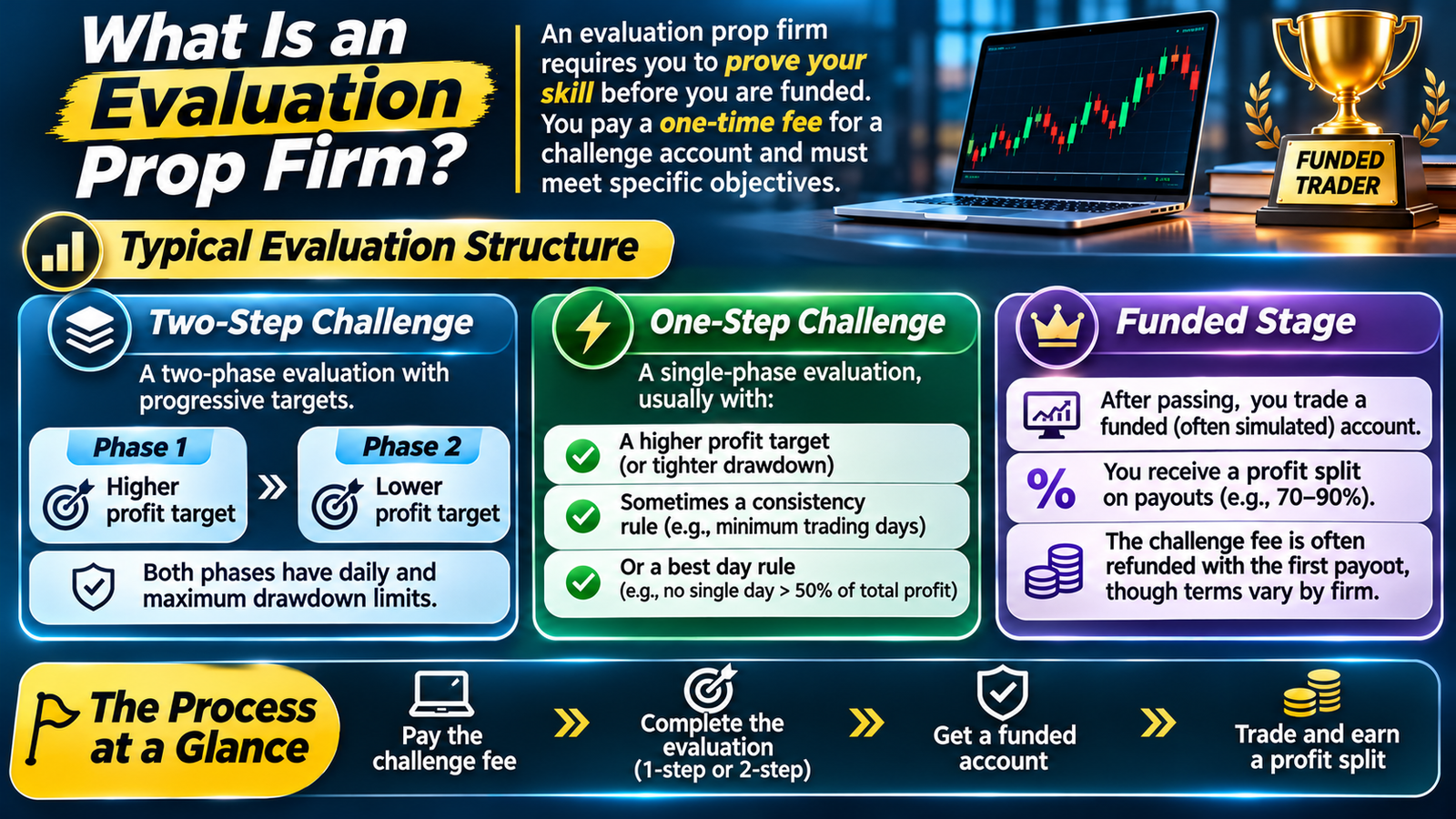
An evaluation prop firm requires you to prove your skill before you are funded. You pay a one-time fee for a challenge account and must meet specific objectives.
Typical evaluation structure
- Two-step challenge: Phase 1 has a higher profit target, Phase 2 a lower one. Both have daily and maximum drawdown limits.
- One-step challenge: A single phase, often with a higher profit target or tighter drawdown, and sometimes a consistency or best day rule.
- Funded stage: After passing, you trade a funded (often simulated) account and receive a profit split on payouts.
The fee is often refunded with the first payout at many firms, though terms vary.
What Is an Instant Funding Prop Firm?
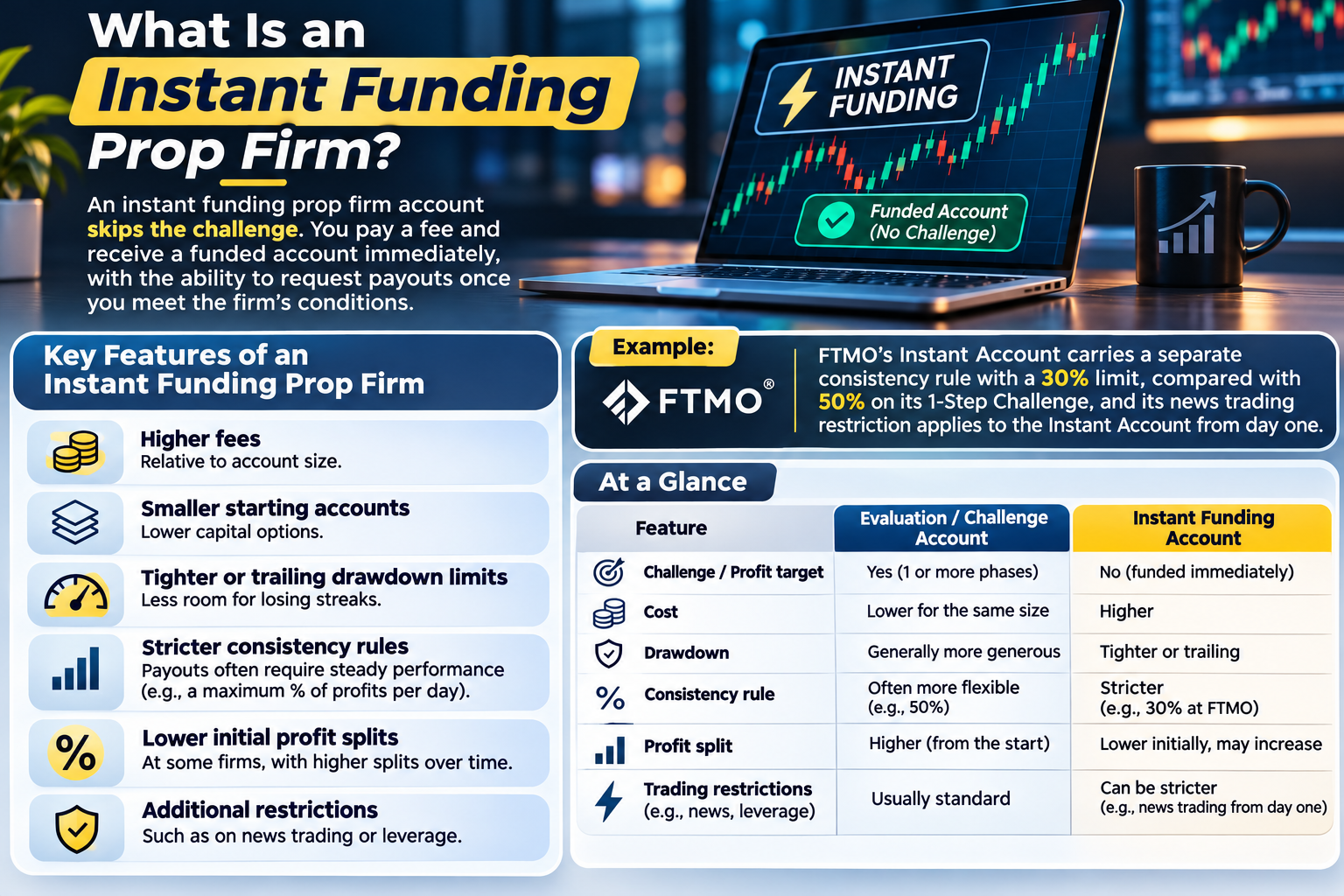
An instant funding prop firm account skips the challenge. You pay a fee and receive a funded account immediately, with the ability to request payouts once you meet the firm’s conditions.
Because the firm has not tested your skill first, it protects itself in other ways. Common features of an instant funding prop firm account include:
- Higher fees relative to account size
- Smaller starting account sizes
- Tighter or trailing drawdown limits
- Stricter consistency rules on payouts
- Lower initial profit splits at some firms, increasing over time
- Additional restrictions, such as on news trading or leverage
For example, FTMO‘s Instant Account carries a separate consistency rule with a 30% limit, compared with 50% on its 1-Step Challenge, and its news trading restriction applies to the Instant Account from day one.
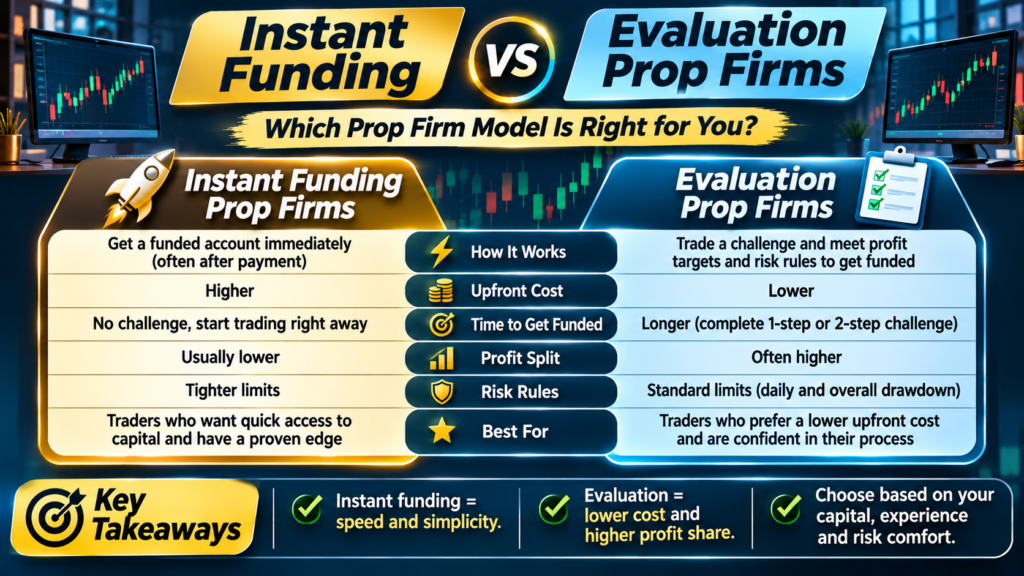
Instant Funding Prop Firm vs Evaluation: Key Differences
| Feature | Evaluation prop firm | Instant funding prop firm |
|---|---|---|
| Access to funded account | After passing a challenge | Immediately after purchase |
| Fee relative to account size | Lower | Higher |
| Typical account sizes | Larger options available | Often smaller |
| Drawdown rules | Daily and maximum limits, often static | Often tighter, sometimes trailing |
| Profit target | Required to pass | None before trading funded |
| Consistency rules | Some firms, often moderate | Common and often stricter |
| Profit split | Often high from the first payout | Sometimes lower at first, rising with scaling |
| Fee refund | Common with first payout | Less common |
| Time to first payout | Weeks, including evaluation | Potentially faster |
The core difference is where the risk sits. Evaluations filter traders before funding; an instant funding prop firm filters them through tighter rules after funding.
Pros and Cons of Evaluation Prop Firms
Pros
- Lower cost for a given account size
- More generous drawdown limits in many cases
- Higher profit splits once funded
- Fee refunds at many firms
- The challenge forces you to follow a plan, which builds discipline
Cons
- Profit targets create pressure to overtrade
- It takes time to pass one or two phases
- Failing means paying again for a new attempt
- Minimum trading day rules can slow progress
Pros and Cons of an Instant Funding Prop Firm
Pros
- No profit target to hit before trading funded capital
- Faster path to a potential payout
- Less pressure to “pass”, which may suit patient traders
- Useful for traders with a proven track record who want to skip testing
Cons
- Higher cost per unit of account size
- Tighter drawdown leaves less room for normal losing streaks
- Trailing drawdown can lock in losses after a winning run
- Strict consistency rules can delay payouts
- Smaller accounts limit income potential
 Understanding Drawdown Rules
Drawdown rules are where many traders fail, especially at an instant funding prop firm.
| Type | How it works | Impact |
|---|---|---|
| Static maximum drawdown | Fixed level below the starting balance | Room to breathe grows as you make profit |
| Trailing drawdown | Moves up as your balance or equity rises | Profits do not create extra buffer until the trail stops |
| Daily drawdown | Limit on loss within one day | Prevents a single bad day from ending the account |
A trailing drawdown is particularly important to understand. If your account rises from $10,000 to $10,600 and the drawdown trails by 6%, your breach level moves up too. A normal pullback after a winning streak can then end the account. Read exactly how your firm calculates it.
Payout Rules and Scaling Plans
Getting funded is only half the picture. What matters in the end is how and when you can withdraw profits, and how the account grows.
- Minimum trading days: Many firms require a set number of trading days before the first payout, whichever model you choose.
- Payout frequency: Some firms pay every two weeks, others monthly. Faster cycles help cash flow but may come with stricter conditions.
- Consistency checks: An instant funding prop firm often applies a consistency rule at payout time, so one large winning day can delay a withdrawal until profits are spread more evenly.
- Profit split progression: Some accounts start with a lower split and increase it after a number of successful payouts.
- Scaling plans: Consistent traders may have their account size increased, often after meeting profit and drawdown conditions over several months.
When comparing offers, look at the full journey from purchase to the third or fourth payout, not just the first one. An instant funding prop firm with a lower starting split but a fast, clear scaling plan can work out better over a year than a cheaper account with slow, restrictive payouts. The reverse can also be true, so model it with realistic monthly returns rather than best-case numbers.
Worked Example: Comparing Costs and Risk
The figures below are hypothetical, to show how to compare the two models.
| Item | Evaluation account | Instant funding account |
|---|---|---|
| Account size | $50,000 | $10,000 |
| Fee | $300 | $350 |
| Fee per $1,000 of capital | $6 | $35 |
| Maximum drawdown | 10% static ($5,000) | 6% trailing ($600) |
| Profit target before funding | 8% then 5% | None |
| Profit split | 80% | 70%, rising later |
If both traders make 4% in their first funded month:
- Evaluation trader: 4% of $50,000 = $2,000, with an 80% split = $1,600, after first passing the challenge.
- Instant funding trader: 4% of $10,000 = $400, with a 70% split = $280, without a challenge, but the fee is not yet recovered.
The instant funding prop firm trader reaches the payout stage sooner, but with a smaller account, higher cost per dollar of capital and less room for drawdown. The evaluation trader faces the risk of failing the challenge, but if they pass, the economics are stronger.
This example is illustrative. Actual firm terms vary widely.
Who Should Choose an Instant Funding Prop Firm?
An instant funding prop firm account may suit you if:
- You have a consistent, documented track record with low drawdowns
- Your style produces steady, small gains rather than occasional big wins
- You dislike the pressure of hitting a profit target in a limited time
- You understand trailing drawdown and consistency rules in detail
- You are comfortable paying more for faster access
Who Should Choose an Evaluation Prop Firm?
An evaluation may suit you better if:
- You want the largest account size for your fee
- You prefer static drawdown with more breathing room
- You want a higher profit split from the start
- You are still building discipline and benefit from a structured test
- Your strategy has larger swings that need wider drawdown limits
How to Evaluate Any Prop Firm
- Reputation: Check reviews, payout proof and how long the firm has operated.
- Rules: Read the full terms for drawdown type, consistency rules, news trading and holding restrictions.
- Payout terms: Minimum days, payout frequency, methods and any caps.
- Platform and instruments: Make sure your preferred pairs and platform are available.
- Costs: Compare fee per unit of capital, not just headline prices.
- Scaling plan: How the account and profit split grow with consistent performance.
- Support: Responsiveness when you have questions about rules or payouts.
Apply the same checklist whether you are choosing an evaluation or an instant funding prop firm.
Common Mistakes With Instant Funding Accounts
- Treating instant funding as “free money”: The rules are often stricter, not looser.
- Ignoring trailing drawdown: Many accounts are lost after a good run because the breach level moved up.
- Oversizing because there is no target: Large positions quickly hit tight limits.
- Overlooking consistency rules: One big day can delay payouts.
- Buying multiple accounts to “average out”: This multiplies costs without improving skill.
- Not reading the news policy: Some instant funding prop firm accounts restrict trading around high-impact news from day one.
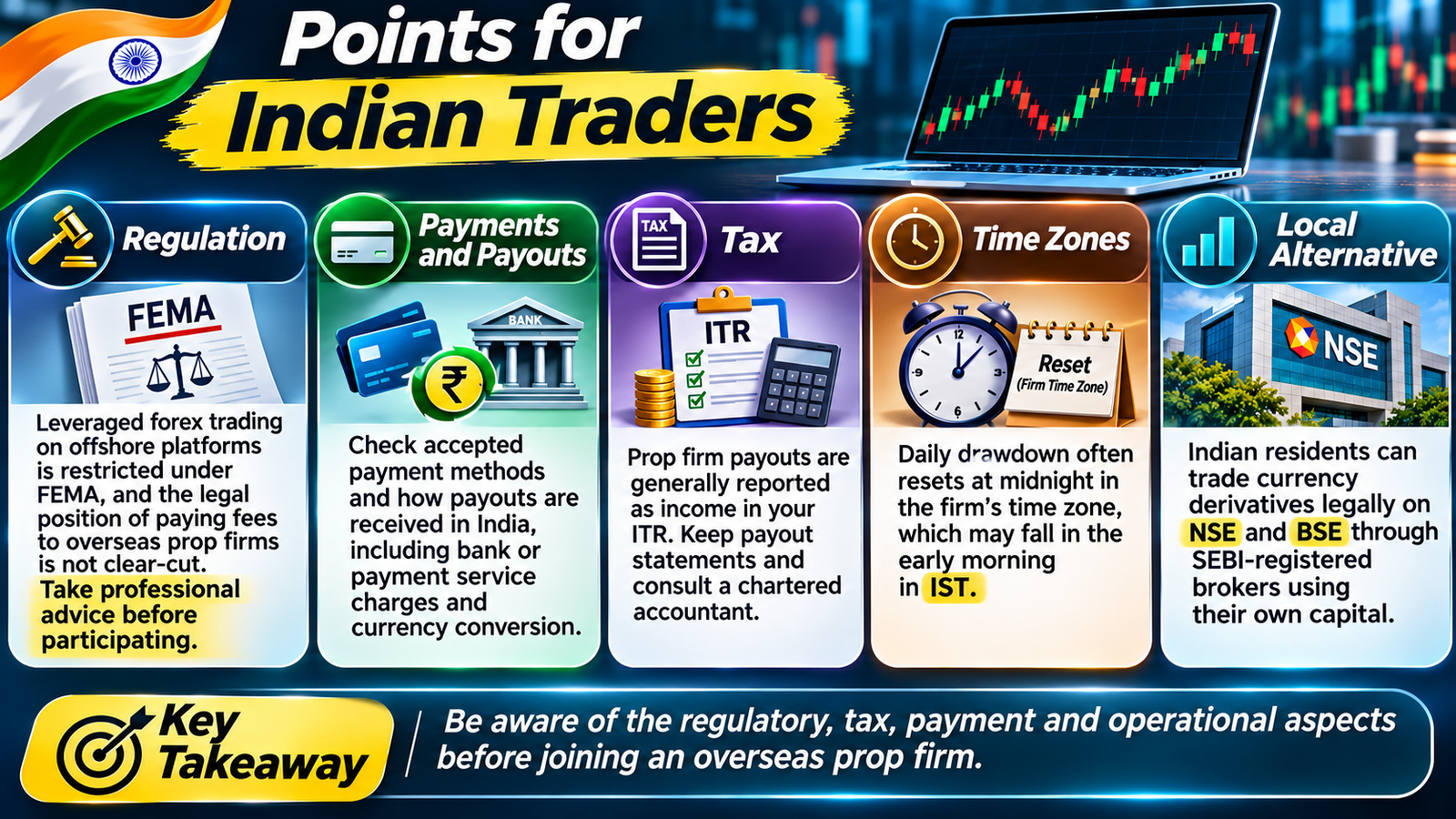
Points for Indian Traders
- Regulation: Leveraged forex trading on offshore platforms is restricted under FEMA, and the legal position of paying fees to overseas prop firms is not clear-cut. Take professional advice before participating.
- Payments and payouts: Check accepted payment methods and how payouts are received in India, including bank or payment service charges and currency conversion.
- Tax: Prop firm payouts are generally reported as income in your ITR. Keep payout statements and consult a chartered accountant.
- Time zones: Daily drawdown often resets at midnight in the firm’s time zone, which may fall in the early morning in IST.
- Local alternative: Indian residents can trade currency derivatives legally on NSE and BSE through SEBI-registered brokers using their own capital.
Instant Funding Prop Firm Checklist
- What is the fee per $1,000 of account size?
- Is the drawdown static or trailing, and how is it calculated?
- What is the daily loss limit and when does it reset?
- Is there a consistency rule, and what is the limit?
- What is the initial profit split, and how does it scale?
- Are there news, weekend or strategy restrictions?
- How and when are payouts made?
FAQs
What is an instant funding prop firm?
It is a prop firm that gives you a funded account immediately after purchase, without requiring you to pass an evaluation challenge first.
Is instant funding better than an evaluation?
Neither is better for everyone. Instant funding is faster but usually costs more and has stricter rules; evaluations cost less per dollar of capital but require passing a challenge.
Why are instant funding accounts more expensive?
The firm takes on traders without testing them, so it charges more and uses tighter rules to manage risk.
Do instant funding accounts have profit targets?
Usually not before funding, but payouts may depend on consistency rules, minimum trading days or other conditions.
Can Indian traders use an instant funding prop firm?
Many firms accept Indian traders, but FEMA and tax implications should be checked with a qualified adviser before paying any fees.
Conclusion
The choice between an evaluation and an instant funding prop firm comes down to trade-offs. Evaluations offer larger accounts, lower costs and higher splits, but you must pass a test first. Instant funding gives faster access with no profit target, but usually at a higher price, with smaller accounts and stricter drawdown and consistency rules.
Whichever route you choose, read the rules in full, compare costs per unit of capital, understand the drawdown type and trade with strict risk management. A funded account is only valuable if you can keep it.