Key Takeaways
- F&O turnover for tax audit is the sum of absolute profits and absolute losses on each trade, not the contract value you traded.
- For FY 2025-26 under the Income-tax Act, 1961, audit under section 44AB applies above ₹1 crore turnover, or ₹10 crore when cash receipts and payments are each within 5%.
- Most F&O traders settle through banks, so the ₹10 crore limit usually applies, but a 44AD history or low declared profit can still trigger audit.
- Currency futures and options on NSE or BSE follow the same turnover method as equity F&O.
- From tax year 2026-27 the Income-tax Act, 2025 applies, with the audit provision renumbered; confirm details with a chartered accountant.
Many traders panic when they see ₹50 crore of contract value on their broker’s annual statement and assume a tax audit is unavoidable. In most cases that number is irrelevant. What matters is F&O turnover calculated the way tax auditors do it. This guide is for Indian traders in equity, commodity and currency derivatives who file ITR-3. You will learn the F&O turnover calculation for tax audit step by step, the thresholds that decide whether you need an audit, a worked rupee example using USD/INR futures and options, and the mistakes that lead to wrong filings or penalties.
How is F&O turnover calculation for tax audit?
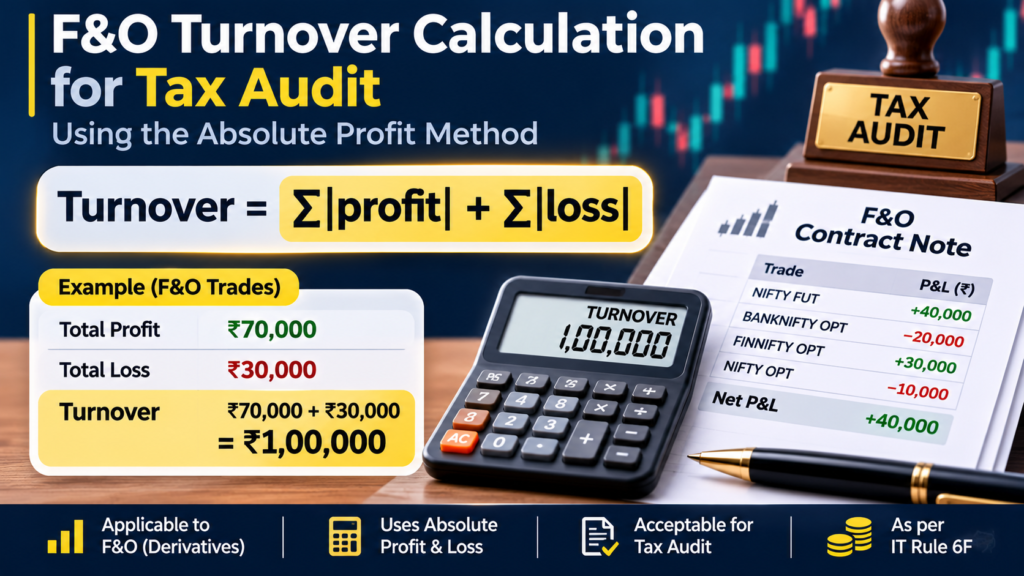
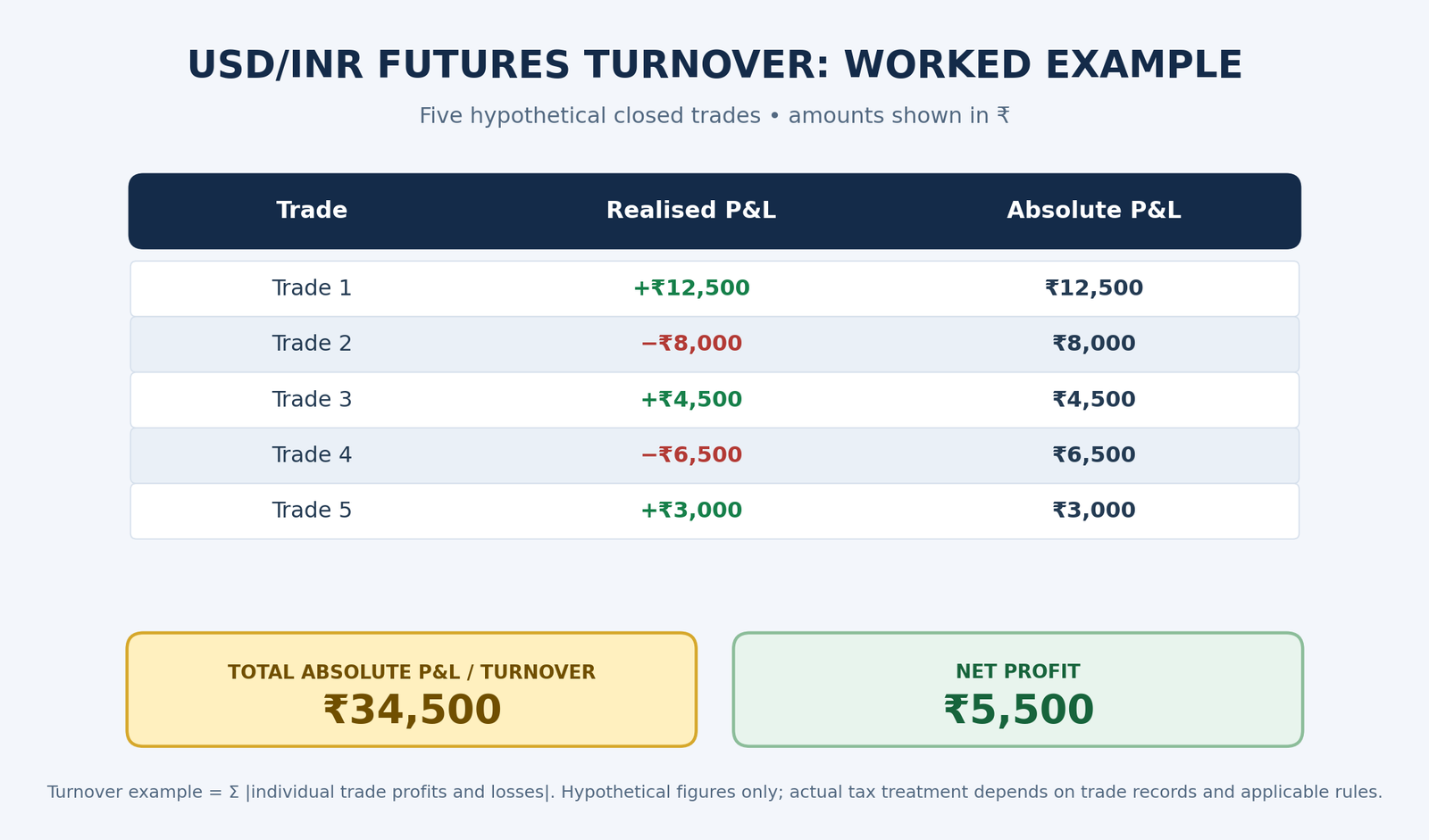
F&O turnover for tax audit is calculated by adding the absolute value of every profit and every loss on squared-off futures and options trades during the year. Losses are added as positive numbers. Contract or notional value is not turnover. This method comes from the ICAI Guidance Note on Tax Audit, not from the Act itself.
Why not use the contract value?
In a futures trade you never pay or receive the full contract value; you only settle the difference. A USD/INR futures lot is US$1,000, but if you buy at 94.50 and sell at 94.60, the money that actually changes hands is the 10-paise difference, or ₹100. Tax practice treats that difference as the turnover of the trade.
What about option premium?
Under the ICAI Guidance Note in use for recent years, premium received on selling options is not added separately, because the premium is already reflected in the trade’s profit or loss. Some older calculators and a few recent commentaries still add premium, so ask your CA which edition of the guidance note they follow before you finalise your numbers.
The F&O turnover formula
F&O turnover = Σ |profit on each trade| + Σ |loss on each trade|
The terms:
- Squared-off trade: a position you opened and closed, or that settled at expiry.
- Absolute value: the number without its plus or minus sign, so a loss of ₹4,000 counts as ₹4,000.
- Trade-wise, not day-wise: each trade’s result counts separately. Netting a day’s profits and losses understates turnover.
Your broker’s tax P&L report usually lists trade-wise or scrip-wise results. Use trade-wise data where possible.
Worked example: currency F&O turnover in rupees
Example (hypothetical): Priya, a salaried professional, trades USD/INR futures and options on NSE alongside her job. One NSE USD/INR lot is US$1,000, so every paisa is worth ₹10 per lot. Here are five of her trades:
| Trade | Instrument | Lots | Result | Absolute value for turnover |
|---|---|---|---|---|
| 1 | USD/INR futures, bought 94.20, sold 94.45 | 10 | +₹2,500 | ₹2,500 |
| 2 | USD/INR futures, sold 94.80, bought 94.98 | 8 | −₹1,440 | ₹1,440 |
| 3 | USD/INR 95.00 call, bought 0.1500, sold 0.2200 | 20 | +₹1,400 | ₹1,400 |
| 4 | USD/INR 94.50 put, bought 0.2000, expired worthless | 15 | −₹3,000 | ₹3,000 |
| 5 | USD/INR futures, bought 94.60, sold 94.55 | 12 | −₹600 | ₹600 |
| Total | −₹1,140 net | ₹8,940 turnover |
Trade 1 is 25 paise × ₹10 × 10 lots = ₹2,500. Trade 4 is the full premium of 0.2000 × 1,000 × 15 lots = ₹3,000 lost.
Her net result is a loss of ₹1,140, but her turnover is ₹8,940. If she made 600 similar trades in the year, her turnover would be roughly ₹10.7 lakh, far below the ₹10 crore limit. Her contract value over those trades would be in the hundreds of crores, which shows why notional value is the wrong number.
Charges such as brokerage, STT, GST and exchange fees are deducted as business expenses, not added to turnover. Our commission calculator helps estimate them per trade.
When does an F&O trader need a tax audit?
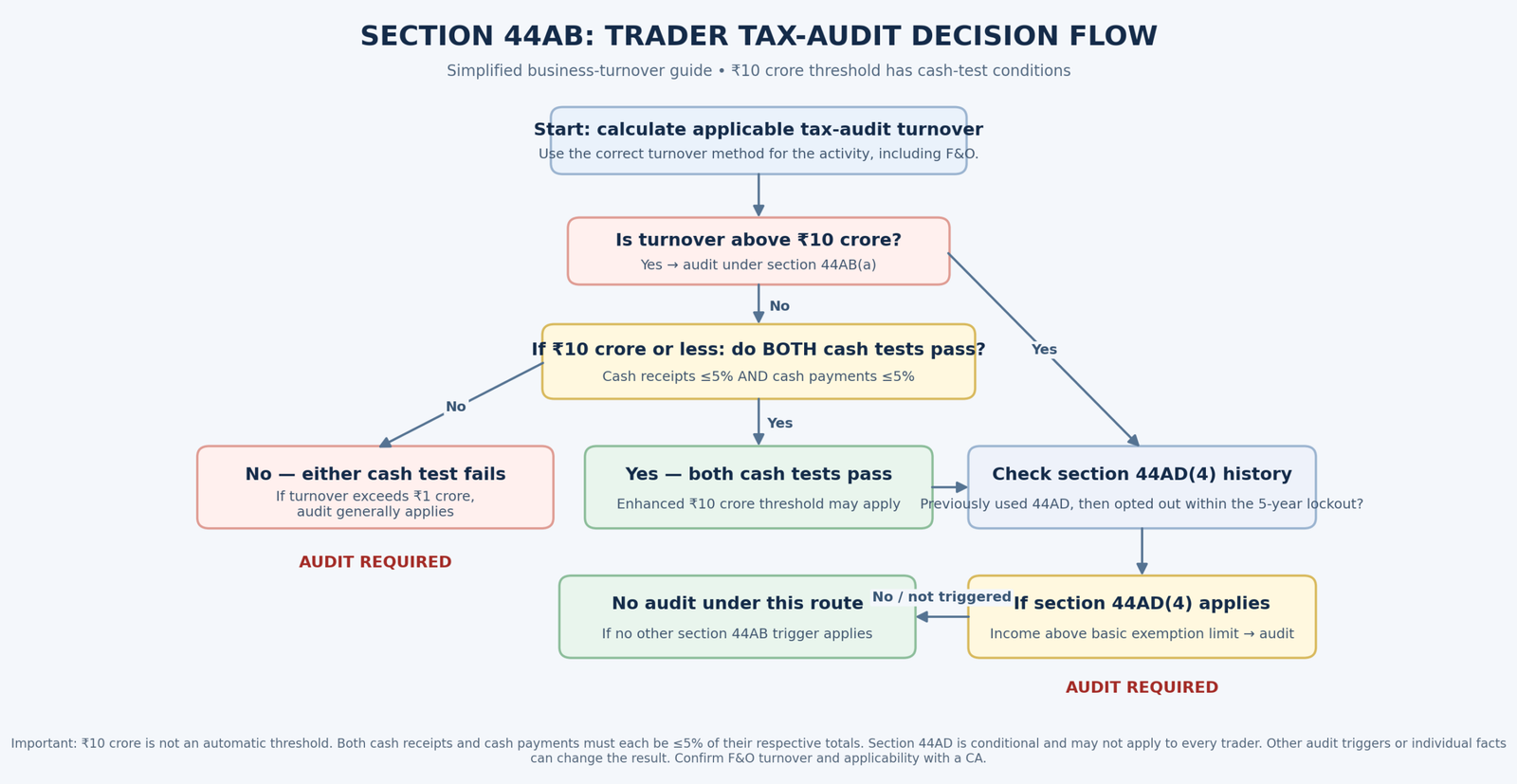
F&O income on recognised exchanges is generally treated as non-speculative business income. For FY 2025-26 under the Income-tax Act, 1961, the main audit triggers are:
| Situation | Audit required? |
|---|---|
| Turnover above ₹10 crore (cash receipts and payments each within 5%) | Yes, under section 44AB(a) |
| Turnover above ₹1 crore where cash exceeds 5% | Yes |
| Turnover within limits, profit declared normally, no 44AD history | Generally no |
| Opted for 44AD presumptive tax in an earlier year, then declared lower profit within the lock-in period, with income above the basic exemption limit | Yes, under section 44AB(e) read with 44AD(4) |
| Loss year with no 44AD history and turnover within limits | Generally no |
Presumptive taxation under section 44AD lets eligible businesses declare a fixed percentage of turnover as income, 6% for digital receipts. If you opt in and later declare lower profit within five years, you may be locked out of 44AD and pulled into audit. Many CAs advise F&O traders to think carefully before choosing 44AD in a loss or low-profit year.
What changes from tax year 2026-27?
The Income-tax Act, 2025 applies from tax year 2026-27, which began on 1 April 2026. Commentaries indicate the tax audit provision is now section 63, read with the presumptive provisions in section 58, and that new audit forms replace Forms 3CA, 3CB and 3CD. Practitioners are still interpreting the new low-profit audit trigger. Treat this as a reason to discuss your FY 2026-27 trades with your CA early rather than in October. The Income Tax Department of India publishes the Act, rules and notified forms.
Step by step: calculating your F&O turnover
- Download your broker’s tax P&L report for the full financial year, for every broker you used.
- Separate segments. Keep F&O (equity, commodity and currency derivatives) apart from intraday equity, which is speculative business, and from delivery trades, which are capital gains.
- List each trade’s result. Use trade-wise P&L, not a daily net figure.
- Convert losses to positive numbers.
- Add all absolute values. This total is your F&O turnover.
- Add turnover from any other business you run, because the audit test looks at total business turnover.
- Compare with the thresholds in the table above.
- Check your 44AD history for the previous five years.
- Total your expenses, including brokerage, statutory charges, data subscriptions and a business share of internet costs. Our breakdown of trading cost calculation shows what to include.
- Share the workings with your CA before filing ITR-3.
Due dates and penalties to remember
For FY 2025-26, the audit report was due by 30 September 2026 and the audited return by 31 October 2026, unless CBDT extended the dates. Missing a required audit can attract a penalty or fee of 0.5% of turnover, capped at ₹1,50,000. Filing late can also cost you the right to carry forward F&O losses.
Non-speculative business losses can be set off against other income except salary in the same year and carried forward for eight years, but only if the return is filed on time. Our guide to forex taxation in India covers set-off rules in more depth, and our full-time trader compliance checklist covers books of account and record-keeping.
Common mistakes in the F&O turnover calculation
Using notional or contract value
This is the single biggest error. It makes turnover look hundreds of times larger and can lead traders to pay for audits they do not need.
Netting profits and losses
Adding a day’s or a month’s net result understates turnover. Each trade’s absolute result must be counted.
Double counting option premium
If your broker’s P&L already includes premium in each trade’s result, adding premium again inflates turnover.
Forgetting smaller brokers or segments
Currency and commodity F&O trades with a second broker still count. Leaving them out can mismatch with the AIS (Annual Information Statement).
Treating F&O losses as unimportant
A loss year still needs ITR-3 filed on time to preserve carry forward. Skipping the return to “save effort” can cost you a valuable set-off later. Traders who pay for courses or data should also read our note on trading course tax deduction.
Ignoring residency rules on what you trade
Indian residents may trade currency derivatives only through SEBI-registered brokers on recognised Indian exchanges such as NSE, BSE and MSE, in permitted pairs. Margin trading on overseas forex platforms through LRS is not permitted, and RBI maintains an Alert List of unauthorised platforms. Income from such platforms creates both tax and FEMA problems.
FAQs
What is the F&O turnover formula for tax audit?
F&O turnover is the sum of the absolute values of all profits and losses on squared-off futures and options trades in the year. A loss of ₹5,000 and a profit of ₹3,000 give turnover of ₹8,000, not ₹2,000. Contract value is ignored, and premium is usually not added separately if it is already in the trade result.
Is tax audit compulsory if I have F&O losses?
Not automatically. A loss alone does not trigger audit if turnover is within the limits and you have no recent 44AD presumptive history. Audit can become compulsory if turnover exceeds the threshold, or if you opted for 44AD earlier and now declare lower profit while income exceeds the basic exemption limit.
What is the tax audit limit for F&O traders?
For FY 2025-26 under section 44AB of the 1961 Act, the limit is ₹1 crore of turnover, rising to ₹10 crore if cash receipts and cash payments are each within 5% of totals. Because F&O trades settle through bank accounts, most traders qualify for the ₹10 crore limit. Confirm current figures with your CA.
How is currency futures turnover calculated?
Currency futures turnover uses the same method as equity F&O. Work out the rupee profit or loss on each USD/INR, EUR/INR or other permitted contract, convert losses to positive numbers and add them. For USD/INR, each paisa of movement equals ₹10 per lot, so a 15-paise move on 4 lots is ₹600.
Should F&O traders opt for section 44AD?
It depends on your profits and plans. Section 44AD lets you declare 6% of digital turnover as income, which can suit profitable traders who want simpler compliance. But opting in and later declaring lower profit within five years can trigger audit. Many traders in loss years avoid 44AD and file normally. Discuss with a CA first.
Which ITR form do F&O traders file?
Individual and HUF F&O traders file ITR-3, because F&O income is business income. You report turnover, gross profit, expenses and net profit or loss in the business schedules. If an audit applies, the CA’s audit report must be filed before the return and is linked to it.
Conclusion
F&O turnover calculation for tax audit is simpler than the scary numbers on a broker statement suggest. Add the absolute value of every trade’s profit and loss, ignore contract value, avoid double counting premium, and combine all brokers and segments. Then test the total against the ₹1 crore or ₹10 crore limit and check your 44AD history before deciding on audit. With the Income-tax Act, 2025 now in force for tax year 2026-27, sit down with your CA early. To prepare clean expense figures, run your trades through the commission calculator and read our full guide to forex taxation in India.