Introduction on itr 3 for traders
If you trade futures and options (F&O) or buy and sell shares intraday, your income tax return is more complex than a salaried person’s. Trading income is usually treated as business income, which means the simple ITR-1 or ITR-2 forms are not enough. For most active traders, the right form is ITR-3.
Many traders find ITR-3 intimidating because it includes business schedules, a profit and loss account and questions about turnover and audit. But once you understand the structure, filing becomes much more manageable.
This guide explains ITR-3 for traders step by step:
- Who needs to file ITR-3
- How trading income is classified
- How to calculate trading turnover
- When a tax audit applies
- Due dates and regime choice
- A step-by-step filing process
- Common mistakes to avoid
Who Needs ITR-3 for Traders?
ITR-3 is the return form for individuals and Hindu Undivided Families (HUFs) who have income from business or profession. For traders, it usually applies if you have:
- Income or loss from F&O trading (equity, currency or commodity derivatives)
- Income or loss from intraday equity trading
- Income from share trading treated as a business
- Any business or professional income alongside salary, capital gains or other income
Even if you made a loss, filing ITR-3 for traders is important. Without a return filed on time, you generally cannot carry forward business losses to future years.
ITR-2 vs ITR-3 vs ITR-4
| Form | Suitable for |
|---|---|
| ITR-2 | Salary, capital gains (for example, delivery-based investing) and other income, but no business income |
| ITR-3 | Business or professional income, including F&O and intraday trading |
| ITR-4 | Presumptive income schemes; generally risky for F&O and intraday traders, especially with losses |
How Trading Income Is Classified in ITR-3 for Traders
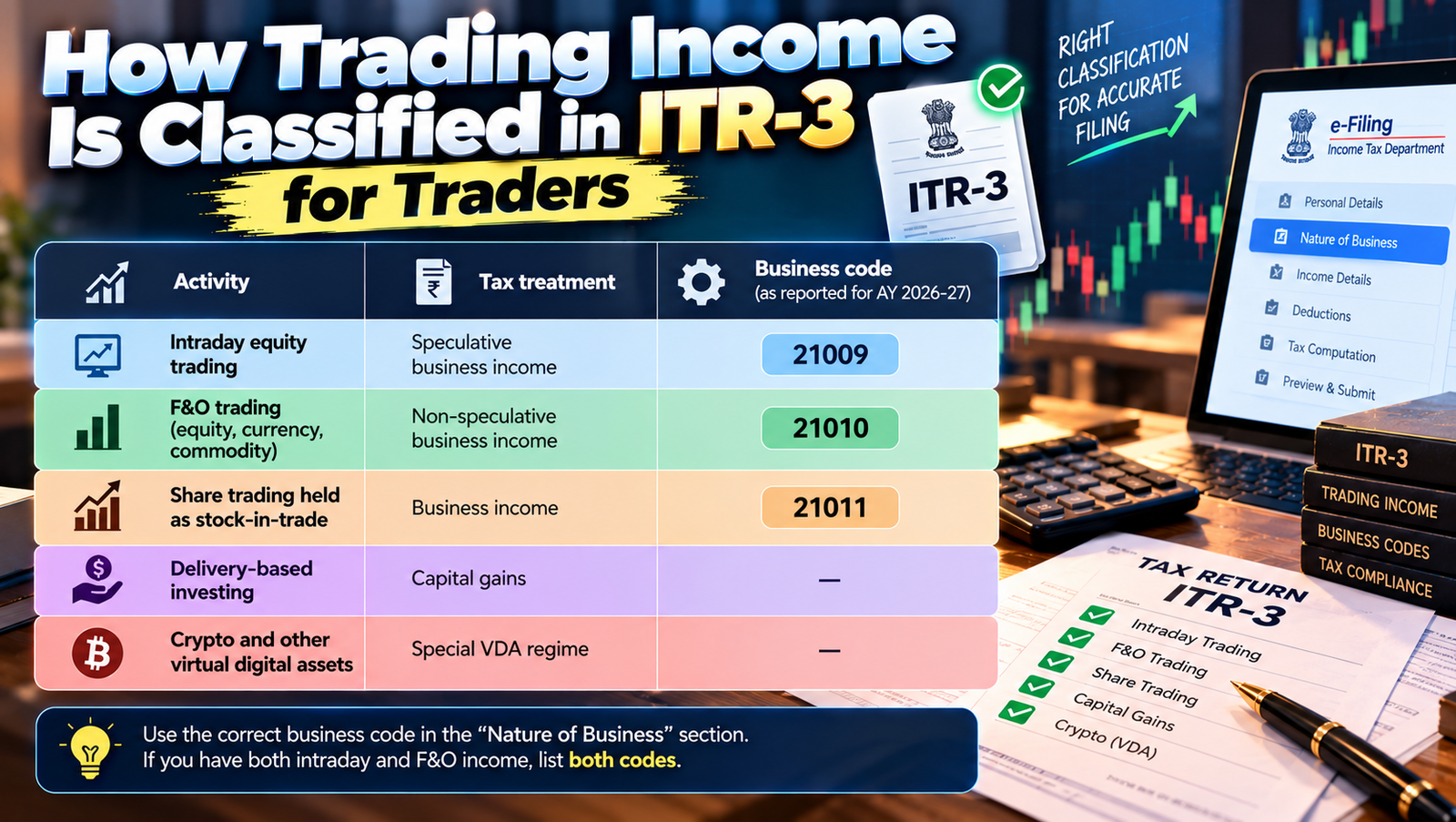
The first step in using ITR-3 for traders is to classify each type of income correctly.
| Activity | Tax treatment | Business code (as reported for AY 2026-27) |
|---|---|---|
| Intraday equity trading | Speculative business income | 21009 |
| F&O trading (equity, currency, commodity) | Non-speculative business income | 21010 |
| Share trading held as stock-in-trade | Business income | 21011 |
| Delivery-based investing | Capital gains | — |
| Crypto and other virtual digital assets | Special VDA regime | — |
Use the correct business code in the “Nature of Business” section. If you have both intraday and F&O income, list both codes.
Calculating Turnover in ITR-3 for Traders
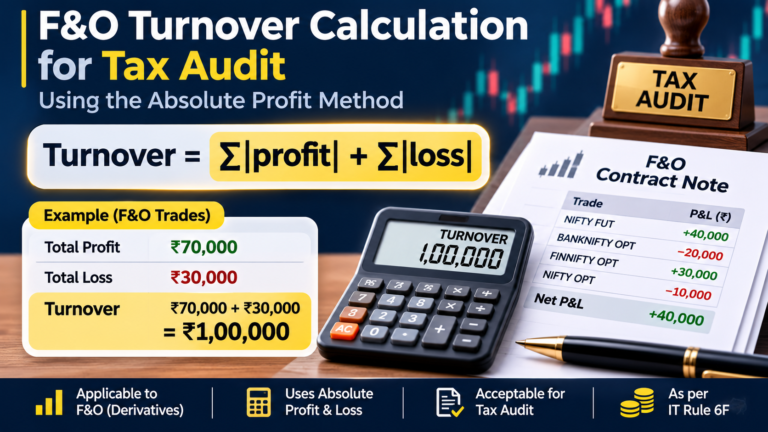
Turnover for traders is not the total value of contracts traded. It is calculated differently, based on guidance from the Institute of Chartered Accountants of India (ICAI):
- F&O (futures): The absolute sum of profits and losses on each trade (treating both as positive numbers).
- F&O (options): The absolute sum of profits and losses on each trade. Under ICAI’s updated guidance, the premium received on sold options is generally no longer added to turnover.
- Intraday trading: The absolute sum of profits and losses on each trade.
Example
Suppose you made three trades: a profit of ₹20,000, a loss of ₹15,000 and a profit of ₹5,000.
- Net profit: ₹20,000 − ₹15,000 + ₹5,000 = ₹10,000
- Turnover: ₹20,000 + ₹15,000 + ₹5,000 = ₹40,000
Your broker’s tax P&L statement usually shows turnover, but check that it uses the correct method. For AY 2026-27, ITR-3 asks for F&O turnover and F&O income separately, alongside intraday turnover and income, in the trading account section. Leaving these fields blank can make the return defective.
ITR-3 for Traders: Do You Need a Tax Audit?
A tax audit under section 44AB of the 1961 Act depends mainly on turnover:
- Up to ₹10 crore: No audit is required if cash transactions are no more than 5% of total receipts and payments. Most traders who use banks and brokers meet this condition.
- ₹1 crore: The general threshold if the cash condition is not met.
- Presumptive taxation (section 44AD): If you opted for presumptive taxation in an earlier year and then declare lower profits, or move out of the scheme within the lock-in period, an audit may be required in some cases.
A loss on its own does not automatically require an audit. But because the rules interact in complex ways, ask a chartered accountant to confirm your position. An audit changes your due date and adds penalties if filed late.
Books of account
Separately, books of account may need to be maintained if your business turnover or profit crosses certain thresholds. Keep broker contract notes, ledgers and bank statements for every year.
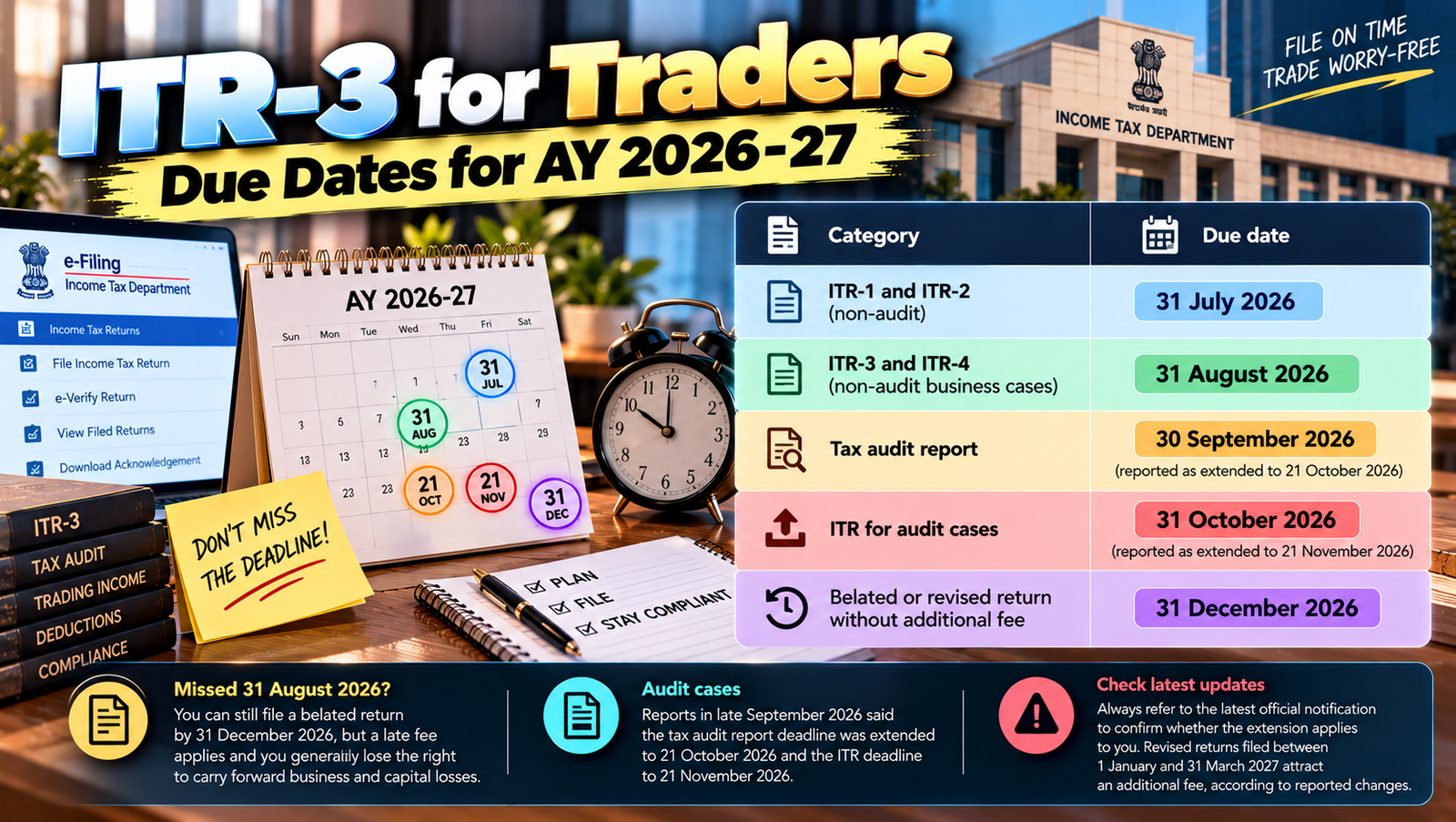
ITR-3 for Traders: Due Dates for AY 2026-27
| Category | Due date |
|---|---|
| ITR-1 and ITR-2 (non-audit) | 31 July 2026 |
| ITR-3 and ITR-4 (non-audit business cases) | 31 August 2026 |
| Tax audit report | 30 September 2026, reported as extended to 21 October 2026 |
| ITR for audit cases | 31 October 2026, reported as extended to 21 November 2026 |
| Belated or revised return without additional fee | 31 December 2026 |
For AY 2026-27, the due date for non-audit ITR-3 cases was set at 31 August 2026, later than the 31 July date for ITR-1 and ITR-2. If you missed it, you can still file a belated return by 31 December 2026, but a late fee applies and you generally lose the right to carry forward business and capital losses.
For audit cases, reports in late September 2026 said the tax audit report deadline had been extended to 21 October 2026 and the ITR deadline to 21 November 2026. Check the latest official notification to confirm whether the extension applies to you. Revised returns filed between 1 January and 31 March 2027 attract an additional fee, according to reported changes.
Choosing a Tax Regime When Filing ITR-3 for Traders
The new tax regime is the default. If you have business income and want the old regime (for example, to claim deductions under section 80C), you generally need to file Form 10-IEA before the ITR due date. Taxpayers with business income have limited flexibility to switch back and forth between regimes, so plan carefully.
A chartered accountant can model both options as part of preparing ITR-3 for traders. Compare your tax under both regimes before deciding. For many traders with few deductions, the new regime may work out cheaper.
Step-by-Step: Filing ITR-3 for Traders
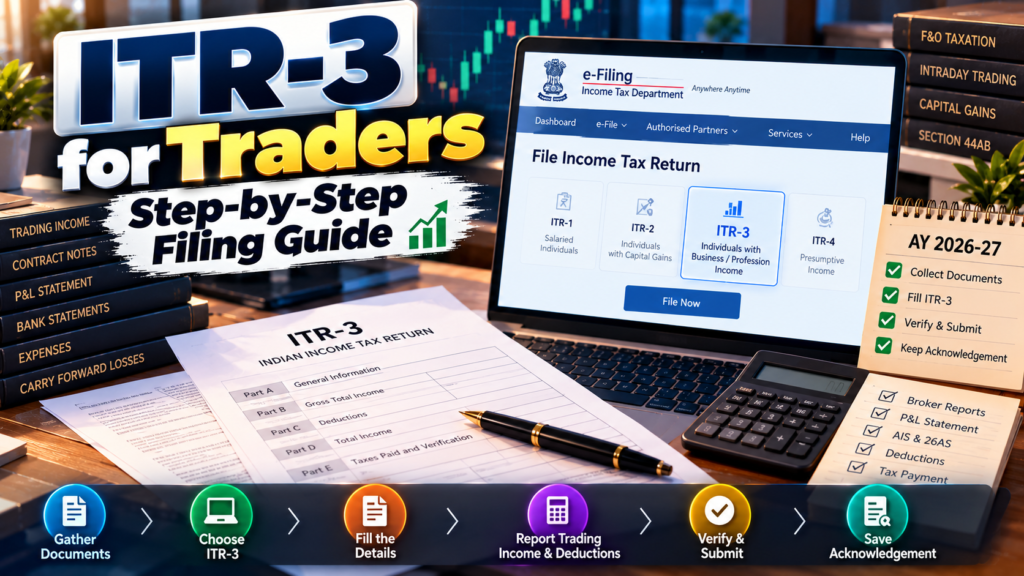
Here is a practical sequence for completing ITR-3 for traders on the e-filing portal. Allow enough time, especially if this is your first business return.
Step 1: Gather your documents
- Broker tax P&L statements and contract notes for F&O, intraday and delivery trades
- Annual Information Statement (AIS) and Form 26AS
- Bank statements
- Form 16, if you have salary income
- Records of expenses related to trading
- Details of losses carried forward from earlier years
Step 2: Reconcile with AIS
Check that your broker statements match the transactions reported in AIS. Investigate any mismatches before filing.
Step 3: Classify income and calculate turnover
Separate speculative (intraday), non-speculative (F&O) and capital gains results. Calculate turnover for each business activity.
Step 4: Prepare the profit and loss account
Include trading results and allowable expenses, such as brokerage (if not already netted), internet costs, trading software subscriptions and advisory fees directly related to trading. Securities Transaction Tax (STT) is generally not deductible when computing business income.
Step 5: Log in and select ITR-3
Log in to the income tax e-filing portal, choose the assessment year and select ITR-3. Fill in personal information and choose your tax regime.
Step 6: Complete the key schedules
- Nature of Business: Enter business codes such as 21009 and 21010.
- Part A – Trading Account and P&L: Enter turnover, income and expenses, including the separate F&O and intraday fields.
- Balance sheet: Fill in if required, or use the “no account case” option where applicable.
- Schedule BP: Compute business income, separating speculative and non-speculative results.
- Schedule CG: Report capital gains from delivery-based trades.
- Schedule CYLA and BFLA: Set off current-year and brought-forward losses.
- Schedule CFL: Record losses to carry forward.
- Schedule VDA: Report crypto transactions, if any.
Step 7: Calculate tax and pay any balance
Check whether advance tax was due. Traders with business income may need to pay advance tax in instalments during the year to avoid interest. Advance tax is generally due in four installments, in June, September, December and March, if your total tax liability for the year is ₹10,000 or more after TDS. Because trading profits can be uneven, review your position before each instalment date. This is often overlooked by people filing ITR-3 for traders for the first time.
Step 8: Submit and verify
Submit the return and e-verify it, for example using Aadhar OTP or net banking. An unverified return is treated as not filed.
Record-Keeping Tips for Traders
Good records make filing faster and reduce the risk of errors. Download your broker’s tax P&L report at the end of each financial year and save contract notes and ledgers in one folder. Keep a simple spreadsheet listing each year’s losses, their type and the year they expire. If you trade with more than one broker, combine the reports before calculating turnover, because audit thresholds apply to your total business turnover, not each account separately.
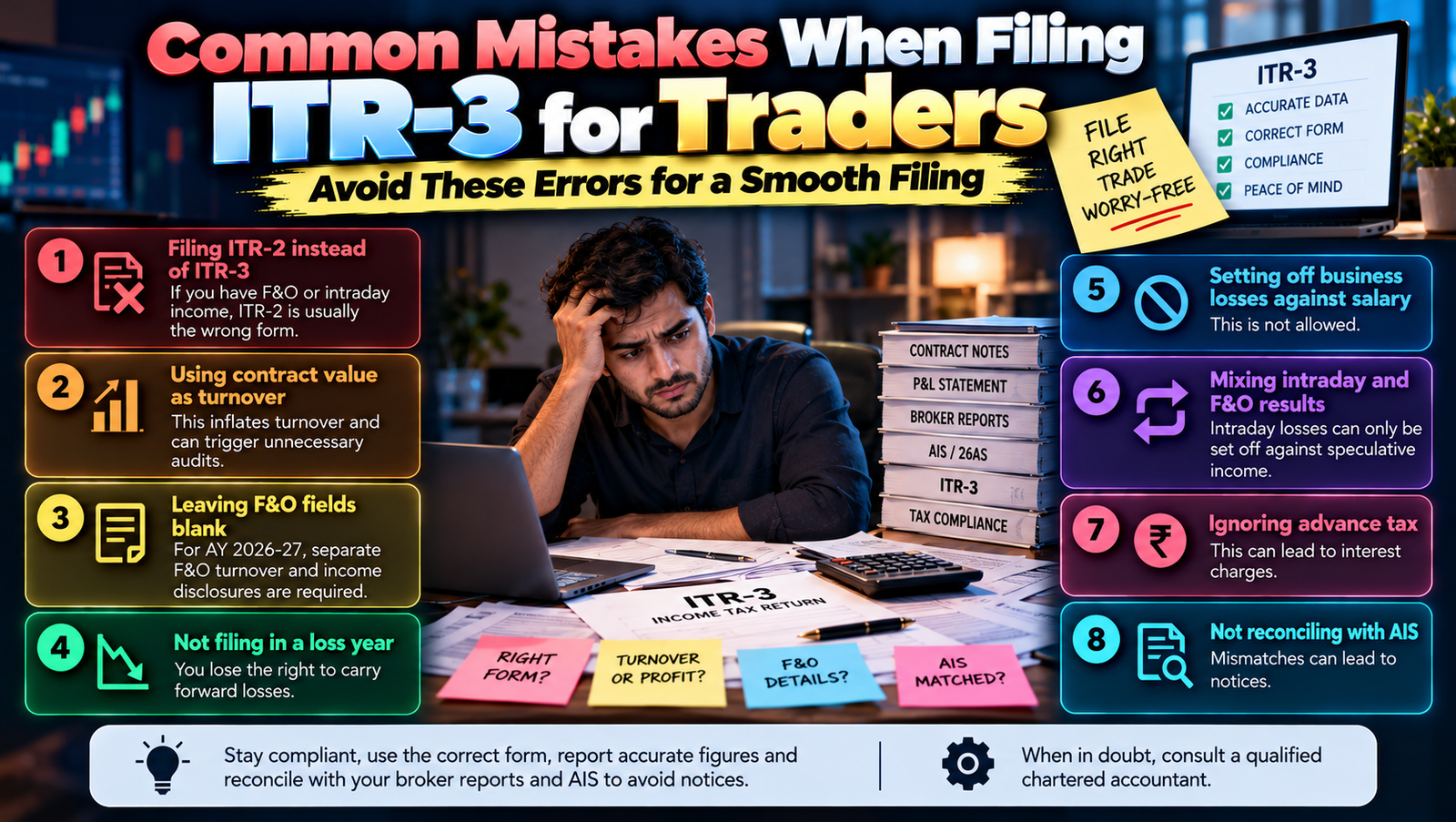
Common Mistakes When Filing ITR-3 for Traders
- Filing ITR-2 instead of ITR-3: If you have F&O or intraday income, ITR-2 is usually the wrong form.
- Using contract value as turnover: This inflates turnover and can trigger unnecessary audits.
- Leaving F&O fields blank: For AY 2026-27, separate F&O turnover and income disclosures are required.
- Not filing in a loss year: You lose the right to carry forward losses.
- Setting off business losses against salary: This is not allowed.
- Mixing intraday and F&O results: Intraday losses can only be set off against speculative income.
- Ignoring advance tax: This can lead to interest charges.
- Not reconciling with AIS: Mismatches can lead to notices.
Loss Set-Off and Carry Forward in ITR-3 for Traders
| Loss type | Set off against (same year) | Carry forward |
|---|---|---|
| F&O (non-speculative) | All heads except salary | 8 years, against business income |
| Intraday (speculative) | Speculative income only | 4 years, against speculative income |
| Short-term capital loss | Short- and long-term gains | 8 years |
| Long-term capital loss | Long-term gains only | 8 years |
Carrying forward losses requires the return to be filed by the due date. This is one of the biggest reasons to take ITR-3 for traders seriously, even in a bad year.
What Changes for ITR-3 for Traders From Next Year?
The Income-tax Act 2025 came into force on 1 April 2026, replacing the 1961 Act and introducing a single “tax year” concept. Income earned from 1 April 2026 will be reported under the new framework, and the forms and section numbers may change. Published analyses suggest the core rules for business losses and carry-forward remain largely the same, but check the new forms carefully when they are released.
FAQs
Is ITR-3 for traders the right form for F&O?
Generally yes, because F&O income is treated as non-speculative business income.
Is ITR-3 needed for intraday trading?
Yes. Intraday equity trading is speculative business income, which is reported in ITR-3.
Do I need a tax audit if I made a loss?
Not automatically. It depends on turnover, cash transactions and whether presumptive taxation rules apply. Consult a chartered accountant.
What is the due date for ITR-3 for AY 2026-27?
31 August 2026 for non-audit cases. For audit cases, the original date of 31 October 2026 was reported as extended to 21 November 2026.
Can I file ITR-3 for traders after the due date?
Yes, as a belated return by 31 December 2026, but a late fee applies and loss carry-forward is generally not allowed.
Can I claim trading expenses?
Yes, expenses directly related to trading, such as internet costs and software subscriptions, may be claimed. STT is generally not deductible.
Conclusion
Filing ITR-3 for traders becomes much easier once you break it into steps: classify your income, calculate turnover correctly, check audit requirements, choose your tax regime and complete the right schedules. Filing on time is especially important in loss years, because it protects your right to carry forward losses.
Keep good records throughout the year, reconcile your broker statements with AIS, and work with a chartered accountant if your situation is complex. A well-prepared return reduces the risk of notices and helps you make the most of every legitimate deduction and loss.