

NSE Currency Derivatives Trading Hours in IST
Introduction
Currency derivatives on the National Stock Exchange (NSE) are the main legal way for Indian residents to trade currencies. They let traders, investors and businesses take positions on pairs such as USD/INR, EUR/INR and GBP/INR through a regulated exchange, using a SEBI-registered broker.
One of the first things new traders ask is: when can I trade? NSE currency trading timings differ from equity market hours, and the rules for expiry days and holidays have their own details. Knowing them helps you plan your day, avoid surprises and trade when liquidity is best.
This guide explains:
- The regular NSE currency trading timings in IST
- Timings for INR pairs and cross-currency pairs
- Expiry-day rules and settlement
- Holidays and special sessions
- The best time of day to trade
- Recent regulatory changes that affect currency traders
What Are NSE Currency Derivatives?
NSE currency derivatives are exchange-traded futures and options contracts based on exchange rates. Instead of buying or selling foreign currency directly, you trade contracts whose value moves with the underlying exchange rate.
The main products include:
- INR pairs: USD/INR, EUR/INR, GBP/INR and JPY/INR
- Cross-currency pairs: EUR/USD, GBP/USD and USD/JPY
- Instruments: Futures and options on these pairs
These contracts are cash-settled in Indian rupees, so no physical delivery of foreign currency takes place. Because they trade on a recognised exchange, they are regulated and settled through a clearing corporation, which removes counterparty risk.

Regular NSE Currency Trading Timings in IST
The standard NSE currency trading timings for INR pairs are:
| Segment | Trading days | Trading hours (IST) |
|---|---|---|
| INR pairs (USD/INR, EUR/INR, GBP/INR, JPY/INR), futures and options | Monday to Friday | 9:00 am – 5:00 pm |
| Cross-currency pairs (EUR/USD, GBP/USD, USD/JPY) | Monday to Friday | See note below |
The 9:00 am start means currency trading opens 15 minutes before the equity market’s normal session, and the 5:00 pm close is 90 minutes after equities close at 3:30 pm. That extra time in the afternoon is useful, because it overlaps with the start of the European trading day.
A note on cross-currency hours
For cross-currency pairs, NSE’s contract specification page lists trading hours of 9:00 am to 7:30 pm IST, which would cover part of the London session. However, the same page also refers to a 2020 circular that revised cross-currency hours to 5:00 pm. Because of this, check the current NSE currency trading timings for cross-currency pairs with your broker or on NSE’s latest circulars before planning evening trades.
Why the NSE Currency Trading Timings Matter
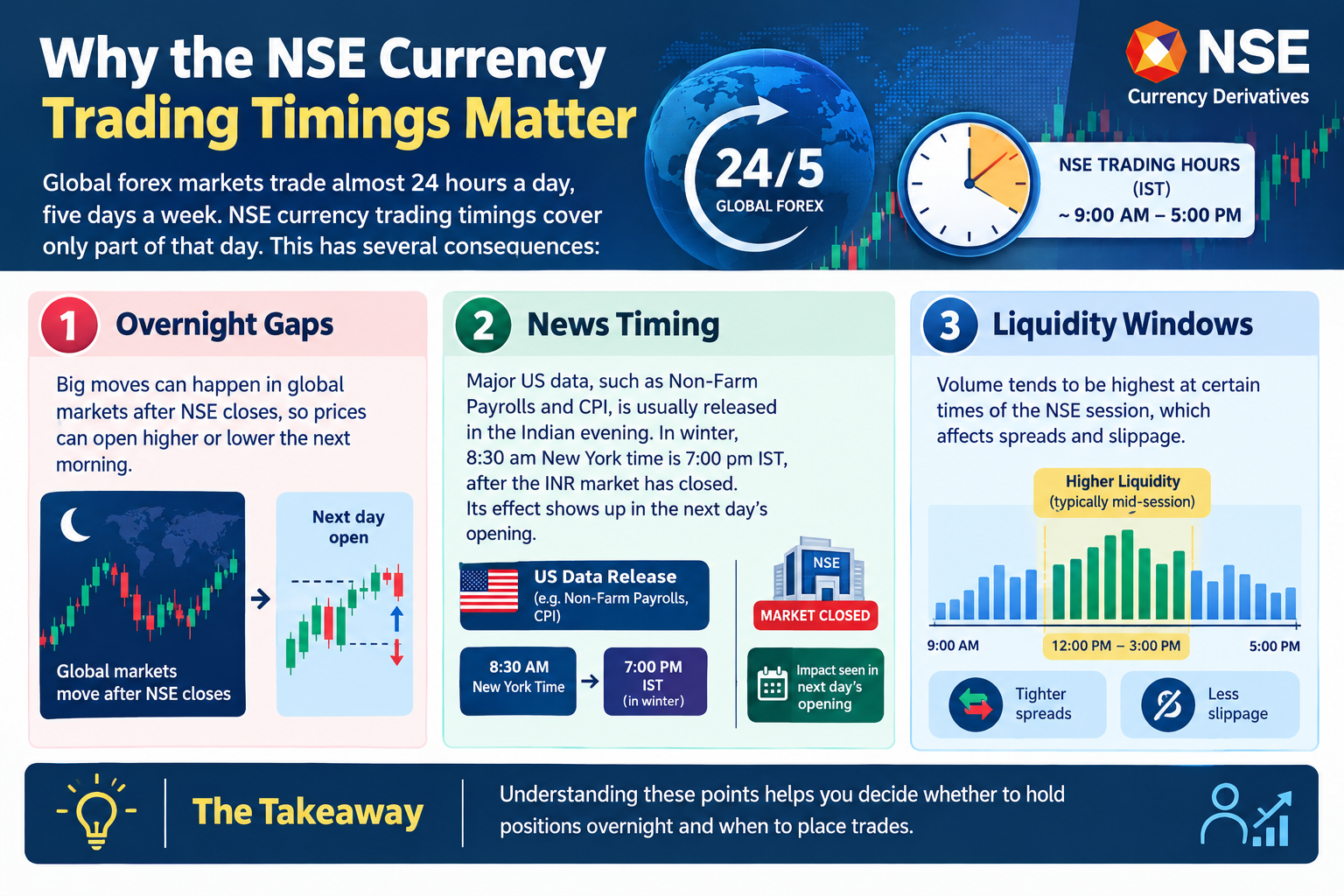
Global forex markets trade almost 24 hours a day, five days a week. NSE currency trading timings cover only part of that day. This has several consequences:
- Overnight gaps: Big moves can happen in global markets after NSE closes, so prices can open higher or lower the next morning.
- News timing: Major US data, such as Non-Farm Payrolls and CPI, is usually released in the Indian evening. In winter, 8:30 am New York time is 7:00 pm IST, after the INR market has closed. Its effect shows up in the next day’s opening.
- Liquidity windows: Volume tends to be highest at certain times of the NSE session, which affects spreads and slippage.
Understanding these points helps you decide whether to hold positions overnight and when to place trades.
NSE Currency Trading Timings on Expiry Day
Expiry days have special NSE currency trading timings that every trader should know.
Monthly INR contracts
- Last trading day: Two working days before the last business day of the expiry month.
- Expiry-day close: Trading in the expiring INR contract ends at 12:30 pm IST, earlier than the normal 5:00 pm close.
- Final settlement: Expiring USD/INR contracts are cash-settled at the RBI reference rate on the last trading day. Other INR pairs are settled at the relevant reference rates.
Other contract months continue trading until the normal close. If you hold an expiring position, remember the earlier cut-off so you are not caught out.
Weekly contracts
NSE also offers weekly contracts on some currency pairs. These have their own expiry days and cut-off times. Always check the contract details in your trading platform before trading weekly products.
USD/INR Futures: Key Contract Facts
USD/INR is by far the most traded NSE currency contract. Key details include:
| Feature | Detail |
|---|---|
| Lot size | USD 1,000 |
| Tick size | ₹0.0025 |
| Value of 1 paise move | ₹10 per lot |
| Trading hours | 9:00 am – 5:00 pm IST |
| Expiry-day cut-off | 12:30 pm IST |
| Settlement | Cash-settled in rupees at the RBI reference rate |
For example, if you buy one USD/INR futures lot at ₹88.00 and sell at ₹88.20, the 20-paise move earns ₹200 before costs.
Prices in this example are illustrative.
Cross-Currency Pairs at a Glance
For cross-currency pairs, NSE’s specifications for GBP/USD futures show a lot size of 1,000 pounds, a tick size of 0.0001, prices quoted in US dollars and cash settlement in rupees. EUR/USD and USD/JPY follow a similar structure, with their own lot sizes and tick sizes.
Cross-currency pairs let Indian traders take a view on global currencies through a legal, exchange-traded route. Liquidity is typically lower than in USD/INR, so spreads can be wider, especially outside the busiest hours.
Holidays and Special Sessions: NSE Currency Trading Timings
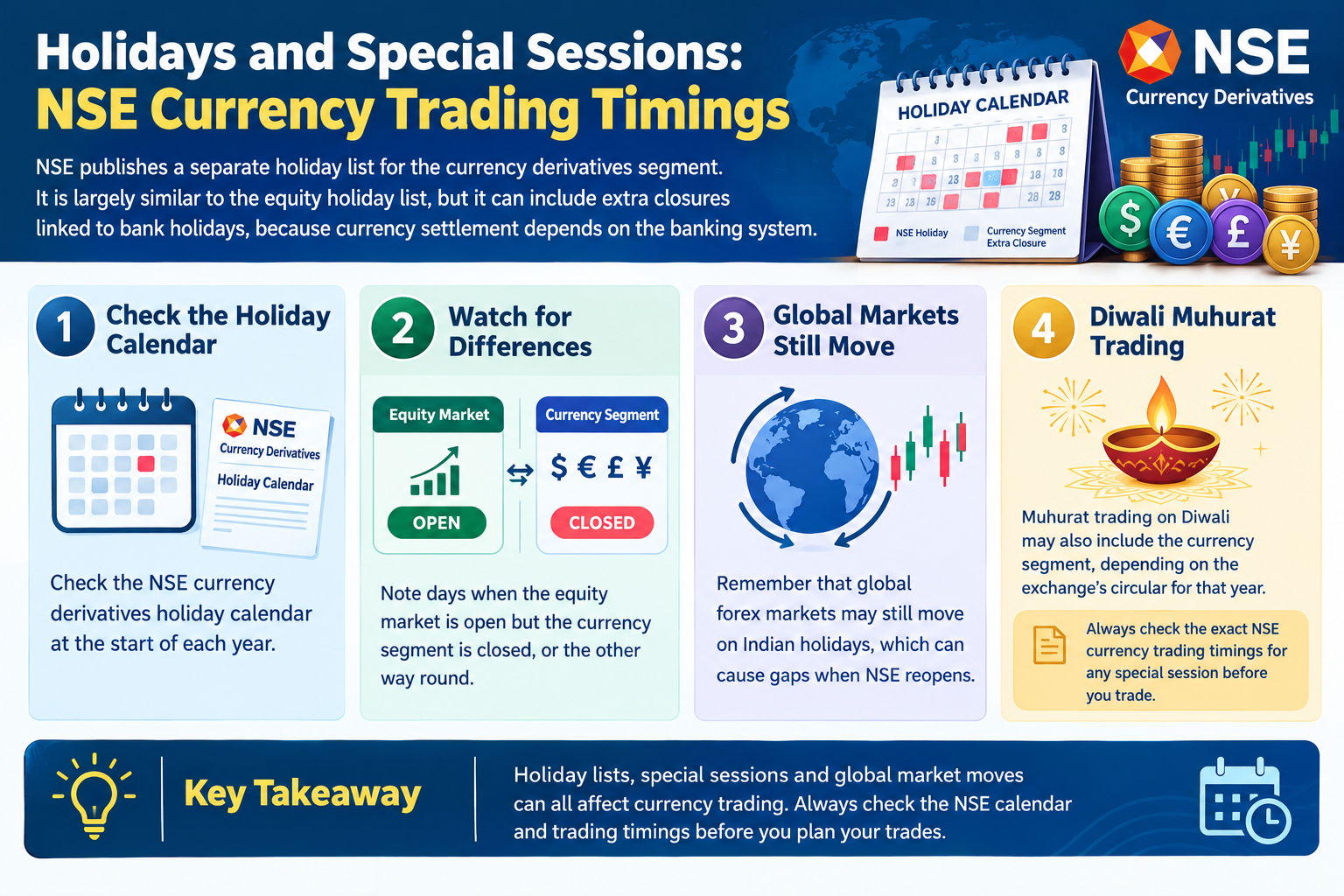
NSE publishes a separate holiday list for the currency derivatives segment. It is largely similar to the equity holiday list, but it can include extra closures linked to bank holidays, because currency settlement depends on the banking system.
- Check the NSE currency derivatives holiday calendar at the start of each year.
- Note days when the equity market is open but the currency segment is closed, or the other way round.
- Remember that global forex markets may still move on Indian holidays, which can cause gaps when NSE reopens.
Muhurat trading on Diwali may also include the currency segment, depending on the exchange’s circular for that year. Check the exact NSE currency trading timings for any special session before you trade.
Best Time to Trade Within NSE Currency Trading Timings
Not every hour of the session is equally active. Many traders find these windows useful:
| Time (IST) | What usually happens |
|---|---|
| 9:00 am – 10:30 am | Opening activity, reaction to overnight global moves and early order flow |
| 10:30 am – 1:00 pm | Often quieter, with range-bound trading |
| 1:30 pm – 5:00 pm | Activity can pick up as the European session opens (around 1:30 pm IST in winter, 12:30 pm in summer) |
The opening hour can be volatile as the market absorbs overnight news. The afternoon brings European participation, which can lead to fresh moves. Many traders build their routine around these two windows within the NSE currency trading timings.
Watch for RBI activity
The Reserve Bank of India sometimes intervenes in the currency market to smooth sharp moves in the rupee. Intervention can happen at any time during the session, and it can cause sudden reversals. Watch for unusual price behaviour near key levels.
NSE Currency Trading Timings vs Equity and Commodity Hours
| Market | Normal trading hours (IST) |
|---|---|
| NSE equity (cash and F&O) | 9:15 am – 3:30 pm |
| NSE currency derivatives (INR pairs) | 9:00 am – 5:00 pm |
| MCX commodities | From 9:00 am into the late evening (closing time varies by commodity and season) |
This comparison shows why NSE currency trading timings suit people who want a session that runs a little longer than equities, but without trading late into the night.
Recent Regulatory Changes to Know
Trading hours are only part of the picture. Rules on who can trade, and how much, matter too.
According to reports on RBI circulars issued in October 2026, the limit for taking positions in exchange-traded INR currency derivatives without proving an underlying exposure was cut from USD 100 million to USD 5 million, across all exchanges combined. The change was reported as effective from 10 October 2026. Positions above that level now need a demonstrated underlying exposure.
For most small retail traders, the USD 5 million limit may still be well above their position size, but it is important to understand the rule and check with your broker how it is being applied. Read the official RBI circulars or speak to your broker for the latest details.
If you trade through more than one broker or exchange, remember that the limit applies to your combined position across all recognised exchanges, not to each account separately. Keep a simple record of your open positions in each account so you can see your total exposure at a glance, and ask your broker whether it has set any internal limits of its own.
Fitting NSE Currency Trading Timings Around a Day Job
Many Indian traders have full-time jobs, which makes a 9:00 am to 5:00 pm session harder to follow. There are still practical ways to take part:
- Trade the open: Place trades between 9:00 am and 9:30 am, before the working day gets busy, using pre-set stop-loss and target orders.
- Use the lunch hour: A quick check around midday lets you manage open positions.
- Trade the afternoon: If your schedule allows, the 3:30 pm to 5:00 pm window, after equities close, often coincides with European activity.
- Choose longer timeframes: Swing trading on daily charts needs fewer decisions during market hours.
Whatever you choose, build your routine around the NSE currency trading timings rather than trying to watch the screen all day. A plan that fits your life is easier to follow consistently.
Tips for Planning Your Trading Day
- Know the cut-offs: Note the 5:00 pm normal close and the 12:30 pm expiry-day close for INR contracts.
- Check the economic calendar: Know when major Indian, US and European data is due.
- Plan for overnight risk: Decide in advance whether to hold positions after the close.
- Use limit orders: In quieter periods, limit orders help avoid poor fills.
- Keep your broker app updated: Brokers often send alerts about changes to NSE currency trading timings.
- Track holidays: Mark currency segment holidays in your calendar.
Common Mistakes Traders Make
- Assuming currency hours are the same as equity hours
- Forgetting the early close on expiry day
- Holding large positions overnight without considering global news
- Trading illiquid cross-currency contracts at quiet times
- Ignoring separate currency segment holidays
- Trading leveraged forex through offshore platforms instead of using NSE or BSE, which can breach FEMA rules
FAQs
What are the NSE currency trading timings?
For INR pairs such as USD/INR, EUR/INR, GBP/INR and JPY/INR, trading runs from 9:00 am to 5:00 pm IST, Monday to Friday.
Are cross-currency pairs traded until 7:30 pm?
NSE’s specification page lists 9:00 am to 7:30 pm for cross-currency pairs, but also cites a 2020 circular that set 5:00 pm. Confirm the current hours with your broker.
What time does trading stop on expiry day?
For expiring monthly INR contracts, trading stops at 12:30 pm IST on the last trading day.
Is currency trading open on Saturdays?
No. NSE currency derivatives trade Monday to Friday only, apart from any special sessions announced by the exchange.
Do NSE and BSE have the same currency trading hours?
The regular hours for INR pairs are generally aligned across exchanges, but always check each exchange’s current circulars.
Can Indian residents trade forex legally?
Yes, through exchange-traded currency derivatives on NSE and BSE via SEBI-registered brokers. Leveraged forex trading through offshore platforms is not permitted under FEMA.
Conclusion
NSE currency trading timings give Indian traders a regulated window to trade currencies from 9:00 am to 5:00 pm IST, with an early 12:30 pm close for expiring INR contracts. Cross-currency pairs may have different hours, so check the latest circulars.
Plan your day around the most active windows, watch the economic calendar and holiday list, and keep up with regulatory changes such as the revised RBI position limits. With a clear routine and an understanding of the timings, you can trade currencies legally and with more confidence.