Introduction
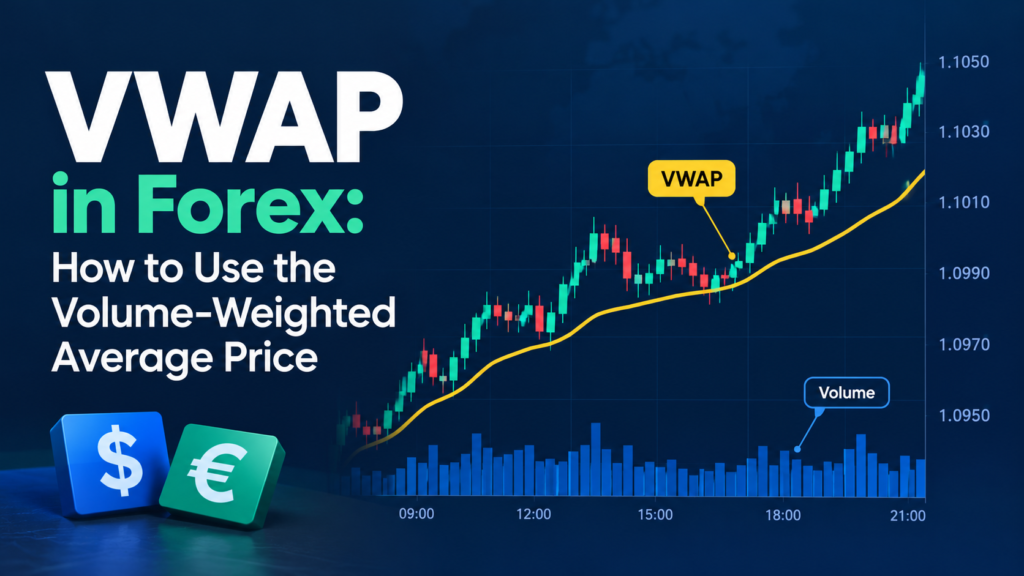
The volume-weighted average price, or VWAP, is one of the most widely used tools among professional traders. Banks, funds and algorithmic desks use it to judge whether they are buying or selling at a good price. Day traders use it as a fair-value line and a guide to intraday trend.
VWAP started in stock markets, where exchanges report every trade and its volume. Using it in currencies, an approach often called VWAP forex trading, is a little different, because spot forex has no single central exchange. That does not make VWAP forex trading useless, but it does mean you need to understand its limits.
This guide covers:
- What VWAP is and how it is calculated
- How VWAP forex calculations work, including the tick volume issue
- Session resets, anchored VWAP and VWAP bands
- Four practical strategies, a worked example and common mistakes
What Is VWAP?
VWAP is the average price of an asset over a period, weighted by how much was traded at each price. Prices where a lot of volume traded have more influence on the average than prices where little traded.
Unlike a simple moving average, which treats every candle equally, VWAP reflects where the bulk of trading actually happened. That is why many traders see it as the “true” average price of the session.
The VWAP formula
VWAP = Σ (typical price × volume) ÷ Σ volume
The typical price for each candle is usually (high + low + close) ÷ 3. The calculation starts at the beginning of a session and adds each new candle cumulatively until the session ends, then resets.
Simple example
| Candle | Typical price | Volume | Price × volume |
|---|---|---|---|
| 1 | 1.1200 | 100 | 112.00 |
| 2 | 1.1210 | 300 | 336.30 |
| 3 | 1.1220 | 100 | 112.20 |
| Total | 500 | 560.50 |
VWAP = 560.50 ÷ 500 = 1.1210. A simple average of the three prices would also be 1.1210 here, but if the heavy volume had traded at 1.1220 instead, VWAP would have moved closer to 1.1220. That is the key difference: VWAP leans toward the prices where most trading happened.
How VWAP Forex Calculations Work
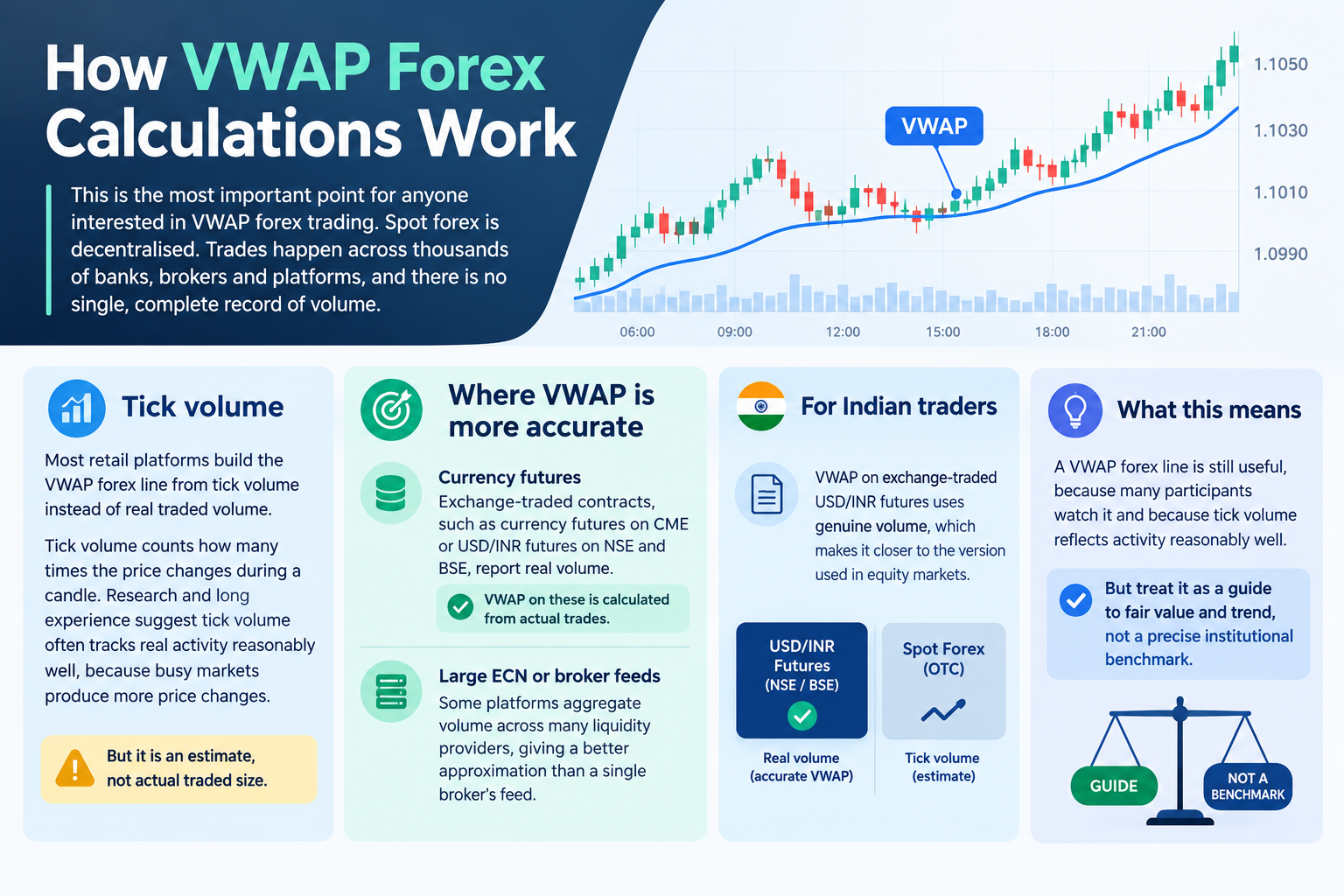
This is the most important point for anyone interested in VWAP forex trading. Spot forex is decentralised. Trades happen across thousands of banks, brokers and platforms, and there is no single, complete record of volume.
Tick volume
Most retail platforms build the VWAP forex line from tick volume instead of real traded volume. Tick volume counts how many times the price changes during a candle. Research and long experience suggest tick volume often tracks real activity reasonably well, because busy markets produce more price changes. But it is an estimate, not actual traded size.
Where VWAP is more accurate
- Currency futures: Exchange-traded contracts, such as currency futures on CME or USD/INR futures on NSE and BSE, report real volume. VWAP on these is calculated from actual trades.
- Large ECN or broker feeds: Some platforms aggregate volume across many liquidity providers, giving a better approximation than a single broker’s feed.
For Indian traders, this is a useful point: VWAP on exchange-traded USD/INR futures uses genuine volume, which makes it closer to the version used in equity markets.
What this means
A VWAP forex line is still useful, because many participants watch it and because tick volume reflects activity reasonably well. But treat it as a guide to fair value and trend, not a precise institutional benchmark.
Session Resets: When Does VWAP Start?
Standard VWAP resets at the start of each session. In stocks, that is the market open. Forex trades almost 24 hours a day, so the reset time depends on your platform.
| Reset point | Typical use |
|---|---|
| Platform midnight (server time) | Default on many charting platforms |
| 5:00 pm New York (forex daily close) | Matches the standard forex trading day |
| Midnight New York | Popular with ICT-style traders |
| Exchange open (for futures) | For USD/INR futures, the 9:00 am IST open |
The reset time changes where the VWAP forex line sits, so be consistent. If you compare levels with other traders or use VWAP forex signals from analysts, check which reset they use.

VWAP Bands and Anchored VWAP
VWAP bands
Many platforms let you add standard deviation bands around the VWAP forex line, similar to Bollinger Bands. Common settings are 1, 2 and 3 standard deviations.
- Price near VWAP: Trading close to fair value.
- Price at the first band: A normal extension of the move.
- Price at the second or third band: Stretched and potentially due for a pullback toward VWAP.
Anchored VWAP
Anchored VWAP lets you start the calculation from any point you choose, rather than the session open. Traders often anchor it to:
- A major swing high or low
- The start of a new trend
- A big news event, such as a central bank decision
- The weekly or monthly open
Anchored VWAP shows the average price paid by everyone who traded since that event. If price is above it, those buyers are, on average, in profit. If price falls below it, they are in loss, which can trigger selling. This makes anchored VWAP forex levels useful for swing traders as well as day traders.
How to Read VWAP Forex Charts
- Price above VWAP: Buyers are in control for the session. Many traders favour long trades.
- Price below VWAP: Sellers are in control. Many traders favour short trades.
- Price crossing VWAP: Control may be shifting. Watch for confirmation.
- VWAP slope: A rising VWAP signals an uptrend; a flat VWAP signals a range.
The simplest way to use VWAP forex analysis is as a filter: only look for buys above VWAP and sells below it.
Four VWAP Forex Strategies
1. VWAP pullback (trend continuation)
- Confirm the trend: price has stayed above a rising VWAP for most of the session.
- Wait for price to pull back to VWAP.
- Look for a bullish rejection candle or a small double bottom at VWAP.
- Enter long, with a stop just below VWAP or the pullback low.
- Target the session high or the first upper band.
This is the most popular VWAP forex strategy, because it trades with the trend and offers a clear, logical stop.
2. VWAP reversion
- Wait for price to stretch to the second or third standard deviation band.
- Look for signs of exhaustion, such as long wicks or divergence on the RSI.
- Enter a trade back toward VWAP.
- Place a stop beyond the extreme of the move.
- Target VWAP itself.
This works best in ranging markets. In strong trends, price can stay stretched for a long time, so be careful.
3. VWAP breakout and retest
- Price trades below VWAP for a period, then breaks above it with a strong candle.
- Wait for price to retest VWAP from above.
- Enter long if VWAP holds as support.
- Place a stop below the retest low.
The retest helps filter out false breaks, which are common around VWAP.
4. Anchored VWAP from a news event
- Anchor VWAP to the candle of a major announcement, such as a Fed or RBI decision.
- Watch how price behaves around the anchored line over the following hours or days.
- Buy pullbacks to the anchored VWAP if price holds above it, or sell rallies if price stays below it.
This helps you see whether the market has accepted or rejected the news.
VWAP Forex Worked Example on EUR/USD
Imagine VWAP is reset at the start of the trading day. During the London session, EUR/USD trades steadily above a rising VWAP. By mid-morning, VWAP sits at 1.1215, and price has reached 1.1240.
Price then pulls back and touches 1.1216, just above VWAP, before forming a bullish engulfing candle. A trader buys at 1.1220 with a stop at 1.1208, below VWAP. The target is the session high at 1.1244, a 24-pip gain against a 12-pip risk, giving a 1:2 risk-reward ratio.
This example is illustrative and uses hypothetical prices.
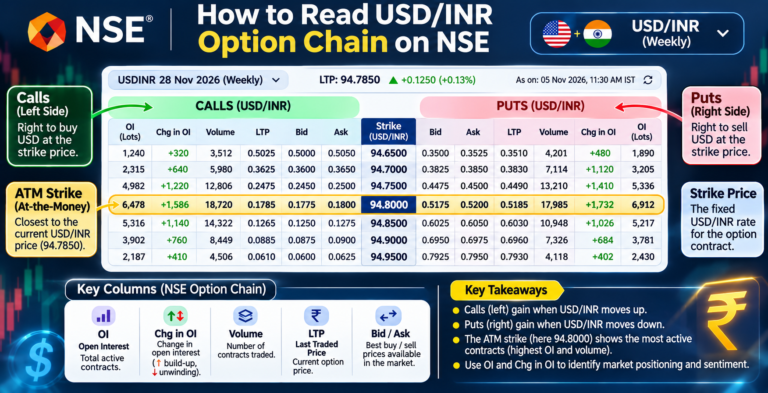
Using VWAP on USD/INR Futures
For traders in India, VWAP is especially useful on exchange-traded USD/INR futures, because the volume is real. A few tips:
- Use the 9:00 am IST exchange open as the reset point.
- Combine VWAP with the opening range from the first 15 to 30 minutes.
- Watch how price behaves around VWAP near levels where the RBI has intervened in the past.
- Remember that each 1-paise move is worth ₹10 per lot, so size positions carefully.
Indian residents should trade currencies only through recognised exchanges such as NSE and BSE, via SEBI-registered brokers, rather than offshore CFD platforms.
Combining VWAP Forex Signals With Other Tools
- Support and resistance: VWAP signals near key levels are stronger.
- Moving averages: A higher-timeframe moving average helps confirm the overall trend.
- RSI: Useful for spotting exhaustion at VWAP bands.
- Market sessions: VWAP is most meaningful during active sessions, such as London and New York.
- Economic calendar: Major news can push price far from VWAP very quickly.
Building a Simple VWAP Forex Trading Plan
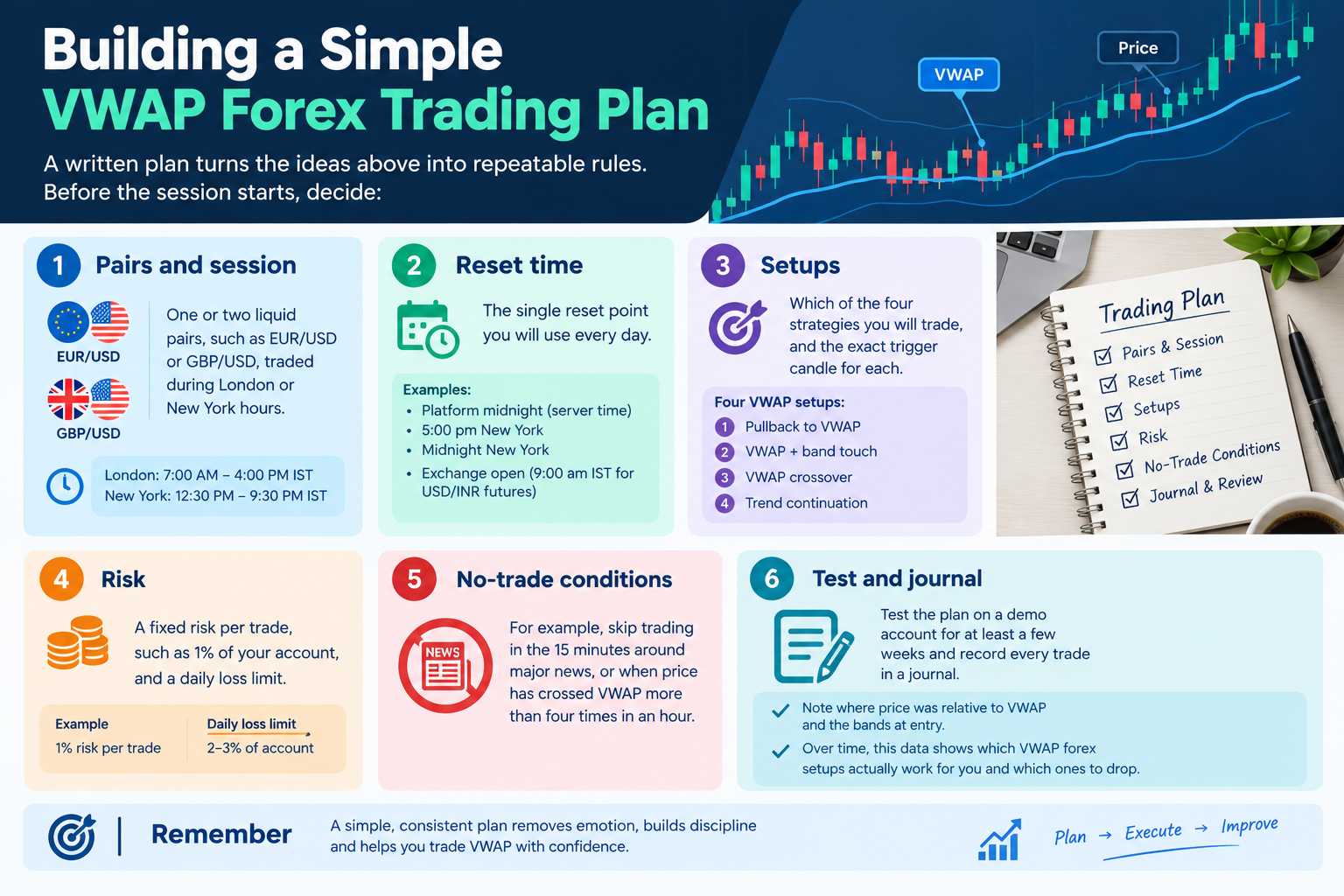
A written plan turns the ideas above into repeatable rules. Before the session starts, decide:
- Pairs and session: One or two liquid pairs, such as EUR/USD or GBP/USD, traded during London or New York hours.
- Reset time: The single reset point you will use every day.
- Setups: Which of the four strategies you will trade, and the exact trigger candle for each.
- Risk: A fixed risk per trade, such as 1% of your account, and a daily loss limit.
- No-trade conditions: For example, skip trading in the 15 minutes around major news, or when price has crossed VWAP more than four times in an hour.
Test the plan on a demo account for at least a few weeks and record every trade in a journal. Note where price was relative to VWAP and the bands at entry. Over time, this data shows which VWAP forex setups actually work for you and which ones to drop.
Common VWAP Forex Mistakes
- Treating tick volume as real volume: Spot forex VWAP is an approximation.
- Using inconsistent reset times: Different resets give different VWAP levels.
- Fading strong trends: Reversion trades against a strong trend can be costly.
- Trading every VWAP touch: In choppy markets, price may cross VWAP many times with no follow-through.
- Ignoring the session: Late in a session, VWAP moves very little and becomes less responsive.
- Using it alone: VWAP works best as part of a complete trading plan.
Pros and Cons of VWAP in Forex
Pros
- Shows a volume-weighted fair-value price
- Gives a clear intraday trend filter
- Offers logical entries and stops for pullback trades
- Anchored VWAP adds flexibility for swing trading
Cons
- Spot forex volume is incomplete
- Reset times vary between platforms
- Less useful in very quiet or very choppy markets
- Becomes slow-moving late in the session
FAQs
Does VWAP work in forex?
Yes, as a guide to fair value and intraday trend. Because spot forex uses tick volume rather than real volume, it is an approximation. VWAP on currency futures uses real exchange volume.
What is the best timeframe for VWAP forex trading?
Intraday charts such as 5-minute, 15-minute and 1-hour. For longer-term analysis, use anchored VWAP from a weekly open or major event.
What is the difference between VWAP and a moving average?
A moving average treats each candle equally. VWAP weights prices by volume, so it leans toward the prices where most trading happened.
What is anchored VWAP?
A version of VWAP that starts from a point you choose, such as a swing low or a news event, instead of the session open.
Can I use VWAP for USD/INR?
Yes. USD/INR futures on Indian exchanges report real volume, which makes VWAP more reliable than on spot forex charts.
Conclusion
VWAP is a simple but powerful tool that shows where the bulk of trading has taken place. In forex, it comes with a caveat: spot markets rely on tick volume, so the line is an estimate. Even so, many traders use VWAP forex analysis as a fair-value guide, a trend filter and a framework for pullback and reversion trades.
Choose a consistent reset time, use VWAP bands and anchored VWAP to add context, and combine the indicator with key levels and sound risk management. Practise on a demo account, review your results, and VWAP can become a valuable part of your intraday toolkit.