

Introduction
Social media is full of ads promising easy profits from trading EUR/USD, gold and other global markets with high leverage. Many of these ads come from offshore brokers offering forex CFDs. At the same time, Indian exchanges such as NSE and BSE offer regulated currency futures and options.
For Indian traders, the currency futures vs forex CFD question is not just about features or costs. It is also about legality. One route is regulated by SEBI and the RBI. The other can expose Indian residents to serious legal and financial risk.
This guide explains the key differences, covering:
- What currency futures and forex CFDs are
- Which one is legal for Indian residents
- Contract specs, leverage, costs and trading hours
- Taxes, risks and how to choose
What Are Currency Futures?
A currency future is a standardised contract to buy or sell a currency pair at a fixed price on a future date. In India, currency futures trade on recognised stock exchanges such as NSE and BSE and are regulated by SEBI and the RBI.
The most popular contract is USD/INR, but exchanges also offer other INR pairs, such as EUR/INR, GBP/INR and JPY/INR, along with a few cross-currency pairs, such as EUR/USD, GBP/USD and USD/JPY.
Key features of Indian currency futures:
- Exchange-traded: Trades happen on a regulated exchange with a central clearing house, which reduces counterparty risk.
- Standardised: Fixed lot sizes, expiry dates and tick sizes.
- Cash-settled in rupees: No actual foreign currency changes hands. Profits and losses are settled in INR.
- Transparent pricing: Prices are visible to all participants on the exchange order book.
What Are Forex CFDs?
To understand the currency futures vs forex CFD choice, you also need to know how CFDs work. A CFD, or contract for difference, is an agreement with a broker to exchange the difference in an asset’s price between when you open and close a trade. Forex CFDs let you speculate on currency pairs like EUR/USD or GBP/JPY, as well as gold (XAU/USD), indices and commodities, without owning the underlying asset.
Key features of forex CFDs:
- Over-the-counter (OTC): You trade directly with the broker, not on an exchange.
- Very high leverage: Offshore brokers often offer leverage of 1:100, 1:500 or more.
- Flexible sizes: Positions can be as small as micro lots.
- 24/5 trading: Markets are open around the clock on weekdays.
- Broker-set pricing: The broker quotes the price and may act as the counterparty to your trade.
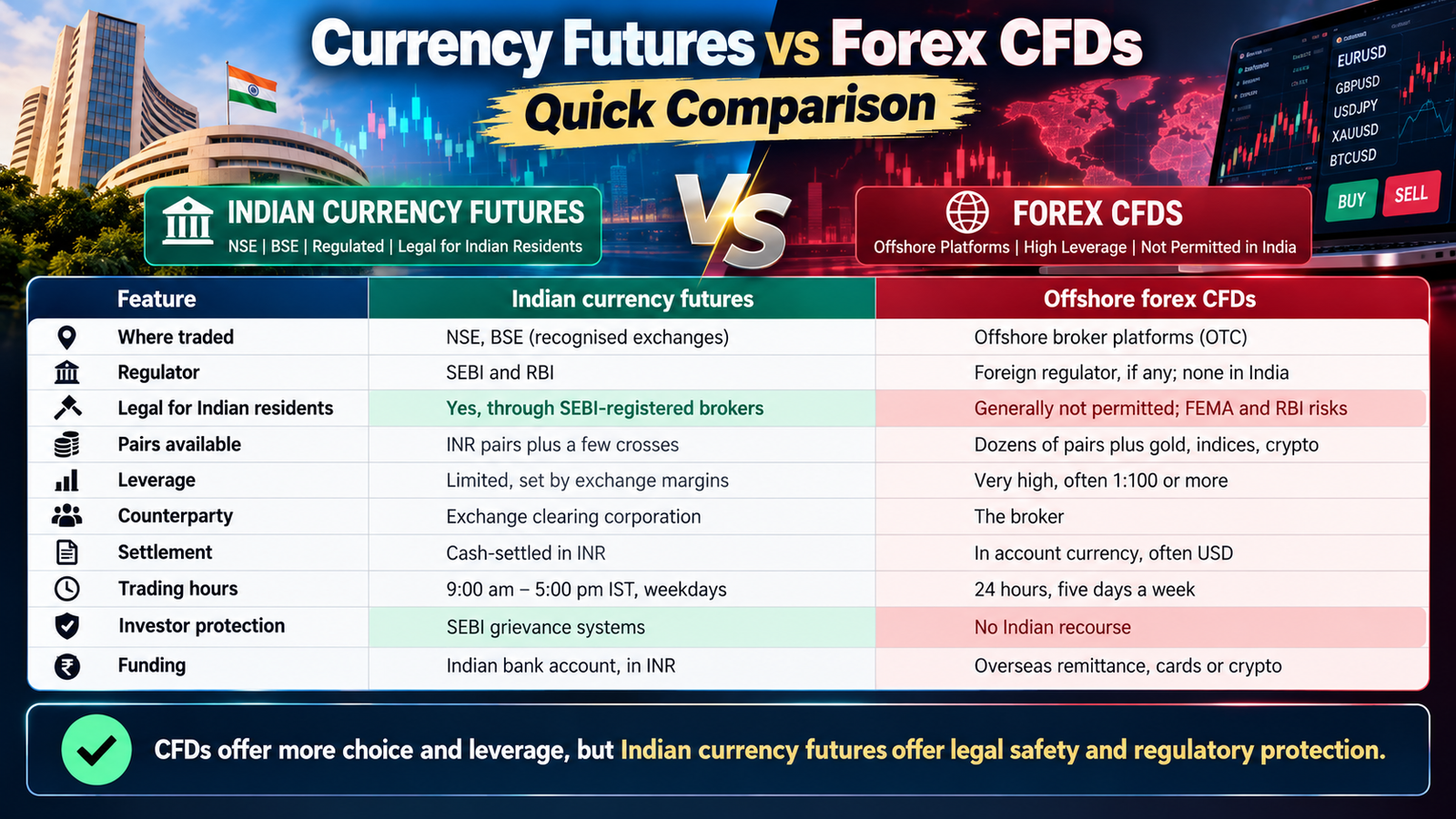
Currency Futures vs Forex CFDs: Quick Comparison
| Feature | Indian currency futures | Offshore forex CFDs |
|---|---|---|
| Where traded | NSE, BSE (recognised exchanges) | Offshore broker platforms (OTC) |
| Regulator | SEBI and RBI | Foreign regulator, if any; none in India |
| Legal for Indian residents | Yes, through SEBI-registered brokers | Generally not permitted; FEMA and RBI risks |
| Pairs available | INR pairs plus a few crosses | Dozens of pairs plus gold, indices, crypto |
| Leverage | Limited, set by exchange margins | Very high, often 1:100 or more |
| Counterparty | Exchange clearing corporation | The broker |
| Settlement | Cash-settled in INR | In account currency, often USD |
| Trading hours | 9:00 am – 5:00 pm IST, weekdays | 24 hours, five days a week |
| Investor protection | SEBI grievance systems | No Indian recourse |
| Funding | Indian bank account, in INR | Overseas remittance, cards or crypto |
The table makes the core of the currency futures vs forex CFD debate clear: CFDs offer more choice and leverage, but Indian currency futures offer legal safety and regulatory protection.
Currency Futures vs Forex CFDs: Is CFD Trading Legal in India?
This is the most important part of any currency futures vs forex comparison for Indian residents.
What the rules say
- FEMA: Foreign exchange in India is governed by the Foreign Exchange Management Act. Resident Indians can trade currency derivatives only on recognised Indian exchanges, through authorised intermediaries.
- LRS restrictions: The Liberalised Remittance Scheme, which allows Indians to send money abroad, does not permit remittances for margin or leveraged forex trading. Sending money to an offshore CFD broker for this purpose can breach FEMA, and penalties can be up to three times the amount involved.
- RBI Alert List: The RBI maintains an Alert List of unauthorised forex trading platforms and websites. As of its November 2025 update, it named 95 entities. The RBI has repeatedly warned residents not to trade through them.
What this means
For Indian residents, trading forex CFDs through overseas platforms is not a legally safe option. The risk falls on the trader, not the broker. Funds sent abroad may also be hard to recover if a platform freezes withdrawals, and there is no Indian regulator to complain to.
A broker not appearing on the RBI Alert List does not mean it is authorised. The list is not exhaustive.
Currency Futures vs Forex: Indian Contract Specifications
Here are the standard specifications for USD/INR futures on NSE:
| Feature | Detail |
|---|---|
| Underlying | USD/INR exchange rate |
| Lot size | $1,000 per contract |
| Quotation | Rupees per US dollar |
| Tick size | ₹0.0025 (0.25 paise) |
| Trading hours | 9:00 am – 5:00 pm IST, Monday to Friday |
| Contract cycle | Monthly contracts up to 12 months |
| Last trading day | Two working days before the last business day of the expiry month, at 12:30 pm |
| Final settlement price | RBI reference rate |
| Settlement | Cash-settled in INR |
With USD/INR near 95, one lot represents about ₹95,000 of exposure. Each 1-paise move (₹0.01) changes the value of one lot by ₹10. The exchange sets the margin you must deposit, which is a small fraction of the contract value.
Recent rule change
On 10 October 2026, the RBI cut the limit for currency derivative positions taken without proving an underlying exposure from $100 million to $5 million, combined across exchanges and INR pairs. With one lot at $1,000, that is about 5,000 lots, so most retail traders are unlikely to be affected. Still, check your broker’s latest guidance.
Leverage: The Biggest Difference
Leverage is where the currency futures vs forex CFD contrast is sharpest.
Offshore CFD brokers often advertise leverage of 1:500 or more. That means a ₹10,000 deposit can control ₹50 lakh of currency. A move of just 0.2% against you could wipe out your entire deposit.
Indian currency futures use exchange-set margins, which provide much lower effective leverage. That can feel restrictive, but it also limits how quickly losses can grow.
Example
| Scenario | Capital | Leverage | Position size | Loss from a 1% adverse move |
|---|---|---|---|---|
| Forex CFD (offshore) | ₹50,000 | 1:500 | ₹2.5 crore | ₹2.5 lakh (account wiped out) |
| Forex CFD (offshore) | ₹50,000 | 1:50 | ₹25 lakh | ₹25,000 (half the account) |
| USD/INR futures (5 lots) | ₹50,000 | Exchange margin | About ₹4.75 lakh | About ₹4,750 |
Figures are illustrative. Actual margins vary and are set by the exchange and broker.
High leverage is a key reason why many CFD traders lose money quickly. In the currency futures vs forex choice, lower leverage is often an advantage, not a drawback.

Currency Futures vs Forex CFDs: Costs and Pricing
Currency futures
- Brokerage, which is often low or flat-fee at discount brokers
- Exchange transaction charges, GST, SEBI fees and stamp duty
- Bid-ask spreads on the exchange, usually tight for USD/INR near-month contracts
Forex CFDs
- Spreads set by the broker, which can widen during news
- Commissions on some account types
- Overnight swap or rollover charges for holding positions
- Deposit and withdrawal fees, plus currency conversion costs
On costs, the currency futures vs forex CFD picture is mixed, but transparency favours futures. CFD pricing is set by the broker, so it can be less transparent. Exchange-traded futures show prices from a central order book.
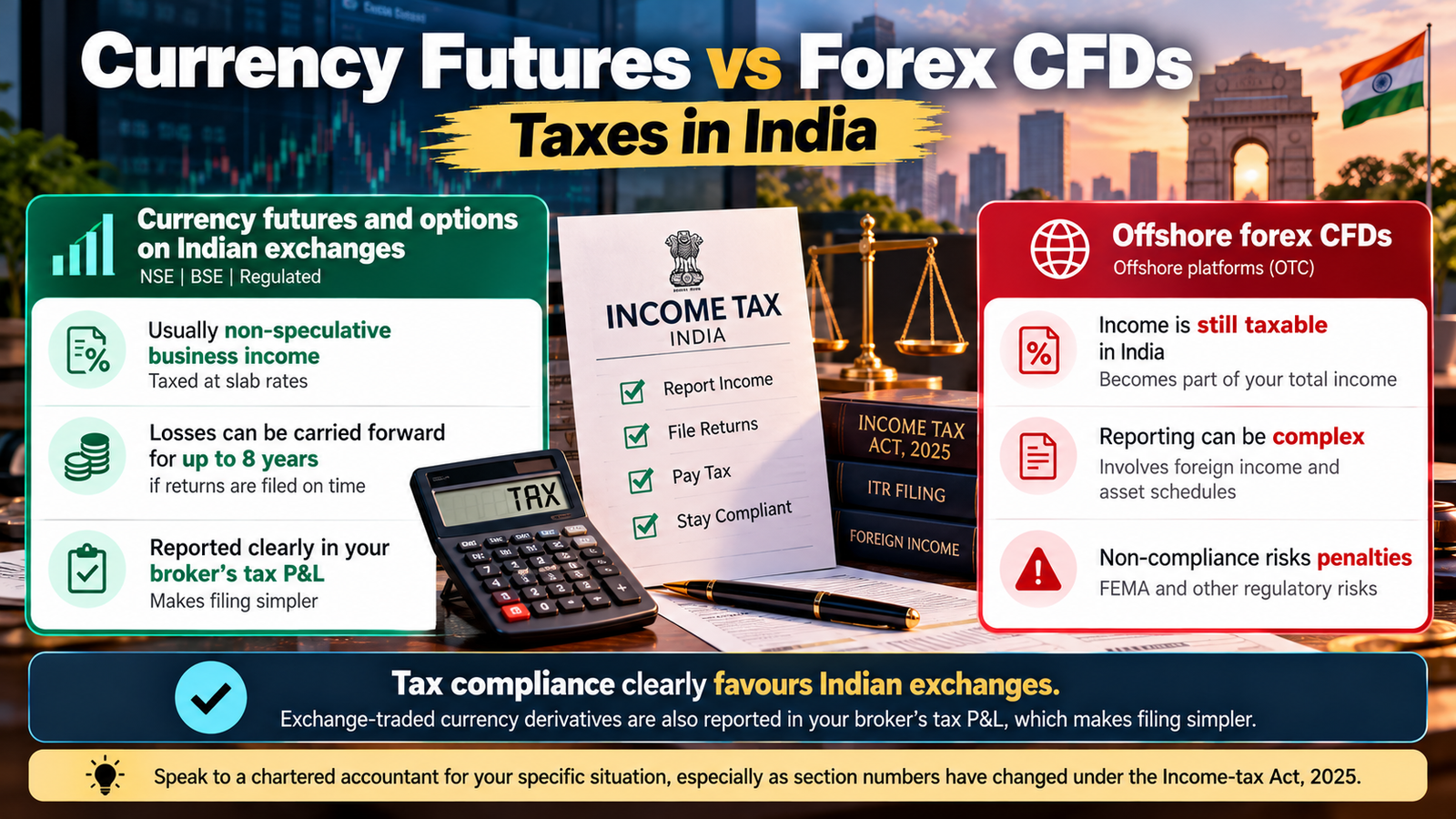
Currency Futures vs Forex CFDs: Taxes in India
| Instrument | Typical tax treatment |
|---|---|
| Currency futures and options on Indian exchanges | Usually non-speculative business income, taxed at slab rates; losses can be carried forward for up to 8 years if returns are filed on time |
| Offshore forex CFDs | Income is still taxable in India, but reporting can be complex, involving foreign income and asset schedules; non-compliance risks penalties |
Tax compliance is another point where the currency futures vs forex CFD comparison clearly favours Indian exchanges. Exchange-traded currency derivatives are also reported clearly in your broker’s tax P&L, which makes filing simpler. Speak to a chartered accountant for your specific situation, especially as section numbers have changed under the Income-tax Act, 2025.
Currency Futures vs Forex CFDs: Pros and Cons
Indian currency futures
- Pros: Legal and regulated, transparent pricing, exchange clearing, simple INR funding, clear tax reporting, investor protection.
- Cons: Limited currency pairs, shorter trading hours, lower leverage, fixed lot sizes.
Offshore forex CFDs
- Pros: Many markets, flexible position sizes, 24-hour trading, high leverage.
- Cons: Legal risk under FEMA, possible RBI Alert List platforms, broker counterparty risk, no Indian investor protection, complex taxes, high leverage that magnifies losses.
How to Choose
For most Indian residents, the currency futures vs forex CFD decision is simple: trade regulated currency futures and options on NSE or BSE through a SEBI-registered broker. If you want exposure to global currencies, the available cross pairs, such as EUR/USD, GBP/USD and USD/JPY, offer a legal route.
Before you start:
- Open an account with a SEBI-registered broker and activate the currency derivatives segment.
- Learn the contract specs, margins and expiry rules.
- Start with one or two lots and practise risk management.
- Track key drivers, such as RBI policy, crude oil prices, the dollar index and US Fed decisions.
- Keep records of every trade for tax purposes.
Common Myths in the Currency Futures vs Forex Debate
- “CFDs are legal because the broker is regulated abroad.” A foreign licence does not make it legal for Indian residents to send money for leveraged forex trading. Indian rules apply to you, wherever the broker is based.
- “Currency futures are only for big companies.” With a $1,000 lot size, retail traders can start small with USD/INR or cross-pair futures.
- “Low leverage means low profits.” Lower leverage means smaller, more controlled positions. Over time, avoiding large losses matters more than chasing big wins.
- “You cannot trade global currencies in India.” Indian exchanges offer EUR/USD, GBP/USD and USD/JPY contracts, giving legal access to major global pairs.
Clearing up these myths makes the currency futures vs forex decision much easier for most Indian traders.
Red Flags of Unauthorised Forex Platforms
- Promises of guaranteed or very high returns
- Leverage of 1:500 or more offered to Indian residents
- Deposits through personal bank accounts, UPI to individuals or crypto
- Aggressive promotion through social media, messaging groups or influencers
- No SEBI registration or Indian exchange membership
- Appearance on the RBI Alert List
If a platform shows these signs, stay away. Understanding currency futures vs forex risks is the first step in protecting your money.
FAQs
Is forex trading legal in India?
Yes, but only through currency derivatives on recognised Indian exchanges such as NSE and BSE, via SEBI-registered brokers. Trading forex CFDs through offshore platforms is generally not permitted.
Which currency pairs can I trade legally in India?
INR pairs such as USD/INR, EUR/INR, GBP/INR and JPY/INR, plus cross pairs such as EUR/USD, GBP/USD and USD/JPY on Indian exchanges.
What is the lot size for USD/INR futures?
One lot is $1,000.
Why do offshore brokers offer such high leverage?
High leverage attracts traders and increases trading volume, but it also magnifies losses. Many retail CFD traders lose money.
What is the main difference in currency futures vs forex CFDs?
Currency futures trade on regulated Indian exchanges with clearing and investor protection. Forex CFDs are traded directly with a broker, usually offshore, with higher leverage and legal risks for Indian residents.
Conclusion
Forex CFDs may look attractive, with dozens of markets, round-the-clock trading and huge leverage. But for Indian residents, they come with legal, financial and tax risks that can far outweigh their benefits.
Indian currency futures offer a regulated, transparent alternative with exchange clearing, INR settlement and investor protection. When weighing currency futures vs forex CFDs, choose the route that keeps you compliant and protects your capital. Learn the rules, start small, manage risk carefully and trade only through SEBI-registered brokers.
Disclaimer: This article is for general information only and is not legal, tax or investment advice. Rules and regulator lists change; check the RBI, SEBI and exchange websites and consult qualified professionals before trading.