
If you trade futures and options, run an intraday book, or book profits on delivery trades, nobody deducts tax from your gains. The Income Tax Department still expects its share during the year, not when you file your return. That obligation is advance tax, and active traders often get it wrong.
This guide covers who must pay, the FY 2026-27 due dates, how to calculate each installment from your trading P&L, and the interest for missing a date.
What Is Advance Tax for Traders?
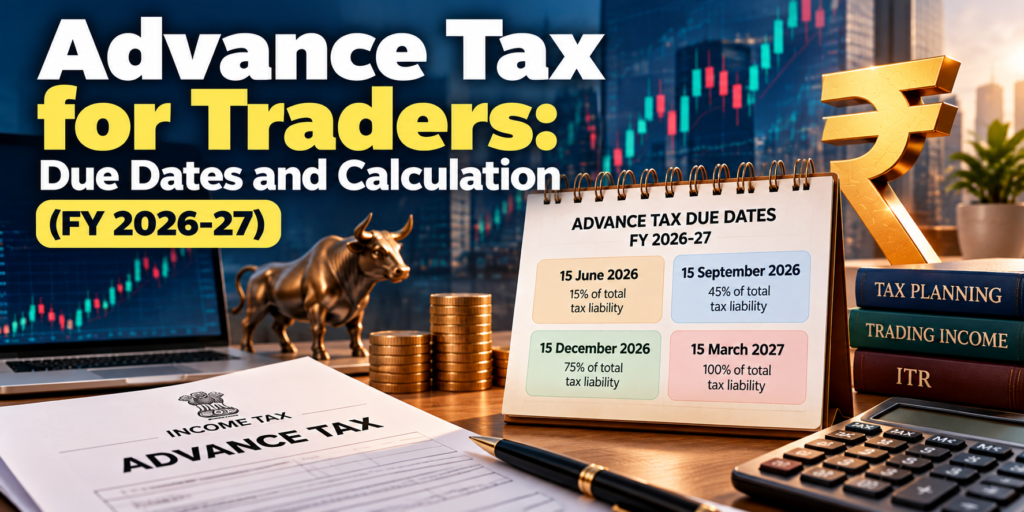
Advance tax is income tax paid in installments during the same financial year in which you earn the income. For FY 2026-27 (1 April 2026 to 31 March 2027), a trader must pay advance tax if the estimated tax for the year, after subtracting TDS and TCS, is ₹10,000 or more. Payments are due by 15 June, 15 September, 15 December and 15 March, at cumulative levels of 15%, 45%, 75% and 100%.
What Changed in FY 2026-27: The Income-tax Act, 2025
From 1 April 2026, the Income-tax Act, 2025 replaced the Income-tax Act, 1961, and FY 2026-27 is the first year governed by the new law. It also replaces “previous year” and “assessment year” with a single “tax year”.
For traders, the substance is unchanged: the threshold, dates, percentages and interest rate all carry over. Only the section numbers moved:
| Provision | Income-tax Act, 1961 | Income-tax Act, 2025 |
|---|---|---|
| Liability to pay advance tax | Section 207 | Section 403 |
| ₹10,000 threshold | Section 208 | Section 404 |
| Computation | Section 209 | Section 405 |
| Instalments and due dates | Section 211 | Section 408 |
| Interest for shortfall in total advance tax | Section 234B | Section 424 |
| Interest for deferment of instalments | Section 234C | Section 425 |
Advance tax for FY 2025-26, including the 15 March 2026 instalment, still falls under the 1961 Act.
Who Must Pay Advance Tax as a Trader?
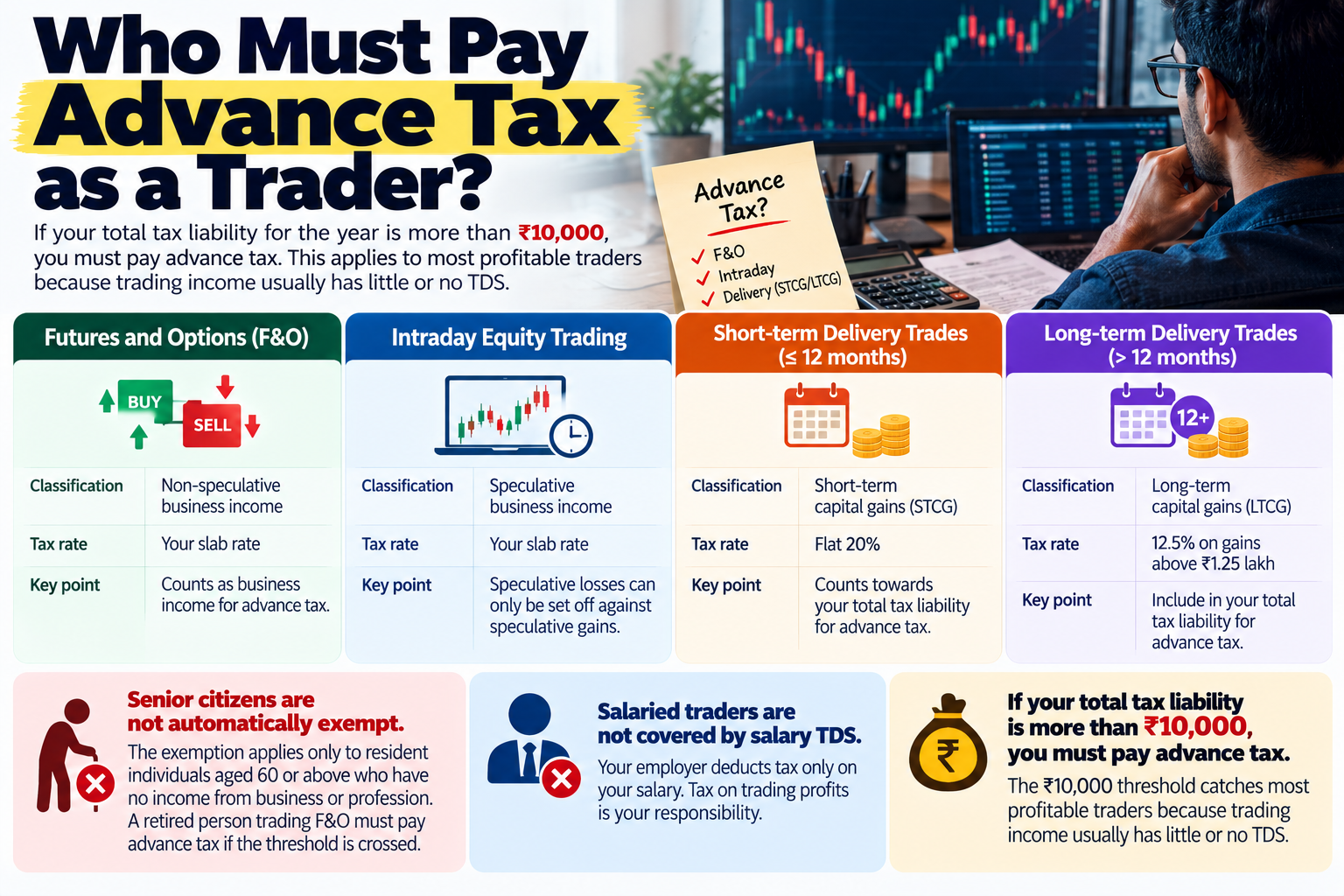
The ₹10,000 threshold catches most profitable traders, because trading income usually has little or no TDS.
How your trading income is classified matters for calculation:
- Futures and options (F&O): Generally treated as non-speculative business income and taxed at your slab rate.
- Intraday equity trading: Treated as speculative business income, also taxed at your slab rate. Speculative losses can only be set off against speculative gains.
- Short-term delivery trades in listed equity (held 12 months or less): Short-term capital gains (STCG) taxed at a flat 20%.
- Long-term delivery trades in listed equity (held more than 12 months): Long-term capital gains (LTCG) taxed at 12.5% on gains above ₹1.25 lakh in a year.
Because F&O and intraday profits count as business income, two common assumptions fail:
- Senior citizens are not automatically exempt. The exemption applies only to resident individuals aged 60 or above who have no income from business or profession. A retired person trading F&O has business income and must pay advance tax if the threshold is crossed.
- Salaried traders are not covered by salary TDS. Your employer deducts tax only on your salary. Tax on trading profits is your responsibility.
Advance Tax Due Dates for FY 2026-27
| Instalment | Due date | Cumulative tax to be paid |
|---|---|---|
| First | 15 June 2026 | At least 15% |
| Second | 15 September 2026 | At least 45% |
| Third | 15 December 2026 | At least 75% |
| Fourth | 15 March 2027 | 100% |
As of 15 October 2026, the first two dates have passed. The next instalment is due on 15 December 2026, by which you must have paid at least 75% of your estimated tax for the year.
Presumptive taxpayers: If you have opted for presumptive taxation of business income (Section 58 of the 2025 Act, formerly Section 44AD), you can pay your entire advance tax in one instalment by 15 March. It has its own eligibility conditions and consequences for traders, so consult a chartered accountant first.
Unforeseeable income: Capital gains and dividends are hard to predict at the start of the year. If such income arises after an instalment date, you do not pay deferment interest on it for the earlier instalments, provided you pay the tax on it in the remaining instalments (or by 31 March if it arises after 15 March). This relief does not extend to F&O or intraday profits, which are business income.
How to Calculate Advance Tax for Traders: Step by Step
Step 1: Estimate your full-year income
Project the whole year: realised P&L to date plus a realistic estimate for the remaining months. Include every head:
- Net F&O profit, after deducting business expenses such as brokerage, exchange charges, advisory subscriptions and a reasonable share of internet and data costs
- Intraday (speculative) profit
- Realised STCG and LTCG on delivery trades
- Salary, interest, rent and other income
STT paid on F&O trades taxed as business income is generally deductible as a business expense. Note that Budget 2026 raised STT on futures from 0.02% to 0.05% and on options premium from 0.10% to 0.15% for transactions from 1 April 2026, so your expense estimate should reflect the higher rates.
Step 2: Choose your tax regime
The new tax regime is the default. Budget 2026 left slab rates unchanged, so FY 2026-27 slabs under the new regime are:
| Total income | Rate |
|---|---|
| Up to ₹4,00,000 | Nil |
| ₹4,00,001 to ₹8,00,000 | 5% |
| ₹8,00,001 to ₹12,00,000 | 10% |
| ₹12,00,001 to ₹16,00,000 | 15% |
| ₹16,00,001 to ₹20,00,000 | 20% |
| ₹20,00,001 to ₹24,00,000 | 25% |
| Above ₹24,00,000 | 30% |
Under the new regime, the rebate that makes income up to ₹12 lakh effectively tax-free does not apply to tax on special-rate income such as STCG or LTCG on listed shares. A trader whose income is mostly capital gains may therefore owe tax even below ₹12 lakh.
Step 3: Compute tax, add cess, subtract TDS
Apply slab rates to normal income and special rates to capital gains. Add surcharge if your income exceeds ₹50 lakh, then 4% health and education cess. Subtract TDS and TCS you expect for the year. The balance is your advance tax liability.
Formula:
Advance tax = (Tax on estimated total income + surcharge + 4% cess) − rebates and reliefs − expected TDS/TCS
Step 4: Split it across the instalments
Pay the cumulative percentage due by each date, minus what you have already paid. Re-estimate before every instalment.
Worked Example: An F&O Trader in FY 2026-27
This is a hypothetical example under the new regime, using rates in force for FY 2026-27. It is for illustration only.
Rohit is a full-time trader with the following estimated income:
| Income | Amount (₹) |
|---|---|
| Net F&O profit (after expenses) | 14,00,000 |
| Intraday profit | 1,00,000 |
| FD interest (TDS of ₹5,000 deducted) | 50,000 |
| STCG on delivery trades, booked in November | 2,00,000 |
Tax calculation:
| Particulars | Amount (₹) |
|---|---|
| Normal income (F&O + intraday + interest) | 15,50,000 |
| Slab tax: 5% on ₹4 lakh + 10% on ₹4 lakh + 15% on ₹3.5 lakh | 1,12,500 |
| STCG tax at 20% on ₹2,00,000 | 40,000 |
| Tax before cess | 1,52,500 |
| Add 4% cess | 6,100 |
| Total tax | 1,58,600 |
| Less TDS on FD interest | (5,000) |
| Advance tax payable | 1,53,600 |
Rohit’s normal income exceeds ₹12 lakh, so no rebate applies. Because the STCG arises in November, the June and September instalments cover regular income only. Tax on regular income, including cess and after TDS, is ₹1,12,000 (₹1,12,500 × 1.04 − ₹5,000). Tax on the STCG, including cess, is ₹41,600.
| Due date | Cumulative target | Cumulative paid | Pay on this date |
|---|---|---|---|
| 15 Jun 2026 | 15% of ₹1,12,000 | ₹16,800 | ₹16,800 |
| 15 Sep 2026 | 45% of ₹1,12,000 | ₹50,400 | ₹33,600 |
| 15 Dec 2026 | 75% of ₹1,12,000 + full STCG tax | ₹1,25,600 | ₹75,200 |
| 15 Mar 2027 | 100% | ₹1,53,600 | ₹28,000 |
Paying the full STCG tax in December is the conservative approach and avoids deferment interest on that gain.
Interest for Late or Short Payment
Missing a date does not attract a penalty, but it does attract simple interest at 1% per month, under two separate provisions. Any part of a month counts as a full month, and the amount on which interest is charged is rounded down to the nearest ₹100.
Section 425 (formerly 234C): Deferment of instalments
This applies when an individual instalment falls short. Interest runs for 3 months on shortfalls at 15 June, 15 September and 15 December, and for 1 month at 15 March. There is a buffer for the first two dates: no interest if you have paid at least 12% by 15 June and 36% by 15 September.
Example: Suppose Rohit paid nothing in June and September, then caught up fully on 15 December. His June shortfall of ₹16,800 attracts ₹504 (16,800 × 1% × 3), and his September shortfall of ₹50,400 attracts ₹1,512 (50,400 × 1% × 3). Total deferment interest: ₹2,016, even though he caught up later. Each date is checked independently.
Section 424 (formerly 234B): Shortfall in total advance tax
This applies if the advance tax you paid by 31 March is less than 90% of your assessed tax. Interest runs from 1 April after the year ends until you pay the balance.
Example: If Rohit paid no advance tax at all and cleared ₹1,53,600 on 31 July 2027, he would owe ₹6,144 under Section 424 (1,53,600 × 1% × 4 months), in addition to deferment interest under Section 425.
How to Pay Advance Tax Online
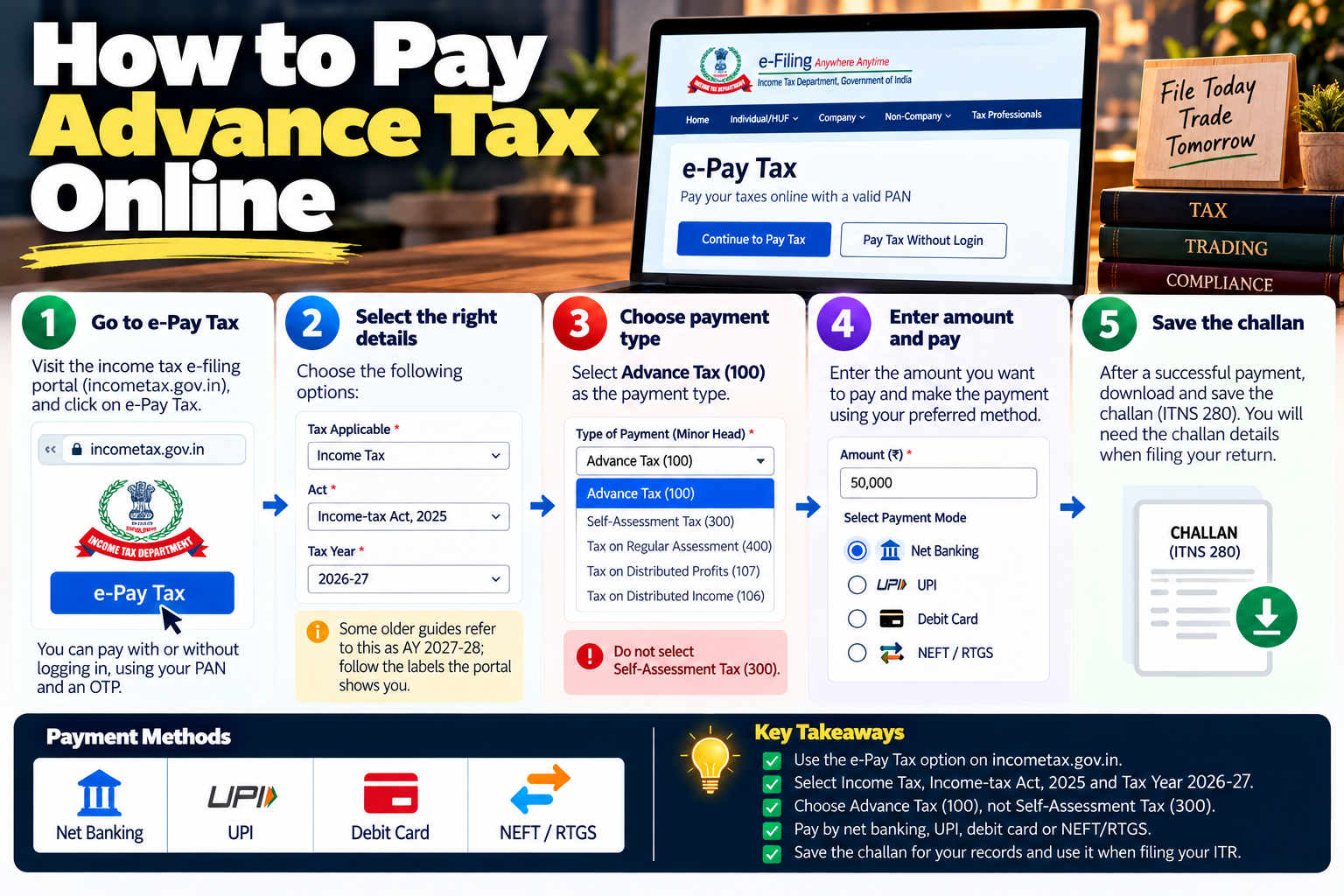
- Go to the e-Pay Tax option on the income tax e-filing portal (incometax.gov.in). You can pay with or without logging in, using your PAN and an OTP.
- Select Income Tax, choose the Income-tax Act, 2025, and select Tax Year 2026-27. Some older guides refer to this as AY 2027-28; follow the labels the portal shows you.
- Choose Advance Tax (100) as the payment type, not Self-Assessment Tax (300).
- Enter the amount and pay by net banking, UPI, debit card or NEFT/RTGS.
- Save the challan. You will need the challan details when filing your return.
Common Mistakes Traders Make
- Using last year’s profit as this year’s estimate. Trading income is volatile. Re-estimate before every instalment and adjust the payment up or down.
- Ignoring a strong final quarter. A big profit in February or March still needs to be covered by 15 March.
- Overestimating TDS. Check your Annual Information Statement before assuming TDS will cover a slice of your tax.
- Mixing up categories. Applying slab rates to STCG, or treating F&O losses as capital losses, produces the wrong liability.
Frequently Asked Questions
Do F&O traders have to pay advance tax?
Yes, if their estimated tax for the year after TDS and TCS is ₹10,000 or more. F&O profit is business income taxed at slab rates, and it has no TDS, so most profitable F&O traders cross the threshold.
What if I have an F&O loss for the year?
If your overall estimated tax after set-offs is below ₹10,000, you have no advance tax liability. Losses on F&O cannot be set off against salary income, so a salaried trader may still owe tax on salary not fully covered by TDS.
Is advance tax payable on intraday trading profit?
Yes. Intraday equity profit is speculative business income taxed at slab rates and counts toward your ₹10,000 threshold.
Can I pay all my advance tax on 15 March?
You can, but you will owe deferment interest under Section 425 for the June, September and December instalments, unless you are a presumptive taxpayer or the income is capital gains or dividends that arose late in the year.
Are senior citizen traders exempt from advance tax?
Only if they have no business or professional income. A senior citizen who trades F&O or intraday has business income and must pay advance tax once the threshold is crossed.
What happens if I overpay advance tax?
The excess is refunded after you file your return, usually with interest, but it locks up trading capital until then.
Conclusion
Advance tax for traders comes down to three habits: estimate your full-year income from all trading segments, apply the correct rate to each type of income, and revisit your estimate before every due date. With the 15 December 2026 instalment approaching, now is a good time to review your FY 2026-27 P&L and bring your payments up to 75%.
Disclaimer: This article is for educational purposes only and does not constitute tax, legal or investment advice. Tax treatment depends on individual facts. Rates and rules referred to apply to FY 2026-27 and may change. Consult a qualified chartered accountant before making tax decisions.