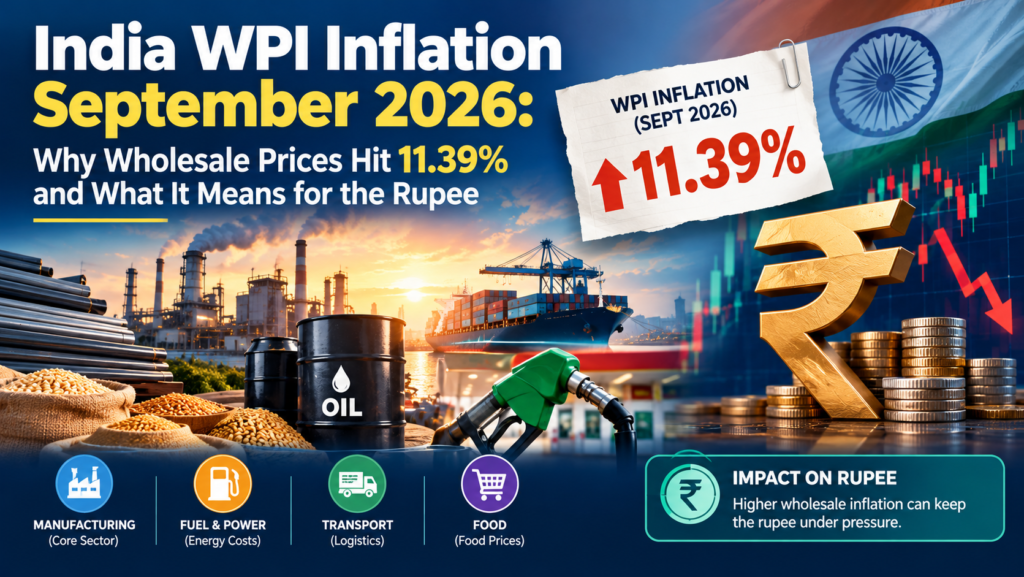
India’s wholesale inflation moved into double digits in September 2026. The Wholesale Price Index (WPI) rose 11.39% from a year earlier, up from 9.92% in August and well above the 10.18% average forecast in a Reuters poll of economists. Fuel, metals and chemicals led the increase, and all three are linked to the price of imported crude oil and the value of the rupee.
This article explains the September WPI data, how it compares with retail inflation, why a weak rupee and wholesale prices feed each other, and what traders and businesses in India should watch next.
India WPI Inflation September 2026 at a Glance
According to the Ministry of Commerce and Industry’s release of 14 October 2026, India’s annual WPI inflation was 11.39% in September 2026 (provisional), compared with 9.92% in August and 9.78% in July. The All Commodities index rose to 112.5 from 110.8 in August, a month-on-month increase of about 1.5%. Fuel and power inflation reached 25.85%, the highest among the major groups.
| WPI group | September 2026 | August 2026 |
|---|---|---|
| All Commodities (headline) | 11.39% | 9.92% |
| Primary Articles | 8.67% | 7.76% |
| Food Articles | 8.14% | 5.67% |
| Fuel and Power | 25.85% | 22.93% |
| Manufactured Products | 9.76% | 8.37% |
| WPI Food Index | 8.66% | 7.05% |
Source: Ministry of Commerce and Industry, WPI (base 2022-23) press release, 14 October 2026. September figures are provisional.
The September reading is based on a weighted response rate of 83.4%, so it may be revised when the final figure is published with the October data on 16 November 2026.
What Is Driving Wholesale Inflation
Fuel and Power
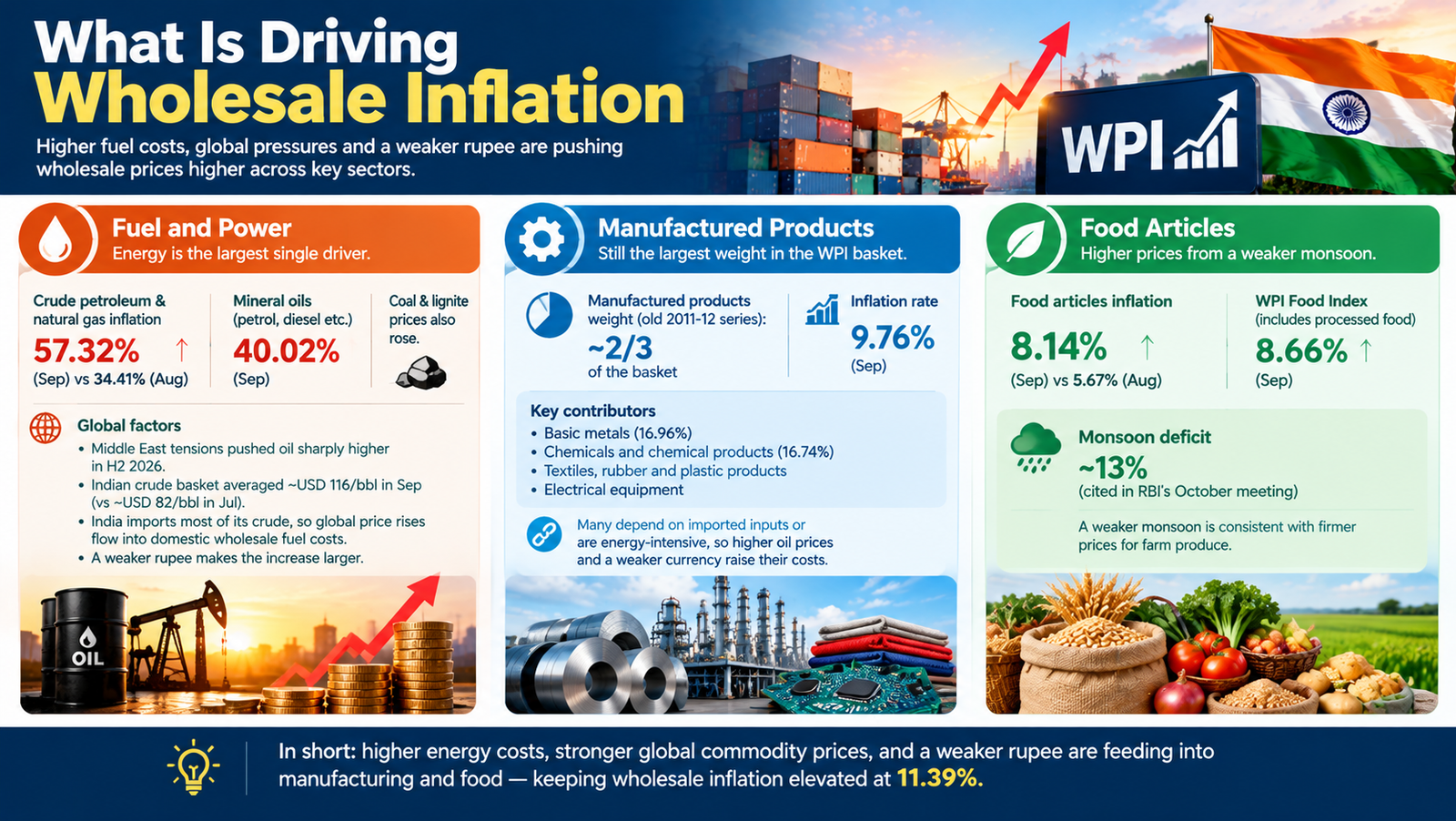
Energy is the largest single driver. Inflation in crude petroleum and natural gas rose to 57.32% in September from 34.41% in August, and mineral oils, which include petrol, diesel and other petroleum products, rose 40.02%. Coal and lignite prices also increased.
The cause is global. Middle East tensions pushed oil sharply higher in the second half of 2026, and the Indian crude basket averaged about USD 116 a barrel in September, up from about USD 82 in July, according to figures cited in coverage of the RBI’s October policy meeting. Because India imports most of its crude, every rise in global prices passes into domestic wholesale fuel costs, and a weaker rupee makes that increase larger.
Manufactured Products
Manufactured products have traditionally carried the largest weight in the WPI, close to two-thirds of the basket in the old 2011-12 series, so their acceleration to 9.76% matters for the headline. The release named basic metals (16.96%), chemicals and chemical products (16.74%), textiles, rubber and plastic products, and electrical equipment as key contributors. Several of these depend on imported inputs or on energy-intensive production, so higher oil prices and a weaker currency raise their costs.
Food Articles
Food articles inflation rose to 8.14% from 5.67%, and the broader WPI Food Index, which also includes processed food, rose to 8.66%. Reports on the RBI’s October meeting cited a monsoon deficit of about 13%, which is consistent with firmer prices for farm produce.
Understanding the New WPI Series
The September data uses the revised WPI series with base year 2022-23, which the Office of Economic Adviser in the Department for Promotion of Industry and Internal Trade (DPIIT) launched on 15 June 2026. It replaced the 2011-12 series. Three changes matter when comparing numbers:
- The basket expanded from 697 to 957 items.
- Weights are now based on the gross value of output rather than net traded value.
- Crude petroleum and natural gas moved from Primary Articles to Fuel and Power, which partly explains why the fuel group now shows such high inflation.
Annual comparisons use linking factors published by DPIIT to join the old and new series. Traders comparing September 2026 figures with older reports should check that both numbers come from the same base.
WPI vs CPI: Why the Gap Is So Wide
Retail inflation is much lower. India’s Consumer Price Index (base 2024) rose 5.54% in September 2026, up from 4.83% in August, according to the Ministry of Statistics and Programme Implementation (MoSPI). Consumer food inflation was 7.74%.
| Measure | September 2026 | What it tracks |
|---|---|---|
| WPI headline | 11.39% | Prices at the first point of bulk sale: raw materials, fuel, manufactured goods |
| CPI headline | 5.54% | Prices paid by households, including services such as housing, health and education |
| Gap | 5.85 percentage points | WPI above CPI |
Month-on-month changes tell a similar story. The WPI index rose about 1.5% in September alone, a pace that would compound to about 20% over a year if it continued. That does not mean it will, but it shows how quickly cost pressure built up during the month.
The gap between the two indices comes from what each one contains. WPI has no services and gives heavy weight to fuel, metals and industrial inputs, which are the categories rising fastest. CPI includes services, where prices move more slowly, and many retail fuel prices in India are administered or adjusted with a lag.
A large WPI-CPI gap is usually read in two ways. It squeezes the margins of companies that cannot pass higher input costs on to customers. It also signals that some of the wholesale increase is likely to reach retail prices in the coming months, which is why the RBI watches WPI closely even though its inflation target is set in CPI terms.
How WPI Inflation and the Rupee Affect Each Other
A Weaker Rupee Raises Wholesale Prices
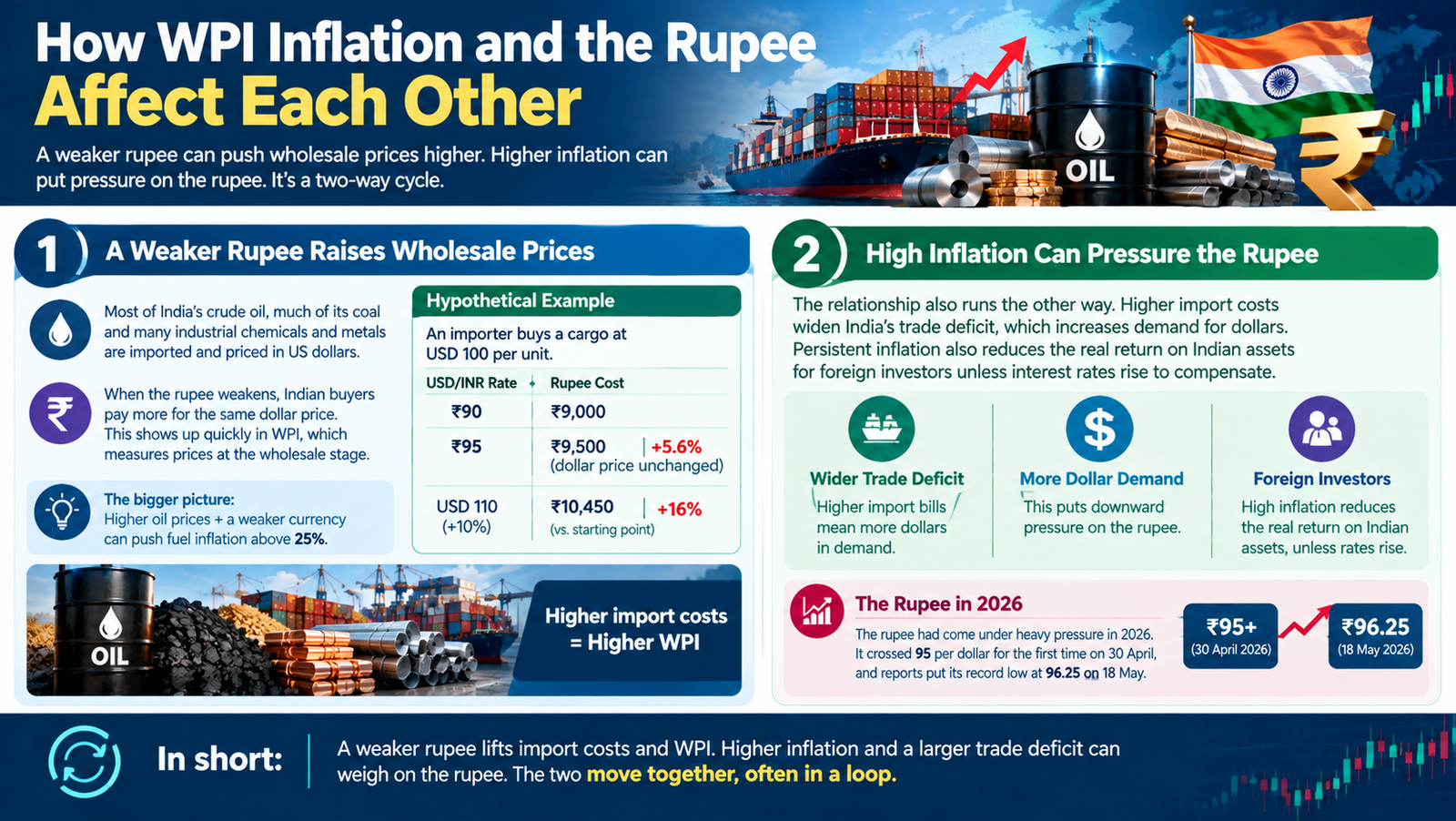
Most of India’s crude oil, much of its coal and many industrial chemicals and metals are imported and priced in US dollars. When the rupee weakens, Indian buyers pay more for the same dollar price. This shows up quickly in WPI, which measures prices at the wholesale stage.
Hypothetical example: an importer buys a cargo priced at USD 100 per unit. At ₹90 per dollar, the cost is ₹9,000. At ₹95 per dollar, the cost is ₹9,500, an increase of about 5.6% with no change in the dollar price. If the dollar price also rises 10%, to USD 110, the rupee cost becomes ₹10,450, about 16% higher than the starting point. This is how a combination of higher oil prices and a weaker currency can push fuel inflation above 25%.
High Inflation Can Pressure the Rupee
The relationship also runs the other way. Higher import costs widen India’s trade deficit, which increases demand for dollars. Persistent inflation also reduces the real return on Indian assets for foreign investors unless interest rates rise to compensate.
The rupee had come under heavy pressure in 2026. It crossed 95 per dollar for the first time on 30 April, and reports put its record low at 96.25 on 18 May.
How the Rupee Reacted to the September WPI Data
The WPI release on 14 October came out at noon IST, and its effect on the currency was limited. Three factors outweighed it.
RBI intervention. The Reserve Bank of India had moved to curb speculative dollar demand. According to Reuters reports, it routed part of oil-import dollar demand through a special facility, tightened hedging rules and imposed cash-margin requirements on certain importer and bank hedges, and followed up with direct dollar sales. Governor Sanjay Malhotra said the steps were aimed at speculation and that the RBI would act further if needed. India’s foreign exchange reserves fell by USD 12.95 billion to USD 734.61 billion in the week ended 2 October, according to RBI data, a decline that reflects intervention as well as changes in the value of reserve assets.
A higher repo rate. On 7 October 2026, the RBI’s Monetary Policy Committee raised the repo rate by 25 basis points to 5.50% and changed its stance from neutral to “calibrated tightening,” as reported by several outlets. Higher rates make rupee assets more attractive to hold and support the currency.
A weaker dollar. Later on 14 October, US inflation data briefly lifted the dollar, but the move reversed by the next morning.
As a result, the rupee closed at about 95.15 per dollar on 14 October, a one-month high, and at a provisional 95.05 on 15 October, its fifth straight session of gains. Foreign institutional investors were still net sellers of Indian equities, at about ₹1,857 crore on 14 October, which limited further gains.
What 11.39% WPI Inflation Means for RBI Policy
The RBI targets CPI inflation of 4%, with a tolerance band of 2% to 6%. September CPI at 5.54% is inside the band, but the RBI projected in October that CPI would average close to 5.8% over the next three quarters and peak around 6.0% in the October to December 2026 quarter.
The September WPI data supports that concern. Wholesale prices often lead retail prices for manufactured goods, and a 9.76% rise in manufactured product prices suggests that more cost increases could reach consumers. The minutes of the October meeting, due on 21 October, and the next policy decision on 2 to 4 December will show whether the MPC sees a case for further tightening.
What Traders and Businesses Should Watch
- 16 November 2026: October WPI data, along with the final September figure.
- 12 November 2026: October CPI data from MoSPI.
- Crude oil prices: the single largest driver of WPI fuel inflation.
- RBI statements and reserve data: weekly reserve figures show how much the RBI is spending to support the rupee.
- Foreign portfolio flows: continued equity outflows would add to pressure on USD/INR.
For currency traders, USD/INR futures on NSE and BSE trade from 9:00 AM to 5:00 PM IST, so the noon WPI release falls within trading hours, unlike US data released in the evening. In the current environment, however, RBI actions and oil prices have moved the rupee more than domestic inflation data.
Check the Risk-On / Risk-Off Meter here!
Frequently Asked Questions
What is India’s WPI inflation for September 2026?
India’s WPI inflation was 11.39% in September 2026 (provisional), up from 9.92% in August. Fuel and power inflation was 25.85%, manufactured products 9.76% and primary articles 8.67%.
Why is WPI inflation higher than CPI inflation?
WPI gives more weight to fuel, metals and industrial inputs and excludes services. These goods are rising fastest because of higher oil prices and a weaker rupee, while CPI includes services and administered fuel prices that move more slowly.
How does WPI inflation affect the rupee?
High wholesale inflation, especially when driven by imports, widens the trade deficit and raises dollar demand, which can weaken the rupee. A weaker rupee in turn raises the rupee cost of imports and pushes WPI higher.
Who publishes India’s WPI data?
The Office of Economic Adviser in DPIIT, under the Ministry of Commerce and Industry, publishes WPI data around the 14th of each month. Since June 2026, it uses the new base year 2022-23.
When is the next WPI release?
October 2026 WPI data is scheduled for Monday, 16 November 2026. The same release will carry the final September figure, which may differ from the provisional 11.39% because the September estimate was based on an 83.4% response rate.
Does the RBI target WPI inflation?
No. The RBI targets CPI inflation of 4% with a 2% to 6% band. It tracks WPI because wholesale price trends can signal future pressure on retail prices.
Conclusion
India’s WPI inflation of 11.39% in September 2026 reflects imported cost pressure: oil prices above USD 100 a barrel, a rupee near 95 per dollar and rising prices for metals and chemicals. The gap with 5.54% retail inflation means businesses are absorbing costs that may still reach consumers. The rupee has steadied because of RBI intervention and a higher repo rate, not because inflation has eased. Until oil prices fall or wholesale inflation turns lower, both the rupee and RBI policy are likely to stay under pressure.
Disclaimer
This article is for educational purposes only and does not constitute investment, trading, tax or legal advice. Economic data are provisional and subject to revision. Market levels cited are approximate and drawn from published reports. Examples are hypothetical. Currency and derivatives trading involves substantial risk of loss; Indian residents should trade only through authorised persons and recognised exchanges as permitted under FEMA, and consult a SEBI-registered adviser before making financial decisions.