Introduction
You’ve found your setup, calculated your position size and decided where your stop-loss goes. Now you have to tell your broker how to enter and exit, and that means choosing an order type. Pick the wrong one and you can pay more than you planned, miss the trade entirely, or find your stop-loss filled well below where you set it. This guide covers the main forex order types every beginner needs.
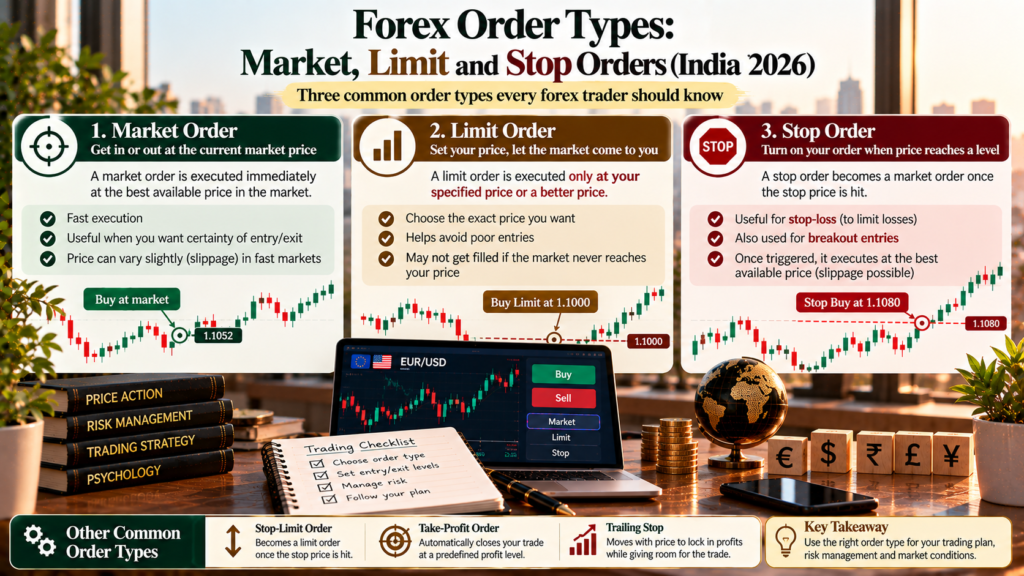
Quick answer: A market order buys or sells immediately at the best available price, so you’re guaranteed a fill but not the price. A limit order buys or sells only at your chosen price or better, so you’re guaranteed the price but not a fill. A stop order (stop-loss) waits until price reaches a trigger level, then becomes an order to buy or sell. It’s used to cut losses or enter on a breakout. A stop-limit order triggers like a stop but only fills within a price limit you set.
Why this matters
- Order type decides two things: whether you get filled and at what price. You can usually guarantee one, not both.
- For Indian traders, the relevant market is exchange-traded currency derivatives on NSE and BSE, such as USD/INR futures. On NSE, one USD/INR lot is $1,000 and the tick size is ₹0.0025, so each tick is worth ₹2.50 per lot.
- Resident Indians may trade only permitted currency pairs on recognised exchanges through SEBI-registered brokers. The order concepts here apply across markets, but the India examples use NSE currency futures.
The main order types
Market order
A market order executes straight away at the best price available. When you buy, you pay the ask (offer); when you sell, you receive the bid.
- Use it when getting in or out now matters more than the exact price, for example exiting a trade that has gone wrong.
- Risk: in fast or thin markets, you can be filled at a worse price than you saw on screen. This is called slippage.
Limit order
A limit order sets the worst price you’ll accept. A buy limit fills at your price or lower; a sell limit fills at your price or higher.
- Use it when price matters more than certainty of fill, for example buying a pullback to support or taking profit at a target.
- Risk: if price never reaches your level, or touches it only briefly with too few sellers or buyers there, you don’t get filled.
Stop order (stop-loss)
A stop order sits inactive until price reaches a trigger price, then it becomes an order to trade. A sell stop sits below the current price; a buy stop sits above it.
- Use it when you want to exit a losing trade automatically, or enter only if price breaks through a level.
- Risk: the trigger isn’t the fill price. In a fast move or a gap, the order can fill beyond your trigger.
Stop-limit order
A stop-limit has two prices: a trigger and a limit. When the trigger is hit, a limit order is placed at your limit price.
- Use it when you want protection against a bad fill after the trigger.
- Risk: if price jumps past your limit, the order may not fill at all, leaving you in a losing position.
Buy limit, sell limit, buy stop, sell stop
The type depends on where your order sits relative to the current price.
| Order | Placed | What you expect | Typical use |
|---|---|---|---|
| Buy limit | Below current price | Price dips, then rises | Buy a pullback to support |
| Sell limit | Above current price | Price rises, then falls | Sell at resistance or take profit on a long |
| Buy stop | Above current price | Price breaks up and keeps going | Enter a breakout, or stop-loss on a short |
| Sell stop | Below current price | Price breaks down and keeps falling | Stop-loss on a long, or enter a breakdown |
Easy way to remember: limit orders want a better price than now; stop orders accept a worse price than now, in exchange for confirmation or protection.
Comparison at a glance
| Market | Limit | Stop (stop-loss) | Stop-limit | |
|---|---|---|---|---|
| Fill guaranteed? | Almost always, if there’s liquidity | No | Once triggered, usually yes | No |
| Price guaranteed? | No | Yes (your price or better) | No | Yes (within your limit) |
| Slippage risk | Yes | No | Yes | No, but may not fill |
| Best for | Urgent entries and exits | Planned entries and targets | Protective exits, breakouts | Controlled exits in orderly markets |
Slippage and gaps
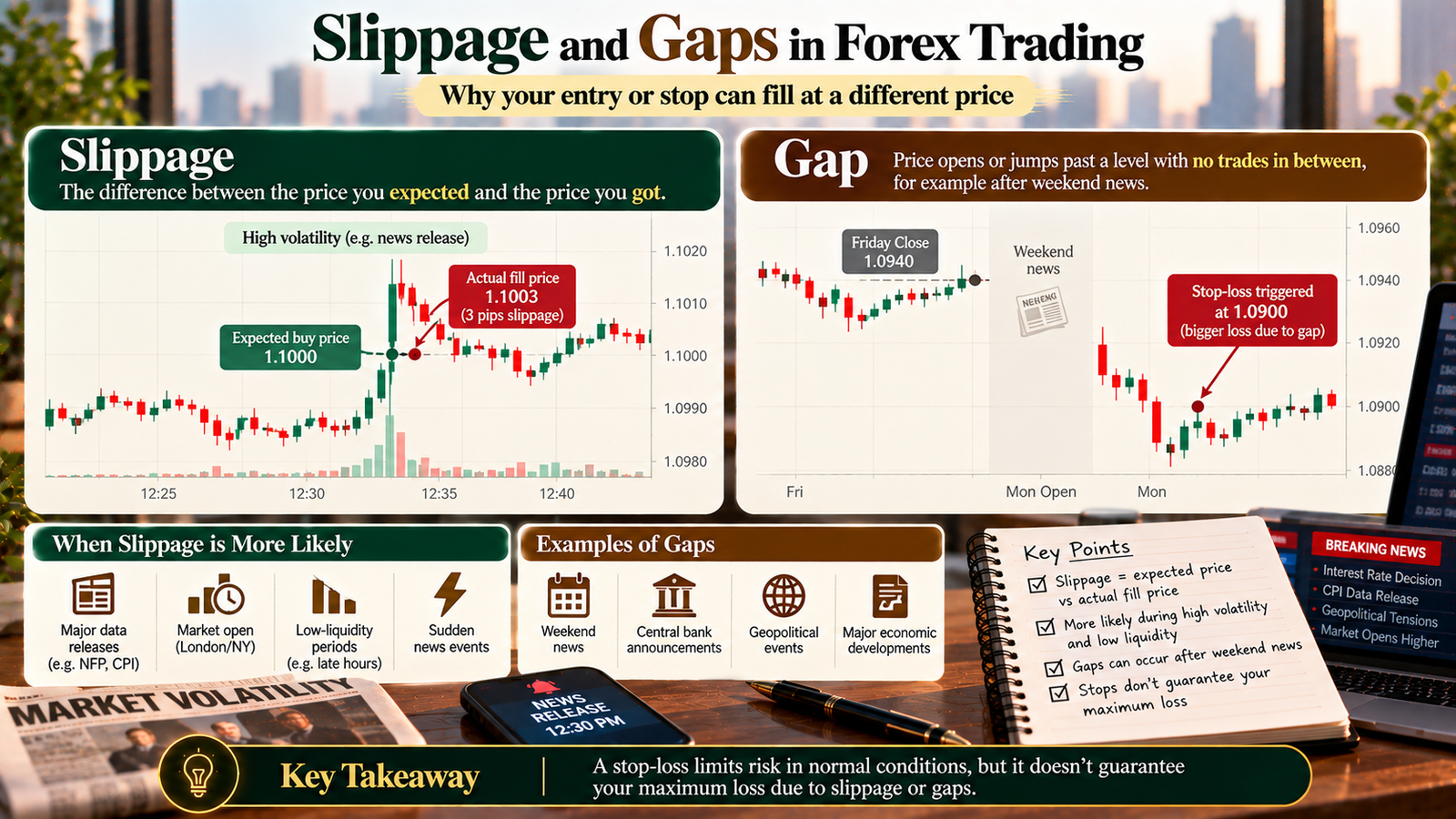
Slippage is the difference between the price you expected and the price you got. It’s more likely around major data releases, at the open, in low-liquidity periods and during sudden news.
A gap happens when price opens or jumps past a level with no trades in between, for example after weekend news. Your stop can then fill at the first available price, which may be much worse than your trigger. A stop-loss limits risk in normal conditions, but it doesn’t guarantee your maximum loss.
The India angle: orders on NSE currency futures
Key contract facts (NSE USD/INR futures)
| Item | Detail |
|---|---|
| Lot size | $1,000 |
| Tick size | ₹0.0025 (0.25 paise), worth ₹2.50 per lot |
| Trading hours | Monday to Friday, 9:00 am to 5:00 pm |
| Expiry | Two working days before the last business day of the month, at 12:30 pm |
| Final settlement | RBI reference rate, cash-settled in rupees |
Order types and conditions on NSE’s trading system
- Price conditions: limit, market and stop-loss orders.
- Time conditions: Day orders are valid until the end of the trading day and cancel automatically if unfilled. IOC (immediate or cancel) orders fill whatever they can immediately and cancel the rest.
- How stop-loss works on NSE: a sell stop-loss activates when the last traded price falls to or below the trigger price; a buy stop-loss activates when it rises to or above the trigger. Once triggered, the order enters the order book as a limit order. In practice, an exchange stop-loss order has both a trigger price and a limit price, so it works like a stop-limit.
- Broker order types: many brokers also offer SL-M (stop-loss market), bracket or cover orders, and GTT (good till triggered). Availability differs by broker and segment, so check before relying on one.
Worked examples (illustrative)
Assume USD/INR futures are trading at ₹95.50, and you trade one lot ($1,000). A move of ₹0.01 equals ₹10 per lot.
| Scenario | Order | What happens | Result per lot |
|---|---|---|---|
| You want to buy a pullback to 95.30 | Buy limit at 95.30 | Fills only if price trades at 95.30 or lower | No slippage; may not fill |
| You’re long from 95.50 and want to cap your loss | Sell stop-loss, trigger 95.30, limit 95.25 | Triggers at 95.30; fills anywhere down to 95.25 | Planned loss of ₹200 (95.50 → 95.30) |
| A fast drop fills your stop at 95.27 | Same stop-loss | Filled 3 paise below the trigger | Loss of ₹230, which includes ₹30 of slippage |
| Price gaps straight from 95.40 to 95.20 | Same stop-loss | Trigger hit, but the 95.25 limit is above the market, so it doesn’t fill | Still in the trade; loss keeps growing |
| You want to take profit at 95.80 | Sell limit at 95.80 | Fills at 95.80 or better | Profit of ₹300 |
The gap row shows the trade-off with stop-limit orders: a tight limit protects the price, but can leave you unfilled. Many traders leave a wider gap between the trigger and limit prices for protective stops.
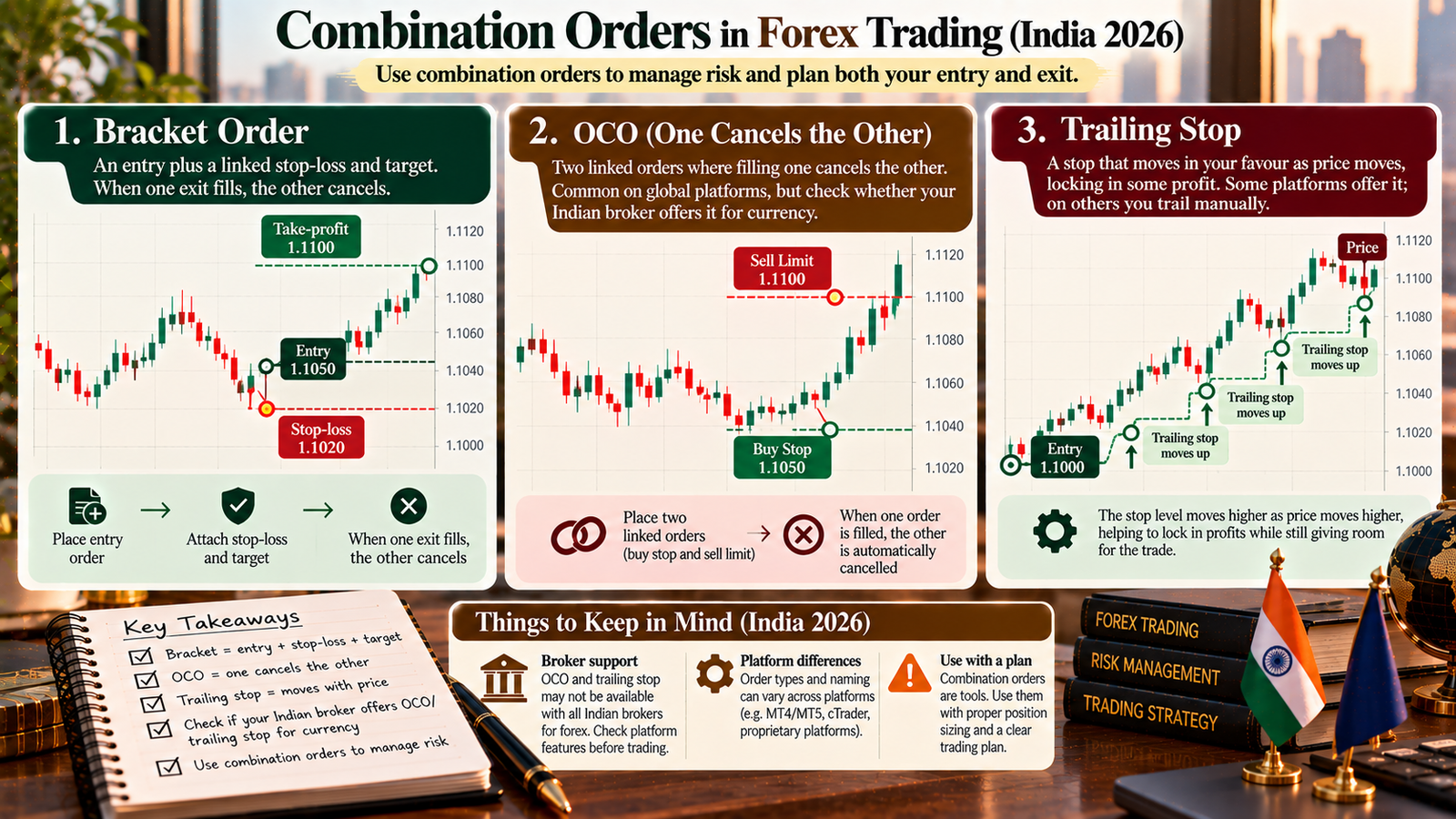
Combination orders
- Bracket order: an entry plus a linked stop-loss and target. When one exit fills, the other cancels.
- OCO (one cancels the other): two linked orders where filling one cancels the other. It’s common on global platforms, but check whether your Indian broker offers it for currency.
- Trailing stop: a stop that moves in your favour as price moves, locking in some profit. Some platforms offer it; on others you trail manually.
Expert analysis
Fact: On NSE’s trading system, stop-loss orders activate when the last traded price reaches the trigger and then enter the order book as limit orders. Market orders execute at the best price available when entered. Limit orders fill only at the specified price or better.
Analysis: Every order type trades certainty of fill against certainty of price. Market orders favour the fill, limit orders favour the price, and stop orders are about timing: they wait for a condition. For protective exits, missing the fill is usually the bigger risk, so the gap between trigger and limit prices on a stop-loss matters more than beginners expect.
Opinion: A sensible beginner setup is limit orders for planned entries and profit targets, and a stop-loss placed the moment you enter, with enough room between trigger and limit to fill in a fast market. Use market orders mainly for urgent exits. Avoid entering with market orders just before major data releases, when spreads can widen and slippage is more likely.
Common mistakes
- Using market orders for every entry. You give up price control, especially in fast markets.
- Confusing buy limit and buy stop. A buy limit sits below price; a buy stop sits above it.
- Setting the stop-limit too tight. A gap can jump over it and leave you unfilled.
- Placing the stop-loss “later”. Place it as soon as you enter.
- Assuming a stop-loss guarantees your maximum loss. Slippage and gaps can make losses bigger.
- Forgetting order validity. Day orders expire at the close; a pending order you thought was working may have been cancelled.
- Chasing a missed limit fill with a market order. This is often FOMO in action.
- Not checking what your broker supports. SL-M, bracket, OCO and trailing orders vary by broker and segment.
Myths vs facts
| Myth | Fact |
|---|---|
| “A stop-loss always exits at my stop price.” | The trigger isn’t the fill. Fast moves and gaps can cause slippage or, with stop-limits, no fill. |
| “Limit orders are always better.” | They protect price but may never fill, which is costly for urgent exits. |
| “Market orders are dangerous and should never be used.” | They’re the right tool when getting out quickly matters most. |
| “Buy stop and buy limit are the same.” | A buy stop triggers above the current price; a buy limit waits below it. |
| “Pending orders stay active forever.” | Day orders expire at the end of the session unless your broker offers longer validity such as GTT. |
Key takeaways
- Market orders guarantee a fill but not the price; limit orders guarantee the price but not a fill.
- Stop orders wait for a trigger, then trade. They’re used for stop-losses and breakout entries.
- Stop-limit orders control price after the trigger but can miss fills in gaps.
- On NSE, stop-loss orders enter the book as limit orders once triggered.
- Place your stop-loss when you enter, and allow for slippage when sizing positions.
- Check your broker’s supported order types and validity for the currency segment.
FAQs
- What are the main forex order types? Market, limit, stop (stop-loss) and stop-limit orders. Platforms may also offer combination orders such as bracket, OCO and trailing stops.
- What is the difference between a market order and a limit order? A market order fills immediately at the best available price. A limit order fills only at your chosen price or better, and may not fill at all.
- What is a stop-loss order? An order that activates when price reaches a trigger level and then exits your position, limiting losses in normal market conditions.
- What is the difference between a stop order and a stop-limit order? Both wait for a trigger. After triggering, a stop (market) order fills at the next available price, while a stop-limit only fills within your limit price.
- When should I use a buy limit vs a buy stop? Use a buy limit below the current price to buy a pullback. Use a buy stop above the current price to buy a breakout.
- What is slippage? The difference between the price you expected and the price you were filled at. It’s common in fast markets, around news and in thin liquidity.
- Does a stop-loss guarantee my maximum loss? No. Slippage and gaps can fill your stop at a worse price, and a stop-limit may not fill at all.
- How does a stop-loss order work on NSE? It activates when the last traded price reaches the trigger, then enters the order book as a limit order at your limit price.
- What is an SL-M order? A stop-loss market order: once triggered, it executes at the market price. Availability depends on your broker and segment.
- What is a Day order? An order valid only for the trading day it’s placed. If unfilled, it’s cancelled at the end of the session.
- What is an IOC order? Immediate or cancel: it fills whatever quantity it can immediately and cancels the rest.
- What is a bracket order? An entry order with a linked stop-loss and profit target. When one exit fills, the other is cancelled.
- What is an OCO order? One cancels the other: two linked orders where filling one automatically cancels the other.
- What is a trailing stop? A stop-loss that moves in your favour as price moves, locking in part of your profit while leaving room for further gains.
- What is the tick value of USD/INR futures on NSE? The tick size is ₹0.0025 and one lot is $1,000, so each tick is worth ₹2.50 per lot.
- Which order type is best for beginners? Limit orders for planned entries and targets, a stop-loss placed at entry, and market orders mainly for urgent exits.
- Why didn’t my limit order fill even though price touched my level? There may not have been enough volume at that price to fill your order, or other orders at the same price were ahead of yours in the queue.