

Quick answer
In FTMO vs FundedNext for India: FTMO (est. 2014) offers a longer track record, a standard 2-step model and fast payouts; FundedNext (est. 2022) offers cheaper entry, more challenge types and higher profit splits. Both are offshore and sit in India’s legal grey area – and FundedNext has appeared on the RBI Alert List.
Introduction
FTMO and FundedNext are the two names that dominate almost every Indian trader’s prop-firm shortlist, and ‘FTMO vs FundedNext for India’ is one of the most-searched trading questions in the country. Most of the comparisons you’ll find, though, are written by the firms or their affiliates, who focus on features and skip the parts that matter most to an Indian resident: the legal grey area, the RBI Alert List, and the tax.
This guide fixes that. It compares the two firms fairly on the features that count, then adds the India-specific context the affiliate content leaves out. A caveat up front: prop-firm pricing, rules and profit splits change frequently and without notice, so treat every figure here as a checked-but-verify-live snapshot from 2026. This is educational information, not financial, legal or tax advice – and no endorsement of either firm.
The Two Firms at a Glance
Both sell access to simulated capital: you pay a fee, pass an evaluation, and earn a profit split on a funded (simulated) account. Their philosophies differ:
- FTMO – the established benchmark, founded in 2014 in the Czech Republic. Known for a long track record, a single standardised model, structure and payout reliability.
- FundedNext – the fast-growing challenger, founded in 2022 in the UAE. Known for flexibility, cheaper entry, multiple challenge types and higher profit splits.

Head-to-Head Comparison
The key differences side by side (verify live figures on each firm’s site, as they change often):
| Feature | FTMO | FundedNext |
|---|---|---|
| Founded / HQ | 2014, Czech Republic | 2022, UAE |
| Evaluation model | Standardised 2-step | 1-step, 2-step, Instant, Express, Stellar |
| Entry price (~$10K acct) | Higher (around $155) | Lower (around $99, some lower) |
| Profit split | 80% scaling to 90% | Up to 95% (CFDs), 100% (Futures); 15% during eval |
| Products | CFDs only | CFDs and Futures |
| Payout speed | About 1-2 business days | 24-hour guarantee |
| Track record | 12+ years, high on-time payout rate | Newer, fast-growing, large payouts |
| News trading | Restricted around major news | Allowed (e.g. Express account) |
The pattern is clear: FTMO trades a premium price for a longer record and simplicity; FundedNext trades a newer track record for lower cost, more flexibility and higher splits.
FTMO: Strengths and Who It Suits
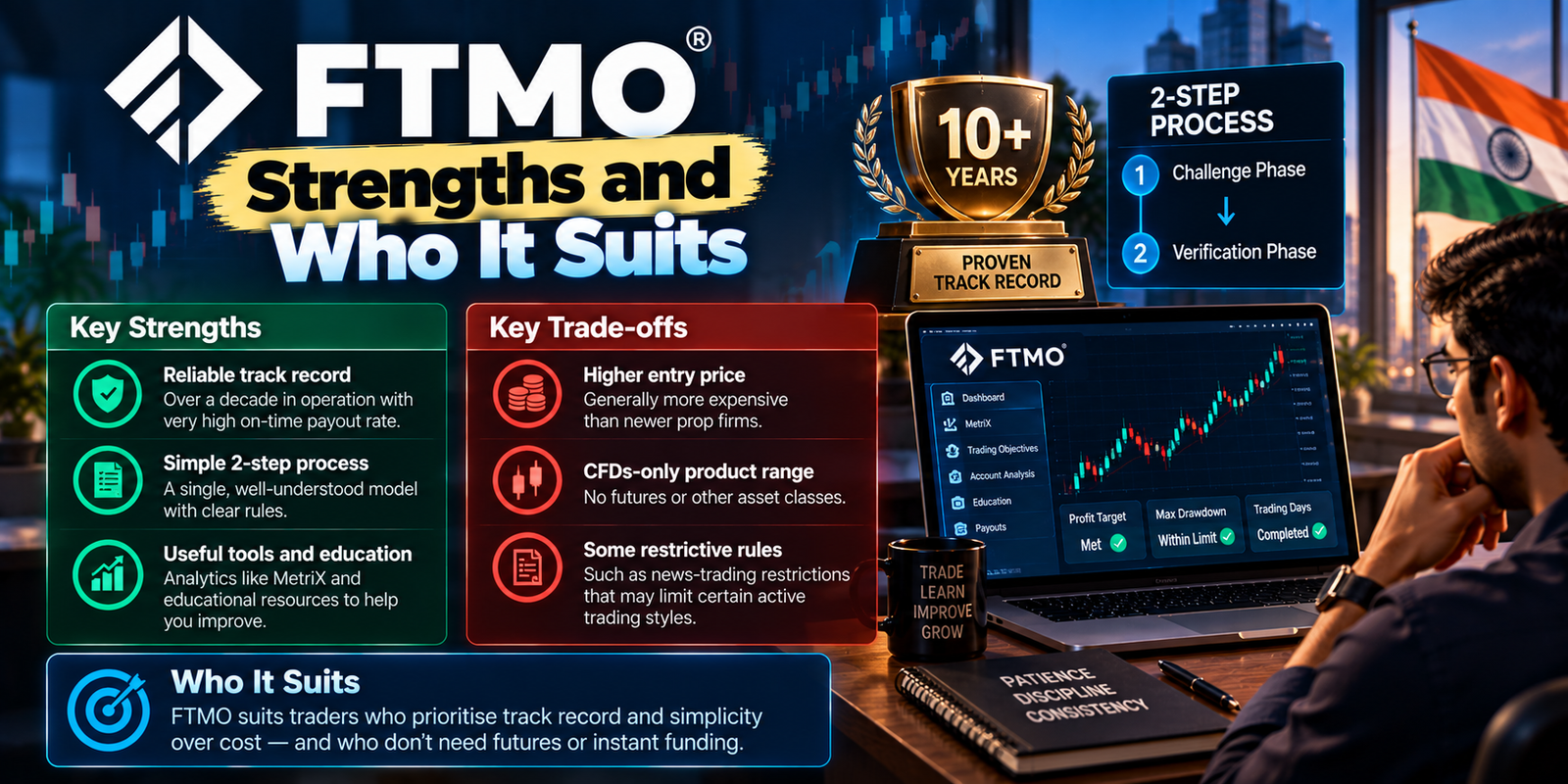
FTMO’s appeal is reliability. With over a decade in operation, a very high on-time payout rate and a single, well-understood 2-step process, it minimises the number of moving parts between a profitable month and a withdrawal. Its analytics (like MetriX) and educational resources add value for developing traders. The trade-offs are a higher entry price, a CFDs-only product range, and rules (such as news-trading restrictions) that some active traders find limiting. FTMO suits traders who prioritise track record and simplicity over cost – and who don’t need futures or instant funding.
FundedNext: Strengths and Who It Suits
FundedNext’s appeal is flexibility and value. It offers a menu of challenge types (1-step, 2-step, instant, Express, Stellar), cheaper entry, and among the highest profit splits in the industry – up to 95% on CFDs and 100% on futures – plus a distinctive profit share during the evaluation phase and a 24-hour payout guarantee. It supports both CFDs and futures and permits news trading on certain accounts. The trade-offs are a shorter track record, tight daily loss limits, and a consistency rule that can affect what a payout actually contains. FundedNext suits price-sensitive traders and ‘format shoppers’ who will read the fine print – especially the consistency mathematics – before buying.
The India Layer: What the Affiliate Reviews Skip
This is where a comparison for Indian traders must go beyond features. Three India-specific realities apply to both firms:
1. Both are offshore and unregulated – the grey area
Neither FTMO nor FundedNext is regulated as a trading firm, and both operate from outside India. Prop participation sits in India’s legal grey area: generally treated as buying a simulated evaluation service (not illegal offshore forex), but not explicitly permitted either. (See our guide on whether prop firms are legal in India.)
2. FundedNext and the RBI Alert List
A fact worth knowing: FundedNext reportedly appeared on the RBI Alert List in an October 2024 update, and publicly stated that this was an error and that it does not operate in India. Whatever the merits, an Indian trader should check the current RBI Alert List for both firms themselves before engaging – and factor this history in. FTMO, as far as we’re aware, has not featured on the list, but verify the live list rather than relying on this.
3. Payments, remittance and tax
For both firms, you’ll pay the challenge fee as an outward remittance (a service payment, within remittance rules) and receive payouts as inward foreign income. Those payouts are taxable in India – generally as foreign-source business income on ITR-3 with Schedule FSI/FA disclosure – and non-disclosure risks the Black Money Act. (See our guide on how prop-firm payouts are taxed in India.)
Which Should an Indian Trader Choose?
On features alone, the honest answer is ‘it depends on your style’: choose FTMO if you value track record, simplicity and payout reliability and don’t mind paying more; choose FundedNext if you want lower cost, more challenge formats and higher splits, and you’ll read the consistency rules carefully. But for an Indian trader, the firm choice is arguably the second decision. The first is whether to engage with offshore prop firms at all, given the grey area and the compliance load – and if you do, to do it properly: verify the current RBI Alert List, keep clean remittance records, and declare every payout. The best-featured firm is worthless if you skip the India homework.
The Honest Caveats (Both Firms)
- Low pass rates – the large majority of traders fail prop challenges; the fee is a real, likely cost, not an investment.
- Offshore risk – both are unregulated as trading firms; rules can change and, in a dispute, there’s no Indian recourse.
- Fast-changing terms – prices, splits and rules shift frequently; always verify on the firm’s live page before paying.
- The grey area – prop participation isn’t explicitly permitted in India; treat it as a defensible-but-unsettled position.
- Tax is non-negotiable – payouts are taxable foreign income; disclosure failures carry serious penalties.
Common Misconceptions
- ‘One firm is simply the best for everyone.’ – They suit different priorities: FTMO for record, FundedNext for value/flexibility.
- ‘A prop firm is a way to get funded capital risk-free.’ – You pay a fee and most fail; it’s not free money.
- ‘These firms are tailored to India.’ – They’re global; India’s grey area and tax rules are on you.
- ‘If it’s on the RBI Alert List, it’s automatically a scam.’ – The list flags unauthorised-in-India entities; check and judge, but know the history.
- ‘The affiliate review settles the choice.’ – Those pages earn commissions; verify facts independently.
Learn more abiut Daily Chart Forex Trading Strategy
Myths vs Facts
| Myth | Fact |
|---|---|
| FTMO and FundedNext are basically identical. | FTMO favours track record/simplicity; FundedNext favours cost/flexibility/splits. |
| Higher profit split always means more money. | Consistency rules and pass rates affect what you actually keep. |
| Prop firms are clearly legal and safe in India. | They’re an offshore grey area; FundedNext has appeared on the RBI Alert List. |
| Payouts don’t need to be declared. | They’re taxable foreign income; non-disclosure risks the Black Money Act. |
Disclaimer
This article is for educational purposes only and is not financial, legal or tax advice, and is not an endorsement of FTMO, FundedNext or any prop firm. Prop-firm terms, pricing and rules change frequently; figures were checked against 2026 sources but must be verified live before purchase. Prop participation in India is an unsettled legal grey area, most traders fail challenges, and offshore firms offer no Indian recourse. Verify the current RBI Alert List, and consult a qualified chartered accountant or lawyer familiar with FEMA and foreign income before acting
Expert Analysis
Comparing FTMO and FundedNext on features is easy and, for an Indian trader, slightly beside the point. On the merits, the two firms genuinely occupy different ends of the prop shelf: FTMO is the incumbent that sells certainty – a decade-plus record, one model, and a payout process with very little friction – while FundedNext is the challenger that sells optionality and price, with more challenge formats, higher splits and faster payouts, at the cost of a shorter history and more fine print to read. Neither is objectively ‘better’; a disciplined swing trader who values reliability will rationally prefer FTMO, while a cost-conscious trader who will actually study the consistency rules will rationally prefer FundedNext. The feature comparison, in other words, has a clean answer only once you’ve defined your own priorities.
What the glossy comparisons systematically underweight is everything that is specific to being Indian. Both firms are offshore and unregulated, both sit inside the same legal grey area, and one of them – FundedNext – has actually surfaced on the RBI Alert List, a detail an Indian trader is far more affected by than a five-percentage-point difference in profit split. Layer on the tax reality – payouts are taxable foreign income that must be disclosed, with the Black Money Act waiting for those who don’t – and the ordering of decisions inverts. The mature approach is to treat ‘FTMO or FundedNext’ as the last question, not the first: decide whether you are willing to operate in the grey area at all, commit to doing the compliance properly, accept that most challenges fail and the fee is a probable cost, and only then pick the firm whose model fits your trading. Done in that order, the choice between two competent firms is a genuine luxury; done in the reverse order, the profit split you optimised for is the least of your problems.
Key Takeaways
- FTMO (2014, Czech Republic): longer track record, standard 2-step, CFDs only, higher price, fast reliable payouts.
- FundedNext (2022, UAE): cheaper entry, more challenge types, up to 95%/100% splits, CFDs + futures, 24-hour payouts.
- Choose FTMO for record and simplicity; FundedNext for cost, flexibility and higher splits (read the consistency rules).
- Both are offshore grey-area firms for India; FundedNext has appeared on the RBI Alert List – verify the current list.
- Payouts are taxable foreign income; most traders fail challenges; verify live terms and do the India compliance first.
Frequently Asked Questions (FAQ)
Q: FTMO vs FundedNext – which is better for Indian traders?
A: It depends on priorities: FTMO for track record, simplicity and payout reliability; FundedNext for lower cost, more challenge types and higher splits. Both are offshore grey-area firms in India.
Q: Is FundedNext on the RBI Alert List?
A: FundedNext reportedly appeared on the RBI Alert List in an October 2024 update and publicly called it an error, saying it doesn’t operate in India. Check the current list yourself before engaging.
Q: Do FTMO and FundedNext accept Indian traders?
A: Both generally accept traders from India (FTMO notably excludes US traders). Verify current country policies on each firm’s site.
Q: Which is cheaper, FTMO or FundedNext?
A: FundedNext generally has cheaper entry (around $99 for a $10K account versus about $155 for FTMO), plus frequent discounts. Verify live pricing.
Q: Which has the higher profit split?
A: FundedNext – up to 95% on CFDs and 100% on futures, plus a profit share during evaluation – versus FTMO’s 80% scaling to 90%.
Q: Which pays out faster?
A: FundedNext advertises a 24-hour payout guarantee; FTMO typically pays within 1-2 business days with a very high on-time rate.
Q: Which firm is more reliable?
A: FTMO has the longer track record (since 2014) and a high on-time payout rate; FundedNext is newer but large and fast-growing.
Q: Are these prop firms legal in India?
A: Prop participation is generally treated as legal but sits in an unregulated grey area – buying a simulated evaluation, not offshore forex. Get professional advice.
Q: Do I pay tax on FTMO or FundedNext payouts?
A: Yes. Payouts are taxable in India, generally as foreign-source business income on ITR-3 with Schedule FSI/FA disclosure.
Q: Can I pay the challenge fee from India?
A: Yes, typically by card or remittance as a service payment within LRS/remittance rules; keep records. Check the RBI Alert List first.
Q: Which is better for beginners?
A: FTMO’s single, structured model and educational resources suit learners; FundedNext’s flexibility and lower cost suit experimentation – both require discipline.
Q: Which supports futures?
A: FundedNext supports both CFDs and futures; FTMO is CFDs only.
Q: What is a consistency rule?
A: A rule (notable at FundedNext) that limits how concentrated your profits can be, affecting payout eligibility – read it carefully before choosing.
Q: What are the risks with either firm?
A: Low pass rates, offshore/unregulated status with no Indian recourse, fast-changing terms, the legal grey area, and tax-disclosure obligations.
Q: Should I trust a prop firm’s own comparison?
A: Treat it with caution – the firms and affiliates earn from sign-ups. Verify facts independently and get professional advice.