Introduction
The daily forex strategy is one of the most reliable approaches for traders who want consistent results without spending countless hours watching price movements. Unlike lower timeframes that often produce market noise and false signals, the daily chart provides a broader perspective of market trends, making it easier to identify high-probability trading opportunities. Professional traders and institutional investors frequently rely on daily charts because they offer clearer price action, stronger technical signals, and more reliable trend confirmation.
Trading on the daily timeframe is particularly beneficial for individuals who have full-time jobs or other responsibilities. Instead of monitoring the markets throughout the day, traders only need to analyze the charts once the daily candle closes. This creates a disciplined trading routine that reduces emotional decision-making and helps traders focus on quality setups rather than frequent trades.
A successful daily forex strategy combines technical analysis, proper risk management, patience, and discipline. Traders learn to follow established trends, identify important support and resistance levels, and wait for price action confirmations before entering trades. Because daily candles represent an entire trading day, each signal carries more weight than signals on lower timeframes. This significantly improves the probability of successful trades while reducing the impact of random market fluctuations.
Swing Trading with the Daily Forex Strategy
One of the biggest advantages of the daily forex strategy is its suitability for swing trading. Swing trading involves holding positions for several days or even weeks to capture larger market movements. Instead of aiming for small intraday profits, swing traders seek significant price swings that develop over time.
Daily charts are ideal for identifying these larger market movements because they clearly reveal long-term trends and meaningful pullbacks. Traders typically wait for price to retrace toward support in an uptrend or resistance in a downtrend before entering a position. This allows them to join the prevailing trend with relatively low risk.
Swing trading also provides flexibility. Traders do not need to monitor the charts continuously because daily candles only close once every twenty-four hours. Decisions can be made after the daily candle closes, allowing traders to manage their positions without interrupting their daily routine.
Risk management also becomes easier with swing trading. Wider stop losses account for normal market fluctuations while larger profit targets maintain favorable risk-to-reward ratios. Many successful traders target reward-to-risk ratios of 2:1 or even 3:1, allowing profitability even if only half of their trades are winners.
Patience is perhaps the most valuable quality in swing trading. Instead of chasing every market movement, traders wait for prices to reach predetermined areas before entering. This disciplined approach often produces more consistent long-term results than constant short-term trading.
Trend Following Using the Daily Forex Strategy
Trend following forms the foundation of nearly every successful daily forex strategy. Financial markets spend much of their time moving in identifiable trends, and trading in the direction of those trends significantly increases the probability of success.
Daily charts make trend identification straightforward. Traders observe whether price is creating higher highs and higher lows, indicating an uptrend, or lower highs and lower lows, signaling a downtrend. Moving averages such as the 50-day and 200-day averages provide additional confirmation of the prevailing market direction.
When markets trend upward, traders look for buying opportunities during temporary pullbacks rather than attempting to sell against the trend. Conversely, during downtrends, traders search for selling opportunities after corrective rallies. This approach aligns traders with institutional money flow instead of fighting against it.
Trend-following strategies also reduce emotional decision-making. Rather than constantly predicting reversals, traders simply follow what price is already doing. This objective decision-making process improves consistency and helps eliminate impulsive trades based on fear or greed.
Risk Management in the Daily Forex Strategy
Even the best daily forex strategy cannot succeed without effective risk management. Successful traders understand that preserving capital is more important than maximizing profits on individual trades.
Risk should generally be limited to a small percentage of the trading account on each position. Many experienced traders risk only one or two percent of their account per trade. This ensures that a series of losing trades does not significantly damage overall capital.
Stop-loss orders should always be placed based on market structure rather than arbitrary distances. Logical locations include below support for long trades or above resistance for short trades.
Position sizing should be adjusted according to stop-loss distance. Wider stops require smaller position sizes, while tighter stops allow slightly larger positions while maintaining consistent risk.
Emotional discipline is equally important. Traders must resist moving stop losses farther away or closing profitable trades prematurely due to fear. Following a well-tested trading plan consistently is far more effective than reacting emotionally to every market movement.
Low-Stress Trading with Daily Charts
One of the primary reasons many traders choose the daily forex strategy is the opportunity for low-stress trading. Unlike scalping or day trading, daily chart trading eliminates the pressure of constantly monitoring price movements throughout the day.
Lower timeframe trading often involves rapid decisions, frequent market noise, and emotional reactions to every price fluctuation. This environment can quickly lead to stress, fatigue, and poor decision-making. Daily chart traders experience the opposite. They typically analyze the market once after the daily candle closes, identify potential opportunities, and then allow the market sufficient time to develop.
This slower pace encourages better planning. Every trade is carefully evaluated using technical analysis, risk management, and market structure before execution. Since traders are not making split-second decisions, they are less likely to enter impulsive trades.
Low-stress trading also promotes psychological stability. Traders become more patient, confident, and disciplined because they are focused on long-term consistency rather than immediate results. Emotional swings caused by frequent wins and losses become far less significant.
Another advantage is improved work-life balance. Many traders successfully combine daily chart trading with full-time careers because chart analysis requires only a limited amount of time each day. This makes daily trading an attractive option for professionals, students, and business owners alike.
Ultimately, low-stress trading contributes to better trading performance by allowing traders to remain objective and disciplined regardless of short-term market fluctuations.
Forex Setups for a Daily Chart Forex Trading Strategy

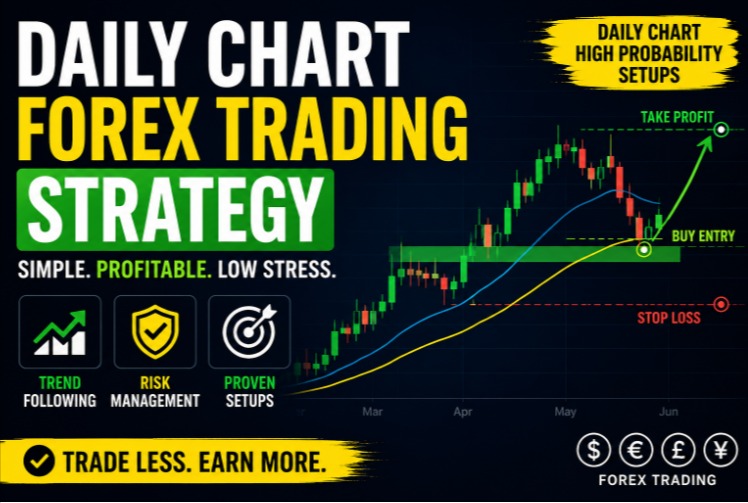
Successful forex setups are the backbone of any daily forex strategy because they help traders identify high-probability trading opportunities while avoiding unnecessary market noise. The daily chart offers stronger technical signals than lower timeframes since each candlestick represents an entire trading day. This allows traders to make informed decisions based on significant price movements rather than reacting to short-term fluctuations. A well-planned forex setup combines trend analysis, support and resistance levels, candlestick confirmation, and risk management to improve trading consistency.
The first step in identifying quality forex setups is determining the overall market trend. In an uptrend, traders should focus on buying opportunities after temporary pullbacks toward support levels or moving averages. In a downtrend, selling opportunities become more favorable when price retraces toward resistance before continuing lower. Trading in the direction of the dominant trend increases the probability of success because it aligns trades with the broader market momentum.
Support and resistance zones are another essential part of daily chart forex setups. Historical price levels where buyers or sellers previously entered the market often become areas where future price reactions occur. When price approaches these zones and forms a strong candlestick pattern such as a bullish engulfing candle, bearish engulfing candle, pin bar, or inside bar, traders receive additional confirmation that the market may continue in the expected direction.
Moving averages also strengthen daily chart forex setups. Many traders use the 20-day, 50-day, or 200-day moving averages to identify dynamic support and resistance. When price pulls back to one of these averages while maintaining the overall trend, it often creates a high-probability entry opportunity. Combining moving averages with horizontal support or resistance further improves trade quality.
Conclusion
The daily forex strategy offers one of the most balanced and sustainable approaches to trading the foreign exchange market. By focusing on higher timeframe analysis, traders benefit from clearer trends, more reliable technical signals, and reduced market noise. This creates an environment where patience, discipline, and consistency become the primary drivers of long-term success.
The strategy naturally complements swing trading, allowing traders to capture significant market moves while avoiding the constant pressure of lower timeframe trading. Through trend following, traders align themselves with the dominant market direction, increasing the probability of profitable trades. The slower pace of low-stress trading helps reduce emotional decision-making and supports a healthier work-life balance, making the strategy ideal for both part-time and full-time traders. By learning to identify high-quality forex setups, practicing sound risk management, and maintaining a structured trading routine, traders can steadily improve their performance over time.
Although no trading strategy guarantees profits, the daily chart provides one of the strongest foundations for consistent forex trading. Success ultimately depends on patience, discipline, continuous learning, and strict adherence to a well-defined trading plan. Traders who commit to mastering the daily timeframe often discover that fewer, higher-quality trades can produce better long-term results than frequent trading driven by emotion. With proper execution and realistic expectations, the daily forex strategy can become a reliable framework for building lasting success in the forex market.