
Quick answer
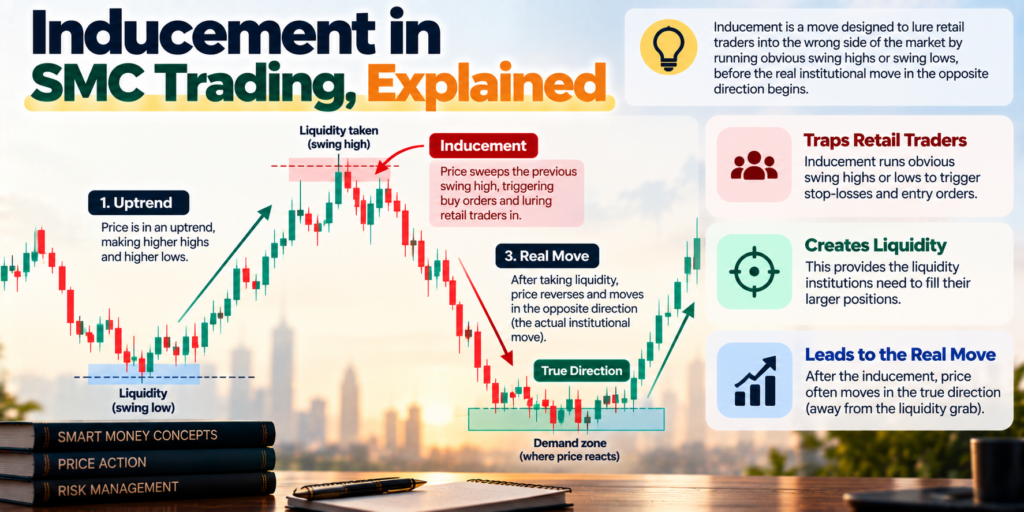
Inducement in SMC trading is the ‘bait’ – trap liquidity placed before a genuine order block or supply/demand zone to lure retail traders in early. Smart money induces those traders, sweeps their stops, then moves to the real zone. Spotting inducement stops you entering too soon and becoming the liquidity.
Introduction
Ever entered a ‘perfect’ setup, watched it stop you out by a whisker, then seen price rocket exactly the way you predicted – without you? You were probably caught by inducement. In Smart Money Concepts, inducement is the trap that makes retail traders enter too early, feeding the very liquidity institutions need. Understanding inducement in SMC trading is what turns a trader from bait into a patient hunter.
This guide explains what inducement is, how it fits with liquidity and order blocks, how to spot it, and how to trade around it instead of into it. This is educational content, not investment advice – SMC is a discretionary framework, and no concept guarantees a winning trade.
What Is Inducement?
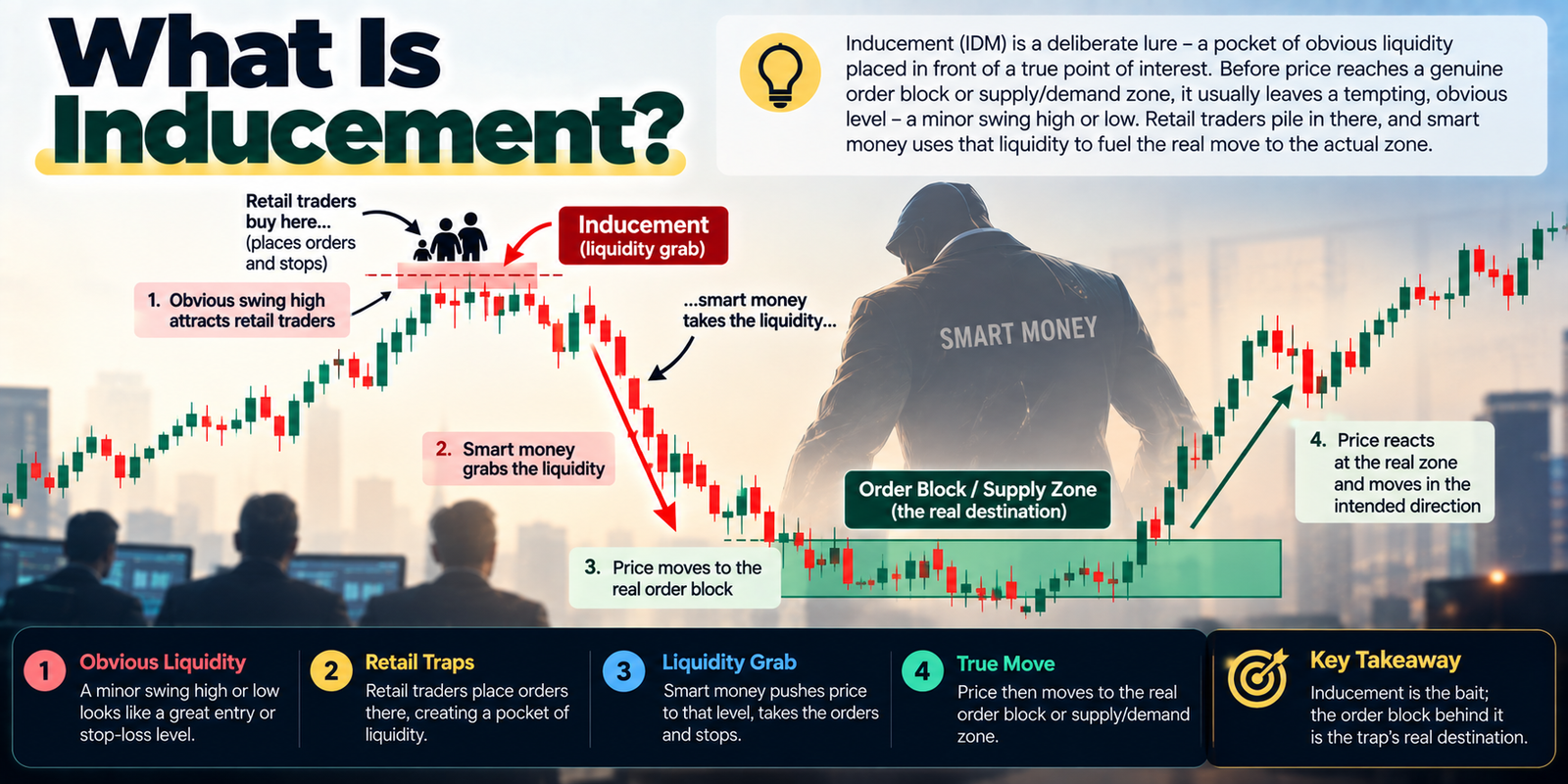
Inducement (often shortened to IDM) is a deliberate lure – a pocket of obvious liquidity placed in front of a true point of interest. Before price reaches a genuine order block or supply/demand zone, it usually leaves a tempting, obvious level: a minor swing high or low that looks like a great entry or a safe place for a stop-loss. Retail traders pile in there. That obvious level is the inducement, and the orders and stops sitting at it are exactly the liquidity smart money intends to grab on the way to the real zone.
In plain terms: inducement is the bait; the order block behind it is the trap’s real destination. The market ‘induces’ you to commit early, takes your liquidity, then does what it was always going to do.
Inducement, Liquidity and Order Blocks: The Relationship
These three concepts are easy to muddle, so here’s how they line up:
| Concept | What it is | Its role |
|---|---|---|
| Liquidity | Resting orders/stops at obvious levels | The fuel institutions need to fill positions |
| Inducement (IDM) | A specific pocket of liquidity before the real zone | The bait that lures retail in early |
| Order block / zone | The area where institutions actually enter | The true destination and entry point |
So inducement is a type of liquidity – the particular one positioned to trap traders before the order block. The sequence is almost always: obvious level (inducement) first, real zone (order block) behind it.
How Inducement Works: The Trap in Motion
A typical bullish example shows the mechanism:
- The obvious level forms – in an uptrend, a minor higher low appears that looks like clean support – the inducement.
- Retail enters early – traders buy that support and place stops just below it, creating a pool of sell-side liquidity.
- Price sweeps the inducement – the market dips through that level, triggering those stops and grabbing the liquidity.
- Price reaches the real order block – it continues to the genuine demand zone sitting below the inducement.
- The real move begins – from the order block, price reverses up – now with the early traders already stopped out.
The painful part for the early trader is that their read on direction was right; their timing, tricked by the inducement, was wrong.
How to Identify Inducement
Inducement hides in plain sight because it’s meant to look attractive. Watch for:
- A minor swing high or low between current price and your intended order block – the most recent ‘obvious’ level.
- Equal highs or equal lows, which advertise a cluster of stops sitting just beyond them.
- A textbook support/resistance level that ‘everyone’ can see – the more obvious, the more likely it’s bait.
- An unmitigated minor level sitting in front of a stronger, higher-timeframe zone.
A useful rule of thumb: if a level looks too clean and too obvious to be an entry, it may be inducement designed to trap you before the real zone.
Why Inducement Matters
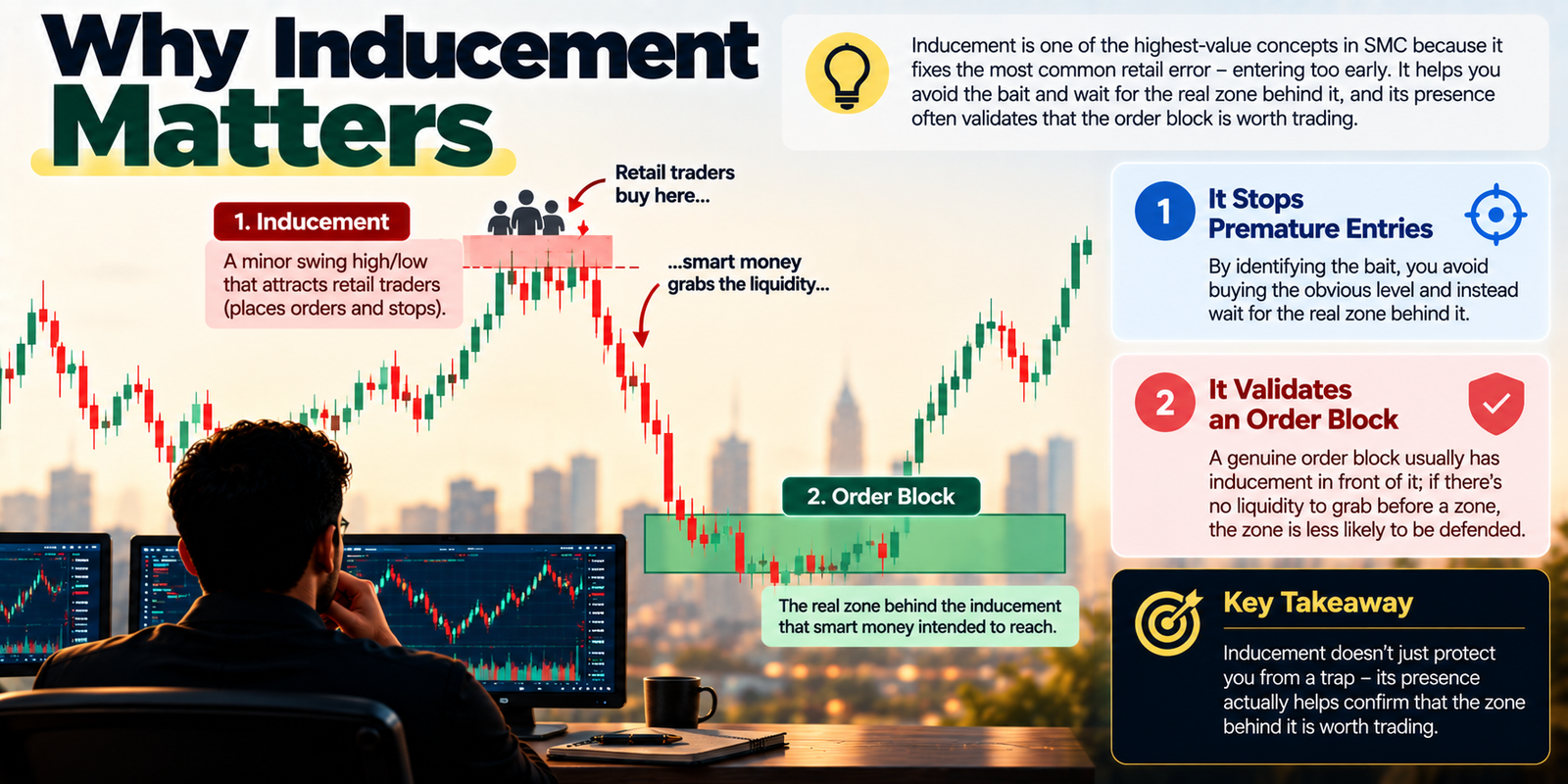
Inducement is one of the highest-value concepts in SMC precisely because it fixes the most common retail error – entering too early. It does two jobs for you:
- It stops premature entries – by identifying the bait, you avoid buying the obvious level and instead wait for the real zone behind it.
- It validates an order block – a genuine order block usually has inducement in front of it; if there’s no liquidity to grab before a zone, the zone is less likely to be defended.
In other words, inducement doesn’t just protect you from a trap – its presence actually helps confirm that the zone behind it is worth trading.
How to Trade Around Inducement
The whole point is to let the inducement do its job to someone else, then enter where institutions do:
- Read structure and find the zone – identify the trend and your real order block or supply/demand zone (your point of interest).
- Spot the inducement in front – mark the obvious minor level between price and the zone.
- Wait for the sweep – let price take out the inducement (grab the liquidity) rather than entering at it.
- Enter at the real zone – look for the reaction at the order block behind the inducement, with confirmation.
- Stop beyond the zone – place your stop past the order block’s far edge, and target the next liquidity or structure.
Patience is the entire edge here: the trader who waits for inducement to be swept enters where the trapped trader’s stop-loss just was.
Inducement in Ranges vs Trends
Inducement appears in both, with a slightly different flavour. In a trend, it’s usually the minor pullback level before a continuation zone – a quick trap before the trend resumes. In a range, inducement often sits just inside the boundaries: price pokes past an obvious range high or low (grabbing breakout traders’ stops) before reversing back into the range toward the opposite side. In both cases the principle holds: the obvious level is the bait, and the real reaction comes from the zone or boundary behind it.
Does It Work? An Honest Take
Inducement describes something real – markets genuinely do sweep obvious levels before reversing, and ‘stopped out right before the move’ is a universal trader experience for a reason. As a concept, it’s one of the more useful pieces of SMC because it directly targets impatience. But the honest caveats apply: inducement is discretionary and, like all SMC ideas, can be drawn in after the fact to explain any wick. Not every obvious level is inducement, and not every sweep leads to a clean reversal. Treat it as a filter for patience and a validation tool for zones – not a guarantee – and keep it inside a plan with strict risk management. Used that way, it can meaningfully cut down the early, trapped entries that plague retail traders.
Common Mistakes
- Entering at the inducement itself – the exact trap the concept warns against.
- Labelling every level as inducement in hindsight to explain a loss.
- Ignoring the higher-timeframe zone and fixating on the obvious minor level.
- Entering before the inducement is actually swept.
- Dropping the stop-loss because the setup ‘looks certain’ after the sweep.
Myths vs Facts
| Myth | Fact |
|---|---|
| Inducement is a guaranteed reversal signal. | It’s a discretionary trap concept; sweeps don’t always reverse cleanly. |
| The obvious support/resistance is the entry. | Often it’s the inducement; the real entry is the zone behind it. |
| Inducement and order blocks are the same. | Inducement is the bait liquidity; the order block is the real zone. |
| You can enter before the inducement is taken. | The setup waits for the sweep first, then enters at the real zone. |
Risk disclaimer
This article is for educational purposes only and is not investment advice. Inducement is a discretionary Smart Money Concepts idea, not a guaranteed signal, and setups can fail. Trading involves risk of loss, and most retail traders lose money. Always use a stop-loss and sound position sizing, trade only through SEBI-registered brokers on recognised exchanges, and consult a qualified professional before trading.
Expert Analysis
Inducement is arguably the single most practically useful idea in the Smart Money toolkit, because it attacks the error that costs retail traders more than any faulty indicator: entering too early at the obvious level. Every beginner is taught to buy support and sell resistance, which means every beginner’s orders and stops cluster at exactly the levels institutions can see and exploit. Inducement is the formalisation of that exploitation – the recognition that the cleanest-looking level in front of a real zone is often placed there, in effect, to be taken. Once a trader internalises this, their whole relationship with ‘obvious’ levels changes: instead of rushing to trade them, they start asking whether that level is the destination or merely the bait in front of it.
The discipline inducement demands is patience, and patience is where its real value and its real difficulty both lie. Waiting for the obvious level to be swept before entering at the zone behind it feels counterintuitive – you are deliberately passing on the entry that looks good to wait for the one that feels late – and it requires trusting your higher-timeframe read while price does something uncomfortable. That is also precisely why it works when it works: you end up entering where the trapped traders’ stops just were, with those weaker hands already flushed out and the path ahead clearer. The honest caveat remains that inducement, like all of SMC, is discretionary and easy to over-fit in hindsight, so it should filter and validate rather than dictate. But as a mental model – ‘is this the zone, or the bait before it?’ – it is one of the more genuinely edge-giving questions a trader can learn to ask, provided it sits inside disciplined risk management rather than replacing it.
Key Takeaways
- Inducement (IDM) is trap liquidity – the bait placed before a real order block to lure retail in early.
- It’s a specific type of liquidity; the order block behind it is the true entry.
- Spot it as the obvious minor level (or equal highs/lows) between price and your zone.
- Wait for the inducement to be swept, then enter at the real zone with a stop beyond it.
- It curbs early entries and helps validate a zone – but it’s discretionary, not guaranteed.
Frequently Asked Questions (FAQ)
Q: What is inducement in SMC trading?
A: It’s trap liquidity – an obvious level placed before a real order block or zone to lure retail traders in early, so smart money can sweep their stops.
Q: What does IDM mean?
A: IDM is shorthand for inducement in Smart Money Concepts – the bait liquidity before a genuine point of interest.
Q: How do I spot inducement?
A: Look for the obvious minor swing high/low, or equal highs/lows, sitting between current price and your intended order block or zone.
Q: What is the difference between inducement and an order block?
A: Inducement is the bait liquidity that gets swept; the order block is the real zone where institutions enter and price reacts.
Q: Is inducement the same as liquidity?
A: Inducement is a specific type of liquidity – the pocket positioned to trap traders before the real zone.
Q: Why does inducement matter?
A: It stops you entering too early at the obvious level, and its presence helps validate that the zone behind it is worth trading.
Q: How do I trade around inducement?
A: Find your real zone, mark the inducement in front, wait for it to be swept, then enter at the zone with a stop beyond it.
Q: Should I enter at the inducement level?
A: No – that’s the trap. The setup waits for the inducement to be swept, then enters at the real order block behind it.
Q: What is an inducement sweep?
A: When price runs through the inducement level, triggering the stops resting there, before moving on to the real zone.
Q: Does a valid order block need inducement?
A: Often yes – a genuine order block usually has inducement in front of it; without liquidity to grab, a zone is less likely to be defended.
Q: How is inducement different in a range?
A: In a range, inducement often sits just inside the boundaries, trapping breakout traders before price reverses back inside.
Q: Is inducement a guaranteed reversal signal?
A: No. It’s a discretionary concept; sweeps don’t always lead to clean reversals, so use it with confirmation and risk control.
Q: Does inducement work on Indian markets?
A: Yes. It reads liquidity behaviour and applies to any market, including forex and Indian currency derivatives.
Q: How does inducement relate to ICT?
A: ICT uses the same idea under liquidity and manipulation concepts; inducement is the SMC term for the bait before the real move.
Q: Can I over-use the inducement concept?
A: Yes – labelling every level as inducement in hindsight is a common trap. Use it as a filter, not an after-the-fact excuse.