
Ask any experienced trader what changed when they finally became consistent, and the answer is rarely a new indicator. It’s a process — the same preparation, the same checks, the same review, done every session whether they feel like it or not. Strategy gets the attention, but a trading routine and daily habits are what actually compound over time. This guide shows how to build one that survives contact with real markets and real emotions, instead of collapsing after the first bad week.
QUICK ANSWER
A trading routine is a fixed set of daily habits split across three phases: pre-market (prepare — news, watchlist, levels, risk limit), the session (execute — follow the plan, size by risk, journal live), and post-market (review — journal, tag trades, one lesson). Make it stick by starting small, anchoring each habit to an existing one, and reviewing weekly — consistency beats intensity every time.
Why a trading routine matters
Markets are an endless stream of tempting decisions, and every decision drains a little willpower. Without a routine, you improvise — and improvisation under pressure is where fear and greed take over. A routine does three things: it removes decision fatigue by pre-deciding what you’ll do, it makes your trading measurable so you can actually improve, and it protects you from your own impulses on the days that matter most. That’s why building solid trading routine daily habits is the highest-leverage work a developing trader can do — far more than hunting for one more setup.
The three phases of a trading day
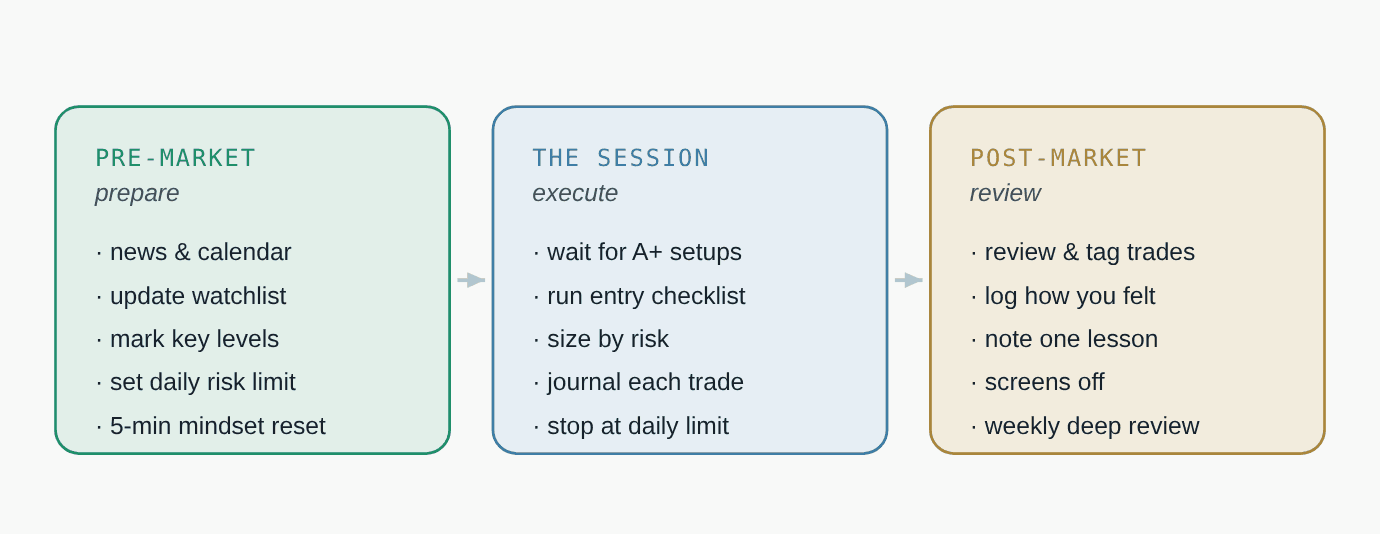
A durable routine isn’t a long to-do list; it’s a simple structure repeated daily. Think of your trading day in three phases — before, during and after the session — each with a short, fixed set of habits.
The pre-market routine: prepare
The pre-market routine is where most of the day’s edge is won, quietly, before a single trade. Spend a fixed block — even 15 minutes — checking the economic calendar and overnight news, updating your watchlist, marking the key support and resistance levels you care about, and deciding your maximum risk for the day. Finish with a short mindset reset: a couple of minutes to arrive calm and rule-bound rather than reactive. A consistent pre-market routine means you enter the session with a plan instead of a feeling.
The session routine: execute
During the session, the goal is boring: follow the plan you already made. This is where discipline is tested, so keep the in-session habits mechanical. Wait for the setups that meet your criteria instead of forcing trades; run a short pre-trade checklist before every entry; size each position by your risk rule, not your conviction; and jot a quick note on each trade as you take it. Crucially, set a daily loss limit and honour it — when you hit it, you’re done for the day. These are the daily habits that stop one bad hour from becoming a blown account.
| 1 | Does this setup match my strategy’s rules — or am I forcing it? |
| 2 | Where is my stop, and how many pips away is it? |
| 3 | What lot size keeps my risk within my per-trade limit? |
| 4 | What’s my target, and is the reward worth the risk? |
| 5 | Am I calm and within my daily limit — or trading on emotion? |
The post-market routine: review
The habit that separates traders who improve from those who repeat the same mistakes is the review. After the session, go through every trade: tag it (setup type, followed-plan or not), note what you felt, and write down a single lesson. Once a week, zoom out and read your journal for patterns — which setups actually make money, which times of day you trade worst, when emotion crept in. This post-session review is where your trading routine daily habits turn into genuine, compounding improvement rather than just activity.
Making the habits stick: the habit loop
Knowing the routine isn’t the hard part — doing it every day is. Behaviour research describes habits as a loop: a cue triggers a routine, which delivers a reward, and the reward makes the loop more automatic next time. You can engineer that loop deliberately for trading.
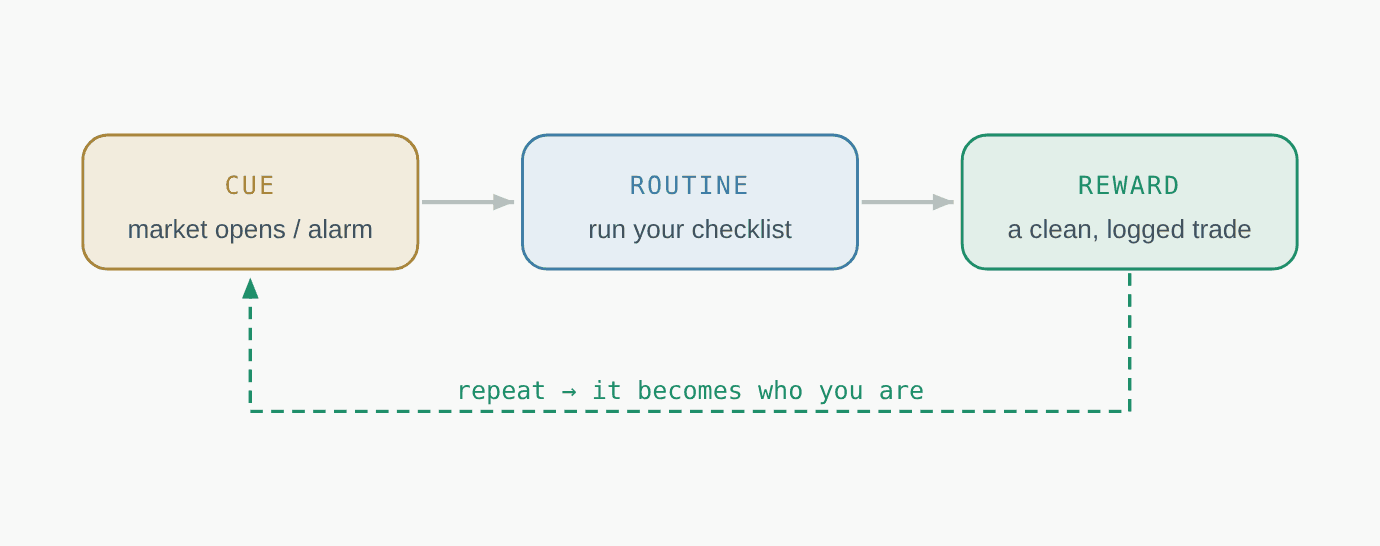
A few principles make the loop hold:
- Start absurdly small. A five-minute pre-market check you actually do beats a one-hour ritual you abandon. Build the habit first, expand later.
- Anchor to an existing habit. Attach your routine to something you already do daily — “after my morning coffee, I check the calendar.” The old habit becomes the cue.
- Design your environment. Keep your journal open, your checklist visible, distractions closed. Make the good routine the path of least resistance.
- Make the reward visible. Tick a box, keep a streak, end each session logged and calm. The felt reward of a followed process is what wires the habit in.
- Choose consistency over intensity. Ten minutes every day beats three hours once a week. Habits are built by frequency, not effort.
A sample daily trading routine
| When | Daily habits |
|---|---|
| Before | Check economic calendar & overnight news · update watchlist · mark key levels · set the day’s max risk · 5-minute mindset reset |
| During | Trade only planned setups · run the pre-trade checklist · size every position by risk · journal each trade live · stop at the daily loss limit |
| After | Review & tag every trade · log the emotion behind each · write one lesson · close the screens |
| Weekly | Read the journal for patterns · check rule-adherence, not just P&L · adjust one thing · rest |
The exact times matter less than the order and the repetition. Adapt the blocks to your market’s hours and your own energy — a routine built around someone else’s schedule rarely sticks.
Why routines fail (and how to fix it)
- Too ambitious. A routine with twenty steps dies in a week. Cut it to the few habits that matter and protect those.
- No review loop. Without the journal and weekly review, you can’t see what’s working, so the routine never improves.
- Skipping after a loss. The days you least feel like following the routine are the days it matters most. Adherence is the metric, not mood.
- Tying self-worth to P&L. Judge yourself on whether you followed your process, not on whether the trade won. Good process sometimes loses; that’s normal.
- Overtrading and screen fatigue. A routine should include stopping — a daily limit and a hard end time protect both your account and your head.
The honest caveat: a routine makes you consistent — it does not make you profitable on its own. Its job is to protect you from your own worst impulses and give a real edge the chance to show up over many trades. Guard your wellbeing too: trading can become compulsive, so build in limits and time away, don’t chase losses, and step back entirely if it’s affecting your sleep, mood or finances. Trading carries a real risk of loss; never risk money you can’t afford to lose. For traders in India: anchor your routine to the hours you actually trade — residents trade currency derivatives legally through a SEBI-registered broker, while offshore spot forex is restricted under FEMA.
Key takeaways
- Consistency, not a secret strategy, is what makes traders profitable — and a routine is how you get consistent.
- Structure the day in three phases: pre-market (prepare), session (execute), post-market (review).
- The journal and weekly review are the keystone habits — they turn activity into improvement.
- Make habits stick via the cue → routine → reward loop: start small, anchor to existing habits, reward the process.
- Judge yourself on rule-adherence, not each trade’s outcome.
- Build in limits and rest — a routine that never stops is a health risk, not an edge.
Learn more about What Is a Currency Pair? Base vs Quote Explained
Frequently asked questions
What are the daily habits of a good trading routine?
Checking the economic calendar and news, updating a watchlist, marking key levels, setting a daily risk limit, following a pre-trade checklist, sizing by risk, journaling every trade, and reviewing at the end of the day. A weekly review ties it together.
How long should a trading routine take?
It can be short — even 15 minutes of pre-market prep and a few minutes of post-session review is enough to start. Consistency matters far more than length; a small routine you do daily beats a long one you abandon.
What is a pre-market routine?
A pre-market routine is the fixed set of things you do before the session: reviewing news and the economic calendar, updating your watchlist, marking key levels, deciding your risk for the day, and getting into a calm, rule-focused mindset.
Why is a trading journal so important?
The journal is the keystone habit. By recording each trade — setup, whether you followed the plan, and how you felt — you can review for patterns and actually improve, rather than repeating the same mistakes unknowingly.
How do I make a trading routine stick?
Use the habit loop: pick a reliable cue, keep the routine small, and reward the process (a ticked checklist, a logged trade, a kept streak). Anchor new habits to existing ones, design your environment to make them easy, and prioritise consistency over intensity.
How do I stop overtrading?
Build limits into the routine: a maximum number of trades or a daily loss limit, plus a hard end time. When you hit a limit, the session is over. Judging yourself on following the plan rather than on making money also removes the urge to force trades.
Should I follow my routine even after a big loss?
Yes — especially then. The days you least want to follow the process are when discipline protects you most. If a loss has you rattled, the routine’s job is to slow you down, and its daily limit is there to stop revenge trading.
How do I measure whether my routine is working?
Track adherence, not just profit: what percentage of trades followed your rules, and whether you completed each phase of the routine. Over time, high adherence with a sound strategy is what produces results; measuring only P&L hides the process.