Quick answer
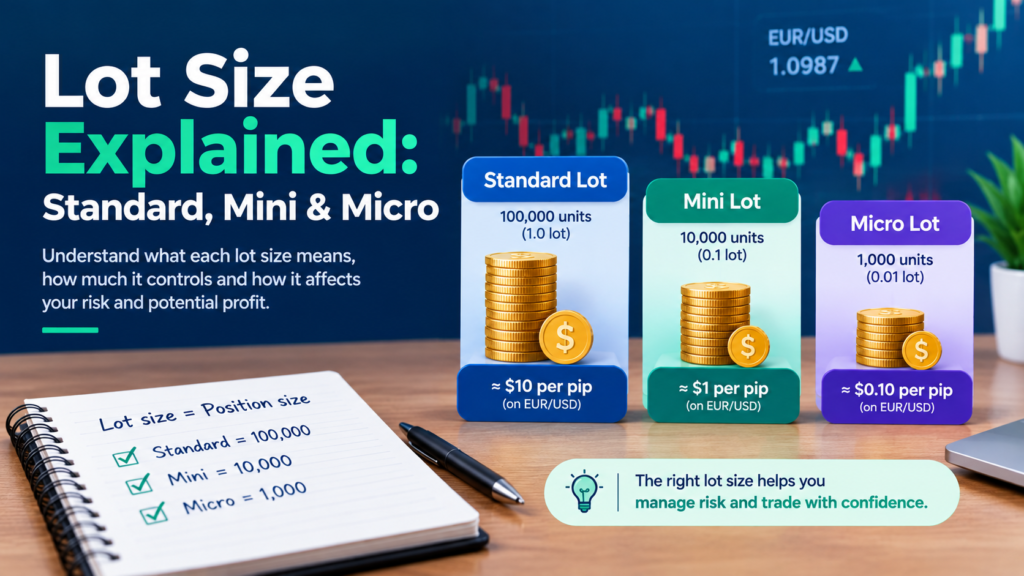
A lot is the standardised trade size in forex, measured in units of the base currency. The lot size in forex sets how much each pip is worth: a standard lot is 100,000 units (about $10 per pip), a mini lot 10,000 ($1), a micro lot 1,000 ($0.10) and a nano lot 100 ($0.01).
Introduction
Ask a new trader what決 they risk on a trade and many can’t say – because they haven’t grasped lot size. Yet the lot size in forex is the dial that turns a price move into a rupee or dollar amount: the same 20-pip move can mean two dollars or two hundred, depending purely on your lot. Understanding lots is therefore the bridge between ‘the chart moved’ and ‘my account changed’.
This guide explains lot size from scratch: what a lot is, how the standard, mini, micro and nano sizes compare, how lot size drives your pip value and risk, and the important way it differs on Indian exchanges. All figures were computed and verified. It’s educational information, not investment advice.
What Is a Lot in Forex?
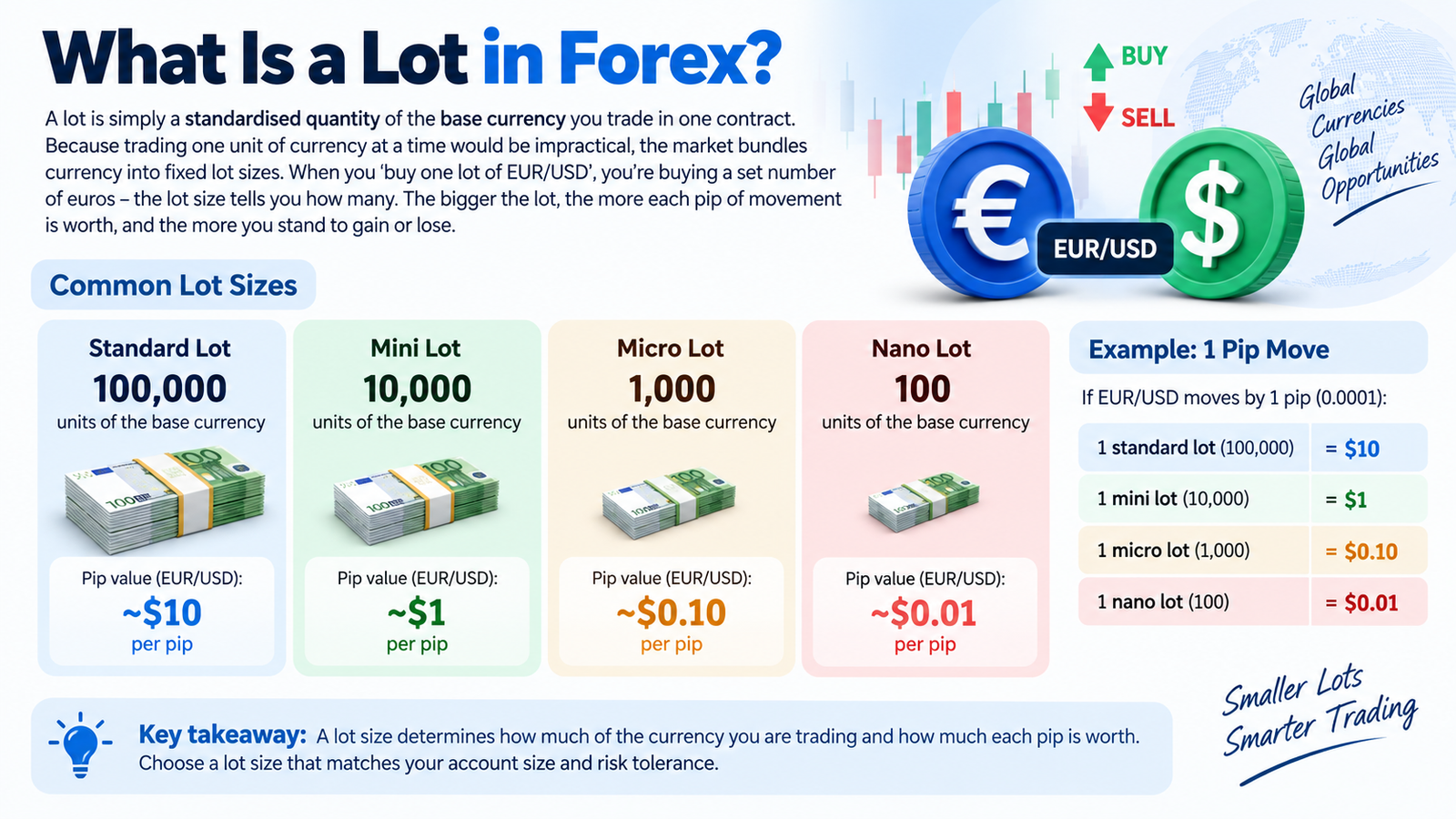
A lot is simply a standardised quantity of the base currency you trade in one contract. Because trading one unit of currency at a time would be impractical, the market bundles currency into fixed lot sizes. When you ‘buy one lot of EUR/USD‘, you’re buying a set number of euros – the lot size tells you how many. The bigger the lot, the more each pip of movement is worth, and the more you stand to gain or lose.
So the lot size in forex isn’t a technicality – it’s the single input that scales every trade. Get it right and your risk is controlled; get it wrong and a normal market wobble can do outsized damage.
The Four Lot Sizes
The industry uses four standard tiers, each ten times the one below it:
| Lot type | Units of base currency | Nickname |
|---|---|---|
| Standard lot | 100,000 | 1.0 lot |
| Mini lot | 10,000 | 0.1 lot |
| Micro lot | 1,000 | 0.01 lot |
| Nano lot | 100 | 0.001 lot (some brokers) |
Not every broker offers nano lots, and lot sizing on regulated exchanges can differ (more on India below). But the standard/mini/micro ladder is the global convention almost everyone learns first.
How Lot Size Sets Your Pip Value
This is the crucial link: lot size determines pip value. For a pair like EUR/USD (with a USD account), one pip is worth:
| Lot type | Units | Pip value (EUR/USD) |
|---|---|---|
| Standard | 100,000 | $10.00 per pip |
| Mini | 10,000 | $1.00 per pip |
| Micro | 1,000 | $0.10 per pip |
| Nano | 100 | $0.01 per pip |
The pattern is clean: each step down the ladder divides your pip value by ten. This is exactly why beginners are steered toward micro (or even nano) lots – the same strategy can be practised with a fraction of the money at stake per pip.
How Lot Size Drives Your Risk (a Worked Example)
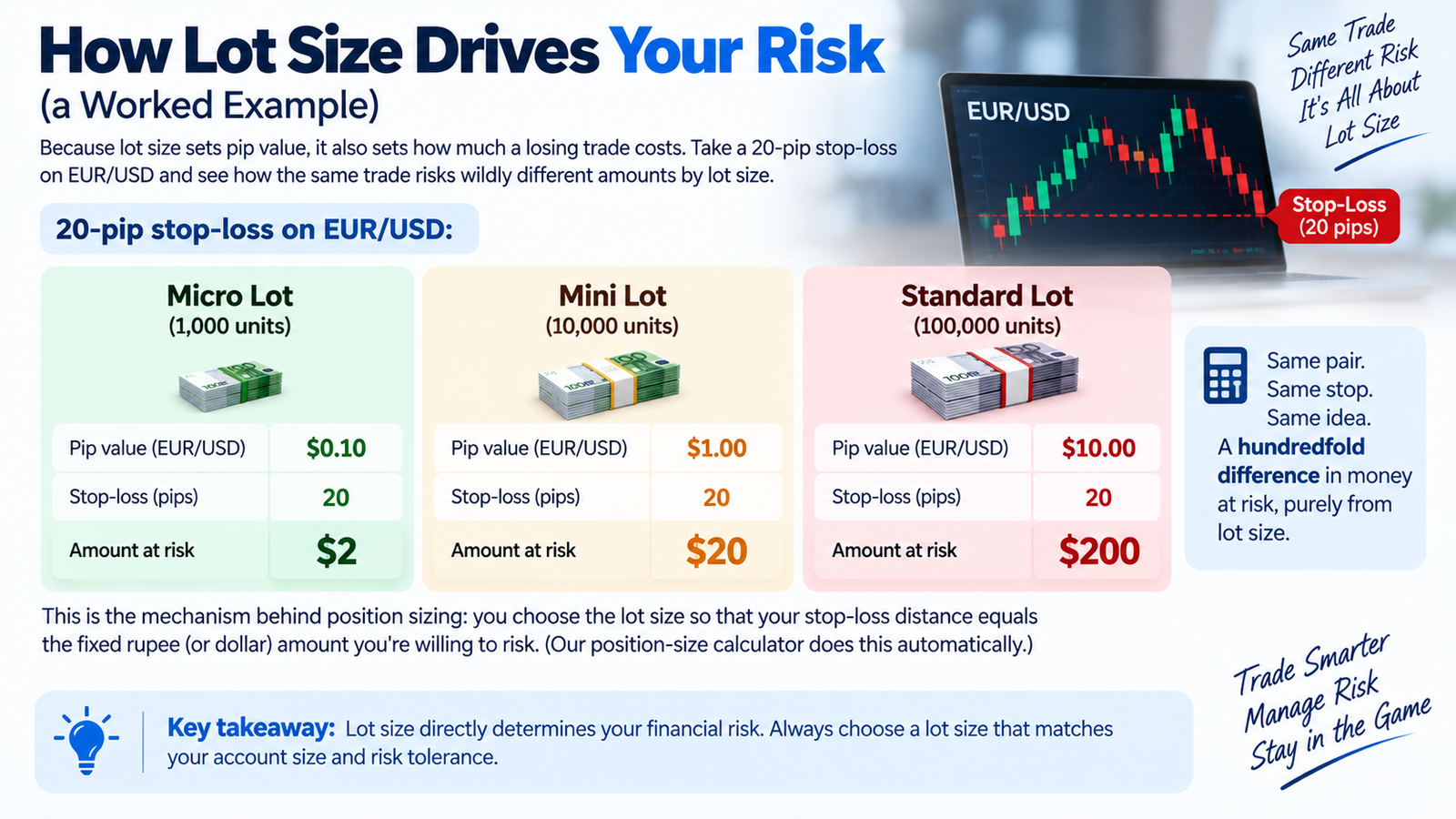
Because lot size sets pip value, it also sets how much a losing trade costs. Take a 20-pip stop-loss on EUR/USD and see how the same trade risks wildly different amounts by lot:
20-pip stop-loss on EUR/USD:
1 micro lot -> 20 x $0.10 = $2 at risk
1 mini lot -> 20 x $1.00 = $20 at risk
1 standard lot -> 20 x $10.00 = $200 at risk
Same pair, same stop, same idea – but a hundredfold difference in money at risk, purely from lot size. This is the mechanism behind position sizing: you choose the lot size so that your stop-loss distance equals the fixed rupee (or dollar) amount you’re willing to risk. (Our position-size calculator does this automatically.)
Lot Sizes in India (an Important Difference)
Here’s a point global guides miss for Indian traders: on Indian exchanges, the contract sizes are fixed and mostly smaller than the global ‘standard lot’. Rather than a 100,000-unit standard lot, NSE/BSE currency derivatives use these contract sizes (verify current specs with the exchange):
| Pair (NSE/BSE) | Contract size | Comparable to |
|---|---|---|
| USD/INR | USD 1,000 | a micro lot |
| EUR/INR | EUR 1,000 | a micro lot |
| GBP/INR | GBP 1,000 | a micro lot |
| JPY/INR | JPY 100,000 | yen-adjusted |
| EUR/USD, GBP/USD, USD/JPY | 1,000 units of the base | a micro lot |
So an Indian resident trading legally is effectively dealing in micro-sized contracts – which keeps the entry accessible. A USD/INR contract’s pip is only about ₹0.10, so one contract carries small per-pip risk, letting beginners start conservatively. Remember, legal currency trading in India is exchange-traded via SEBI-registered brokers, not the offshore 100,000-unit-lot model.
How to Choose the Right Lot Size
Don’t pick a lot size by gut feel – derive it from your risk. The professional method works backwards:
- Set your risk per trade – a small fixed percentage of your account (many use 1-2%).
- Measure your stop in pips – based on the chart, not on what you’d like to risk.
- Find the pip value you can afford – risk amount divided by stop in pips.
- Translate to a lot size – choose the lot whose pip value matches (micro/mini/standard).
- Start small – beginners should favour micro lots while learning.
Common Mistakes
- Trading a standard lot with a small account – a few pips can wipe you out.
- Picking lot size by feel instead of deriving it from risk.
- Ignoring that lot size sets pip value, and so sets your loss.
- Assuming the global 100,000-unit lot applies on Indian exchanges.
- Increasing lot size to ‘make back’ a loss (revenge sizing).
Myths vs Facts
| Myth | Fact |
|---|---|
| A lot is always 100,000 units. | That’s a standard lot; mini, micro and nano lots are smaller, and exchanges differ. |
| Bigger lots mean better traders. | Bigger lots just mean more risk per pip, not more skill. |
| Lot size and pip value are unrelated. | Lot size directly sets pip value, and therefore your risk. |
| Indian exchanges use standard lots. | NSE/BSE currency contracts are mostly 1,000 units (micro-sized). |
Risk disclaimer
This article is for educational purposes only and is not investment advice. Trading involves risk of loss, and lot size directly affects how much you can lose. Pip values shown assume a USD account for EUR/USD and are illustrative; exchange contract sizes can change. Verify current specifications with your broker or the exchange, and consult a qualified professional before trading.
Expert Analysis
Lot size is deceptively humble – it looks like mere terminology, but it is the single most direct control a trader has over risk. Entry and exit decide whether a trade wins or loses; lot size decides how much that outcome matters. A beginner who trades a standard lot on a small account isn’t being ambitious, they’re being reckless, because the same stop-loss that would cost a couple of dollars on a micro lot can wipe the account on a standard one. The maturity milestone for most new traders is the day they stop choosing a lot size that feels exciting and start choosing the one that keeps each loss to a pre-set, survivable amount.
For Indian traders, the exchange’s micro-sized contracts are a quiet advantage that mirrors this wisdom. Where offshore platforms tempt beginners into 100,000-unit standard lots amplified by extreme leverage, the legal Indian route hands you a 1,000-unit contract by default – small enough that a beginner can learn without catastrophic risk per pip. The lesson generalises: the right lot size is never the biggest one your margin allows, but the one that makes your planned stop-loss equal to the small, fixed amount you decided to risk before the trade. Master that translation – risk to pips to pip value to lot – and you’ve mastered the practical core of position sizing itself.
Key Takeaways
- A lot is a standardised trade size in units of the base currency.
- Standard = 100,000 units, mini = 10,000, micro = 1,000, nano = 100.
- Lot size sets pip value: about $10, $1, $0.10 and $0.01 per pip on EUR/USD respectively.
- Indian exchange contracts are mostly 1,000 units (micro-sized), not the global standard lot.
- Choose lot size from your risk – derive it, don’t guess; beginners favour micro lots.
Frequently Asked Questions (FAQ)
Q: What is a lot in forex?
A: A lot is a standardised quantity of the base currency traded in one contract; it determines how much each pip of movement is worth.
Q: What is lot size in forex?
A: It’s the number of currency units in your trade – standard (100,000), mini (10,000), micro (1,000) or nano (100) – which sets your pip value and risk.
Q: What is a standard lot?
A: A standard lot is 100,000 units of the base currency, worth about $10 per pip on a pair like EUR/USD.
Q: What is a mini lot?
A: A mini lot is 10,000 units – one-tenth of a standard lot – worth about $1 per pip on EUR/USD.
Q: What is a micro lot?
A: A micro lot is 1,000 units, worth about $0.10 per pip on EUR/USD – a common choice for beginners.
Q: What is a nano lot?
A: A nano lot is 100 units, worth about $0.01 per pip, offered by some brokers for very small position sizes.
Q: How does lot size affect pip value?
A: Directly – each step down the ladder divides pip value by ten, from about $10 (standard) to $0.01 (nano) on EUR/USD.
Q: How does lot size affect risk?
A: Lot size sets pip value, so it sets your loss: a 20-pip stop risks about $2 on a micro lot but $200 on a standard lot.
Q: What lot size should a beginner use?
A: Micro lots, so the money at risk per pip stays small while you learn and test your strategy.
Q: What is the lot size on NSE?
A: NSE currency contracts are mostly 1,000 units (for example, USD 1,000 for USD/INR) – comparable to a micro lot.
Q: Do Indian exchanges use standard lots?
A: No. Their currency contracts are fixed and mostly 1,000 units, smaller than the global 100,000-unit standard lot.
Q: How do I choose the right lot size?
A: Work backwards from risk: risk amount divided by stop in pips gives the pip value, which you translate into a lot size.
Q: Is a bigger lot size better?
A: No. A bigger lot just means more risk per pip; the right size is the one that keeps each loss to your planned amount.
Q: How is lot size related to leverage?
A: Lot size sets the position’s notional value; leverage and margin determine how much of that you must deposit to hold it.
Q: Can I trade fractional lots?
A: Yes. Mini, micro and nano lots are fractions of a standard lot, and many brokers allow sizing in between.