

Quick answer
The global forex market runs 24 hours on weekdays across four sessions. In IST, Tokyo runs roughly 5:30 AM-2:30 PM, London about 1:30-10:30 PM, and New York about 6:30 PM-3:30 AM (all shift ~1 hour with daylight saving). The busiest window for Indian traders is the evening London-New York overlap.
Introduction
The forex market never sleeps during the week – but that doesn’t mean every hour is equal. Knowing the forex market hours india IST helps you trade when the market is liquid and moving, rather than when it’s quiet and choppy. For forex trading for beginners in India especially, timing is one of the easiest edges to pick up, because the busiest global window happens to fall in the convenient Indian evening.
This guide converts the four sessions into IST, shows the overlaps that matter, flags the daylight-saving catch, and – importantly – clarifies the exchange hours that actually govern legal trading in India. All time conversions were computed and verified; treat them as approximate, since daylight saving shifts several by an hour. This is educational information, not investment advice.
The Four Global Forex Sessions
The 24-hour market is really a relay of four regional sessions that open and close around the world:
- Sydney – opens the trading week (Monday morning in Asia-Pacific).
- Tokyo – the main Asian session, active in Indian morning.
- London – the largest session by volume, active in the Indian afternoon-evening.
- New York – overlaps with London, active into the Indian night.
Forex Sessions in IST (Approximate)
Here are the four sessions converted to Indian Standard Time. These are approximate and shift by about an hour when the relevant region is on daylight saving time (mainly London and New York):
| Session | Approx. IST hours | Notes |
|---|---|---|
| Sydney | ~2:30 AM – 11:30 AM | Opens the week; lower liquidity |
| Tokyo | ~5:30 AM – 2:30 PM | Stable (no daylight saving in Japan) |
| London | ~1:30 PM – 10:30 PM | ~1 hour earlier during BST (summer) |
| New York | ~6:30 PM – 3:30 AM | ~1 hour earlier during EDT (summer) |
Read these as guides, not exact clocks. During European and US daylight-saving periods, the London and New York windows move about an hour earlier in IST – so always confirm against a live market-hours clock.
The Overlaps: When the Market Is Busiest
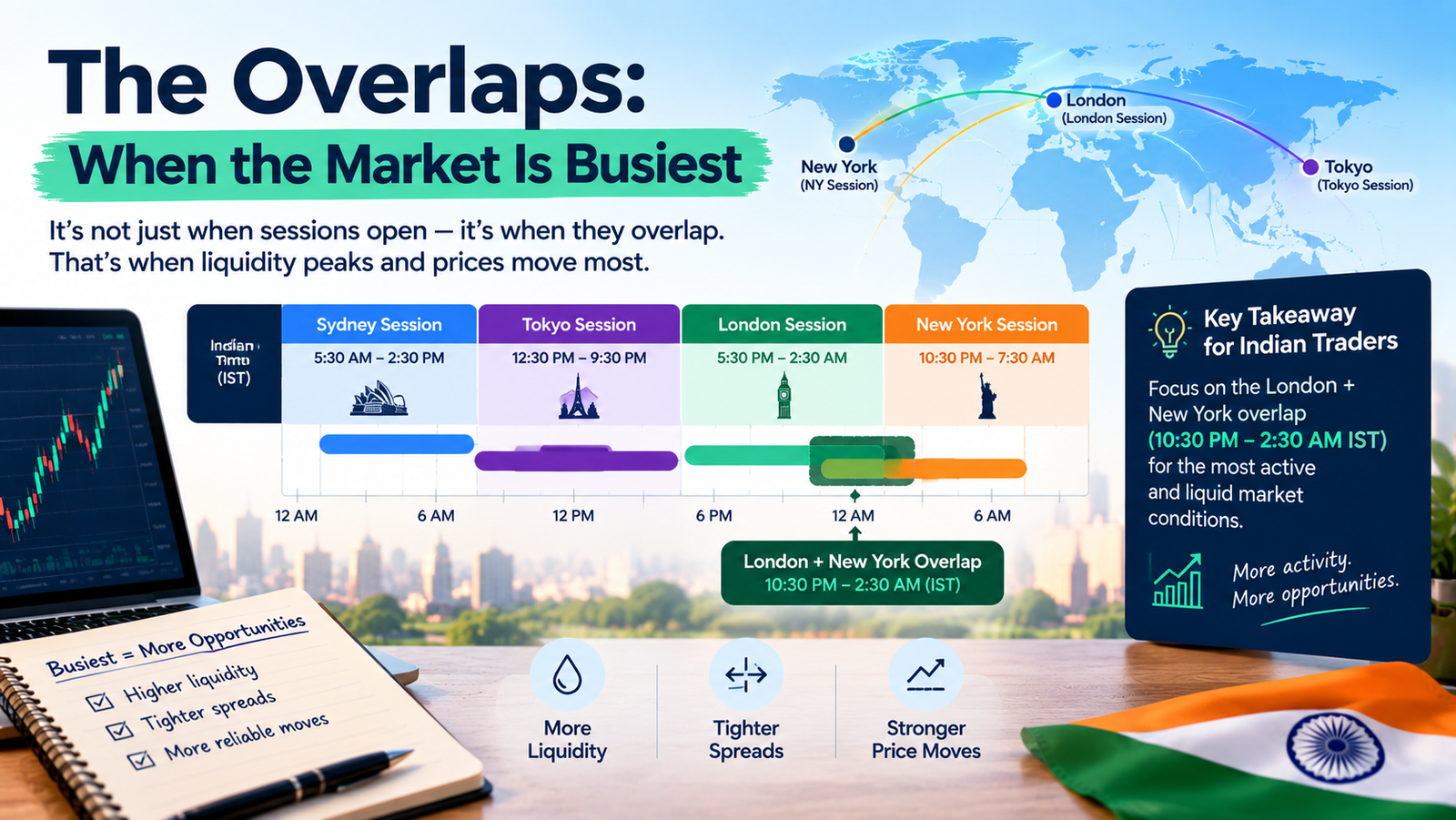
The most important thing about sessions is not when they open, but when they overlap – because that’s when two major centres trade at once, liquidity peaks and prices move most. For Indian traders, one overlap stands out:
London-New York overlap (the big one)
For a few hours, London and New York are both open – roughly 6:30 PM to 9:30 PM IST (about an hour earlier in the summer). This is the most liquid, most volatile window of the entire day, with the tightest spreads and the biggest moves on major pairs. Conveniently for Indian traders, it lands in the evening – after work or college for many – making it the natural prime-time slot.
Tokyo-London overlap (smaller)
Around midday IST, the tail of Tokyo meets the open of London for a shorter, less dramatic overlap – useful but generally quieter than the evening window.
But First: The Hours That Actually Matter in India
Here’s the crucial point most global session guides miss for an Indian audience. Those 24-hour sessions describe the offshore OTC market – which residents cannot legally trade. In India, you trade currencies on recognised exchanges (NSE, BSE, MSE), and their currency segment has its own, much shorter hours:
| Segment | Approx. IST hours |
|---|---|
| Rupee pairs (USD/INR etc.) | ~9:00 AM – 5:00 PM |
| Cross-currency pairs (EUR/USD etc.) | ~9:00 AM – 7:30 PM |
So for legal trading in India, the relevant window is roughly 9 AM to 5 PM (or 7:30 PM for cross pairs), not the global 24-hour clock. Confirm the exact current timings with the exchange, as they can change.
This matters because the famous evening London-New York overlap partly falls outside NSE rupee-pair hours – though cross-currency pairs, which run until about 7:30 PM IST, do catch the start of that active window.
Best Time to Trade Forex from India
Combining the two views gives a practical answer:
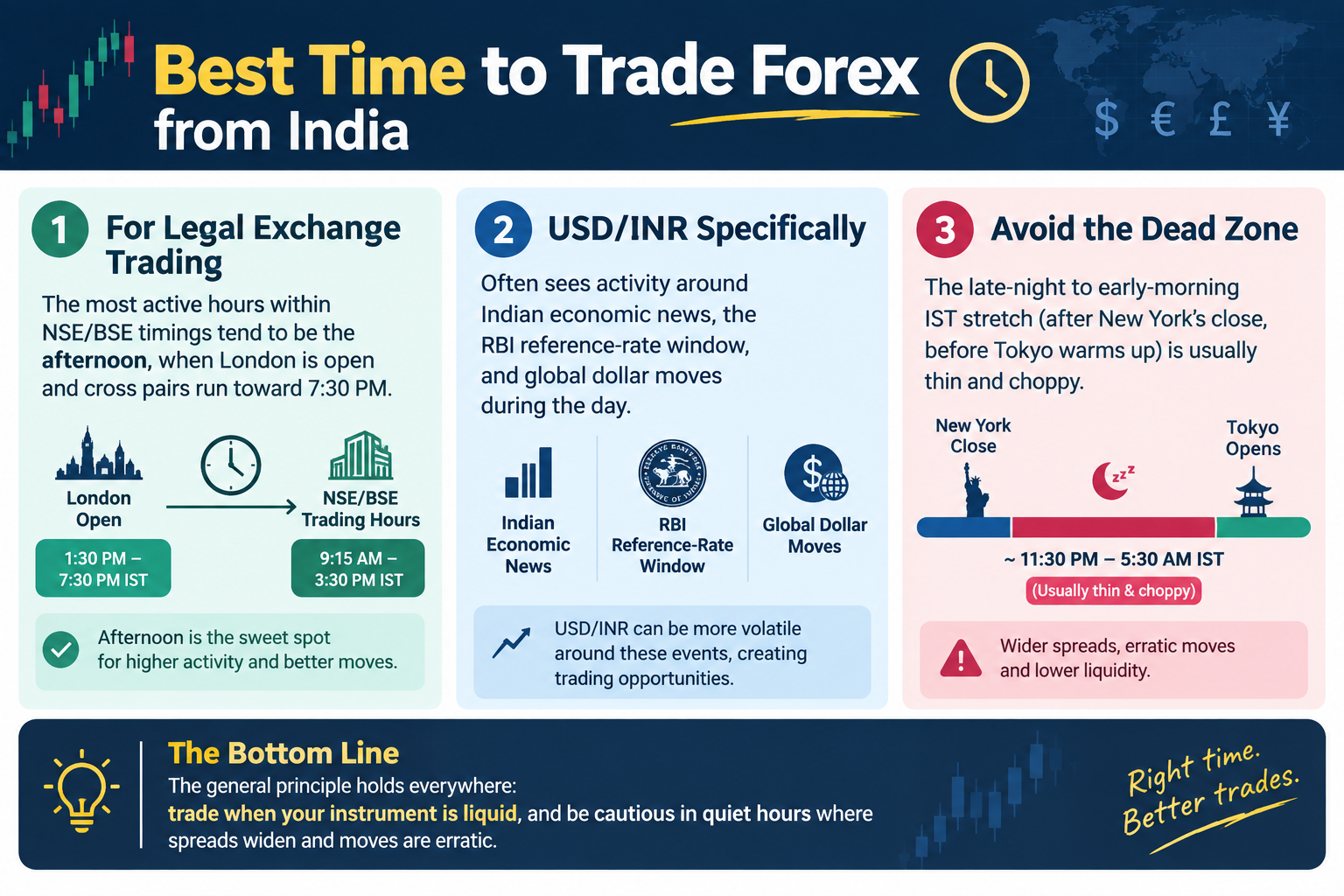
- For legal exchange trading – the most active hours within NSE/BSE timings tend to be the afternoon, when London is open and cross pairs run toward 7:30 PM.
- USD/INR specifically – often sees activity around Indian economic news, the RBI reference-rate window, and global dollar moves during the day.
- Avoid the dead zone – the late-night to early-morning IST stretch (after New York’s close, before Tokyo warms up) is usually thin and choppy.
The general principle holds everywhere: trade when your instrument is liquid, and be cautious in quiet hours where spreads widen and moves are erratic.
How Sessions Affect Volatility
Different pairs come alive in different sessions, because each session is driven by its home region’s participants and news. Broadly, the euro and pound are most active in the London session; the dollar and its pairs move most during the New York and overlap hours; and the yen is liveliest in the Tokyo session. Volatility clusters around session opens, overlaps, and major economic releases. Trading a pair during its most active session usually means better liquidity and cleaner moves than trading it in a quiet one.
The Daylight-Saving Catch
The single biggest source of confusion in session timings is daylight saving time. Europe and the US move their clocks (roughly late March to late October for Europe, and mid-March to early November for the US), which shifts the London and New York sessions about an hour earlier in IST during those months. India does not observe daylight saving, so IST stays fixed while the foreign sessions move around it. Whenever the timings feel ‘off’ by an hour, daylight saving is almost always the reason – so check a live session clock rather than relying on a fixed table.
Common Misconceptions
- ‘The market is equally active all day.’ – No; liquidity peaks in overlaps and dries up overnight IST.
- ‘Session times in IST are fixed.’ – London and New York shift ~1 hour with daylight saving.
- ‘I can trade the 24-hour market legally in India.’ – Residents trade on Indian exchanges with set hours.
- ‘Night trading is best because New York is open.’ – It can be volatile but is outside legal Indian exchange hours.
- ‘All pairs move the same in every session.’ – Each pair is liveliest in its home session.
Myths vs Facts
| Myth | Fact |
|---|---|
| Forex is open 24/7. | It runs 24 hours on weekdays only, closing over the weekend. |
| The best time is whenever you’re free. | Liquidity and moves peak in the London-New York overlap. |
| IST session times never change. | Daylight saving shifts London/NY by ~1 hour part of the year. |
| Global session hours apply to Indian trading. | Legal trading follows NSE/BSE currency hours, not the 24h clock. |
Disclaimer
This article is for educational purposes only and is not investment advice. Session times in IST are approximate and shift with daylight saving; exchange hours can change. Verify current global session times and NSE/BSE/MSE currency timings before trading. Indian residents should trade only through SEBI-registered brokers on recognised exchanges
Expert Analysis
Session timing is one of the few edges available to a beginner that requires no skill to capture – only awareness. The reason is liquidity: spreads are tightest and price action is cleanest when the most participants are active, which is exactly during the London-New York overlap. Trading a major pair at 8 PM IST, when both centres are live, is structurally easier than trading the same pair at 3 AM IST, when only thin overnight flows remain. A new trader who simply chooses to trade in the busy window rather than the dead one has improved their odds before considering a single strategy.
For Indian traders, though, the honest and often-missed point is that legality reshapes the whole timing question. The romanticised 24-hour market belongs to the offshore world residents cannot lawfully access; the market they can trade – currency derivatives on Indian exchanges – runs on ordinary business-day hours, roughly nine to five with cross pairs extending toward the early evening. So the practical timing advice for a compliant Indian trader is less about the New York close at 3:30 AM IST and more about the liquid patches within exchange hours, and around Indian and global news. Understanding both layers – the global rhythm and the local exchange window – is what separates a trader who plans their day from one who simply trades whenever the app is open.
Key Takeaways
- The forex market runs 24 hours on weekdays across the Sydney, Tokyo, London and New York sessions.
- In IST: Tokyo ~5:30 AM-2:30 PM, London ~1:30-10:30 PM, New York ~6:30 PM-3:30 AM (approximate).
- The London-New York overlap (~6:30-9:30 PM IST) is the most liquid, volatile window.
- Daylight saving shifts London/NY about an hour earlier in IST for part of the year.
- For legal Indian trading, NSE/BSE currency hours (~9 AM-5 PM, cross pairs to ~7:30 PM) are what count.
Frequently Asked Questions (FAQ)
Q: What time does the forex market open in India?
A: The global market opens with the Sydney session early Monday morning IST and runs 24 hours on weekdays until New York closes on Saturday morning IST.
Q: What is the best time to trade forex in IST?
A: The London-New York overlap, roughly 6:30 to 9:30 PM IST, is the most liquid and volatile window (about an hour earlier in summer).
Q: When is the London session in IST?
A: Approximately 1:30 PM to 10:30 PM IST, moving about an hour earlier during British Summer Time.
Q: When is the New York session in IST?
A: Approximately 6:30 PM to 3:30 AM IST, moving about an hour earlier during US daylight saving time.
Q: When is the Tokyo session in IST?
A: Roughly 5:30 AM to 2:30 PM IST, and it stays fixed because Japan does not observe daylight saving.
Q: Is forex open 24 hours in India?
A: The global market is open 24 hours on weekdays, but Indian residents can only legally trade on Indian exchanges, which have set daytime hours.
Q: What are NSE currency trading hours?
A: Roughly 9:00 AM to 5:00 PM IST for rupee pairs, with cross-currency pairs running until about 7:30 PM IST; verify current timings with the exchange.
Q: Why do session times change by an hour?
A: Because Europe and the US observe daylight saving while India does not, shifting the London and New York sessions in IST for part of the year.
Q: Which session is most volatile?
A: The London-New York overlap, when two major centres trade simultaneously and liquidity and price movement peak.
Q: Can I trade forex at night in India?
A: The global market is active at night IST during New York’s session, but that falls outside legal Indian exchange hours.
Q: What is the least active time to trade?
A: The late-night to early-morning IST stretch after New York closes and before Tokyo warms up is usually thin and choppy.
Q: Does USD/INR follow global sessions?
A: USD/INR trades on Indian exchange hours and is most influenced by Indian news, the RBI reference rate window and global dollar moves during the day.
Q: Which pairs are best in each session?
A: Euro and pound in London, dollar pairs in New York and the overlap, and the yen in the Tokyo session.
Q: Do Indian holidays affect trading?
A: Indian exchange currency segments observe Indian market holidays, even though the global OTC market may still be open.
Q: How do I confirm the exact session times?
A: Use a live forex market-hours clock, which adjusts automatically for daylight saving, and check the exchange for NSE/BSE timings.