Quick answer
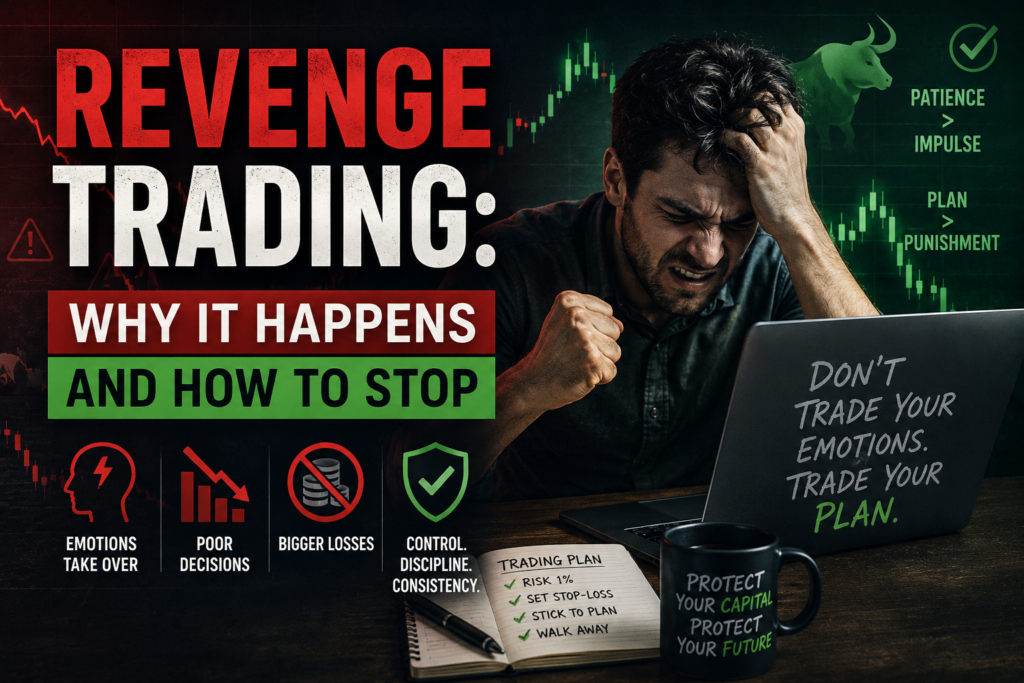
Revenge trading is the impulsive urge to win back a loss by taking bigger, unplanned trades driven by emotion rather than strategy. It usually turns one manageable loss into several larger ones. You stop it by pausing after losses, following a trading plan, and using strict risk rules to remove emotion from decisions.
Introduction
Almost every trader knows the feeling. You take a loss, and instead of stepping back, a hot, urgent voice says: get it back, now. So you jump into another trade – bigger, faster, without a plan – and often lose again. That is revenge trading, and it is one of the most destructive patterns in all of trading psychology.
The good news is that revenge trading is a habit, not a life sentence. Once you understand why it happens, you can build simple systems that make it far harder to act on the impulse. This guide walks through the psychology, the warning signs, and a practical framework to stop revenge trading for good.
What Is Revenge Trading?
Revenge trading is when a trader tries to recover a recent loss by entering new trades driven by anger, frustration or the need to ‘get even’ with the market – rather than by a considered strategy. The market, of course, has no memory of your loss and no opponent to defeat. The revenge is entirely internal, which is exactly what makes it so irrational and so costly.
It is closely related to chasing losses, emotional trading and overtrading. What unites them is that the decision to trade comes from a feeling, not from a setup. Understanding revenge trading as an emotional reflex – not a strategy – is the first step to controlling it.
Why Revenge Trading Happens: The Psychology
Revenge trading is rooted in well-documented features of human psychology. Knowing the mechanisms makes them easier to catch in yourself.
Loss aversion
Research in behavioural economics shows people feel losses roughly twice as intensely as equivalent gains. That outsized pain creates an urgent drive to erase the loss immediately – the engine of revenge trading.
Ego and identity
For many traders a loss feels like a personal defeat, not a statistical event. The trade becomes about being right, and the urge to prove the market wrong overrides the plan.
Emotional flooding
A loss triggers a stress response – adrenaline, a racing mind, tunnel vision. In that flooded state the rational, planning part of the brain goes quiet, and impulsive decisions take over.
The sunk cost fallacy and FOMO
Traders throw good money after bad to justify the loss already taken, while fear of missing the ‘recovery move’ adds FOMO trading to the mix. Together they make doing nothing feel unbearable.
Warning Signs You’re Revenge Trading
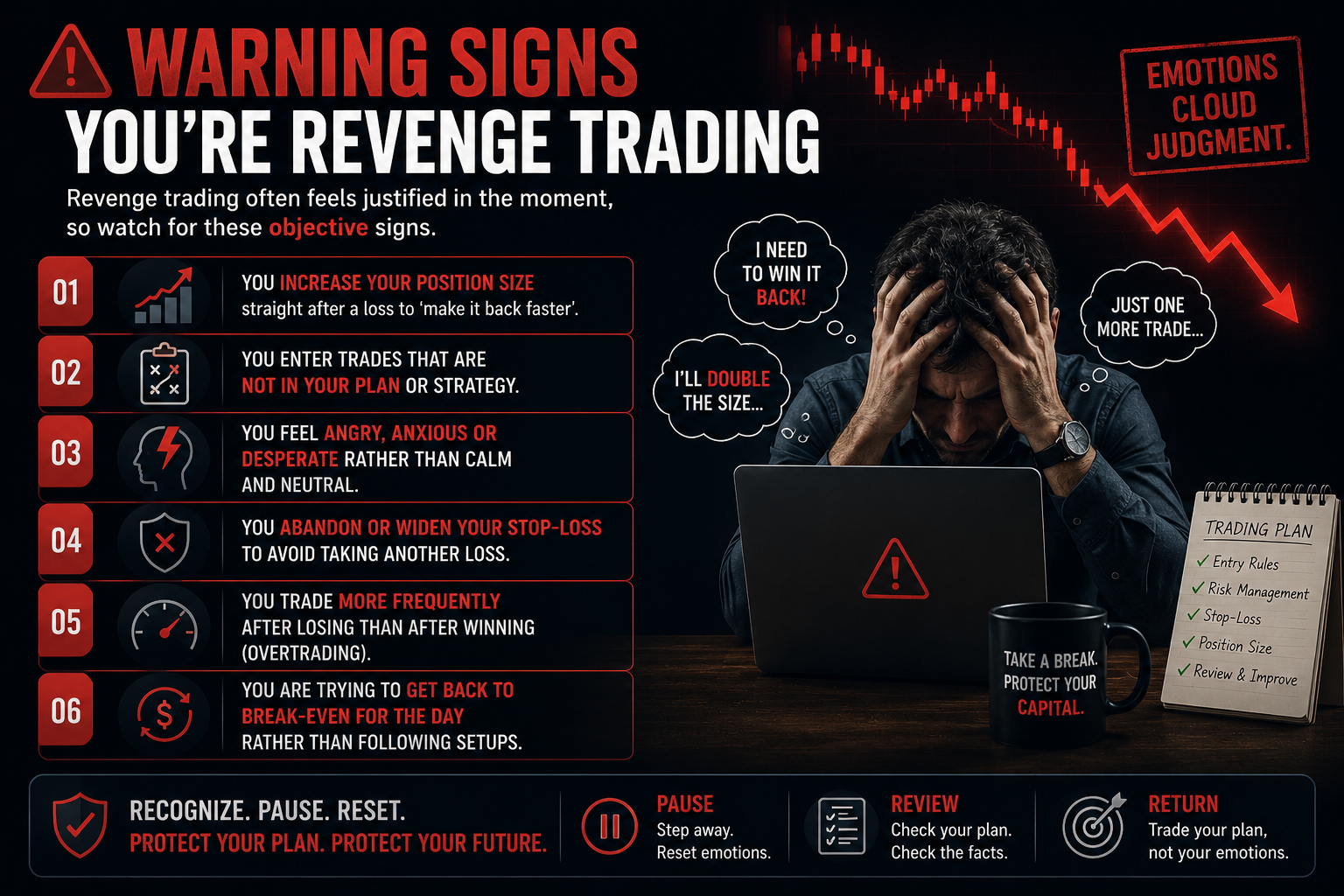
Revenge trading often feels justified in the moment, so it helps to know the objective signs. If several of these ring true, you are likely in the cycle:
- You increase your position size straight after a loss to ‘make it back faster’.
- You enter trades that are not in your plan or strategy.
- You feel angry, anxious or desperate rather than calm and neutral.
- You abandon or widen your stop-loss to avoid taking another loss.
- You trade more frequently after losing than after winning (overtrading).
- You are trying to get back to break-even for the day rather than following setups.
The Revenge Trading Cycle
Revenge trading is a self-reinforcing loop. Recognising the stages helps you interrupt it:
- The trigger – an unexpected or painful loss.
- The emotion – anger, frustration or shame floods in.
- The impulse – an urgent need to trade again immediately.
- The impulsive trade – a bigger, unplanned position with poor risk control.
- The bigger loss – which intensifies the emotion and restarts the loop.
Each turn of the cycle deepens the drawdown and the emotional damage. The only way out is to break the chain between the emotion and the impulsive trade.
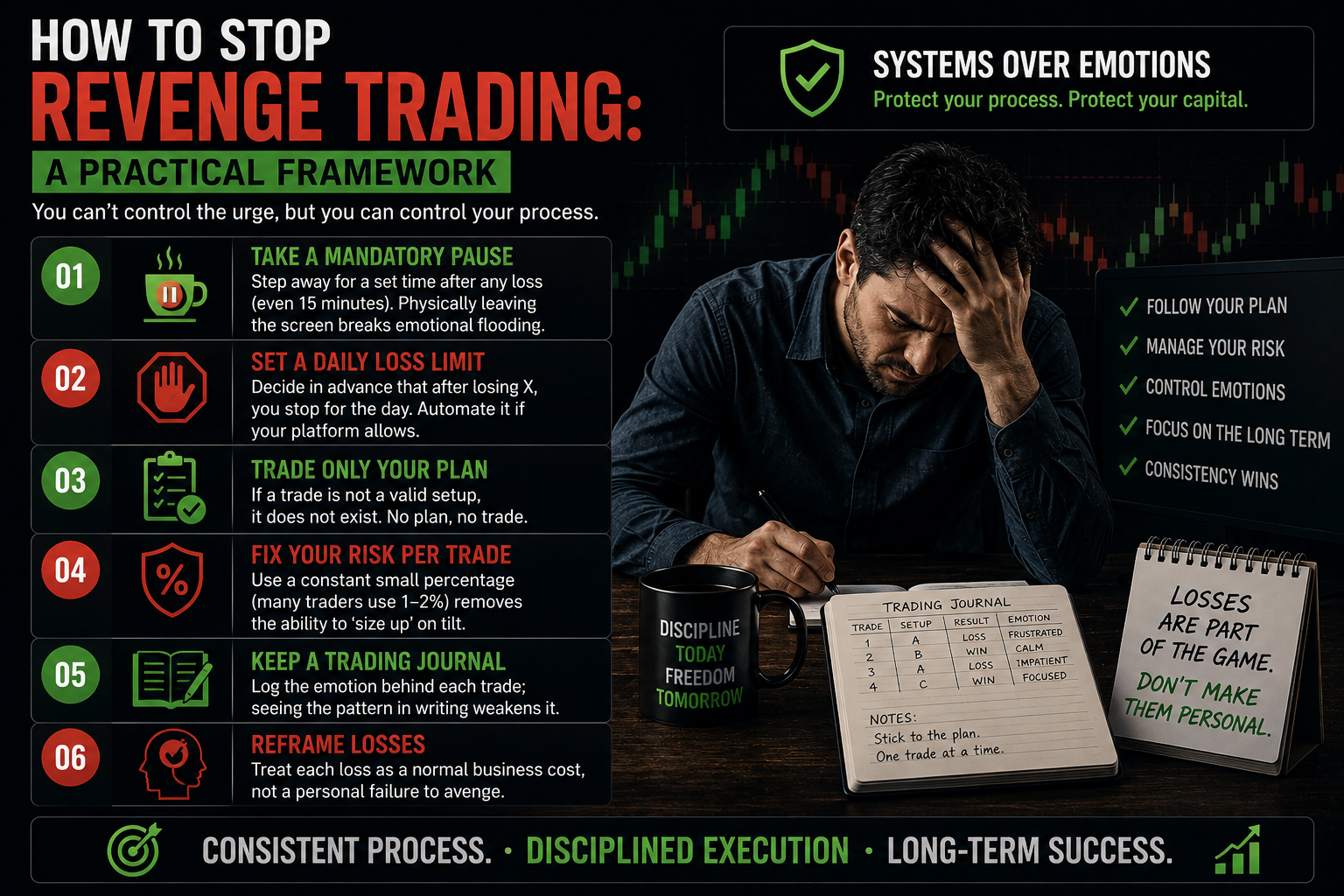
How to Stop Revenge Trading: A Practical Framework
You cannot stop feeling the urge, but you can build systems so the urge does not control your actions. Here is a step-by-step approach to stop revenge trading:
- Take a mandatory pause – step away for a set time after any loss (even 15 minutes). Physically leaving the screen breaks emotional flooding.
- Set a daily loss limit – decide in advance that after losing X, you stop for the day. Automate it if your platform allows.
- Trade only your plan – if a trade is not a valid setup, it does not exist. No plan, no trade.
- Fix your risk per trade – a constant small percentage (many traders use 1-2%) removes the ability to ‘size up’ on tilt.
- Keep a trading journal – log the emotion behind each trade; seeing the pattern in writing weakens it.
- Reframe losses – treat each loss as a normal business cost, not a personal failure to avenge.
Building Long-Term Discipline
Stopping revenge trading in the moment is a rescue; preventing it is the cure. Discipline is built between trades, not during them. A written trading plan, predefined risk rules and a routine that includes breaks all reduce the emotional charge of any single loss. Over time, following the plan becomes identity: you become the kind of trader who does not chase losses, and the urge loses its grip.
It also helps to zoom out. A single loss is one data point in a long series; judged over hundreds of trades, no individual loss deserves an emotional response – let alone revenge trading.
Learn more about Trading Psychology
An Illustrative Example
Consider a trader who risks a steady 1% per trade and has a losing morning – three small losses, about 3% down. Following the plan, they hit their daily loss limit, close the platform and return tomorrow calm. A revenge trader, facing the same three losses, doubles size to ‘get it back’, takes two unplanned trades, and ends the day down 15%. Same market, same losses – the only difference is the response. That gap is the entire cost of revenge trading. (Illustrative scenario.)
Myths vs Facts
| Myth | Fact |
|---|---|
| Revenge trading is just being aggressive. | It is emotion-driven, not strategy-driven – the opposite of controlled aggression. |
| Winning the money back fixes it. | Even a lucky recovery reinforces the habit and leads to a bigger blow-up later. |
| Only beginners revenge trade. | Experienced traders do too; the urge is human, not skill-based. |
| More screen time means more control. | Fatigue and screen time worsen emotional trading, not improve it. |
When It’s More Than a Bad Habit
Sometimes compulsive loss-chasing goes beyond a discipline problem. If trading feels impossible to stop, is driven by a need to recover losses at any cost, or is harming your finances, sleep, relationships or mental health, that pattern shares features with problem gambling and deserves real support. This is not a weakness – it is a common and treatable issue.
Consider speaking with a licensed counsellor or contacting a problem-gambling helpline in your country. Taking a complete break from trading while you get support is a sign of strength, not failure.
A note on wellbeing
If revenge trading or loss-chasing is causing you distress or financial harm, please reach out to a mental-health professional or a problem-gambling helpline in your region. Stepping away from the market to protect yourself is always the right call.
Expert Analysis
The most important insight about revenge trading is that it is a systems problem disguised as a willpower problem. Traders who beat it rarely do so by ‘trying harder’ in the heat of the moment – willpower is exactly what emotional flooding strips away. Instead, they engineer their environment in advance: hard daily loss limits, fixed position sizes, mandatory cool-off periods and a plan specific enough that an impulsive trade is obviously off-script. The decision to not revenge trade is made once, calmly, before the market opens – not repeatedly under stress.
There is also a reframing that helps enormously: the market is not an opponent and owes you nothing, so there is no one to take revenge on. Losses are simply the cost of doing business. Traders who internalise this treat a loss the way a shopkeeper treats spoilage – a normal expense to manage, never an insult to answer. That single shift removes most of the emotional fuel that revenge trading runs on.
Key Takeaways
- Revenge trading is chasing losses with emotional, unplanned trades – it usually multiplies losses.
- It is driven by loss aversion, ego, emotional flooding and FOMO, not by strategy.
- Watch for warning signs: sizing up after losses, breaking your plan, trading to get back to break-even.
- Stop it with systems: a post-loss pause, a daily loss limit, fixed risk and a strict trading plan.
- If loss-chasing feels compulsive or harmful, seek support – it can resemble problem gambling.
Frequently Asked Questions (FAQ)
Q: What is revenge trading?
A: Revenge trading is the impulsive urge to win back a recent loss by taking bigger, unplanned trades driven by emotion rather than a strategy.
Q: Why do traders revenge trade?
A: Because losses feel painful and personal. Loss aversion, ego, a stress response and fear of missing the recovery all push traders to act impulsively.
Q: How do I stop revenge trading?
A: Take a mandatory pause after losses, set a daily loss limit, trade only valid setups, fix your risk per trade, and keep a trading journal.
Q: What are the signs of revenge trading?
A: Increasing position size after a loss, abandoning your plan, widening stops, trading more after losing, and trying to get back to break-even.
Q: Is revenge trading the same as gambling?
A: They share features – especially chasing losses. Compulsive, harmful loss-chasing can resemble problem gambling and may warrant professional support.
Q: Why is revenge trading so dangerous?
A: It replaces strategy with emotion and usually increases risk, turning one manageable loss into a series of larger ones – a fast route to big drawdowns.
Q: Do professional traders revenge trade?
A: The urge is human, so even experienced traders feel it. What differs is that they rely on systems and rules to stop it from controlling their actions.
Q: Does a trading journal help with revenge trading?
A: Yes. Recording the emotion behind each trade exposes the pattern, which makes it easier to catch and interrupt over time.
Q: What is a daily loss limit?
A: A pre-set amount that, once lost in a day, means you stop trading until the next session – a powerful guard against revenge trading.
Q: How does loss aversion cause revenge trading?
A: People feel losses about twice as strongly as equivalent gains, creating an urgent drive to erase the loss immediately, often recklessly.
Q: Is revenge trading a sign I should quit trading?
A: Not necessarily – it is a common, fixable habit. But if it feels compulsive or is harming your life, take a break and seek support.
Q: How long should I pause after a loss?
A: Any deliberate break helps; even 15 minutes away from the screen can calm the stress response. Some traders stop for the rest of the day.
Q: Can risk management prevent revenge trading?
A: Fixed, small risk per trade removes the ability to ‘size up’ on tilt, which is one of the most effective structural defences.
Q: What is the difference between revenge trading and overtrading?
A: Overtrading is trading too much generally; revenge trading is a specific, emotion-driven surge in activity after a loss.
Q: How do I recover mentally after a big loss?
A: Step away, avoid immediate re-entry, review the trade calmly later, and reframe the loss as a normal business cost rather than a personal defeat.