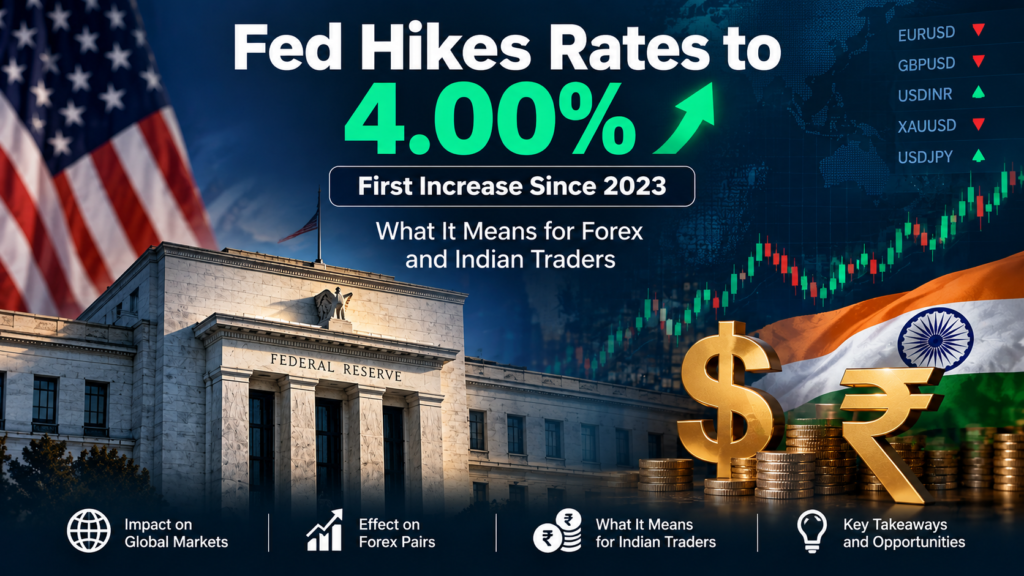
In one line: The Fed rate hike– The US Federal Reserve raised its benchmark interest rate by 25 basis points to a target range of 3.75%–4.00% on 16 September 2026 (announced 11:30 PM IST) — the first hike since July 2023 and the first under new Chair Kevin Warsh. With most of the move already priced in, the market’s focus has shifted to the dot plot and Warsh’s forward guidance, which will drive the dollar, the rupee, gold, and the Nifty–Sensex over the coming sessions.
Key Takeaways
- Decision: Fed hiked 25 bps → 3.75%–4.00% (headline upper bound: 4.00%, up from 3.75%). Matched the ~90%+ market expectation.
- First hike since 2023, and the first of Kevin Warsh’s tenure as the 17th Fed Chair.
- Why: Inflation stuck above the 2% target (running in the mid-3% range), with Iran war–driven oil prices reviving price pressures.
- The real signal: the dot plot — whether this is a one-off “recalibration” or the start of a new tightening cycle.
- Market backdrop: US 10-year Treasury yield pushed above 5%, the Dollar Index (DXY) firmed near 99.5, and gold held around $4,300/oz.
- Forex: A stronger dollar pressures EUR/USD, GBP/USD and the risk-sensitive AUD; USD/JPY held above 155.
- India: Expect pressure on the rupee, potential FII outflows, and a rate-sensitive open for the Sensex and Nifty on Thursday.
What the Fed Actually Decided
The Federal Open Market Committee (FOMC) voted to lift the federal funds target range by a quarter point to 3.75%–4.00%, ending a long stretch of holds that ran through most of 2026. It is the central bank’s first rate increase in more than three years.
Crucially, the groundwork was laid at July’s meeting, when the committee held rates in a divided 9–3 vote — with three officials (Beth Hammack, Neel Kashkari, and Lorie Logan) already pushing to tighten. This week, that dissent moved into the majority.
The headline vs. the range — cleared up: Economic calendars quote the fed funds rate as a single number (now 4.00%, up from 3.75%). Technically the Fed sets a band, which moved from 3.50%–3.75% to 3.75%–4.00%. Both describe the same decision; the quoted figure is simply the upper bound.
Why the Fed rate Hike Now
New Chair Kevin Warsh — who succeeded Jerome Powell in May 2026 — framed the move around persistently elevated inflation. Three drivers stand out:
- Sticky inflation. US price growth has stayed above the Fed’s 2% goal, with the latest CPI posting its biggest jump in four months.
- An oil shock the Fed can’t fix. The ongoing Iran conflict has kept crude elevated near $100, feeding through to broader inflation.
- Credibility. Analysts at J.P. Morgan described the hike as “credibility-focused” rather than a response to an overheating economy — the Fed tightening to prove it will defend its 2% target after July’s split vote raised doubts.
The Dot Plot: The Number That Actually Matters
Because the hike was so widely expected, the Summary of Economic Projections (SEP) and the dot plot — where each policymaker anonymously marks their expected rate path — carry more weight than the decision itself.
The key question for every trader tonight: is this one-and-done, or the first step of a cycle?
- A “recalibration” framing (one hike, then a pause) is the softer outcome — it lets the dollar’s rally fade.
- A “higher-for-longer” dot plot (signalling more hikes into 2027) is the hawkish outcome — dollar and yields firmer, pressure on gold and rate-sensitive equities.
Warsh’s press conference (12:00 AM IST) is where this tone gets set. His deliberately minimalist communication style means the written projections do a lot of the talking.
Immediate Market Reaction
Heading into and through the decision:
- US Treasury yields: the 10-year pushed above 5%, its highest in years, as oil-driven inflation fears and the hike bets lifted borrowing costs.
- US Dollar Index (DXY): firmed to around 99.5–99.6, its strongest in weeks.
- Gold: held near $4,300/oz — notably, the dollar and gold have been rising together, an unusual pairing that reflects traders betting on Fed resolve short-term while reserve managers hedge long-term.
- Oil: stayed elevated on Middle East supply disruptions, keeping the inflation narrative alive.
Prices are moving in real time around the press conference — confirm live quotes before acting.
How the Fed Hike Impacts Forex Traders
For the FX market, a rate decision is rarely about the number — it’s about the path. Here’s the practical read:
- The dollar’s direction hinges on the dot plot, not the hike. Because ~90% of a 25 bps move was already priced, the “buy the rumour” phase is largely done. A hawkish dot plot can extend dollar strength; a “one-and-done” tone can trigger a classic “sell the news” pullback in the DXY even after a hike.
- Watch the major pairs.
- EUR/USD & GBP/USD: A firmer dollar and rising US yields pressure both. Widening rate differentials favour the greenback unless the ECB/BoE turn more hawkish in parallel.
- USD/JPY: Held above 155, supported by the US–Japan yield gap. The Bank of Japan’s own decision this week is the offsetting risk — watch for intervention chatter at extremes.
- AUD/USD & other risk/EM currencies: The most vulnerable. A stronger dollar plus higher US yields drains risk appetite and pressures commodity and emerging-market currencies.
- Carry trades and funding costs. Higher US front-end rates raise the cost of leverage and shift carry dynamics. Dollar-funded carry into higher-yielders gets more expensive; positioning can unwind quickly if the dot plot surprises hawkish.
- Volatility is the trade. FOMC nights are event-risk nights: expect sharp two-way spikes across USD pairs and gold during the statement (11:30 PM IST) and again during the presser (12:00 AM IST). Wider spreads and slippage are common.
Practical checklist for FX traders:
- Don’t fight the first spike — the durable move often comes 15–30 minutes into Warsh’s Q&A.
- Size down and widen stops through the event; volatility can blow through tight levels.
- Trade the reaction, not your prediction — let the dot plot and tone confirm direction.
- Key gauges to track: DXY, US 2-year yield, and the 10-year at the 5% line.
How the Fed Hike Impacts Indian Traders
For Dalal Street, a US rate hike is imported tightening. Here’s what to watch when markets open Thursday:
- The rupee (USD/INR). A stronger dollar and wider US–India yield gap put the rupee under pressure, potentially toward record lows. The RBI is likely to intervene to smooth volatility, especially with India importing most of its oil in dollars while crude sits near $100. A weaker rupee raises imported inflation — a headache before the RBI’s October review.
- FII / FPI flows. Higher US yields make dollar assets relatively more attractive, prompting foreign investors to trim emerging-market exposure. Sustained FII selling has already weighed on the Nifty and Sensex, and a hawkish dot plot could extend it.
- Sectors — who wins, who loses.
- IT / exporters (pharma, IT services): A weaker rupee is a tailwind for dollar earners, though IT has seen recent profit-booking, so any bounce may be selective.
- Banks, NBFCs, realty, autos (rate-sensitives): Pressured. A parallel Fed hike plus a possible RBI repo move toward 6.5% in October could push India’s 10-year yield toward 7.45%–7.50%, raising the cost of capital.
- Metals & commodity plays: Sensitive to the stronger dollar and global growth worries.
- Gold in rupee terms. Global gold near $4,300 combined with a weaker rupee tends to keep domestic gold prices firm — supportive for Indian bullion investors even when dollar-gold wobbles.
- Technical levels on the Nifty. Watch resistance around 23,400–23,600 and crucial support at 23,000–23,100. A sustained move above 23,600 would signal improving momentum; a break below 23,000 opens downside risk.
Practical checklist for Indian traders:
- Track Gift Nifty overnight for the gap-open cue.
- Watch USD/INR and Brent crude as the two biggest external triggers.
- Expect IT/export names to react to the rupee, and rate-sensitives to react to yields.
- Keep the RBI October policy on your radar — the domestic follow-through matters as much as the Fed.
Frequently Asked Questions
What did the Fed decide in September 2026?
The Fed raised its benchmark interest rate by 25 basis points to a target range of 3.75%–4.00% on 16 September 2026 — its first hike since July 2023.
Who is the Fed Chair who announced this hike?
Kevin Warsh, the 17th Fed Chair, who succeeded Jerome Powell in May 2026. This is his first rate hike as Chair.
Why did the Fed raise rates?
Inflation has stayed above the Fed’s 2% target, and the Iran conflict pushed oil and broader prices higher, prompting the committee to tighten to defend its credibility.
How does the Fed hike affect forex traders?
It generally strengthens the US dollar and raises US yields, pressuring EUR/USD, GBP/USD and risk-sensitive currencies. But since the hike was priced in, the durable move depends on the dot plot and Warsh’s guidance.
How does the Fed hike affect Indian traders and the rupee?
It pressures the rupee, can trigger foreign-investor outflows from Indian equities, and weighs on rate-sensitive sectors — while a weaker rupee supports IT/export stocks and domestic gold prices.
Will the Fed hike again in 2026?
That depends on the dot plot released with this decision. Some officials framed the move as a one-off “recalibration”; others may signal a longer tightening path. The projections are the key clue.
What is the current US interest rate after this decision?
The federal funds target range is now 3.75%–4.00% (headline figure: 4.00%).
The Bottom Line
The Fed delivered the hike markets expected — but the story is only half told. With 3.75%–4.00% now locked in, the dollar, the rupee, gold, and equities from Wall Street to Dalal Street will trade on one question: is this the end of the move, or the start of a cycle? Forex traders should respect the volatility and let the dot plot confirm direction; Indian traders should watch the rupee, FII flows, and the RBI’s October response as the hike’s effects ripple in.