Quick answer
To control emotions trading requires, prepare before the session with a written plan and fixed risk, use in-the-moment tactics like pausing and slow breathing to interrupt impulses, and review each trade in a journal afterwards. The goal isn’t to feel nothing – it’s to stop feelings from overriding your rules.
Introduction
Every trader has done it: held a loser hoping it turns around, sold a winner in a panic, or jumped into a trade out of pure excitement. Learning to control emotions trading provokes is the difference between a plan that works on paper and one that survives contact with a live market. Strategy is easy to learn; staying calm while money is on the line is the real challenge.
This is a practical guide, not a theory lecture. It gives you a toolkit for before, during and after each session, plus the systems that make emotional control automatic. You will not eliminate emotion – no one can – but you can stop it from making your decisions. Everything here is educational, not financial advice.
Why You Can’t Just ‘Stay Calm’
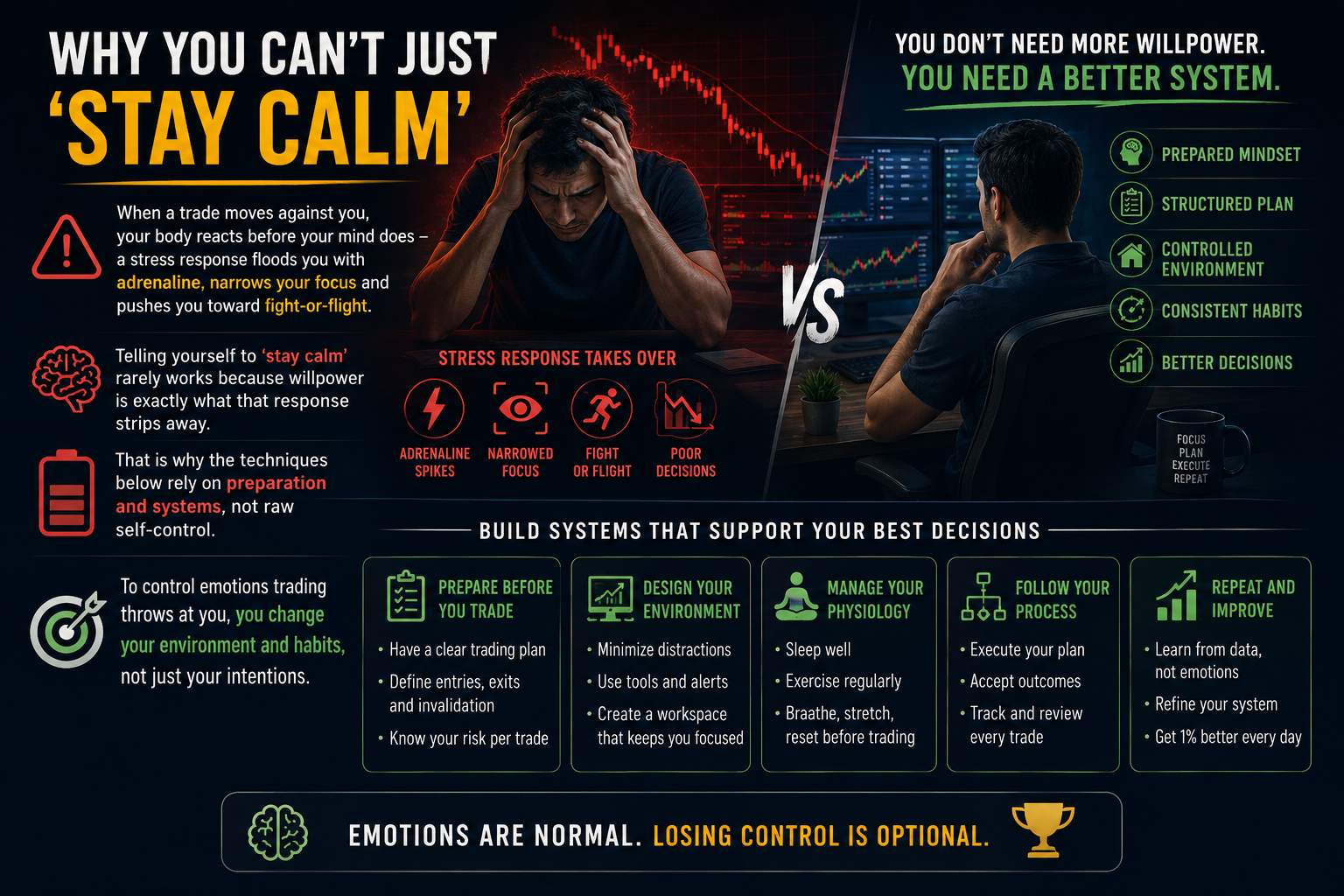
When a trade moves against you, your body reacts before your mind does – a stress response floods you with adrenaline, narrows your focus and pushes you toward fight-or-flight. Telling yourself to ‘stay calm’ rarely works because willpower is exactly what that response strips away. That is why the techniques below rely on preparation and systems, not raw self-control. To control emotions trading throws at you, you change your environment and habits, not just your intentions.
The Emotions You Need to Manage
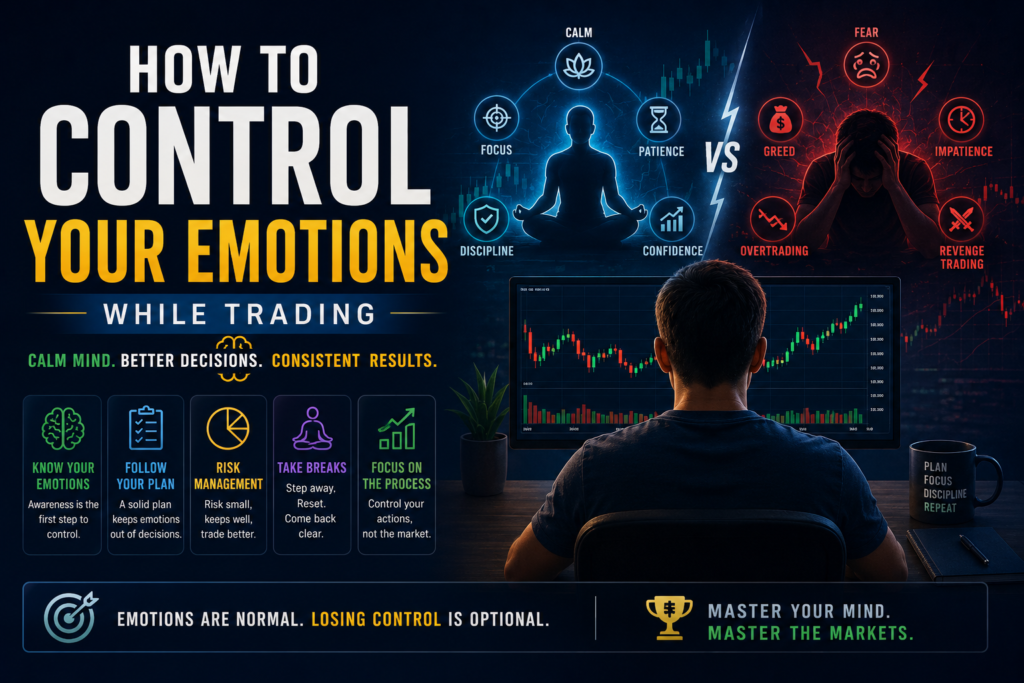
Emotional control starts with naming what you feel. Five emotions cause most trading damage:
| Emotion | How it shows up in trading |
|---|---|
| Fear | Exiting winners early, skipping valid setups, freezing after a loss. |
| Greed | Over-sizing, holding too long, adding to positions to chase more. |
| Hope | Holding a losing trade, ignoring the stop, waiting for a rescue. |
| Regret | Revenge trading after a loss, or chasing a missed move (FOMO). |
| Euphoria | Overconfidence after a big win, leading to reckless risk. |
Before the Session: Prepare to Stay Calm
Most emotional control is won before you place a single trade. A prepared trader has far fewer decisions to make under stress. Build this pre-market routine:
- Write your plan – define your setups, entries, exits and risk before the market opens, so choices aren’t made emotionally.
- Set fixed risk – decide a small, constant percentage per trade (many use 1-2%) so no single loss can trigger panic.
- Set a daily loss limit – agree in advance when you’ll stop for the day, removing the urge to revenge trade.
- Check your state – if you’re tired, angry or stressed, reduce size or skip the session entirely.
- Prepare your space – a quiet, distraction-free setup makes it easier to think clearly.
During the Trade: In-the-Moment Techniques
These are the tactics that help you control emotions trading in real time, when the pressure is highest:
- Pause before acting – when you feel an urge to break your plan, wait. Even ten seconds lets logic catch up with emotion.
- Breathe slowly – a few slow, deep breaths physically calm the stress response and clear tunnel vision.
- Use a pre-trade checklist – if a trade doesn’t tick every box, it doesn’t happen – no exceptions for a ‘feeling’.
- Name the emotion – silently label it (‘this is fear’); naming a feeling reduces its grip on your actions.
- Walk away – if you’re flooded, step back from the screen. No trade is worth acting on tilt.
After the Session: Review Without Judgement
What you do after trading shapes how you feel next time. A calm review turns emotion into learning:
- Journal every trade – record not just the numbers but the emotion behind each decision.
- Grade the process, not the profit – ask ‘did I follow my plan?’, not just ‘did I win?’.
- Separate luck from skill – a winning trade taken on impulse is still a bad trade.
- Close the laptop – a clear end to the session prevents late-night emotional trades.
Systems That Remove Emotion for You
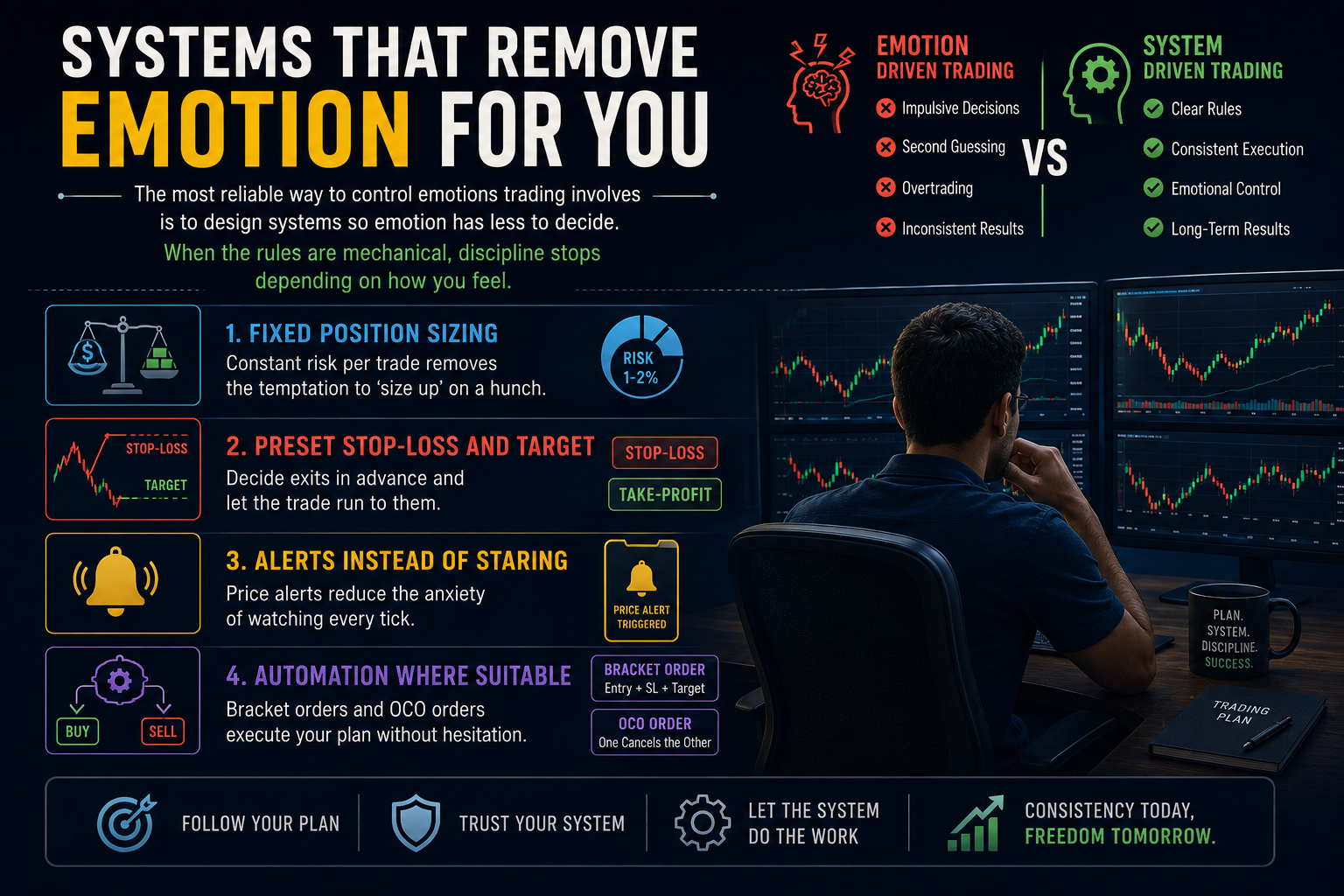
The most reliable way to control emotions trading involves is to design systems so emotion has less to decide. When the rules are mechanical, discipline stops depending on how you feel.
- Fixed position sizing – constant risk per trade removes the temptation to ‘size up’ on a hunch.
- Preset stop-loss and target – decide exits in advance and let the trade run to them.
- Alerts instead of staring – price alerts reduce the anxiety of watching every tick.
- Automation where suitable – bracket orders and OCO orders execute your plan without hesitation.
A Simple Daily Emotional-Control Routine
Combine the techniques above into a repeatable routine. Consistency is what makes emotional control a habit rather than a struggle.
| Stage | What to do |
|---|---|
| Pre-market | Review plan, set risk and daily loss limit, check your mental state. |
| During | Trade only checklist-valid setups; pause and breathe before any impulse. |
| After a loss | Take a short break; do not re-enter to ‘get it back’. |
| Post-market | Journal trades and emotions; grade your process, not the P&L. |
Mind and Body: The Hidden Factors
Emotional control is not only mental. Poor sleep, skipped meals, long unbroken screen time and high life stress all lower your threshold for impulsive decisions. Traders who protect their sleep, take regular breaks and manage stress outside the market find it far easier to control emotions trading requires inside it. Treat your physical state as part of your edge.
Common Mistakes
- Trying to suppress emotions instead of managing them – suppression usually backfires.
- Relying on willpower alone rather than systems and routines.
- Trading while tired, stressed or emotional ‘just this once’.
- Skipping the journal, so the same emotional mistakes repeat unseen.
- Risking too much, which turns every trade into an emotional event.
Myths vs Facts
| Myth | Fact |
|---|---|
| The best traders feel nothing. | They feel emotions too; they’ve built systems so feelings don’t drive actions. |
| You can willpower your way to calm. | Under stress, willpower fades; preparation and routines work better. |
| Emotional control is a personality trait. | It’s a skill built through practice, journaling and habits. |
| One calm session means you’ve mastered it. | It’s an ongoing practice that professionals maintain every day. |
A note on wellbeing
If trading is causing persistent stress, sleeplessness, or an urge to chase losses at any cost, please step back and consider speaking with a mental-health professional or a problem-gambling helpline in your region. Protecting your wellbeing matters more than any trade.
Learn How to Read the Economic Calendar for Forex Trading
Expert Analysis
The traders who best control emotions trading exposes them to share one insight: they stopped trying to feel calm and started designing situations where calm is the default. Fear and greed are hardwired survival responses – useful on the savannah, disastrous on a chart. You cannot argue them away in real time, because the stress response shuts down the very reasoning you’d need. So the winning move is to shift the battle earlier, to the calm hours before the market opens, where a written plan, fixed risk and a daily loss limit are decided once and then simply obeyed.
Seen this way, emotional control is less about willpower and more about design. Every rule you automate – a preset stop, a position-sizing formula, a checklist – is one fewer decision you must make while flooded with adrenaline. The journal then closes the loop, turning each emotional slip into data you can act on. Do this consistently and the market stops feeling like a test of nerve and starts feeling like the execution of a plan.
Key Takeaways
- You can’t delete emotions, but you can stop them from driving your trades.
- Most emotional control is won before the session, through a plan, fixed risk and a loss limit.
- In the moment, pause, breathe, use a checklist and walk away when flooded.
- Journal every trade and grade your process, not just the profit.
- Systems and routines make it far easier to control emotions trading demands than willpower alone.
Frequently Asked Questions (FAQ)
Q: How do I control my emotions while trading?
A: Prepare with a written plan and fixed risk, use in-the-moment tactics like pausing and slow breathing, and review each trade in a journal afterwards.
Q: Why can’t I control my emotions when trading?
A: Because a loss triggers a stress response that suppresses rational thinking. Preparation and systems work better than willpower in that state.
Q: Can you trade without emotions?
A: No. Emotions are part of being human. The goal is to manage them so they don’t override your rules, not to eliminate them.
Q: What emotions affect traders most?
A: Fear, greed, hope, regret and euphoria cause most trading mistakes, from exiting early to revenge trading.
Q: How does risk management help emotional control?
A: Small, fixed risk per trade means no single loss can cause panic, which removes the fuel for impulsive, emotional decisions.
Q: Does breathing really help while trading?
A: Yes. Slow, deep breaths calm the physical stress response, reduce tunnel vision and create a gap between impulse and action.
Q: What is a pre-trade checklist?
A: A short list of conditions a setup must meet before you enter. It forces logic over feeling and filters out impulsive trades.
Q: How do I stop trading on emotion?
A: Trade only checklist-valid setups, set a daily loss limit, automate exits, and take a break the moment you feel flooded.
Q: Should I trade when I’m stressed or tired?
A: It’s best not to. Fatigue and stress lower your threshold for impulsive decisions, so reduce size or skip the session.
Q: How does a trading journal help emotions?
A: Recording the emotion behind each trade reveals your patterns, making them easier to catch and correct over time.
Q: What is revenge trading?
A: Impulsively trying to win back a loss with a bigger, unplanned trade. A daily loss limit and a post-loss break help prevent it.
Q: How long does it take to control trading emotions?
A: It’s an ongoing practice rather than a one-time fix; even professionals actively manage their emotions every session.
Q: Can automation reduce emotional trading?
A: Yes. Preset stops, targets and bracket orders execute your plan without hesitation, removing in-the-moment emotion.
Q: Does sleep affect trading emotions?
A: Strongly. Poor sleep, skipped meals and long screen time all make impulsive, emotional decisions more likely.
Q: Is emotional control more important than strategy?
A: Both matter, but a good strategy fails without the discipline to follow it, so emotional control is essential.