Quick answer
The RBI Alert List is the Reserve Bank of India’s published list of platforms not authorised to deal in forex or run an electronic trading platform in India. Checking the RBI Alert List forex brokers before you deposit is one of the simplest ways to avoid an illegal platform – but the list is not exhaustive.
Introduction
Open Instagram or YouTube in India and you’ll see them: slick forex apps promising huge leverage, fast withdrawals and easy profits. Many are not authorised to operate here at all – and the Reserve Bank of India keeps a public list to warn you. Learning to use the RBI Alert List of forex brokers is one of the cheapest, fastest ways to protect your money before you ever fund an account.
This guide explains what the list is, the important nuance of what it does and doesn’t mean, how it has grown, and exactly how to check a platform – and report one – before or after you’ve dealt with it. Details were verified against current 2026 sources, but the list is updated periodically, so always check the live version on the RBI website. This is educational information, not legal or investment advice.
What Is the RBI Alert List?
The RBI Alert List is a public register of entities, platforms and websites that are neither authorised to deal in foreign exchange under FEMA (the Foreign Exchange Management Act, 1999) nor authorised to operate an electronic trading platform (ETP) for forex transactions in India. It also names websites that appear to promote such unauthorised platforms – including through advertising, or by offering ‘training’ and ‘advisory’ services that funnel users toward them.
In short, the RBI Alert List of forex brokers is a warning label. It tells Indian residents: these platforms are not cleared to offer you forex here, so proceed at your own risk – which, in practice, means don’t.
What Being on the List Really Means (and Doesn’t)
This nuance is where most online coverage gets it wrong, so it’s worth stating carefully:
- It IS a warning to Indian residents that a platform lacks Indian authorisation – the exposure sits with you, the user, not with the firm.
- It is NOT a criminal verdict on the company. The RBI does not call the listed firms ‘illegal’; a firm can be perfectly reputable in its home country and still appear here simply because it has no Indian authorisation.
- Using a listed or otherwise unauthorised platform can attract penal action under FEMA – and if your money disappears, Indian regulators cannot help you recover it.
- Trading software such as MT4 and MT5 can appear on the list as ETP categories; that reflects the platform framework, not a judgment on any single broker.
So the right way to read the list is as a risk signal aimed at you, not a blacklist of ‘bad companies’. The practical takeaway is identical, though: steer clear.
Why the List Exists
The RBI maintains the list under its ETP framework and FEMA mandate to protect the public from a fast-growing ecosystem of unauthorised forex platforms. Permitted forex transactions in India can be carried out only on ETPs authorised by the RBI or on recognised stock exchanges (NSE, BSE, MSE). Offshore platforms operate outside that supervised system, so the RBI’s response is twofold: authorise legitimate venues, and publicly flag the rest. The Alert List is the second half of that strategy – transparency as consumer protection.
How the List Has Grown
The Alert List has expanded steadily as unauthorised platforms have multiplied. Selected milestones (verify current totals on the RBI site):
| Milestone | Entities on the list |
|---|---|
| First Alert List (September 2022) | 34 |
| Update (June 2023) | 56 |
| Latest update (November 2025) | around 95 |
The steady growth is itself a message: the number of platforms illegally targeting Indian traders keeps rising, which is exactly why checking the list before depositing has become essential.
Who and What Appears on It
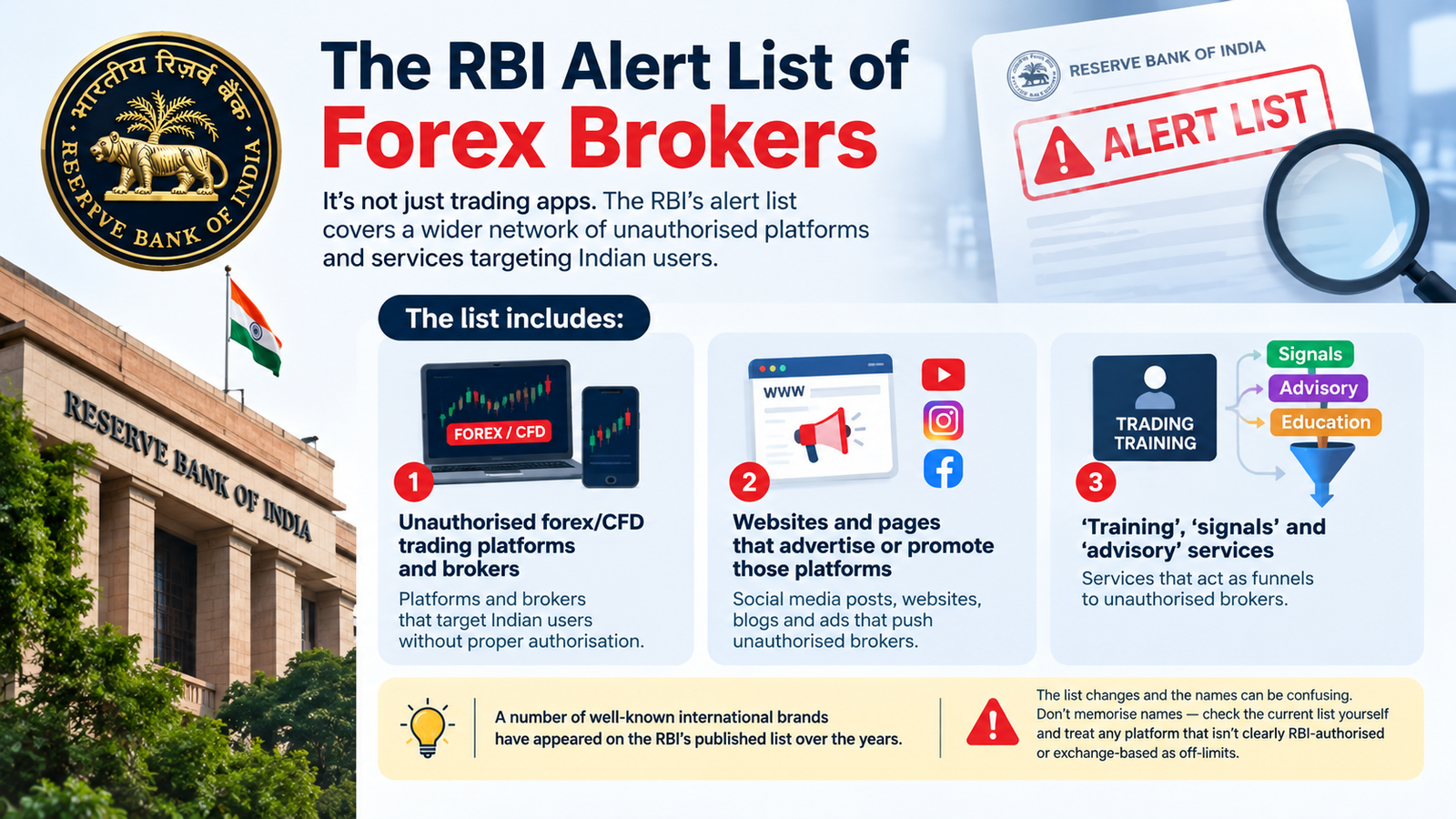
The RBI Alert List of forex brokers covers more than just trading apps. It includes:
- Unauthorised forex/CFD trading platforms and brokers targeting Indian users.
- Websites and pages that advertise or promote those platforms.
- ‘Training’, ‘signals’ and ‘advisory’ services that act as funnels to unauthorised brokers.
Over the years, a number of heavily advertised international brands have appeared on the RBI’s published list. Because the list changes and framing matters, the point is not to memorise names but to check the current list yourself – and to treat any platform that isn’t clearly RBI-authorised or exchange-based as off-limits.
What This Means for You
The single most important idea in this whole topic: the risk lands on the resident, not the offshore firm. If you fund an unauthorised platform, you are the one potentially in breach of FEMA, and you are the one with no recourse if the platform freezes withdrawals or vanishes. These platforms sit outside Indian jurisdiction, so the RBI, SEBI and Indian courts have little ability to help you recover funds. The Alert List exists precisely so you can avoid becoming that person.
How to Check a Forex Broker Before You Deposit
Before funding any platform, run this quick verification – it takes minutes and can save your capital:
- Search the RBI Alert List – check the current list on the RBI website for the platform’s name or website.
- Confirm it’s not the only check – the list is non-exhaustive, so absence from it does NOT mean a platform is authorised.
- Verify authorisation positively – look for the platform on the RBI’s lists of authorised persons and authorised ETPs.
- Check SEBI registration – for exchange-traded currency derivatives, confirm the broker on SEBI’s registered-intermediary list.
- Insist on a recognised exchange – legal currency trading routes through the NSE, BSE or MSE, not a private offshore venue.
If a platform fails any of these, the safe answer is not to deposit. Positive authorisation matters more than mere absence from the Alert List.
What to Do If You’ve Used an Unauthorised Platform
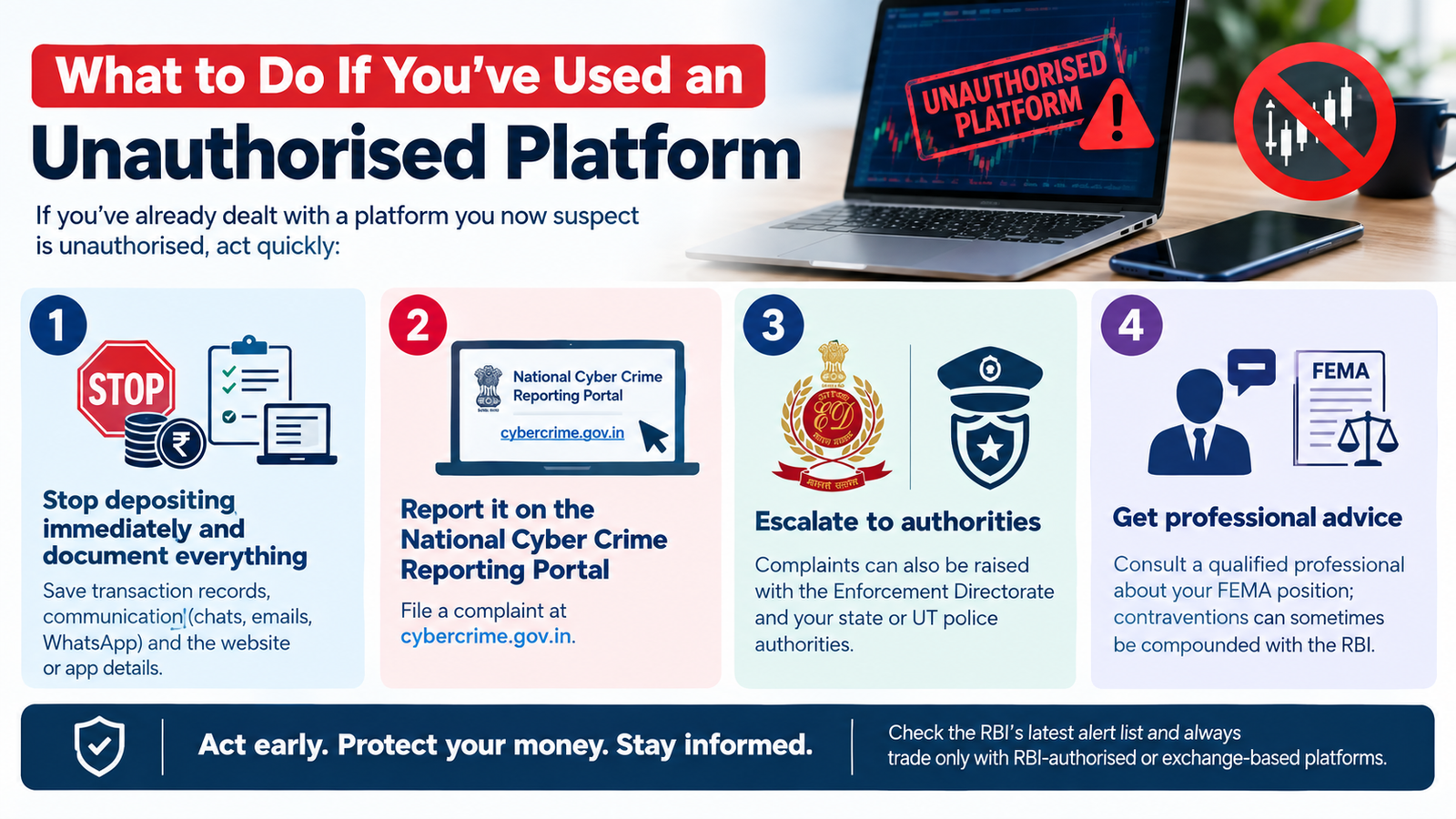
If you’ve already dealt with a platform you now suspect is unauthorised, act quickly:
- Stop depositing immediately and document everything – transactions, communications and the website.
- Report it on the National Cyber Crime Reporting Portal (cybercrime.gov.in).
- Complaints can also be raised with the Enforcement Directorate and your state or UT police authorities.
- Consult a qualified professional about your FEMA position; contraventions can sometimes be compounded with the RBI.
The Legal Alternative
Avoiding the Alert List is only half the job – knowing the legal route is the other half. Indian residents can legally trade currencies as exchange-traded futures and options, on recognised exchanges (NSE, BSE, MSE), through SEBI-registered brokers, in the seven approved pairs (USD/INR, EUR/INR, GBP/INR, JPY/INR, EUR/USD, GBP/USD and USD/JPY). That framework is supervised, rupee-settled and gives you actual recourse – the very things an unauthorised platform cannot offer.
Learn about Pivot Point trading strategy here.
Common Misconceptions
- ‘It’s not on the Alert List, so it’s approved.’ – The list is non-exhaustive; verify authorisation positively.
- ‘The broker is regulated abroad, so it’s fine here.’ – Foreign regulation is not Indian authorisation.
- ‘Being listed means the company is a scam.’ – It means it lacks Indian authorisation; the exposure is yours.
- ‘A VPN or a friend’s account gets around it.’ – Neither changes the FEMA position.
- ‘MT4/MT5 being listed means my broker is banned.’ – Those are software categories, not broker verdicts.
Myths vs Facts
| Myth | Fact |
|---|---|
| The Alert List is a complete list of illegal brokers. | It is explicitly non-exhaustive; absence is not authorisation. |
| Listing is a penalty on the company. | It is a warning to residents; the FEMA exposure sits with the user. |
| A globally reputable broker can’t be listed. | It can, if it has no Indian authorisation to offer forex here. |
| If I lose money, the RBI will help. | Offshore platforms are outside Indian jurisdiction; recovery is unlikely. |
Compliance disclaimer
This article is for educational purposes only and is not legal or investment advice. The RBI Alert List is updated periodically and is non-exhaustive; details here were checked against 2026 sources but may since have changed. Always verify the current Alert List and the RBI’s lists of authorised persons and ETPs directly on rbi.org.in, and consult a qualified professional before acting.
Expert Analysis
The most important reframe about the RBI Alert List of forex brokers is that it is a tool addressed to you, not a scoreboard of villains. The RBI is careful not to brand listed firms as criminals; what it is saying is narrower and more useful – these entities are not authorised to offer forex in India, so if you deal with them, you are outside the protective perimeter of Indian regulation. That distinction changes how you should use the list. It is not a place to check whether a broker is ‘good’, but whether dealing with it exposes you. And because the list is non-exhaustive, its real lesson is to flip your default: assume a platform is unauthorised until you can positively confirm it appears on the RBI’s authorised lists or trades through a recognised exchange.
This is why the smartest consumers treat absence from the Alert List as meaningless and positive authorisation as everything. Scammers know the list is a lagging indicator – a new platform can operate for months before it is flagged – so relying on ‘it’s not listed yet’ is exactly the gap they exploit. The durable protection is structural: trade only where India can actually supervise and, if needed, help you. Every rupee sent to an unauthorised offshore platform is a rupee placed beyond the reach of the only regulators who answer to you, and no advertised leverage or bonus is worth that trade.
Key Takeaways
- The RBI Alert List names platforms not authorised to deal in forex or run an ETP in India.
- Being listed is a warning to residents, not a criminal verdict on the firm – the exposure is yours.
- The list is non-exhaustive: absence from it does not mean a platform is authorised.
- Verify positively – check the RBI’s authorised-persons/ETP lists and SEBI registration – before depositing.
- Legal currency trading is on NSE/BSE/MSE via SEBI-registered brokers in the seven approved pairs.
Frequently Asked Questions (FAQ)
Q: What is the RBI Alert List?
A: It is the RBI’s public list of entities and websites not authorised to deal in forex or operate an electronic trading platform for forex in India.
Q: How do I check if a forex broker is on the RBI Alert List?
A: Search the current Alert List on the RBI website (rbi.org.in) for the platform’s name or website address.
Q: Does being on the list mean the broker is illegal?
A: The RBI does not call listed firms illegal; it means they lack Indian authorisation. The FEMA exposure sits with you, the user.
Q: If a broker isn’t on the list, is it safe?
A: Not necessarily. The list is non-exhaustive, so you must positively verify authorisation, not just rely on absence.
Q: How many platforms are on the RBI Alert List?
A: As of the November 2025 update, around 95 entities – but it is updated periodically, so check the live list.
Q: What happens if I use an unauthorised forex platform?
A: You may be in breach of FEMA, and if the platform withholds funds or disappears, Indian regulators cannot help you recover them.
Q: How do I report an unauthorised forex platform?
A: Report it on the National Cyber Crime Reporting Portal; complaints can also go to the Enforcement Directorate and state/UT police.
Q: Why do MT4 and MT5 appear on the list?
A: They are electronic trading platform categories, so their inclusion reflects the ETP framework, not a verdict on any individual broker.
Q: Can a globally regulated broker be on the list?
A: Yes. Regulation in another country is not the same as authorisation to offer forex to residents in India.
Q: What is an authorised ETP?
A: An electronic trading platform that the RBI has authorised to conduct forex transactions in India, per its ETP framework.
Q: How do I verify a broker positively?
A: Check the RBI’s lists of authorised persons and authorised ETPs, and SEBI’s registered-intermediary list for exchange trading.
Q: Is forex trading legal in India at all?
A: Yes – as exchange-traded currency derivatives on NSE/BSE/MSE via SEBI-registered brokers, in seven approved pairs.
Q: Does a VPN make an unauthorised platform legal?
A: No. A VPN hides your location but does not change your FEMA position; the activity remains unauthorised.
Q: How often is the Alert List updated?
A: Periodically, as the RBI identifies more unauthorised platforms; totals have risen over the years, so always check the latest version.
Q: Where can I find the official Alert List?
A: On the Reserve Bank of India’s website, rbi.org.in, alongside its lists of authorised persons and ETPs.