Most traders spend their first few years hunting for the perfect strategy. They collect indicators, backtest systems, and refine entry rules, convinced that the next tweak will finally deliver consistency. Yet the traders who blow up their accounts rarely do so because their system was flawed. They do so because their minds were. This is the uncomfortable truth at the heart of trading psychology: your emotions, not your indicators, decide whether you survive.
Trading psychology is the study of how mental and emotional states influence trading decisions. It explains why a trader with a profitable strategy still loses money, why disciplined people abandon their rules under pressure, and why the same three destructive patterns — overtrading, FOMO trading, and revenge trading — appear in account after account. If you want to trade for the long term, mastering trading psychology is not optional. It is the foundation everything else sits on.
Why Trading Psychology Matters More Than Strategy
A strategy is only as good as the person executing it. You can hand two traders the identical system, the identical rules, and the identical capital, and one will thrive while the other bleeds out. The difference is almost always trading psychology.
Markets are engineered to provoke emotion. Prices move in ways that trigger fear, greed, hope, and regret — often all within a single session. When money is on the line, the rational part of your brain that built your trading plan gets hijacked by the emotional part that just wants the pain to stop or the gains to keep coming. Good trading psychology is what keeps the plan in charge when the emotions arrive.
This is why so many profitable-on-paper traders never make money in practice. Their edge is real, but their discipline evaporates the moment stress builds. Improving your trading psychology closes that gap. It turns a strategy that works in theory into one that works in your actual account, on your actual worst days.
The Three Traps That Destroy Accounts
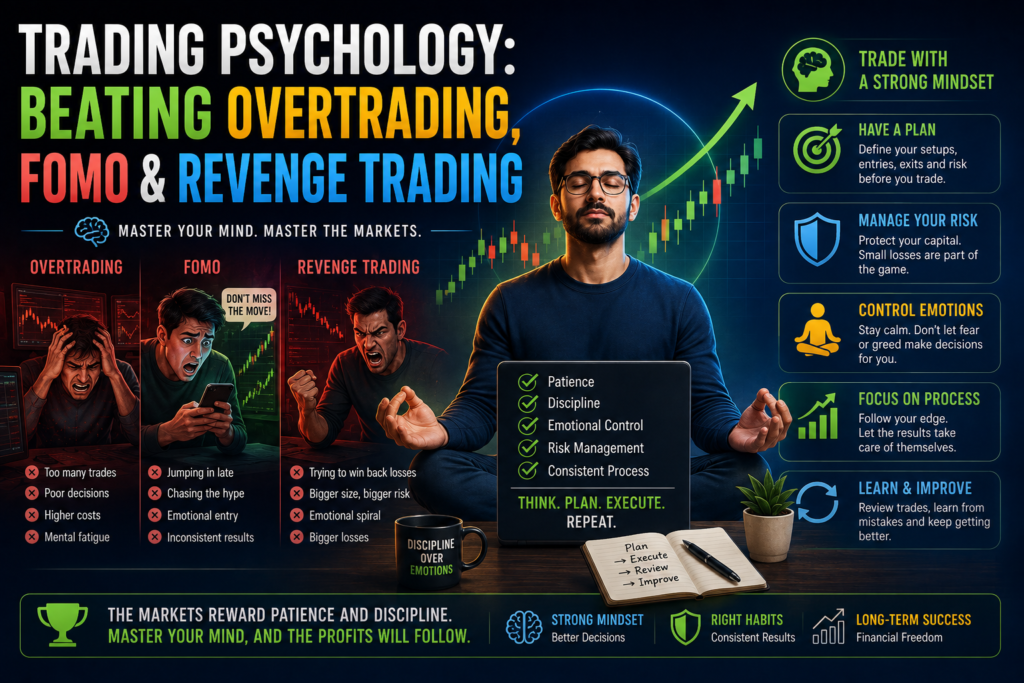
Three behaviours cause the majority of preventable losses. They are distinct, but they share a common root: acting from emotion instead of process. Understanding each one is the first step to beating it.
Overtrading: When Activity Feels Like Progress
Overtrading is placing far more trades than your strategy or account justifies — chasing marginal setups, forcing positions during dead market hours, or trading simply because you feel you should be doing something. It is one of the most common failures in all of trading, and one of the most expensive.
The impulse behind overtrading is usually boredom or a craving for control. When the market offers no clean setups, an undisciplined trader invents them. Each trade carries a spread and commission, so overtrading quietly bleeds capital even when your win rate looks acceptable. Worse, it erodes focus. A trader taking twenty positions a day cannot possibly give each the attention it needs, and quality collapses.
Overtrading also feeds a dangerous illusion. Constant activity feels productive, so the trader mistakes motion for progress. But in trading, doing nothing is often the highest-value action available. The discipline to sit on your hands is a core trading psychology skill, and its absence is what turns a calm strategy into a slot machine.
FOMO Trading: The Fear of Missing Out
FOMO trading is entering a position because a move is already happening and you cannot bear to watch it run without you. The candle is surging, social media is buzzing, and every fibre of your being screams that this is the one — so you chase it, usually near the top, usually right before the reversal.
FOMO trading is emotion at its most primal. The fear of missing out is a deep social instinct, and markets weaponise it. By the time a move is obvious enough to trigger FOMO, the smart-money entry has passed and the risk-to-reward has flipped against you. You are buying the excitement of others, not a calculated setup.
The tell of FOMO trading is that it happens without a plan. There was no pre-defined entry, no stop, no target — just a reaction to price. That reactive, plan-free quality is what makes FOMO trading so destructive, and it is precisely why strong trading psychology treats “I missed it” as a complete, acceptable outcome rather than a wound to be avenged.
Revenge Trading: Chasing Your Losses
Revenge trading is the attempt to win back a loss immediately, driven by anger and wounded pride rather than any signal from the market. You take a loss, you feel it personally, and you jump straight back in — often larger, often against your rules — determined to make the market pay for what it took.
Of the three traps, revenge trading is the most acutely dangerous because it compounds fast. One loss becomes two, position size creeps up to “get it all back in one shot,” and within an hour a small, normal drawdown has become an account-threatening event. Revenge trading is the reason a single bad trade so often turns into a catastrophic day.
The emotional engine here is ego. A loss feels like a defeat, and revenge trading is the mind’s attempt to restore its bruised sense of competence. But the market does not know you lost and owes you nothing. Recognising that a loss is a normal cost of doing business, not a personal insult, is one of the most liberating shifts a trader can make.
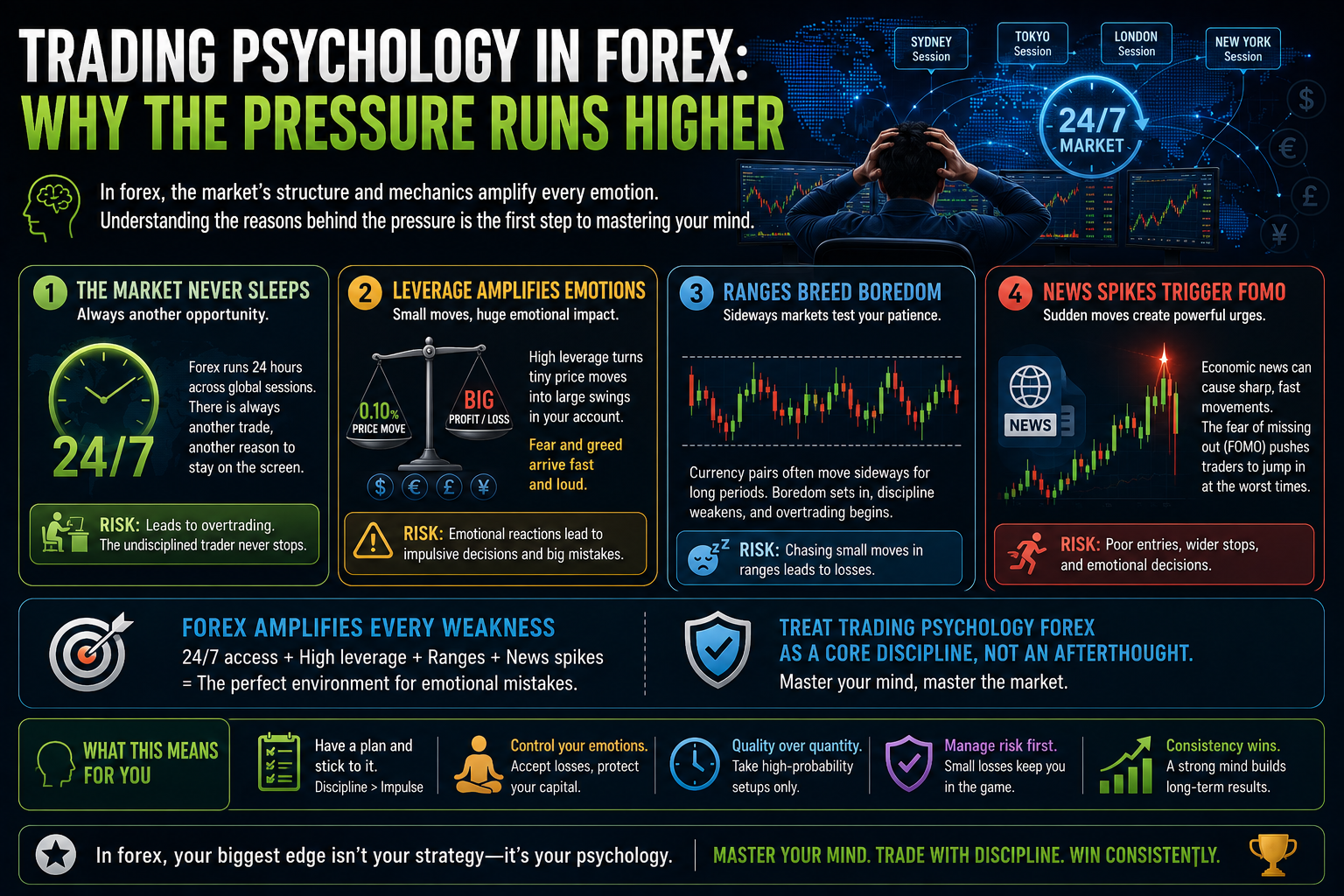
Trading Psychology in Forex: Why the Pressure Runs Higher
Every market tests your mind, but trading psychology forex challenges are unusually intense, and it is worth understanding why. Forex runs twenty-four hours a day across global sessions, which means there is always another opportunity, always another reason to stay glued to the screen. That constant availability is fertile ground for overtrading — the market never closes, so the undisciplined trader never stops.
Leverage magnifies the problem. Retail forex accounts often carry leverage that turns tiny price moves into large emotional swings. When a fraction of a percent move can double or halve your position’s value, fear and greed arrive fast and loud. Trading psychology forex discipline therefore has to be tighter than in slower, less-leveraged markets; the emotional feedback loop is simply quicker.
Currency markets also produce long, grinding ranges punctuated by sharp news-driven spikes. Those spikes are FOMO trading magnets, and the ranges breed the boredom that fuels overtrading. If you trade currencies, treating trading psychology forex as a dedicated discipline — not an afterthought — is essential. The mechanics of forex amplify every psychological weakness you bring to the table.
How to Beat Overtrading
Beating overtrading starts with a hard cap. Decide in advance the maximum number of trades you will take in a day, and treat it as a non-negotiable limit rather than a target. Many traders find their results improve when they cut their trade count, because they are forced to wait for their best setups.
Define what a valid setup actually looks like, in writing. If a potential trade does not tick every box on that checklist, it does not exist. This converts trading from a stream of impulses into a filter — and a good filter rejects far more than it accepts. Sound trading psychology accepts that most of the trading day should be spent waiting.
Finally, schedule your screen time. Trade the sessions where your edge is real and close the platform outside them. Removing yourself from the market physically is often easier than resisting it through willpower alone.
How to Beat FOMO Trading
The antidote to FOMO trading is a written plan for every trade, defined before you enter. Entry, stop, and target must exist on paper before your money is at risk. A move that appears without a pre-planned entry is not your trade — it is someone else’s, and you let it go.
Reframe missed moves. There will always be another setup; the market produces them endlessly. Internalising abundance rather than scarcity strips FOMO trading of its power, because you no longer believe each opportunity is your last. This mindset shift is central to durable trading psychology.
Keep a journal note every time you chase and lose. Over weeks, the pattern becomes undeniable, and seeing your own FOMO trading laid out in black and white does more to change behaviour than any rule you could impose from outside.
How to Beat Revenge Trading
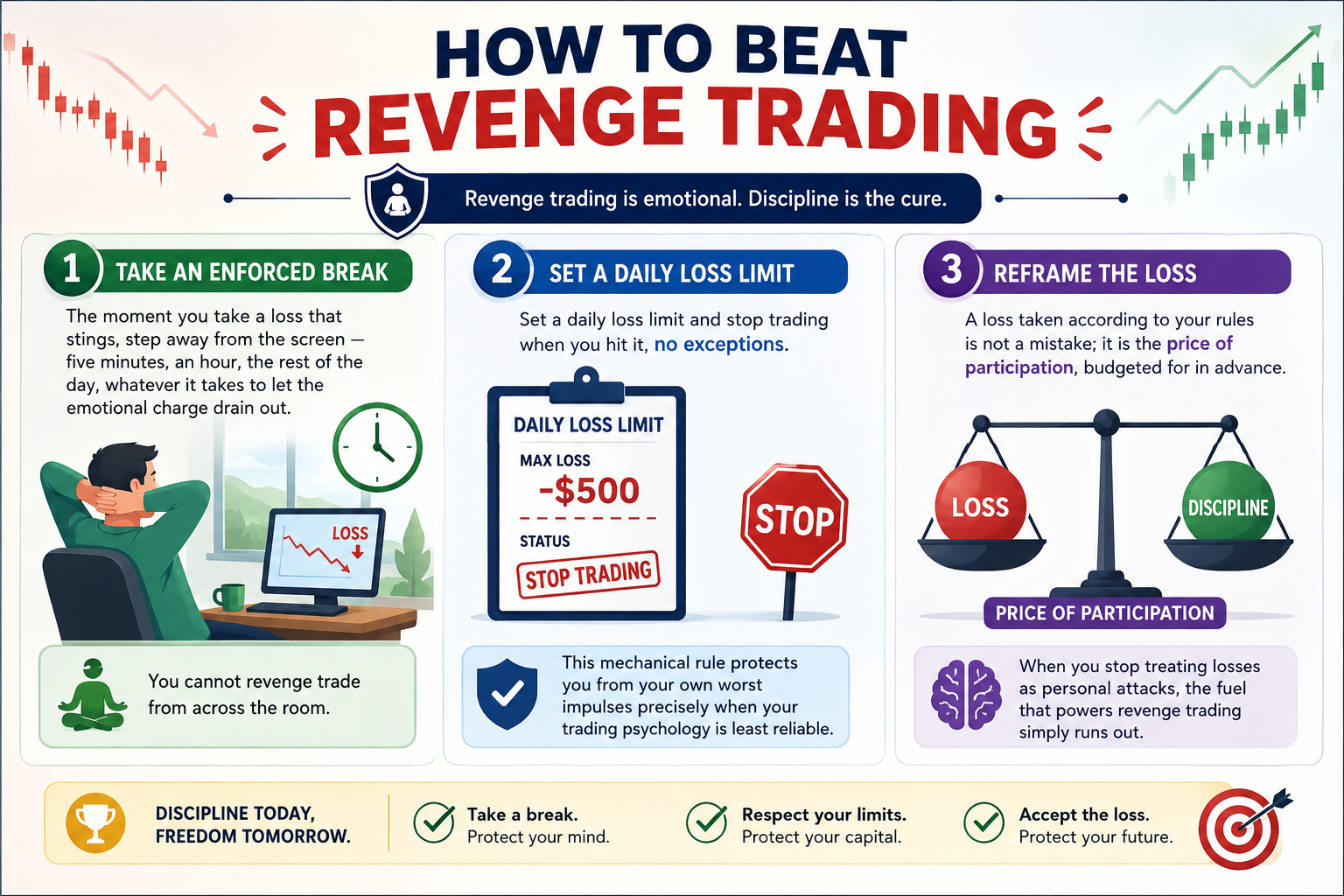
The single most effective defence against revenge trading is the enforced break. The moment you take a loss that stings, step away from the screen — five minutes, an hour, the rest of the day, whatever it takes to let the emotional charge drain out. You cannot revenge trade from across the room.
Set a daily loss limit and stop trading when you hit it, no exceptions. This mechanical rule protects you from your own worst impulses precisely when your trading psychology is least reliable. A defined stopping point turns “I have to win it back now” into “I am done for today, and that is fine.”
Reframe the loss itself. A loss taken according to your rules is not a mistake; it is the price of participation, budgeted for in advance. When you stop treating losses as personal attacks, the fuel that powers revenge trading simply runs out.
Building a Durable Trading Psychology
Beating these three traps individually is useful, but the real goal is a resilient mindset that prevents all of them. Strong trading psychology is built through routines, not resolutions.
Keep a trading journal that records not just your entries and exits but your emotional state at the time. Over months, this journal becomes a mirror, showing you exactly where overtrading, FOMO trading, and revenge trading creep in. You cannot fix a pattern you cannot see, and the journal makes these patterns visible.
Manage risk so that no single trade can hurt you emotionally. When you risk a small, fixed fraction of your account, any one loss becomes trivial — and trivial losses do not trigger revenge trading or panic. Position sizing is, quietly, one of the most powerful trading psychology tools you have.
Build a routine around your sessions: preparation before, focus during, review after. Sleep, breaks, and life away from the screen matter more than traders admit; a rested mind makes better decisions. Much of trading psychology is simply protecting the quality of the mind you bring to the market each day.
Consider adding a layer of external accountability. Trading is a solitary activity, and isolation lets bad habits grow unchecked. A trusted trading partner, a small community, or even a coach who reviews your journal can spot the overtrading or revenge trading you have learned to rationalise away. We defend our own excuses far less easily when someone else is looking at the same evidence.
Finally, accept that you will never eliminate emotion entirely — nor should you want to. The aim is not to feel nothing but to act from process regardless of what you feel. That gap, between feeling an impulse and obeying it, is where all of trading psychology lives.
Final Thoughts
The market will always try to make you overtrade, chase, and seek revenge. Those pressures never fully disappear, even for professionals. What changes is your relationship to them. With deliberate practice, a written plan, honest journaling, and disciplined risk, you learn to notice the impulse and let it pass without acting on it.
Overtrading, FOMO trading, and revenge trading are not signs that you are a bad trader. They are signs that you are human, trading in an environment designed to exploit human instincts. Treat trading psychology as a skill to be trained — with the same seriousness you give your strategy — and you give yourself the one edge that actually compounds over a career: the ability to follow your own plan when it matters most.
Frequently Asked Questions
What is trading psychology?
Trading psychology is the study of how emotions and mental states — fear, greed, hope, ego — influence trading decisions. It explains why a trader with a profitable strategy still loses money, and why disciplined people abandon their rules under pressure. Strong trading psychology is what keeps your plan in charge when emotions arrive.
How do I stop overtrading?
Set a hard daily cap on the number of trades you will take and treat it as a limit, not a target. Define exactly what a valid setup looks like in writing, and reject anything that does not tick every box. Beating overtrading usually means accepting that most of the trading day should be spent waiting, not clicking.
What causes revenge trading?
Revenge trading is driven by ego and wounded pride. A loss feels like a personal defeat, so you jump straight back in — often larger and against your rules — to make the market pay you back. Recognising that a loss is a normal cost of doing business, not an insult, removes the fuel that powers revenge trading.
How can I avoid FOMO trading?
Plan every trade before you enter, with a defined entry, stop, and target. If a move appears without a pre-planned setup, it is not your trade and you let it go. FOMO trading loses its grip once you truly believe the market produces endless opportunities and “I missed it” is an acceptable outcome.
Why is trading psychology harder in forex?
Trading psychology forex challenges are amplified by the market running twenty-four hours a day and by heavy leverage. The constant availability breeds overtrading, and leverage turns small price moves into large emotional swings, so fear and greed arrive faster. For that reason, trading psychology forex discipline needs to be tighter than in slower, less-leveraged markets.
Can trading psychology actually be improved?
Yes. Trading psychology is a skill, not a fixed trait, and it is trained through routines rather than willpower alone. A trading journal that records your emotional state, strict risk management, enforced breaks, and daily loss limits all build the discipline over time. The goal is not to feel no emotion, but to act from process regardless of what you feel.