
Quick answer
To trade USD/INR in India, open an account with a SEBI-registered broker, complete KYC, and trade currency futures or options on the NSE or BSE. You forecast whether the rupee will weaken or strengthen against the dollar, then take a position, manage risk with a stop-loss, and exit for a profit or loss.
Introduction
The rupee-dollar pair is the most actively traded currency contract in India, and learning how to trade USD/INR is a natural first step for anyone entering the currency market. It is influenced by forces every Indian already feels — crude oil prices, RBI policy, foreign investment flows and the global strength of the US dollar.
This complete guide walks through how to trade USD/INR from the ground up: the legal framework, the instruments available, a step-by-step setup, what actually moves the pair, practical strategies, costs and risk management. It is educational only — not trading advice — and any rate mentioned is dated and illustrative, so always check live figures before acting.
What Is USD/INR?
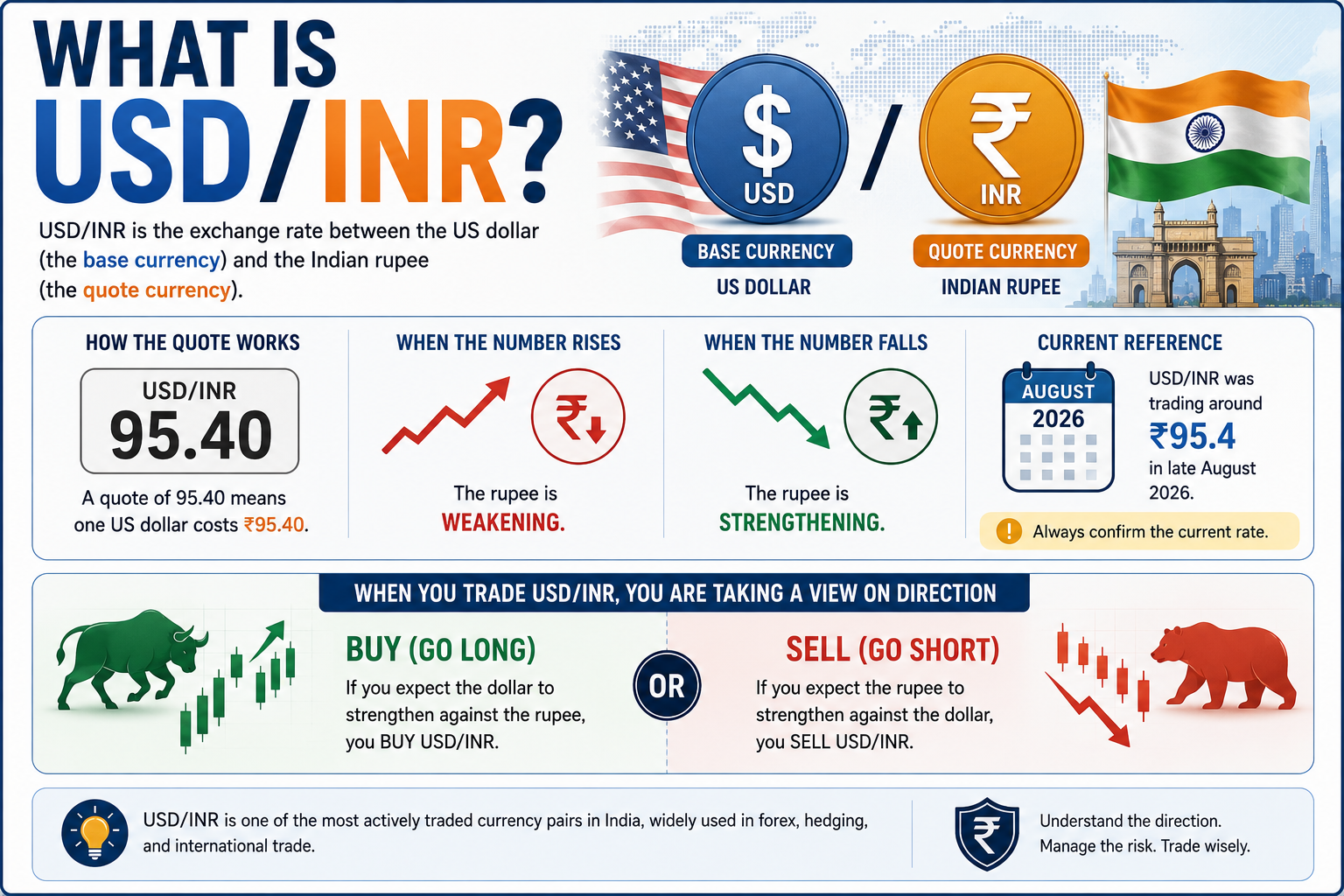
USD/INR is the exchange rate between the US dollar (the base currency) and the Indian rupee (the quote currency). A quote of 95.40 means one US dollar costs ₹95.40. When the number rises, the rupee is weakening; when it falls, the rupee is strengthening. As an illustrative reference, USD/INR was trading around ₹95.4 in late August 2026 — always confirm the current rate.
When you trade the rupee-dollar pair, you are taking a view on that direction: buy (go long) if you expect the dollar to strengthen against the rupee, or sell (go short) if you expect the rupee to gain.
How to Trade USD/INR in India: The Legal Framework
This is the most important part of learning how to trade USD/INR as an Indian resident. Currency trading here is regulated by SEBI and the RBI under FEMA (the Foreign Exchange Management Act). Residents can trade currency derivatives — futures and options — on recognised exchanges such as the NSE and BSE, in permitted pairs.
- Permitted pairs include USD/INR, EUR/INR, GBP/INR and JPY/INR, plus some cross pairs.
- Trading is done through a SEBI-registered broker; spot forex via unregulated offshore platforms is not permitted for residents.
- Contracts are cash-settled in rupees, typically referencing the RBI reference rate.Sticking to SEBI-recognised exchanges is not just a legal formality — it is the core of safe, transparent trading and protects you from the many illegal offshore schemes that target Indian traders.z̤
Instruments: Futures vs Options
There are two main ways to trade USD/INR on Indian exchanges. Each suits a different risk appetite.
| Feature | Currency futures | Currency options |
|---|---|---|
| What it is | Agreement to buy/sell at a set price | Right (not obligation) to buy/sell |
| Risk | Loss can exceed margin | Buyer’s loss limited to premium |
| Upfront cost | Margin | Premium (for buyers) |
| Best for | Directional views, hedging | Defined-risk and strategy trades |
| Settlement | Cash-settled in INR | Cash-settled in INR |
USD/INR Futures: Contract Specifications
Knowing the contract specs is essential before you trade. The figures below reflect standard NSE USD/INR futures; exchanges can revise them, so verify current specifications on the NSE or BSE website.
| Specification | Standard value (NSE USD/INR futures) |
|---|---|
| Underlying | USD/INR exchange rate |
| Lot size | USD 1,000 |
| Quotation | ₹ per US dollar, up to 4 decimals |
| Tick size | 0.0025 (₹2.50 per lot) |
| Settlement | Cash-settled in INR at the RBI reference rate |
| Trading hours | Approx. 9:00 a.m. to 5:00 p.m. IST, Mon-Fri |
How to Start Trading USD/INR: Step by Step
Here is the practical process for how to trade USD/INR, from zero to your first position:
- Open a trading account – choose a SEBI-registered broker (e.g. Zerodha, Upstox, Angel One) offering the currency derivatives segment.
- Complete KYC – submit PAN, address proof and bank details; activate the currency segment.
- Fund your account – deposit margin; currency derivatives are leveraged, so start small.
- Analyse the pair – form a view using fundamental and technical USD/INR analysis (covered below).
- Place the trade – buy or sell the USD/INR futures or options contract, and set a stop-loss.
- Manage and exit – monitor the position, adjust risk, and close it to book profit or cut loss.
What Moves USD/INR?
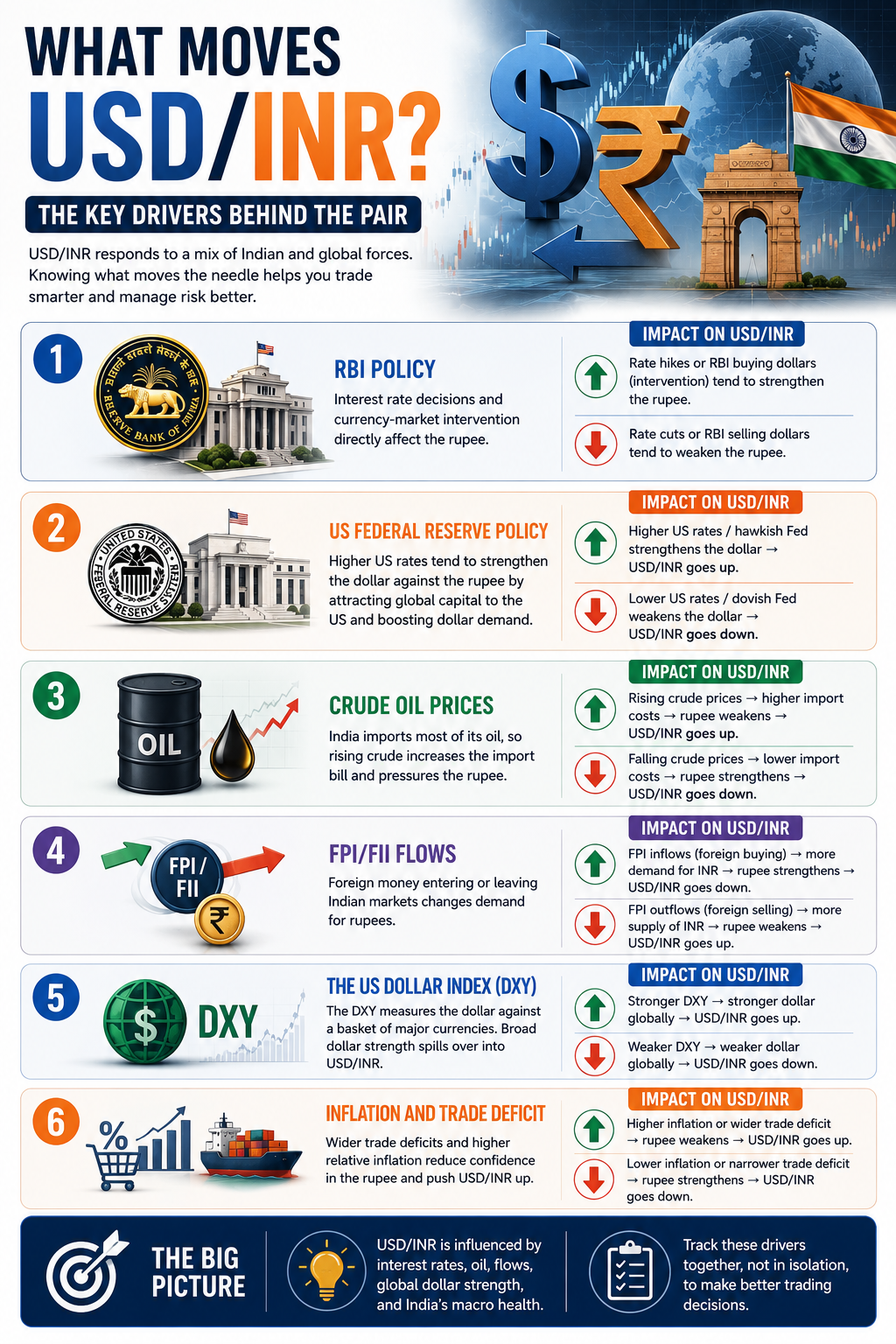
Understanding the drivers is central to how to trade USD/INR well. The pair responds to a mix of Indian and global forces:
- RBI policy – interest rate decisions and currency-market intervention directly affect the rupee.
- US Federal Reserve policy – higher US rates tend to strengthen the dollar against the rupee.
- Crude oil prices – India imports most of its oil, so rising crude usually pressures the rupee.
- FPI/FII flows – foreign money entering or leaving Indian markets moves demand for rupees.
- The US Dollar Index (DXY) – broad dollar strength spills over into USD/INR.
- Inflation and trade deficit – wider deficits and higher relative inflation tend to weaken the rupee.
USD/INR Analysis: Fundamental vs Technical
Good USD/INR analysis blends two lenses. Fundamental analysis studies the economic drivers above – RBI and Fed policy, oil, flows and data releases – to judge the pair’s likely direction over days to months. Technical analysis studies the chart itself, using support and resistance, trends, moving averages and indicators like RSI and MACD to time entries and exits.
Most consistent traders use both: fundamentals to decide which way to lean, and technicals to decide when to act. For a currency as policy-sensitive as the rupee, ignoring the economic calendar is a common and costly mistake.
USD/INR Trading Strategies
There is no single best USD/INR trading strategy – the right one depends on your timeframe and temperament. Here are the most common approaches, framed for education, not as recommendations:
Trend following
Trade in the direction of the prevailing move – going long while the pair makes higher highs, or short while it makes lower lows. It works best when a clear driver (like sustained dollar strength) is in play.
Range trading
The rupee often trades in a band, partly because of RBI activity. Range traders buy near support and sell near resistance, with tight stops beyond the band.
Breakout trading
When the pair breaks out of a long consolidation – often around a major event – breakout traders enter in the direction of the move once it is confirmed.
News / event trading
Positioning around RBI and Fed announcements or key data. High potential, but volatile – spreads widen and slippage rises, so risk control is critical.
Risk Management: The Real Edge
No guide on how to trade USD/INR is complete without risk management, which matters more than any single strategy.
- Position sizing – risk only a small, fixed percentage of capital per trade (many traders use 1-2%).
- Stop-loss – decide your exit before entering, and honour it.
- Respect leverage – currency futures are leveraged; a small move can be a large rupee swing on your margin.
- Avoid overtrading – quality setups beat frequent ones, especially around volatile events.
Costs and Taxation
Costs eat into returns, so factor them in before you trade. Typical charges on Indian currency derivatives include:
| Cost / item | Notes |
|---|---|
| Brokerage | Flat or percentage fee per order (varies by broker) |
| Exchange transaction charges | Levied by NSE/BSE on turnover |
| GST | 18% on brokerage plus transaction charges |
| SEBI turnover fee & stamp duty | Small statutory charges on turnover |
| STT | Not applicable to currency derivatives |
| Taxation | Gains generally treated as non-speculative business income – consult a CA |
Tax treatment can vary with your overall situation, so confirm specifics with a qualified chartered accountant.
Common Mistakes to Avoid
- Using illegal offshore brokers – stick to SEBI-registered platforms and permitted pairs.
- Over-leveraging – the biggest killer of new currency traders.
- Ignoring the economic calendar – RBI and Fed events can move the pair sharply.
- Trading without a stop-loss – one bad move can undo weeks of gains.
- No plan – entering on tips or emotion rather than a defined strategy.
Myths vs Facts
| Myth | Fact |
|---|---|
| Forex trading is banned in India. | INR pairs on SEBI-recognised exchanges are legal for residents. |
| USD/INR is too stable to trade. | It moves enough intraday to trade, and events add volatility. |
| You need a huge amount to start. | Micro-sized lots (USD 1,000) keep the entry accessible. |
| A good strategy guarantees profit. | Risk management, not any single strategy, drives long-term results. |
Frequently Asked Questions (FAQ)
Q: How to trade USD/INR in India as a beginner?
A: Open an account with a SEBI-registered broker, complete KYC, activate the currency segment, fund a small margin, and trade USD/INR futures or options with a stop-loss.
Q: Is USD/INR trading legal in India?
A: Yes. Trading INR currency pairs on SEBI-recognised exchanges like NSE and BSE is legal for residents under FEMA; offshore spot forex platforms are not permitted.
Q: What is the lot size of USD/INR futures?
A: The standard NSE USD/INR futures lot is USD 1,000, which keeps the entry cost accessible for retail traders.
Q: How much money do I need to start trading USD/INR?
A: Because of small lot sizes and leverage, you can start with a modest margin, but you should only risk money you can afford to lose.
Q: What moves the USD/INR rate?
A: Mainly RBI and US Fed policy, crude oil prices, foreign investment flows, the US dollar index, inflation and the trade deficit.
Q: What is the best USD/INR trading strategy?
A: There is no single best one; trend, range, breakout and event strategies each suit different conditions. Risk management matters most.
Q: Can I trade USD/INR intraday?
A: Yes, many traders trade the pair intraday within exchange hours, using technical analysis to time entries and exits.
Q: Futures or options for USD/INR – which is better?
A: Futures suit directional views; options offer defined risk for buyers. The right choice depends on your risk appetite and strategy.
Q: How is USD/INR settled in India?
A: Currency derivatives on Indian exchanges are cash-settled in rupees, typically referencing the RBI reference rate.
Q: Do I pay STT on currency derivatives?
A: No. Securities Transaction Tax does not apply to currency derivatives, though other charges and GST do.
Q: How are USD/INR trading profits taxed?
A: Gains are generally treated as non-speculative business income, but treatment varies – consult a qualified chartered accountant.
Q: What are the trading hours for USD/INR?
A: The NSE currency segment trades roughly 9:00 a.m. to 5:00 p.m. IST on weekdays; verify current timings with the exchange.
Q: What is USD/INR analysis?
A: It is the study of the pair using fundamental drivers (policy, oil, flows) and technical tools (charts, indicators) to guide trades.
Q: Is USD/INR good for beginners?
A: Its small lots, cash settlement and INR quotation make it a relatively approachable pair, provided leverage is used carefully.
Q: Where can I trade the rupee-dollar pair?
A: Through SEBI-registered brokers on the NSE and BSE currency derivatives segments.