
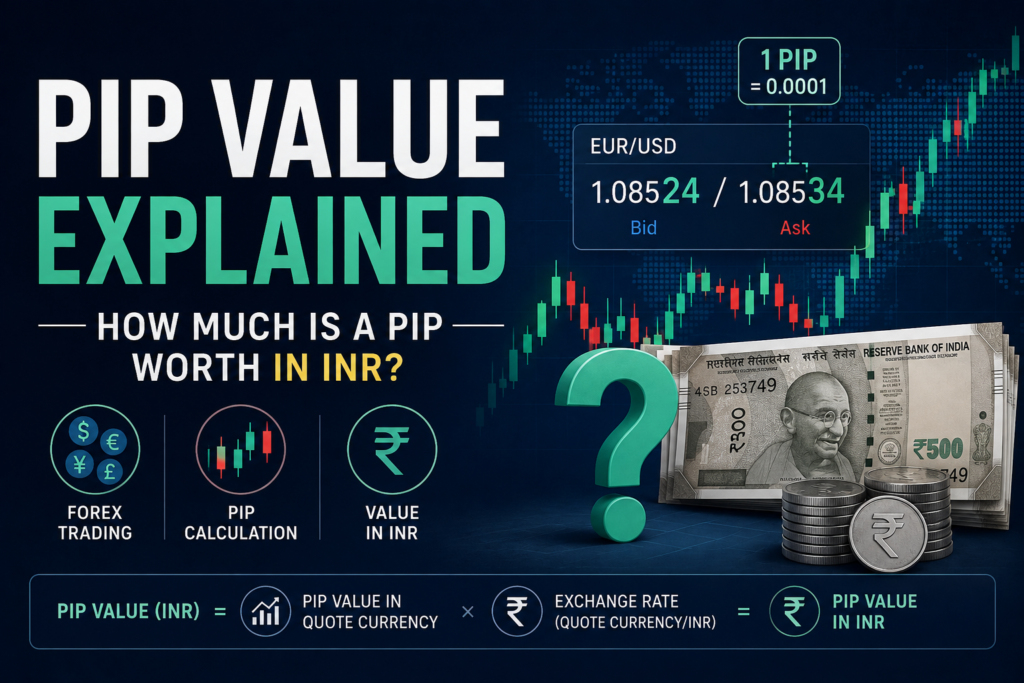
For anyone trading currencies from India, understanding pip value in rupees is one of the most important skills to build early. Every position you open rises and falls in tiny increments called pips, and knowing exactly what each of those movements is worth in your own currency turns an abstract price chart into real profit and loss.
If you have ever asked yourself how much is a pip worth, or wondered how to work out that number before you risk any capital, this guide breaks it down in plain language. We will cover what a pip actually is, what is pip value in forex, how to calculate pip value in rupees for different lot sizes, how a pip value calculator fits in, and why this single number sits at the heart of sensible risk management.
What Is a Pip in Forex?
A pip — short for “percentage in point” or “price interest point” — is the smallest standardized price movement a currency pair is normally quoted in. For the majority of pairs, which are quoted to four decimal places, one pip is a change of 0.0001. So if EUR/USD moves from 1.0850 to 1.0851, that is a one-pip move. Pairs that involve the Japanese yen are an exception: they are quoted to two decimal places, so one pip equals 0.01, and a move from 156.20 to 156.21 counts as one pip.
Many brokers now quote an extra decimal place, called a pipette or fractional pip, which is one-tenth of a pip. It is easy to confuse the two, so always check how your platform displays prices. Getting the pip right is essential, because everything about your rupee pip value is built on top of this basic unit. Once you are comfortable identifying a single pip, working out what a single pip is worth in money becomes far more straightforward.
What Is Pip Value in Forex?
Now to the question that really matters at the trading desk: what is pip value in forex? Pip value is simply the amount of money a one-pip move is worth for the position size you are holding. A pip is a change in price; pip value converts that change into currency. If your pip value is 800 rupees, then every pip the market moves in your favour adds 800 rupees to your account, and every pip against you subtracts the same amount.
Pip value depends on three things: the pip size of the pair, the size of your position (your lot size), and the exchange rate used to convert the result into your account currency. Because trading accounts opened in India are usually denominated in rupees, the figure you care about is your pip value in rupees. That is the number that tells you, in the currency you actually spend, how much each tick of the chart is really costing or earning you. Keep that definition close, because the rest of this guide is really just about turning it into a precise number you can act on.
How to Calculate Pip Value in Rupees
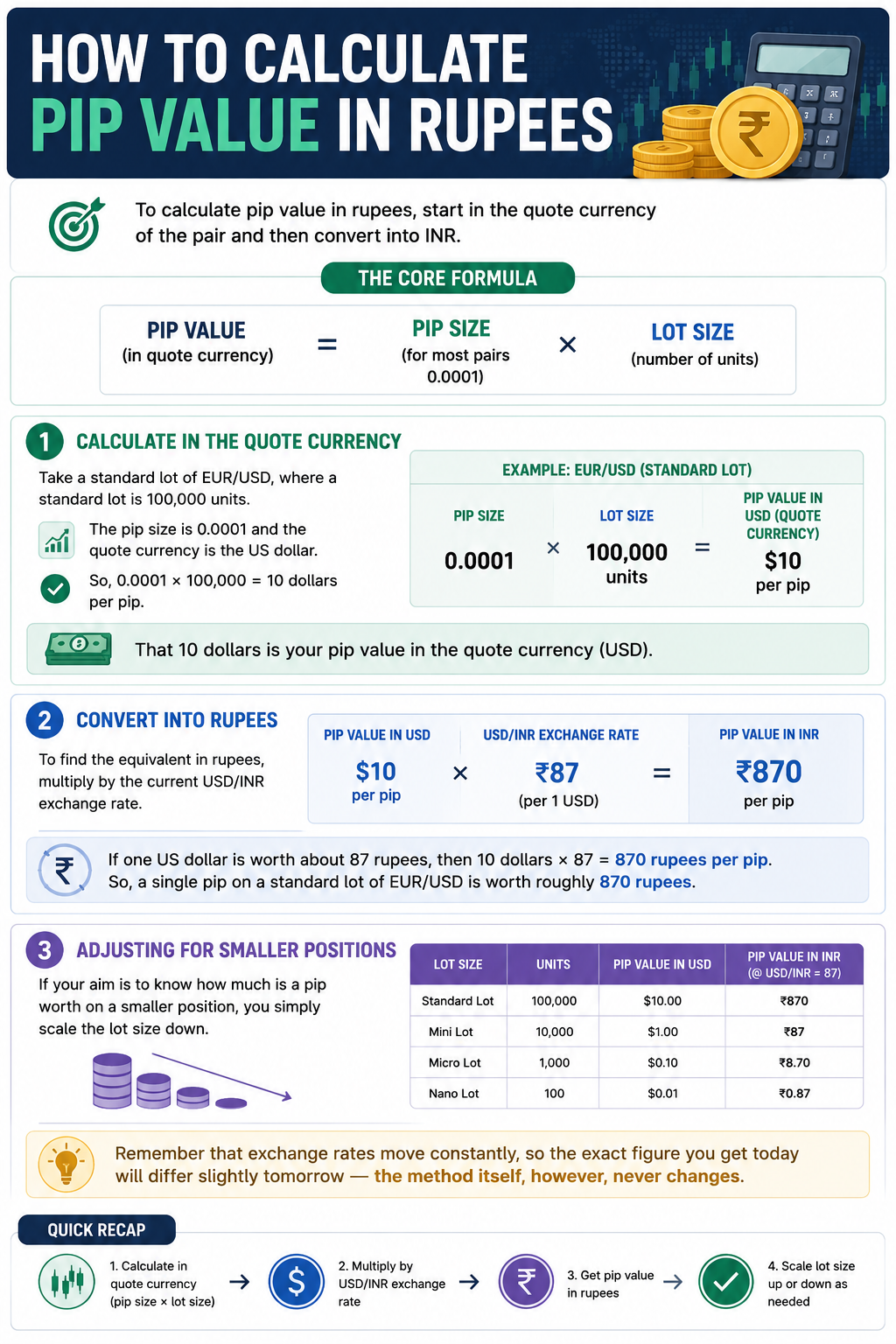
To calculate pip value in rupees, start in the quote currency of the pair and then convert into INR. The core formula is:
Pip value (in quote currency) = pip size × lot size
Take a standard lot of EUR/USD, where a standard lot is 100,000 units. The pip size is 0.0001 and the quote currency is the US dollar, so 0.0001 multiplied by 100,000 gives 10 dollars per pip.
That 10 dollars is your pip value in the quote currency. To find the equivalent in rupees, multiply by the current USD/INR exchange rate. If one US dollar is worth about 87 rupees, then 10 dollars multiplied by 87 equals 870 rupees per pip. So a single pip on a standard lot of EUR/USD is worth roughly 870 rupees.
If your aim is to know how much is a pip worth on a smaller position, you simply scale the lot size down, which we do in the next section. Remember that exchange rates move constantly, so the exact figure you get today will differ slightly tomorrow — the method itself, however, never changes.
Pip Value in Rupees for Standard, Mini, and Micro Lots
Lot size is the biggest lever you control, and it changes your pip value in rupees proportionally. Forex positions are usually measured in standard, mini, and micro lots. A standard lot is 100,000 units of the base currency. A mini lot is 10,000 units, one-tenth of a standard lot. A micro lot is 1,000 units, one-hundredth of a standard lot.
Using EUR/USD again, with a USD/INR rate of around 87 rupees, the numbers work out as shown in the table below.
| Lot type | Units | Pip value (USD) | Approx. pip value in rupees |
|---|---|---|---|
| Standard lot | 100,000 | $10.00 | ₹870 |
| Mini lot | 10,000 | $1.00 | ₹87 |
| Micro lot | 1,000 | $0.10 | ₹8.70 |
The pattern is clean: shrink the lot by a factor of ten and this figure shrinks by the same factor. This is why newer traders are often advised to begin with micro lots — an adverse move of fifty pips costs only about 435 rupees at a micro lot, versus roughly 43,500 rupees at a standard lot. That is a huge difference in real money for the very same market move. Choosing the right lot size is the most direct way to keep your pip value in rupees inside your comfort zone.
Pip Value for USD/INR and Other INR Pairs
For traders in India, the most relevant pairs are often those quoted directly against the rupee, such as USD/INR, EUR/INR, GBP/INR, and JPY/INR, which trade on recognised exchanges like the NSE and BSE. When the rupee is the quote currency, something convenient happens: your pip value is already in rupees, with no conversion step required.
On Indian exchanges, one currency lot is typically 1,000 units of the base currency rather than the 100,000 of an over-the-counter standard lot. For a USD/INR contract of 1,000 dollars, one pip of 0.0001 gives 0.0001 multiplied by 1,000, which is 0.10 rupees per pip, per lot. Because most traders hold several lots at once, these amounts add up quickly across a position. The takeaway is that when INR is the quote currency, the calculation is even simpler, because the formula hands you the answer directly without any exchange-rate multiplication.
A quick regulatory note: Indian residents are permitted to trade INR-based currency derivatives on recognised domestic exchanges, and the rules around foreign-to-foreign pairs through overseas brokers fall under FEMA and can be restricted. This article is educational and is not financial or legal advice; check current SEBI and RBI guidance and speak to a registered advisor before you trade.
Pip Value in Rupees Across Popular Currency Pairs
The quote currency of a pair determines whether you need a conversion at all. Below is an approximate guide to the pip value for a standard lot on several popular pairs, using illustrative rates. Live numbers shift with the market, so treat these as a snapshot rather than a fixed rulebook.
| Currency pair | Pip size | Quote currency | Approx. pip value in rupees (standard lot) |
|---|---|---|---|
| EUR/USD | 0.0001 | USD | ₹870 |
| GBP/USD | 0.0001 | USD | ₹870 |
| USD/JPY | 0.01 | JPY | ₹570 |
| AUD/USD | 0.0001 | USD | ₹870 |
| USD/INR | 0.0001 | INR | ₹10 |
Figures assume a 100,000-unit standard lot and illustrative rates (USD/INR ≈ 87, JPY/INR ≈ 0.57). Actual values change with the live market.
Notice that every dollar-quoted pair shares the same pip value in rupees for a given lot size, because the conversion depends only on the USD/INR rate — not on which pair you happen to trade. The yen and rupee pairs differ because their pip sizes and quote currencies are different from the dollar-quoted majors.
Using a Pip Value Calculator
Doing this arithmetic by hand is fine for learning, but in live trading you want speed and accuracy, which is where a pip value calculator earns its keep. A pip value calculator asks for the currency pair, your lot size, and your account currency, then returns the exact pip value in rupees using an up-to-date exchange rate. Because it pulls live rates, it removes the guesswork that creeps in when you rely on a number you memorised last week.
Most reputable brokers and forex education sites offer a free pip value calculator, and many trading platforms show the figure directly in the order window. Whichever tool you choose, the workflow is the same: enter the pair, set your position size, select INR as the account currency, and read off the result before you place the trade. Used consistently, a pip value calculator becomes a habit that keeps every position properly sized and every risk clearly understood.
Why Pip Value in Rupees Matters for Risk Management
Knowing your pip value in rupees is not an academic exercise — it is the bridge between your stop-loss in pips and your risk in actual money. Suppose you decide never to lose more than 2,000 rupees on a single trade. If you are trading a position where each pip is worth 87 rupees, a 50-pip stop-loss risks 4,350 rupees, which breaks your own rule. Once you can see that figure in rupees, you know to reduce your lot size until the maths fits your limit.
This is the everyday value of understanding how much is a pip worth: it lets you set position sizes deliberately rather than by feel. Professional traders work backwards from a fixed rupee risk to the correct lot size, and pip value in rupees is the number that makes that calculation possible. Ignore it, and even a genuinely good strategy can be undone by positions that are simply too large for the account. In short, your pip value in rupees is the unit that converts chart movement into money in your account, which is exactly why disciplined traders check it before every trade.
Factors That Affect Pip Value in Rupees
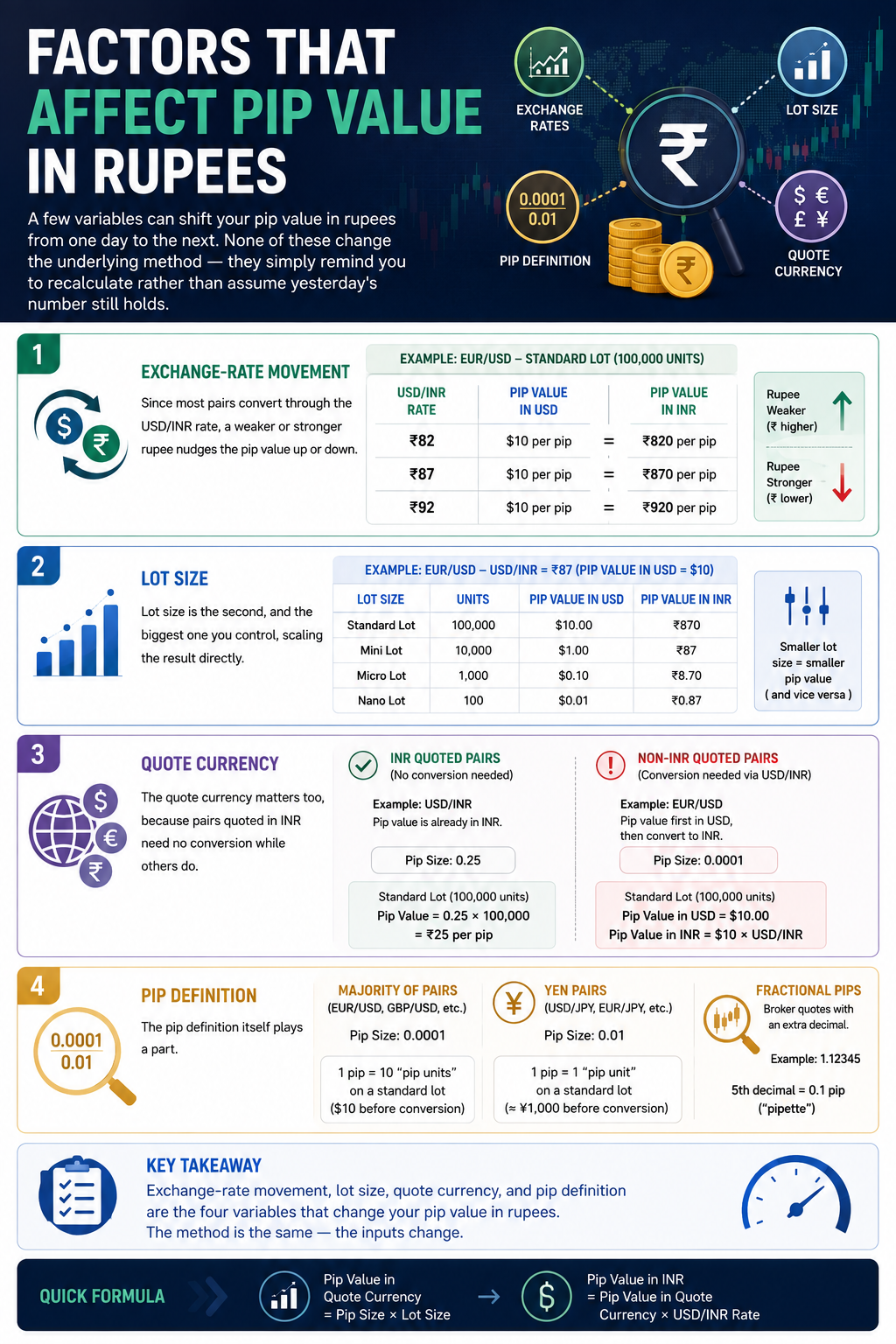
A few variables can shift your pip value in rupees from one day to the next. Exchange-rate movement is the first: since most pairs convert through the USD/INR rate, a weaker or stronger rupee nudges the figure up or down. Lot size is the second, and the biggest one you control, scaling the result directly. The quote currency matters too, because pairs quoted in INR need no conversion while others do. Finally, the pip definition itself plays a part, as yen pairs use 0.01, most others use 0.0001, and fractional pips add another decimal. None of these change the underlying method — they simply remind you to recalculate rather than assume yesterday’s number still holds.
Frequently Asked Questions
How much is a pip worth on a standard lot? For a dollar-quoted pair like EUR/USD, one pip on a standard lot is about 10 dollars, which is roughly 870 rupees at a USD/INR rate near 87. Your exact figure depends on the live rate at the moment you trade.
Is the value the same for every currency pair? No. Dollar-quoted pairs share the same figure for a given lot size, but yen and rupee pairs differ because of different pip sizes and quote currencies.
Do I need a pip value calculator? You can calculate by hand, but a pip value calculator is faster and uses live rates, which keeps your pip value in rupees accurate before each trade.
What is pip value in forex, in one line? It is the money a single pip movement is worth for your position size — the plain-language meaning of pip value in a live market.
Conclusion
Pip value sits quietly behind every forex trade, and getting comfortable with pip value in rupees is what separates guesswork from disciplined trading. Once you understand what pip value in forex means, know how much is a pip worth for your chosen lot size, and lean on a reliable pip value calculator, you can size positions with confidence and keep your risk exactly where you want it. Start small, recalculate as rates move, and let your pip value in rupees guide every decision from your first micro lot to your most confident standard-lot trade.