
Every year, more Indian residents type some version of “LRS forex trading” into a search bar, hoping to move money abroad and trade currencies on a slick offshore platform. The pitch is seductive: high leverage, round-the-clock markets, guaranteed returns. The problem is that the premise is mostly false. Under the Reserve Bank of India’s rules, the Liberalised Remittance Scheme (LRS) does not permit sending money abroad to trade forex speculatively — and doing it anyway is a violation of the Foreign Exchange Management Act. This guide explains the LRS, the RBI rules that govern it, and the one legal way residents can actually trade currencies.
QUICK ANSWER
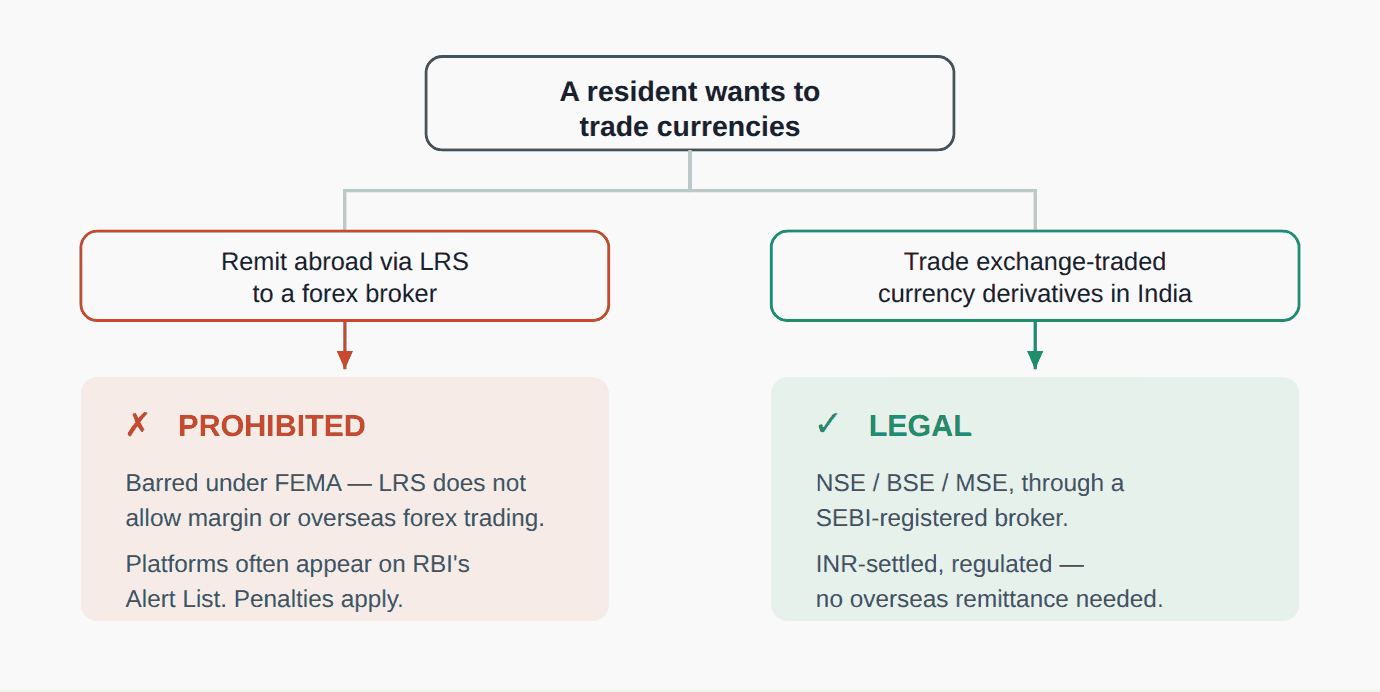
No — you cannot legally use the LRS to send money abroad to trade forex. The LRS lets a resident individual remit up to USD 250,000 per financial year for permitted purposes such as education, travel, medical care, gifts and certain overseas investments. RBI and FEMA specifically prohibit remittances for margin trading and overseas foreign-exchange trading. The only legal way to trade currencies in India is through exchange-traded currency derivatives on NSE, BSE or MSE via a SEBI-registered broker.
What is the LRS?
The Liberalised Remittance Scheme is the RBI framework, operating under FEMA, 1999, that lets a resident individual send money abroad without seeking case-by-case approval. Introduced in 2004, it now allows remittances of up to USD 250,000 per person per financial year (April to March). It is available only to resident individuals — including minors, whose form must be countersigned by a guardian — and not to companies, partnership firms or HUFs.
| Annual limit | USD 250,000 per resident individual, per financial year (April–March) |
| Who can use it | Resident individuals only, including minors (guardian countersigns) |
| How it’s counted | Cumulative across all purposes and all banks, tracked against your PAN |
| Approval | None needed within the limit; beyond it, prior RBI approval is required |
| Governed by | FEMA, 1999 and the RBI Master Direction on LRS |
The LRS limit and forex: what it really covers
Understanding the LRS limit for forex purposes starts with a key distinction: the USD 250,000 ceiling is an overall quota for permitted transactions, not a licence to do anything with the money. The cap is cumulative — every forex-card load, overseas tuition payment and share purchase counts toward the same figure — and once you’ve used it in a year, repatriating funds back to India does not top it up again. Crucially, the permitted purposes are a defined list, and speculative forex trading is not on it. So while people search for the “LRS limit forex” figure expecting a trading allowance, the limit simply doesn’t extend to trading foreign exchange abroad.
RBI rules: why forex trading isn’t allowed under the LRS
The RBI rules on forex trading are unusually explicit. LRS remittances are permitted only for a defined set of current and capital account transactions; anything otherwise impermissible under FEMA is excluded. The prohibited list specifically names remittances for margin trading or margin calls to overseas exchanges and foreign exchange trading abroad. In other words, wiring money to an offshore broker to trade currency pairs is exactly the kind of transaction the scheme is designed to block.
Beyond the LRS itself, the RBI has repeatedly clarified that remittance in any form towards overseas foreign-exchange trading through electronic or internet trading portals is not permitted under FEMA, and that residents may not trade in foreign exchange in domestic or overseas markets — with one carve-out. Residents may trade currency futures and options on stock exchanges recognised by SEBI. That carve-out is the whole legal game, and we’ll come back to it.
| Permitted purposes | Prohibited under FEMA / LRS |
|---|---|
| Education abroad | Margin trading / margin calls abroad |
| Travel & overseas tour packages | Foreign-exchange (forex) trading abroad |
| Medical treatment | Lottery, betting & gambling |
| Gifts & maintenance of relatives | FCCBs in the overseas secondary market |
| Permissible overseas investments | Remittances to FATF non-cooperative jurisdictions |
TCS on money sent abroad under the LRS
Even for permitted purposes, sending money abroad carries a tax overlay: Tax Collected at Source (TCS). For the current financial year, no TCS applies on the first ₹10 lakh of LRS remittances in a year. Above that threshold, the rate depends on the purpose. TCS is not an extra cost you lose — it’s an advance tax you can claim back when filing your income tax return, where it appears in your Form 26AS/AIS.
| Purpose | TCS rate |
|---|---|
| Any LRS remittance up to ₹10 lakh / year (all purposes) | Nil |
| Education funded by an approved education loan | Nil |
| Education / medical (self-funded), above ₹10 lakh | 2% |
| Overseas tour packages | 2% |
| Other remittances (incl. investments), above ₹10 lakh | 20% |
TCS matters here mainly as a reminder: the LRS is a closely tracked, reported channel. Money leaving India under it is tied to your PAN, a declared purpose code and Form A2 — which is precisely why trying to route forex-trading funds through it, under a mislabelled purpose, is both detectable and a serious compliance risk.
Sending money abroad for trading in India: the real risks
The market for offshore forex platforms targeting Indian residents is large and aggressive, promising leverage of 1:500 and instant account opening. When people consider sending money abroad for trading in India, these are usually the platforms they mean — and they sit squarely outside the law. A resident who collects, effects or remits such payments directly or indirectly outside India makes themselves liable to penal action under FEMA.
- It’s a FEMA violation. Remitting for margin or overseas forex trading breaches the Act; the most serious category of contravention is non-compoundable and handled by the Enforcement Directorate.
- No recourse if it goes wrong. These platforms are unregulated in India — if funds vanish or withdrawals are blocked, there is no Indian regulator to appeal to.
- Fraud is common. “Guaranteed high returns” is the classic hook; many of these operations are outright scams.
The RBI Alert List
To help residents spot illegal operators, the RBI publishes an Alert List of entities that are neither authorised to deal in forex under FEMA nor authorised to run an electronic trading platform (ETP) for forex in India. The list is maintained under the RBI’s Electronic Trading Platforms (ETP) Directions and is updated regularly; by its November 2025 update it named around 95 platforms, and it also flags websites that merely advertise or promote such unauthorised operators.
IMPORTANT
The Alert List is not exhaustive. RBI is explicit that a platform’s absence from the list does not mean it is authorised. Before dealing with any forex operator, check both the Alert List and RBI’s list of authorised persons and ETPs on rbi.org.in.
The legal way to trade currencies in India
Here’s the good news for anyone genuinely interested in currency markets: you don’t need the LRS, and you don’t need an offshore broker. Indian residents can legally trade exchange-traded currency derivatives — futures and options — on the recognised stock exchanges (NSE, BSE and MSE) through a SEBI-registered broker. Permitted contracts include USD/INR, EUR/INR, GBP/INR and JPY/INR, plus cross-currency pairs such as EUR/USD, GBP/USD and USD/JPY.
This route is everything the offshore pitch isn’t: it’s rupee-settled, so no money leaves the country and the LRS never enters the picture; it’s regulated by SEBI and the RBI, with exchange-level investor protection; and disputes have a clear grievance-redressal path. For a resident, this is what legitimate currency trading looks like.
A necessary disclaimer: this article is general educational information about Indian foreign-exchange regulation, not legal, tax or financial advice, and it doesn’t create any adviser relationship. Rules, limits and TCS rates change — often at Budget time — and individual circumstances differ. Before remitting money abroad or trading currencies, confirm the current position with your authorised dealer (AD) bank, a qualified chartered accountant or the RBI, and rely on the official text at rbi.org.in.
Key takeaways
- You cannot use the LRS to trade forex abroad. Margin trading and overseas forex trading are prohibited under FEMA.
- The LRS allows USD 250,000 per year for permitted purposes — education, travel, medical, gifts and permissible investments — not speculation.
- Offshore forex platforms targeting residents are illegal to use; many appear on the RBI Alert List, which is not exhaustive.
- TCS of up to 20% applies to larger LRS remittances above ₹10 lakh, and every transfer is tracked against your PAN.
- The only legal route is exchange-traded currency derivatives on NSE/BSE/MSE via a SEBI-registered broker — rupee-settled, no remittance needed.
- Regulations change; verify with your AD bank, a CA, or RBI before acting.
Frequently asked questions
Can I use the LRS to send money abroad and trade forex?
No. RBI and FEMA rules prohibit LRS remittances for margin trading and overseas foreign-exchange trading. The scheme is for permitted purposes such as education, travel, medical care, gifts and certain investments — not speculative forex trading.
What is the LRS limit for forex?
The overall LRS limit is USD 250,000 per resident individual per financial year, cumulative across all permitted purposes. There is no separate “forex trading” allowance, because trading foreign exchange abroad is not a permitted purpose in the first place.
Is forex trading legal in India at all?
Yes, but only through exchange-traded currency derivatives on SEBI-recognised exchanges (NSE, BSE, MSE) via a registered broker. Trading on offshore or online forex portals, or remitting money abroad to do so, is not permitted under FEMA.
What happens if I trade on an offshore forex platform?
Remitting funds for or trading on unauthorised forex platforms is a FEMA violation and can attract penal action. You also have no protection from an Indian regulator if the platform withholds funds or turns out to be fraudulent.
What is the RBI Alert List?
It is RBI’s published list of entities not authorised to deal in forex or operate an electronic trading platform for forex in India. It is updated regularly and is explicitly non-exhaustive, so absence from it does not imply authorisation.
Which currency pairs can residents legally trade?
On Indian exchanges, residents can trade USD/INR, EUR/INR, GBP/INR and JPY/INR, plus cross-currency pairs such as EUR/USD, GBP/USD and USD/JPY, as currency futures and options.
How much TCS applies when I send money abroad under the LRS?
No TCS applies on the first ₹10 lakh of LRS remittances in a year. Above that, most remittances (including investments) attract 20%, while education and medical are 2% (nil for education via an approved loan) and tour packages 2%. TCS is claimable in your tax return.
Can a company use the LRS to trade forex?
No. The LRS is available only to resident individuals, not companies, firms or HUFs — and in any case it does not permit forex trading. Businesses with genuine currency-risk exposure hedge through their AD bank under separate FEMA provisions.