Introduction
Every year, thousands of Indian traders face the same question at tax time: should I file under presumptive taxation, or maintain books and file a regular return? Section 44AD offers a simplified way to report business income, with no need to maintain detailed books or, in many cases, get a tax audit. That sounds attractive, especially for traders worried about audit rules.
But using 44AD for traders is not as simple as it looks. Trading turnover is calculated differently from normal business turnover, losses cannot be declared under the scheme, and a five-year lock-in can create unexpected audit requirements later. Choosing the wrong route can cost more than it saves.
This guide explains:
- What section 44AD is and who can use it
- How turnover is calculated for traders
- The 6% and 8% deemed profit rules
- The five-year lock-in and audit consequences
- ITR-4 vs ITR-3
- When presumptive taxation may or may not make sense
What Is Section 44AD? The Basics of 44AD for Traders
Section 44AD of the Income-tax Act, 1961 is a presumptive taxation scheme for small businesses. Instead of calculating actual profit from detailed accounts, the taxpayer declares profit at a fixed percentage of turnover (or more, if actual profit is higher).
Key features include:
- Deemed profit: 8% of turnover, or 6% for receipts through banking or digital channels.
- Turnover limit: ₹2 crore, rising to ₹3 crore if cash receipts are no more than 5% of total receipts.
- Eligible taxpayers: Resident individuals, resident HUFs and resident partnership firms (not LLPs).
- Simplified compliance: No requirement to maintain detailed books of account under section 44AA for the eligible business, and no audit while you remain in the scheme and meet its conditions.
- No separate expense claims: The deemed profit is treated as covering all business expenses.
Under the Income-tax Act 2025, this scheme has moved to section 58. Published analyses suggest the limits and rates remain essentially the same, with the changes mostly structural.
Can 44AD for Traders Apply to F&O?
Futures and options (F&O) trading on a recognised exchange is generally treated as non-speculative business income. Many tax professionals accept that this income can be reported under section 44AD if the conditions are met.
Intraday equity trading is treated as speculative business income. Practice on applying presumptive taxation to speculative income varies, so take specific advice if most of your activity is intraday.
Before using 44AD for traders, also remember that the scheme was designed for ordinary businesses with sales and receipts. Trading turnover works very differently, which creates some unusual results.
44AD for Traders: How Turnover Is Calculated
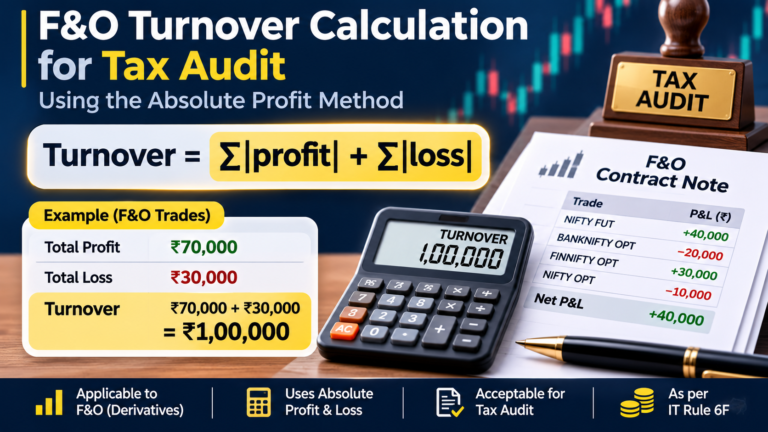
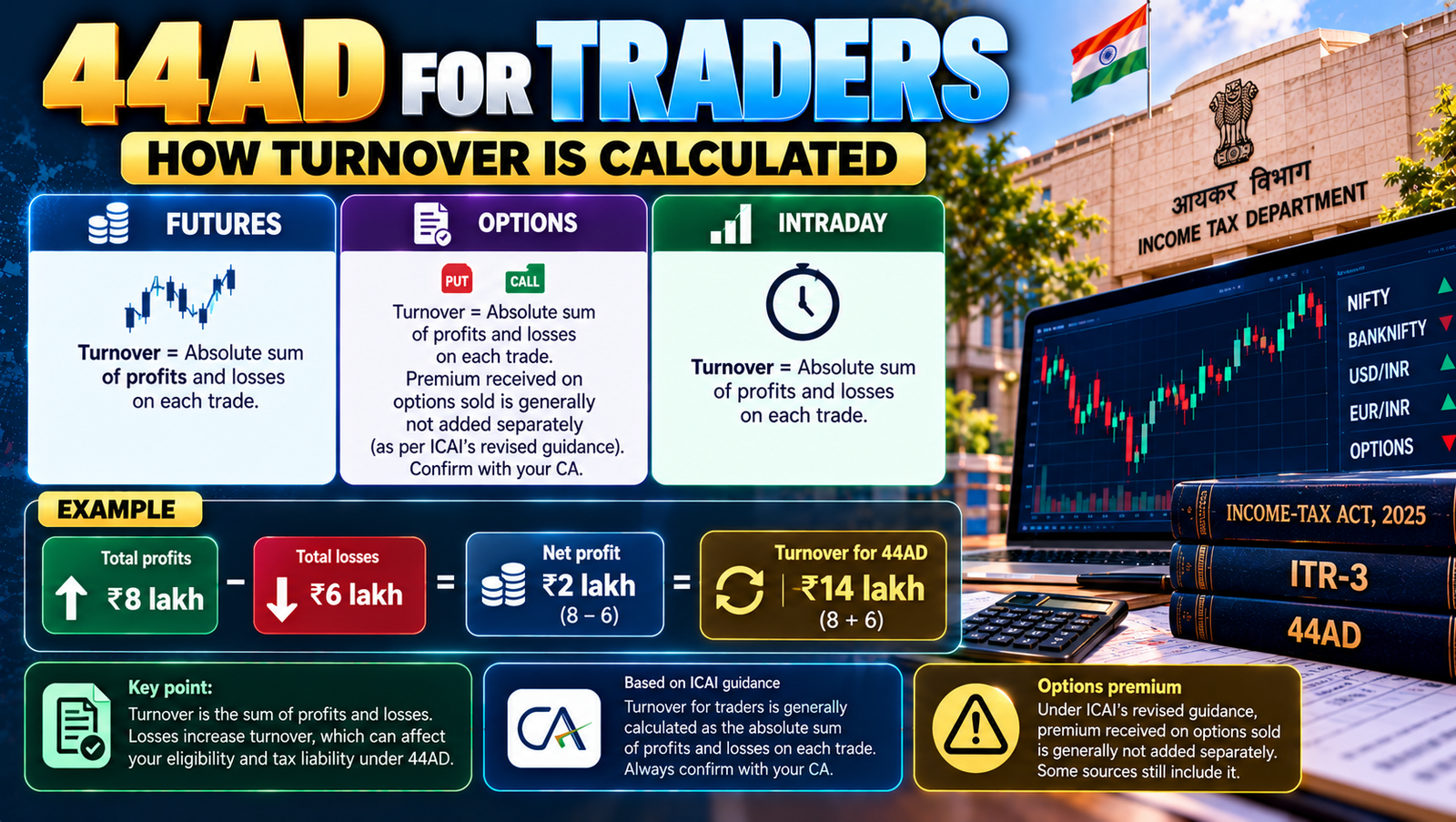
For traders, turnover is not the total value of contracts traded. Based on guidance from the Institute of Chartered Accountants of India (ICAI), it is generally calculated as:
- Futures: The absolute sum of profits and losses on each trade.
- Options: The absolute sum of profits and losses on each trade. Under ICAI’s revised guidance, premium received on options sold is generally not added separately, although some sources still include it. Confirm the treatment with your chartered accountant.
- Intraday: The absolute sum of profits and losses on each trade.
Example
Suppose a trader makes ₹8 lakh of profits on some trades and ₹6 lakh of losses on others.
- Net profit: ₹8 lakh − ₹6 lakh = ₹2 lakh
- Turnover: ₹8 lakh + ₹6 lakh = ₹14 lakh
Notice that losses increase turnover. This is one reason why using 44AD for traders can lead to surprising outcomes.
The 6% and 8% Deemed Profit Rules for Traders
Under section 44AD, you must declare at least 6% of turnover received through banking channels (or 8% for cash receipts) as profit. For most traders, who deal only through brokers and bank accounts, the 6% rate is relevant.
Using the example above:
- Turnover: ₹14 lakh
- Minimum deemed profit at 6%: ₹84,000
- Actual net profit: ₹2 lakh
Because actual profit (₹2 lakh) is higher than 6% of turnover (₹84,000), the trader would need to declare at least ₹2 lakh. Presumptive taxation sets a minimum, not a maximum.
What happens in a loss year?
This is where problems arise. Suppose the trader made ₹6 lakh of profits and ₹8 lakh of losses. Turnover is still ₹14 lakh, but the actual result is a ₹2 lakh loss.
To stay within section 44AD, the trader would have to declare at least ₹84,000 of profit, even though they lost money, and pay tax on income they never earned. The loss also cannot be carried forward under the scheme.
44AD for Traders: The Five-Year Lock-In Under 44AD(4) and 44AD(5)
This is the most important rule to understand before using 44AD for traders.
- Section 44AD(4): If you opt for presumptive taxation in one year and then, in any of the next five years, declare profit below the presumptive rate, you cannot use section 44AD again for the following five years.
- Section 44AD(5): In the year you opt out in this way, if your total income exceeds the basic exemption limit, you generally need to maintain books of account and get a tax audit, regardless of turnover.
For traders, this often bites in a loss year. If you used 44AD in a profitable year and then make a loss the next year, declaring the actual loss means exiting the scheme. That may trigger an audit requirement (if total income, including salary, exceeds the basic exemption limit) and bar you from 44AD for five years.
These consequences apply only to those who opted for presumptive taxation in an earlier year. A trader who has never used the scheme is subject only to the normal turnover-based audit rules.
Normal Tax Audit Rules (Section 44AB) vs 44AD for Traders
If you do not use presumptive taxation, the regular audit thresholds under section 44AB generally apply:
| Turnover | Audit requirement |
|---|---|
| Up to ₹1 crore | No audit |
| ₹1 crore to ₹10 crore | No audit if cash receipts and payments are each no more than 5% |
| Above ₹10 crore | Audit generally required |
Because most traders deal entirely through banks and brokers, many can stay below audit requirements even with sizeable turnover, without needing presumptive taxation at all. This is the key point many people miss when considering 44AD for traders: avoiding an audit is often possible under the normal rules too.
ITR-4 vs ITR-3 When Using 44AD for Traders
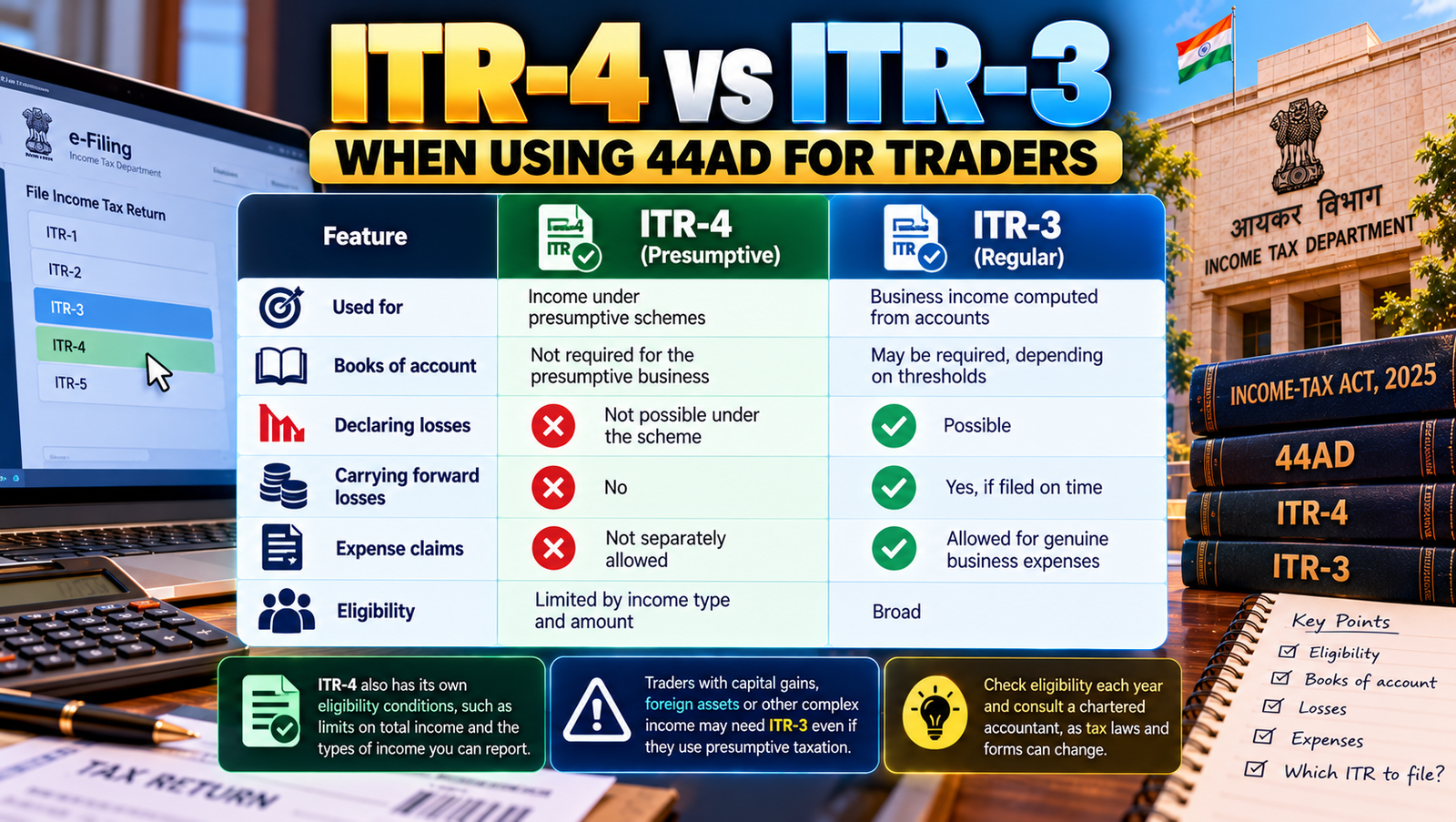
| Feature | ITR-4 (presumptive) | ITR-3 (regular) |
|---|---|---|
| Used for | Income under presumptive schemes | Business income computed from accounts |
| Books of account | Not required for the presumptive business | May be required, depending on thresholds |
| Declaring losses | Not possible under the scheme | Possible |
| Carrying forward losses | No | Yes, if filed on time |
| Expense claims | Not separately allowed | Allowed for genuine business expenses |
| Eligibility | Limited by income type and amount | Broad |
ITR-4 also has its own eligibility conditions, such as limits on total income and the types of income you can report. Traders with capital gains, foreign assets or other complex income may need ITR-3 even if they use presumptive taxation. Check eligibility each year.
When 44AD for Traders May Make Sense
- You have consistent profits, and actual profit is comfortably above 6% of turnover.
- Your trading is relatively small and simple.
- You do not expect losses in the coming years.
- You have few trading-related expenses to claim.
- You want to avoid maintaining detailed books.
When 44AD for Traders May Not Make Sense
- You have made, or might make, losses.
- Your profits are irregular from year to year.
- You have significant expenses, such as data feeds, software or advisory fees.
- You want to carry forward losses to future years.
- You are already below audit thresholds under section 44AB.
For many traders, the regular route (ITR-3 with proper accounts) offers more flexibility, especially because trading results can swing between profit and loss. The right answer for 44AD for traders depends on your individual pattern of results, not on a general rule. A trader with steady profits and few costs may find presumptive filing convenient, while a trader whose results vary widely may find it expensive and restrictive.
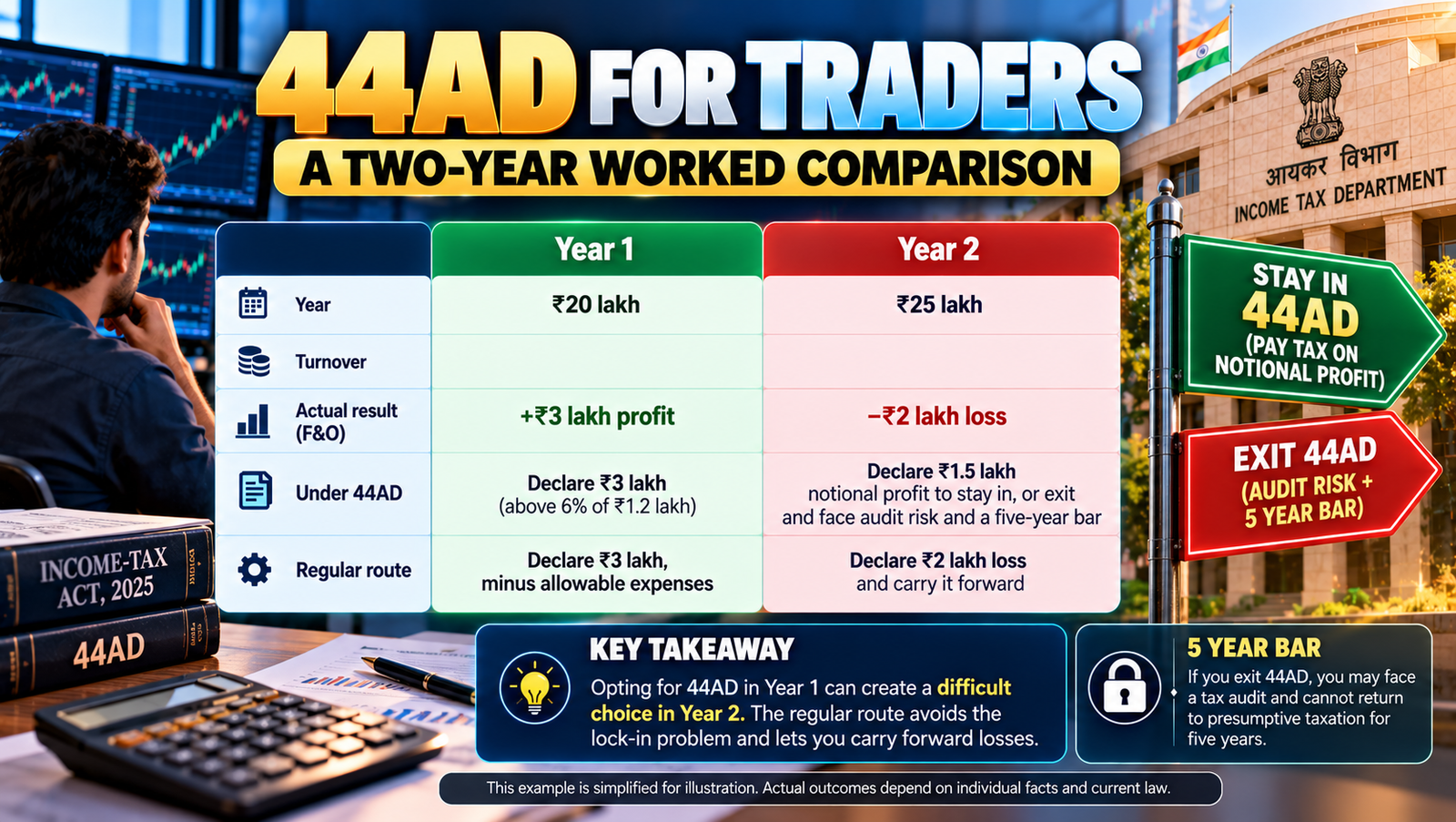
44AD for Traders: A Two-Year Worked Comparison
Consider a salaried trader whose F&O results over two years are:
| Year | Turnover | Actual result | Under 44AD | Regular route |
|---|---|---|---|---|
| Year 1 | ₹20 lakh | +₹3 lakh profit | Declare ₹3 lakh (above 6% of ₹1.2 lakh) | Declare ₹3 lakh, minus allowable expenses |
| Year 2 | ₹25 lakh | −₹2 lakh loss | Declare ₹1.5 lakh notional profit to stay in, or exit and face audit risk and a five-year bar | Declare ₹2 lakh loss and carry it forward |
In this example, opting for 44AD for traders in Year 1 creates a difficult choice in Year 2. The regular route avoids the lock-in problem entirely. If the trader stays in the scheme in Year 2, they pay tax on ₹1.5 lakh of income they never earned and lose the ability to carry forward the ₹2 lakh loss. If they exit, they may face audit costs and cannot return to presumptive taxation for five years. Looking ahead before opting in can prevent this situation.
This example is simplified for illustration. Actual outcomes depend on individual facts and current law.
Common 44AD for Traders Mistakes
- Choosing 44AD just to avoid an audit: Many traders are already below audit thresholds.
- Using contract value as turnover: This greatly overstates turnover.
- Ignoring the lock-in: Opting in one year can affect the next five.
- Declaring losses under ITR-4: Presumptive filing does not allow loss declarations.
- Claiming expenses under 44AD: The deemed profit already covers expenses.
- Missing the due date: Late filing can cost you the right to carry forward losses.
- Not reviewing each year: Decide based on a multi-year view, not a single year.
Practical Checklist: Deciding on 44AD for Traders
- Calculate your trading turnover correctly from broker tax P&L reports.
- Compare actual profit with 6% of turnover.
- Check whether you opted for 44AD in any of the last five years.
- Check whether regular audit rules under section 44AB apply to you.
- Consider your expected results over the next few years.
- Check ITR-4 eligibility if considering presumptive filing.
- Discuss the decision with a chartered accountant before filing.
FAQs
Can F&O traders use section 44AD?
Many tax professionals accept that F&O income can be reported under 44AD if the conditions are met, but it is not always the best choice.
What is the deemed profit rate under 44AD for traders?
Generally 6% of turnover for receipts through banking channels, or 8% for cash receipts.
Can I declare a loss under 44AD?
No. To stay within the scheme, you must declare at least the presumptive rate. Declaring a loss means opting out.
What happens if I opt out within five years?
Under section 44AD(4), you cannot use the scheme for the next five years, and under 44AD(5) you may need books and an audit if total income exceeds the basic exemption limit.
Which ITR form is used for 44AD?
ITR-4 is the usual form for presumptive income, subject to eligibility. Otherwise, ITR-3 may be needed.
Has the Income-tax Act 2025 changed 44AD?
The scheme has moved to section 58 of the new Act. Analyses suggest limits and rates are largely unchanged, but check the details with a professional.
Conclusion
Presumptive taxation can simplify compliance, but 44AD for traders comes with important trade-offs. Trading turnover is calculated from absolute profits and losses, the scheme requires a minimum declared profit, losses cannot be carried forward and the five-year lock-in can trigger audits in future loss years.
For consistently profitable traders with simple affairs, it may be useful. For many others, especially those with variable results, the regular route using ITR-3 offers more flexibility. Look at your results over several years, calculate turnover correctly and work with a chartered accountant to choose the right approach.