
Quick Summary
Do you know what a trailing stop calculator is? Let me tell you that it is a tool for risk management. With the help of this calculator, you can calculate and manage a moving stop-loss automatically. A trailing stop calculator allows profits to grow while limiting downside risk.
Who uses this calculator?
It is a widely used calculator by professional traders of forex, index, and commodity markets. See how it connects to tools like the position size calculator and forex risk calculator for a complete risk management setup.
Why do they use it?
Professionals use it because it removes their guesswork and emotional decision-making from trade exits. Let’s break it down in detail.
A trailing stop calculator is one of the most searched risk management tools in forex and index trading today. Traders across US30, NAS100, XAUUSD (gold), crude oil, EURUSD, and GBPUSD use it to protect open profits without manually watching screens. It sits at the intersection of trade management, position sizing, and dynamic stop-loss adjustment — three pillars that separate consistent traders from emotional ones.
If you are still using fixed stop-loss orders without any trailing mechanism, you are leaving significant profit on the table every single trending session.

What Is a Trailing Stop Calculator in Trading?
A trailing stop calculator is a tool that computes a moving stop-loss level that follows price action in real time. As price moves in your favor, the stop-loss moves with it — but it never moves backward. When price reverses by the trailing distance, the trade closes automatically, locking in profits.
It solves three questions professional traders need answered before every exit:
- How far should the stop trail behind current price?
- When should trailing activation begin — at entry or after confirmation?
- What is the exact monetary risk per pip or point at my current lot size?
The tool directly connects trailing stop distance, lot size, pip value, and account currency into one unified calculation — something manual tracking cannot do consistently.
Pro tip: Before setting any trailing distance, use the pip value calculator to confirm the exact monetary value of each pip at your chosen lot size. A 30-pip trail on a 1.0 lot EURUSD position means $300 of protected profit — or $300 of risk if set incorrectly.
Why Is a Trailing Stop Calculator Better Than Manual Stops?
Why is it better? Because it brings speed, consistency, and objectivity in exits. That’s why it is more effective than manual stops.
- Works well in trending markets
- Maintains consistency across trades
- Eliminates emotional decision-making
- Respond faster than manual trailing
- Prevents giving back profits
- Reduces screen time and overtrading
- More suitable for professional trade management
- Uses dynamic stop-loss adjustment automatically
What Is the Trailing Stop Formula Used by Calculators?
Formula for Trailing Stop:
Trailing Stop = Current Price – Trailing Distance
- Entry: 1.2000
- Trailing Distance: 30 pips
- Price moves to 1.2050.
Stop-loss moves to 1.2020
4 Types of Trailing Stop Methods Explained
Not all trailing stops work the same way. There are four main methods professional traders use, and choosing the wrong one for your market is one of the most damaging trailing stop mistakes in retail trading.
1. Pip-Based / Point-Based Trailing Stop The most straightforward method. You define a fixed pip distance (e.g., 25 pips for EURUSD) or a fixed point distance (e.g., 50 points for US30). The stop trails that exact distance behind price. Best for low-volatility sessions or range-bound conditions.
Use the forex pip calculator or US30 pip calculator to confirm pip/point values before applying this method.
2. Percentage-Based Trailing Stop The stop trails at a fixed percentage of current price. Particularly effective for indices and crypto where absolute price levels vary greatly. A 0.5% trail on NAS100 at 21,500 = a 107-point trailing distance. Confirm monetary exposure with the Nasdaq 100 pip calculator.
3. ATR-Based Trailing Stop (Most Professional) The Average True Range (ATR) trailing stop dynamically adapts to current market volatility. Most professional forex and index traders use an ATR multiplier of 1.5× to 3×. This method filters out normal noise so your trade is not stopped prematurely.
4. Market Structure Trailing Stop The stop is moved manually to just beyond key swing highs or swing lows as they form. This is the method used by smart money and institutional traders. It requires understanding market structure trading to identify which levels are structurally valid trail points versus noise.
How Do You Use a Trailing Stop Calculator Step by Step?
Sounds technical? In reality, it is very easy and simple to use. Here are some steps to make it more clear for you:
- Choose the market you are trading
- Decide the trailing stop method
- Point-based
- Pip-based
- Percentage-based
- ATR-based
- Enter key details
- Entry price
- Lot size or position size
- Trailing distance
- Review the calculated trailing stop levels
- Apply and let the market work
How Does Lot Size Affect Trailing Stop Calculations?
Basically, it affects monetary risk, not pip distance.
| Lot Size | EURUSD Pip Value | 30-Pip Trail = Monetary Value | XAUUSD Point Value (30pts) |
|---|---|---|---|
| 0.01 (Micro) | $0.10 | $3.00 | $0.30 |
| 0.10 (Mini) | $1.00 | $30.00 | $3.00 |
| 1.00 (Standard) | $10.00 | $300.00 | $30.00 |
| 2.00 | $20.00 | $600.00 | $60.00 |
Always cross-reference your trailing distance monetary value using the pip profit calculator or pip lot profit calculator before going live. For gold specifically, use the XAUUSD pip calculator — gold pip values differ significantly from forex pairs.
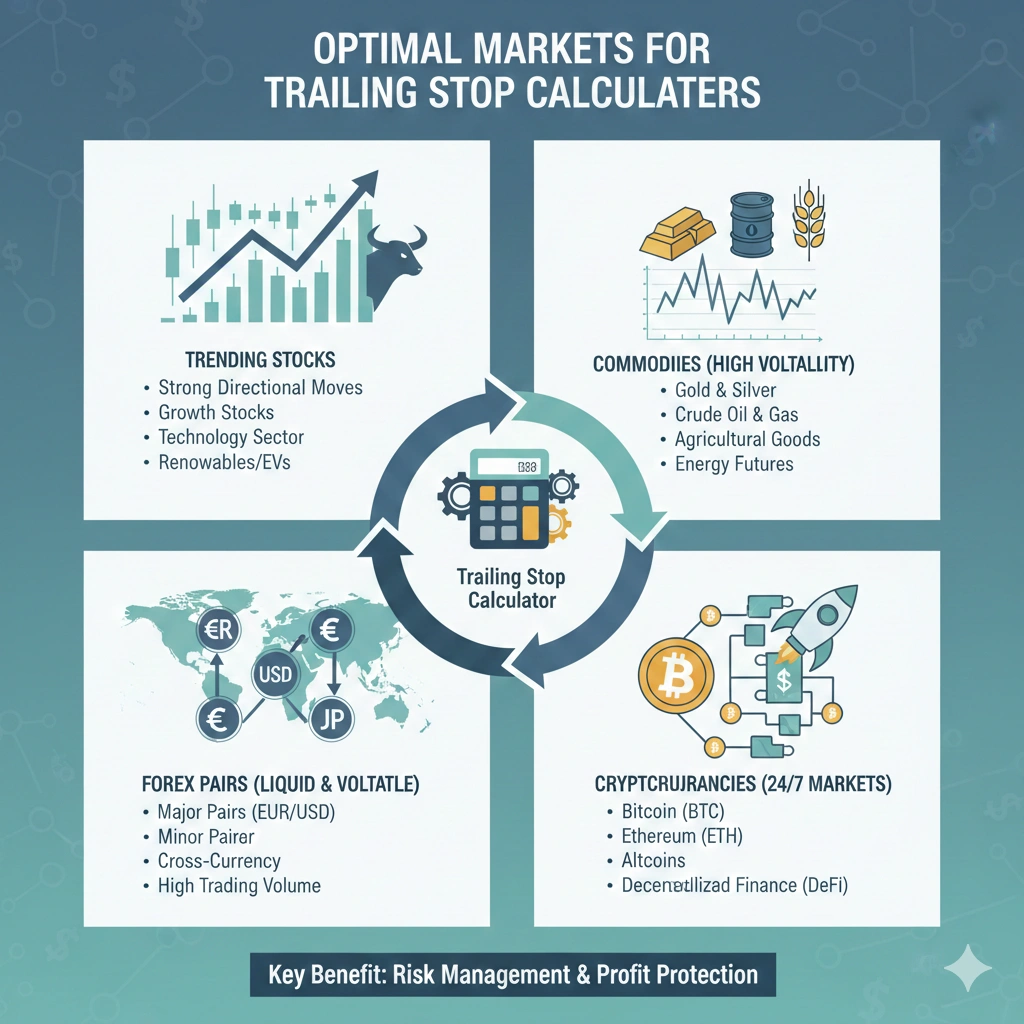
What Are the Best Markets to Use a Trailing Stop Calculator?
What Are the Pros and Cons of Using a Trailing Stop Calculator?
-
Pros
-
- Reduce emotional decision-making
- Helps you stay in trends longer
- Saves mental energy and time
- Protect your profits automatically
- Improves risk-reward consistency
-
Cons
-
- Not ideal for all trading styles
- False sense of automation
- Need market context
- Requires correct trailing distance
- Exit trades too early in choppy markets
Market-Specific Trailing Stop Guidance
Gold (XAUUSD) Gold trends powerfully during macro uncertainty, Fed policy shifts, and safe-haven demand cycles. ATR-based trailing stops are strongly preferred here because gold can move 200–400 points in a single session. The gold pip calculator confirms point values and the gold price outlook helps you assess whether a trending condition even exists before applying a trail.
US30 and NAS100 Dow Jones (US30) and Nasdaq 100 (NAS100) are the most trailed instruments in index trading. Use the US30 pip calculator and Nasdaq 100 pip calculator to calculate point monetary values. The US30 intraday strategy shows which sessions have the trend quality needed for trailing stops to perform.
Crude Oil (WTI / USOIL) Oil markets trend sharply during supply disruption events and geopolitical tension periods. Use the WTI pip calculator or oil pip calculator to size trail distances correctly relative to oil’s wide intraday swings.
Forex Pairs EURUSD, GBPUSD, and USDJPY are the most common pairs for trailing stop strategies. The EUR/USD pip calculator and GBP/JPY pip calculator confirm pip values, and the forex pip calculator formula walks through the manual calculation method for traders who want full understanding of the math.
Trailing Stop Calculator vs. Other Risk Tools
| Tool | Purpose | When to Use Alongside Trailing Stop |
|---|---|---|
| Stop Loss Distance Calculator | Calculates initial stop distance | Before entry — sets your 1R baseline |
| Risk Reward Calculator | Validates trade R:R ratio | Before entry — confirms trade is worth taking |
| Position Size Calculator | Right-sizes your lot | Before entry — ensures % risk is correct |
| Trailing Stop Calculator | Manages exit dynamically | After entry confirmation |
| Trade Recovery Calculator | Plans drawdown recovery | After a losing trade |
Use the stop loss distance calculator to define your initial stop, the risk reward calculator to validate the setup, and the position size calculator to size correctly — then apply your trailing stop once all three confirm a valid trade.
Here is the fully expanded Common Mistakes section with proper informational depth, bold keywords, and internal links woven into existing content naturally:
Common Mistakes Traders Make With Trailing Stops
Mistake 1: Trailing the Stop Too Tight
Setting your trailing distance too close to current price is the single most frequent error across all experience levels. When the trail is too tight — say, 5–8 pips on EURUSD during the London open — normal market noise and spread fluctuation triggers the stop before price has had any real chance to move against you meaningfully.
The result: you exit a perfectly valid trending trade for a tiny profit, then watch price continue 80 pips in your original direction without you.
What to do instead: Your trailing distance must be wider than the instrument’s average intraday noise range. Use the session volatility calculator to measure real ATR for your specific session, then set your trail at minimum 1× ATR — never below it. For gold, that typically means a 60–120 point minimum. For EURUSD during London, rarely below 20–25 pips. Confirm the monetary value of that distance with the pip profit calculator before applying it live.
Mistake 2: Ignoring Market Volatility
Using the same trailing stop distance across all markets and all sessions is a structural error that quietly destroys performance. A 30-pip trail on EURUSD during the Asian session — where average range is 40–60 pips — will get hit constantly. That same 30-pip trail during the New York session — where average range can exceed 120 pips — is far too tight and will exit trades prematurely.
Volatility is not constant. It changes by instrument, session, day of week, and macro event schedule. XAUUSD on a non-news day behaves completely differently from XAUUSD during a Fed rate decision. US30 on a regular Tuesday is nothing like US30 during NFP week.
What to do instead: Build a volatility-aware trailing system. Use the ATR stop loss tool to get a dynamic trail distance that automatically adjusts to current conditions. Pair it with the volatility calculator trading to understand session-level volatility context before you decide on a distance. For gold specifically, the XAUUSD pip calculator helps you see what each point of trail represents monetarily across different volatility environments.
Mistake 3: Activating the Trailing Stop Too Early
Starting your trail the moment you enter the trade — or after just 5–10 pips of movement — is one of the most expensive habits in retail trading. Price almost always retraces or consolidates briefly after entry before continuing in the trend direction. If your trail is already active at that point, it gets hit by the retracement and closes your trade at breakeven or a tiny profit, right before the real move begins.
This mistake is closely linked to impatience and lack of entry confirmation. Traders who activate trailing stops too early are essentially saying they do not trust their own entry model — and the market punishes that lack of conviction every time.
What to do instead: Define a clear trail activation rule before entering the trade. Most professional traders use one of the following trigger conditions:
- Price has moved at least 1R (one full risk unit) in your favor
- Price has closed beyond a key structural level in the trend direction
- The trade has been open for a minimum number of candles confirming momentum
See entry delay trading to understand why waiting after entry is a structural edge, and trade management rules for a professional framework on when trail activation is appropriate versus premature. Also review market momentum trading — trails should only activate when real momentum is confirmed, not speculative.
Mistake 4: Relying on Trailing Stops Without a Strategy
A trailing stop calculator is a trade management tool — not a trading strategy. Using it without a defined entry model, market structure framework, and session filter is like putting a seatbelt on a car with no steering wheel. The exit mechanism is present but there is no logical reason the trade should be open in the first place.
Traders who rely on trailing stops without a strategy typically enter on impulse, apply the trail hoping it will “save” the trade if it goes wrong, and discover that trailing stops cannot fix a bad entry. What follows is a cycle of small losses in choppy conditions and missed profits in trending conditions because the trail distance was guessed rather than calculated.
What to do instead: Build your trailing stop usage on top of a complete trading plan. Your strategy should define: which markets you trade, which sessions, which entry signals, and what constitutes a valid trending environment before a trail is even considered. If you do not have this yet, start with build trading plan and single setup trading plan — both walk through creating a structured, rule-based approach that trailing stops can then enhance rather than carry. Also review rule based trading system to understand how professional traders systematize every exit decision including trailing.
Mistake 5: Trailing in Sideways or Choppy Markets
This is the most misunderstood mistake because it looks like a trailing stop problem when it is actually a market condition identification problem. Trailing stops are trend-following tools. They require sustained directional price movement to function correctly. In ranging, consolidating, or choppy markets, price oscillates back and forth without developing a trend — and a trailing stop will be triggered repeatedly as price swings in both directions.
The result is a series of small losses that are frustrating not just financially but psychologically — because each individual loss seems small and explainable, while the cumulative damage is significant. This is one of the hidden ways traders develop trading burnout without realizing it. Repeated small exits that feel unavoidable drain confidence faster than large singular losses.
What to do instead: Learn to identify trending versus non-trending conditions before applying any trailing stop. Use the daily market outlook to assess whether trend conditions exist for your instrument that session. Study market structure trading to distinguish genuine trend structure (higher highs, higher lows) from range-bound consolidation that will punish trailing stops. The pre-FOMC market behavior guide is particularly useful — the hours before major economic events are typically the worst possible time to run a trailing stop, as price compresses, chops, and fakes before the real move.
When market conditions are ranging, switch to a fixed take-profit level instead of trailing, and return to trailing only when a genuine trend structure is re-established.
Trailing Stop Calculator and Trade Management Integration
A trailing stop calculator does not operate in isolation. Professional traders embed it inside a full trade management framework:
Before Entry: Use the stop loss distance calculator to define your 1R risk. Confirm your monetary exposure with the forex risk calculator. Size your position with the position size calculator.
After Entry Confirmation: Let price move a minimum of 1R before activating the trail. This prevents premature trailing from normal market noise immediately after entry.
During the Trade: Monitor floating PnL in real time using the floating PnL calculator. Consider booking partial profits at key structure levels before letting the trail manage the remainder — a technique explained in partial close trading.
Exit: Trust the trail. Avoid micromanaging. Overriding your trailing stop because “price looks like it wants to go higher” is the single biggest contributor to giving back profits. This is a textbook example of fear of profit loss trading — a real psychological pattern that affects both beginners and experienced traders.
Here is the fully expanded Pro Trader Tips section — each tip short, sharp, and properly fleshed out with bold keywords and internal links woven naturally:
Pro Trader Tips for Using a Trailing Stop Calculator
Tip 1: Ignore Trailing During Low-Liquidity or Sideways Markets
Low-liquidity sessions — particularly the Asian session on most forex pairs — produce choppy, directionless price movement that repeatedly triggers trailing stops before any real trend develops. Running a trail during these windows generates small losses that compound silently. Check the session volatility calculator before every session. If ATR is below your minimum threshold, stay flat or use fixed exits instead.
Tip 2: Trail After Partial Profit Booking
Book 30–50% of your position at the first key structural level, then activate the trailing stop on the remaining portion. This approach guarantees a base profit regardless of what happens next, removes psychological pressure from the open trade, and lets the trailing stop work without emotional interference. The partial close trading guide explains exactly how to execute this correctly without disrupting your overall risk-reward ratio.
Tip 3: Never Use the Same Trailing Stop Settings for All Markets
A 25-pip trail on EURUSD is completely inappropriate for XAUUSD, where 25 points of movement happens inside a single candle. Every instrument has a different average true range, pip value, and volatility profile. Build a separate trail distance reference for each market you trade. Use the pip value calculator for forex pairs, the XAUUSD pip calculator for gold, and the US30 pip calculator for indices — each confirms the monetary reality of your chosen distance before you apply it.
Tip 4: Start Trailing Only After Confirmation
Activating your trail immediately at entry is how profitable trades get closed for near-zero gains. Wait for genuine momentum confirmation — price closing beyond a structural level, a minimum 1R move in your favor, or a momentum candle sequence that validates the trend.
Tip 5: Match Trailing Stop Distance to Market Volatility
Your trail distance must always be calibrated to current volatility — not historical preference. A distance that worked last week may be wrong this week if volatility has expanded or contracted. Use the ATR stop loss tool and volatility calculator trading to get a live ATR reading for your instrument and session. Set your trail at a minimum of 1× ATR — professionals typically use 1.5× to 2× to absorb normal price noise without exiting prematurely.
Tip 6: Combine Trailing Stops With Market Structure
The most reliable trail points are not arbitrary pip distances — they are just beyond significant swing highs or swing lows that the market has already validated. When price breaks a structural level, move your trail to just beneath the previous swing low (in an uptrend). This aligns your exit with institutional order flow rather than arbitrary numbers. Study market structure trading and liquidity based entry model to identify which levels genuinely matter versus random noise.
Tip 7: Backtest Trailing Stop Settings Before Using Real Money
Every trailing distance you use should have at least 20–30 backtested examples before live application. Without backtesting, you are guessing — and guessing with real capital. Log every test trade, record the trail distance used, the outcome, and the session conditions. Review backtesting trading strategies for a structured process, and use R-multiple calculation to score whether your trailing exits outperformed fixed targets across your sample — this is the only objective way to validate a trail setting.
Tip 8: Let the Trailing Stop Exit the Trade
Once the trail is active, do not touch it. The most destructive habit professional traders have eliminated — and beginners have not — is manually overriding a trailing stop because “price looks like it wants to go higher.” This is fear of profit loss disguised as analysis. Every manual override of a systematic trailing stop is a data point confirming emotional trading is still in control. See fear of profit loss trading and emotional detachment trading for the psychological framework that makes it possible to genuinely trust and follow your trailing stop through to exit.
By building these eight habits into your process, the trailing stop calculator stops being an occasional tool and becomes a core pillar of your long-term trading consistency — removing guesswork, protecting profits systematically, and gradually eliminating the emotional decision-making that prevents most retail traders from ever achieving repeatable results.
How Do Professional Traders Combine Trailing Stops With Strategy?
Professional traders never apply a trailing stop calculator casually. Every trailing decision is embedded inside a rules-based system with four clear phases:
They begin with a precise entry model — identifying high-probability setups using trade location strategy and high-probability entry zones rather than impulse entries that trailing stops cannot rescue.
They apply dynamic stop-loss adjustment only after the trade has moved a minimum of 1R in their favor — never at entry. This filters out normal post-entry retracement noise that triggers amateur trailing stops prematurely. See entry delay trading for the structural logic behind this discipline.
They align trail points with validated market structure — moving the stop to just beyond confirmed swing lows in an uptrend, not to arbitrary pip distances. This is explained in full in market structure trading.
They book partial profits at the first key level before letting the trail manage the remainder — removing psychological pressure from the open position. See partial close trading for exact execution.
Finally, they trust the system and avoid micromanaging exits — because every manual override of a trailing stop confirms emotional trading is still in control, not disciplined process.
Is a Trailing Stop Calculator Good for Beginners?
For beginners, the fastest way to learn trailing stops correctly is a structured progression:
Start here → How to calculate pips to understand the unit of measurement.
Then → Pip profit calculator to understand monetary value of pip movement.
Then → Position size calculator to learn how lot size relates to risk.
Then → Stop loss distance calculator to set your initial risk baseline.
Finally → Apply the trailing stop calculator with ATR-based distances after at least 20 backtested trades.
This sequence prevents the most damaging beginner mistake: applying trailing stops without understanding what each pip of trail actually costs or protects in account currency.
How Professional Traders Build a Full Trailing Stop System
For beginners, a trailing stop calculator offers four immediate benefits:
- Makes trade management simpler without requiring advanced technical analysis
- Removes constant emotional decision-making from exits
- Encourages disciplined, rule-based habits from the start
- Reduces fear of giving back profits during normal pullbacks
Moving from casual use of a trailing stop calculator to a systematic, rules-based trailing system requires four components working together:
Component 1 — Entry Model Define your entry trigger precisely. See trade location strategy and high-probability entry zones for building an entry model that puts you in the trade at the right structural location.
Component 2 — Initial Stop + Position Size Use the stop loss distance calculator, risk reward calculator, and position size calculator to quantify every variable before entry.
Component 3 — Trail Activation Rules Write down the exact condition that triggers your trail. Example: “Activate trail after price closes beyond the first key structure high in an uptrend.” See trade management rules for a framework used by professional traders to systematize this exact decision.
Component 4 — Post-Trade Review Use R-multiple calculation methodology (R-multiple calculation) to score every trailing stop exit. This tells you whether your trail settings generated better or worse outcomes than your initial target — a feedback loop that improves settings over time.

Frequently Asked Questions (FAQs)
1. What is the best trailing stop distance?
There is no single universal answer — the best trailing stop distance depends on your instrument, session, and current market volatility. That said, practical starting references are:
- EURUSD / GBPUSD: 20–40 pip range during London and New York sessions. Tighten toward 20 pips in calm trending conditions, widen toward 40+ pips during high-impact news events
- XAUUSD (Gold): 60–150 points minimum, given gold’s wide intraday range
- US30: 40–80 points depending on session momentum
- NAS100: 60–120 points during New York open volatility
The single most reliable method is to set your trail at 1.5× the current ATR for your timeframe and session. This automatically adapts the distance to real market conditions rather than fixed guesses. Use the ATR stop loss tool to calculate this precisely, and always confirm the monetary value of your chosen distance with the pip value calculator before going live.
2. Is a Trailing Stop Calculator Better Than a Fixed Stop-Loss?
For trending markets, yes — a trailing stop calculator is significantly more effective than a fixed stop-loss. A fixed stop stays frozen at your original placement, meaning once price moves 50 pips in your favor, your stop is still at your original risk level protecting nothing. A trailing stop moves with price, continuously locking in a portion of open profit as the trade develops.
However, fixed stop-losses have their place. In ranging or choppy conditions, a fixed stop paired with a fixed take-profit is often cleaner and more reliable than a trailing mechanism that gets repeatedly triggered by noise.
The professional approach combines both: use a fixed initial stop to define your 1R risk before entry, then switch to a trailing stop after the trade has moved a minimum of 1R in your favor. Set your initial stop correctly using the stop loss distance calculator and validate the full trade setup with the risk reward calculator before applying any trailing mechanism.
3. Can Trailing Stops Reduce Losses?
Yes — but with an important distinction. Trailing stops do not reduce the initial loss if a trade goes immediately against you. Your initial stop-loss handles that. What trailing stops reduce is profit giveback — the painful experience of watching a winning trade reverse and close at breakeven or a loss after being significantly in profit.
This is where most retail traders bleed capital silently. A trade that reached +60 pips profit and closed at -10 pips because there was no trailing mechanism is not recorded as a “loss” in most traders’ minds — but it functionally costs 70 pips of expected profit. Trailing stops systematically eliminate this pattern by locking in gains as price progresses.
Used correctly with proper trail activation timing and volatility-calibrated distances, trailing stops also reduce emotional decision-making losses — exits taken too early out of fear, or held too long out of greed. See trading risk management for how trailing stops fit inside a complete capital protection framework, and fear of profit loss trading for the psychological dimension of why traders give back profits without a systematic trailing mechanism in place.
4. Do Professional Traders Use Trailing Stops?
Yes — but not randomly. Professional traders use trailing stops as one structured component of a complete trade management system, not as a standalone solution applied to every trade. The distinction is critical.
Professionals define in advance: which market conditions qualify for trailing, at what point the trail activates, which method (ATR, structure, percentage) applies to which instrument, and how trail distance is recalibrated across different volatility regimes. They never apply the same settings to every trade or every market.
They also combine trailing stops with partial profit booking — closing a portion of the position at a fixed target and trailing the remainder. This creates a guaranteed base profit while still capturing extended trend moves. The trade management rules guide and partial close trading explain exactly how this is structured in a professional workflow. For deeper context on how experienced traders think about risk and exits, the risk rules trader interview provides a real-world perspective on systematic trailing stop usage.
5. Can Trailing Stops Work in Sideways Markets?
Generally, no — and this is one of the most important limitations every trader must understand before applying a trailing stop calculator. Trailing stops are trend-following exit tools. They require sustained directional price movement to function correctly. In sideways or ranging conditions, price oscillates between support and resistance without developing a meaningful trend, and a trailing stop gets triggered repeatedly as price swings back and forth.
The outcome is a series of small losses that individually seem minor but collectively cause significant account drawdown and psychological fatigue. This pattern is one of the hidden causes of trading burnout — repeated small stops that feel unavoidable gradually erode both capital and confidence.
The solution is a market condition filter applied before every trailing stop decision. Use the daily market outlook to assess whether genuine trend structure exists for your instrument that session. Study market structure trading to distinguish real trend conditions from consolidation. In sideways conditions, switch to a fixed take-profit and fixed stop-loss combination, and return to trailing only when a clear directional breakout with momentum is confirmed — not speculated.
Trailing Stop Calculator for Indian Traders
For Indian traders operating in forex, gold, and indices, trailing stops carry specific practical considerations:
Timing: Most US30, NAS100, and XAUUSD trending sessions align with IST evening and night hours. The best time to trade US30 India guide identifies exactly which IST windows produce the trend quality trailing stops need.
Broker Execution: Indian traders using offshore brokers must verify that trailing stop orders are server-side (not client-side). Client-side trailing stops fail when your platform disconnects. Evaluate your broker using broker risk management and check offshore forex brokers for platform reliability data.
Tax and Compliance: Profits locked by trailing stops are still taxable. Understand how to report them correctly through forex income reporting in India and forex taxation India.
Final Thoughts: Should You Use a Trailing Stop Calculator?
Do you want to protect your profit and improve risk management? Then you should definitely use a trailing stop calculator and keep your profitable trades from turning into losses for long-term trading success.
It is not an option; using it becomes a necessity for you if you want to trade long-term. It is also not perfect like other tools, but using it with the right market conditions and strategy, it can change your whole experience of trading.
A trailing stop calculator is not a magic profit machine — it is a systematic discipline tool. It forces you to define your exit rules in advance, removes emotion from the most profit-destroying moment in any trade (the exit), and creates a replicable process that compounds into consistent results over time.
The traders who consistently extract profits from trending markets are not smarter — they have better trade management rules, better risk-reward frameworks, and better tools. A trailing stop calculator is one of those tools.
Before your next trade, build the complete risk stack:
- Set your initial stop with the stop loss distance calculator
- Validate the setup with the risk reward calculator
- Size correctly with the position size calculator
- Confirm pip monetary value with the pip value calculator
- Apply and manage your exit with the trailing stop calculator at InsightfulTrade
That is the complete professional workflow — and it is available to every trader, at every level, right now.
So what are you waiting for? Go and try the trailing stop calculator at InsightfulTrade to manage your risk, lock profits automatically, and reduce emotional mistakes just like professional traders. Join it now!
Author: Arihant Jain
Trading Experience: 5+ Years
Arihant Jain is a financial markets analyst and trading educator with expertise in Forex, indices, crypto, and risk-managed trading systems. His insights are based on real trading experience, data-driven analysis, and transparent market understanding. All content is reviewed for accuracy and aligns with Google’s EEAT guidelines.
For further insights, explore the trader interview series and risk management interview published on InsightfulTrade.
Risk Disclaimer:
Trading involves substantial risk. All information is for educational purposes only and should not be taken as financial advice. Always do your own research.
Last Updated: 10 March 2026