

Introduction
FTMO and The5ers are two of the longest-running and best-known prop trading firms. Both let traders prove their skill in an evaluation and then trade a simulated funded account for a share of the profits. Both are popular with Indian traders. But their rules, pricing and growth paths are quite different.
The5ers vs FTMO is not a question of which firm is “best” in general. It is about which model fits your trading style, budget and risk tolerance. A swing trader with a careful, low-risk approach may suit one firm, while an active day trader may suit the other.
This The5ers vs FTMO guide compares the two firms on challenge models, rules, fees, profit split, payouts, scaling, platforms and the Indian considerations of tax and FEMA, then suggests which type of trader each firm suits.
The Two Firms at a Glance
- FTMO: Founded in 2015 and based in Prague, Czech Republic. Known for its 2-Step Challenge, clear rules and widely recognised brand. It now also offers a 1-Step model.
- The5ers: Founded in 2016 and based in Raanana, Israel. Known for low-cost entry options, multiple programmes and aggressive scaling, with maximum funding of up to $4 million across its programmes.
The5ers vs FTMO: Challenge Models Compared
FTMO offers two main models, while The5ers offers three. Here is how the core rules compare:
| Programme | Phases | Profit target | Daily loss | Maximum loss |
|---|---|---|---|---|
| FTMO 2-Step | 2 | 10%, then 5% | 5% | 10% static |
| FTMO 1-Step | 1 | 10% | 3% | 10% trailing (end of day) |
| The5ers High Stakes | 2 | 8%, then 5% | 5% | 10% |
| The5ers Hyper Growth | 1 | 10% | 3% (account paused for the day) | 6% |
| The5ers Bootcamp | 3 | 6% per phase | No standard daily limit, but stop-losses are mandatory | About 4–5% |
What the differences mean
- Lower first target: The5ers High Stakes asks for 8% in Phase 1, compared with FTMO’s 10%. That is a meaningful advantage for traders who struggle to hit the first target.
- Same drawdown on the 2-step models: FTMO 2-Step and The5ers High Stakes both use a 5% daily limit and a 10% maximum loss.
- Tighter 1-step rules at The5ers: Hyper Growth allows only a 6% maximum loss, against 10% (trailing) for FTMO 1-Step.
- Bootcamp is unique: It has three low targets and a small drawdown, with a low entry fee but a lower starting profit split.
Fees: The5ers vs FTMO
FTMO lists its fees in euros, while The5ers lists its fees in US dollars. Approximate published prices for comparable accounts:
| Account | FTMO 2-Step | FTMO 1-Step | The5ers High Stakes | The5ers Hyper Growth |
|---|---|---|---|---|
| $10,000 | €89 | €79 | — | About $450 |
| 20,000–25,000 | €250 ($25K) | €199 ($25K) | About 165(20K) | About 850(20K) |
| $100,000 | €540 | €499 | About $495 | — |
The5ers Bootcamp uses a split payment: a small entry fee (about $95 for a $100,000 account), with the rest paid only after you pass. This makes it the cheapest way to start, though it comes with stricter risk rules and a lower starting profit split.
Both firms refund the fee on their main 2-step models with the first payout. The FTMO 1-Step fee is not refunded. For Indian traders, the final rupee cost of either firm depends on the exchange rate, your card’s foreign currency markup and bank charges.
The5ers vs FTMO: Profit Split and Payouts
| Feature | FTMO | The5ers |
|---|---|---|
| Starting split | 80% (2-Step); 90% (1-Step) | 80% on High Stakes; lower on Bootcamp |
| Maximum split | 90% via the Scaling Plan | Up to 100% as accounts scale |
| First payout | Usually 14 days after the first funded trade | Usually 14 days after funding |
| Payout frequency | On demand after the first reward | Every two weeks |
| Payout methods | Bank transfer, crypto and others | Bank transfer and crypto |
In this The5ers vs FTMO payout comparison, FTMO offers more flexible timing after the first payout, while The5ers offers a higher potential split, reaching up to 100% for traders who scale successfully.
The5ers vs FTMO: Scaling and Growth Potential
- FTMO Scaling Plan: If you meet growth and payout conditions over a rolling four-month period, your balance can increase by 25% and your split moves to 90%, up to a maximum of $2 million.
- The5ers scaling: Each programme has its own path. High Stakes accounts grow at milestones, Hyper Growth accounts can double after each 10% target, and Bootcamp accounts grow step by step. The firm advertises maximum funding of up to $4 million.
For traders focused on long-term growth, The5ers’ more aggressive scaling is a key point in any The5ers vs FTMO debate. For traders who value stability and simple rules, FTMO’s slower plan may feel more predictable.
The5ers vs FTMO: Trading Rules and Restrictions
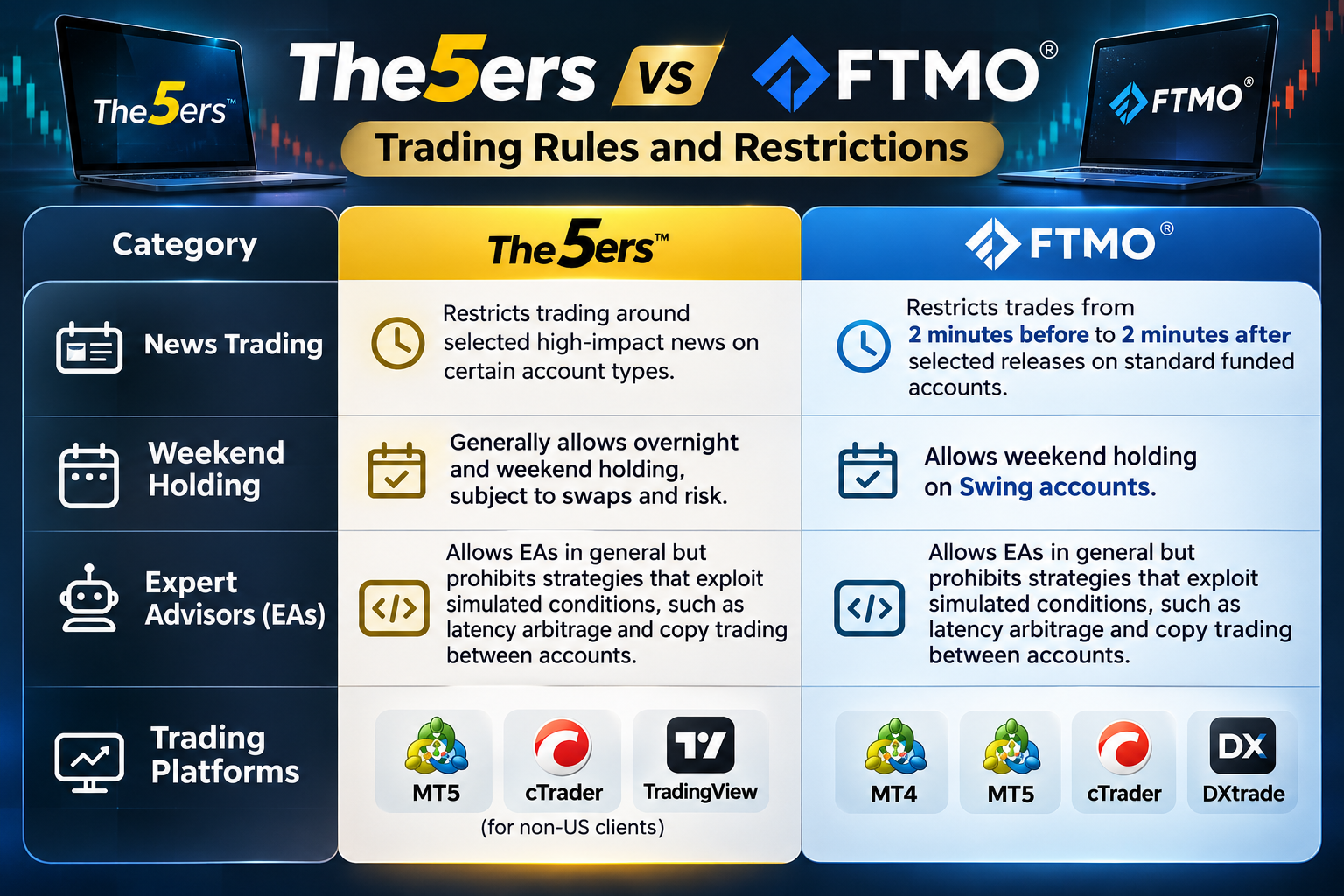
- News trading: Both firms restrict trading around selected high-impact news on certain account types. FTMO restricts trades from two minutes before to two minutes after selected releases on standard funded accounts. Check each firm’s current news policy for your account type.
- Weekend holding: FTMO allows weekend holding on Swing accounts. The5ers generally allows overnight and weekend holding, subject to swaps and risk.
- Expert advisors: Both allow EAs in general but prohibit strategies that exploit simulated conditions, such as latency arbitrage and copy trading between accounts.
- Platforms: FTMO offers MetaTrader 4, MetaTrader 5, cTrader and DXtrade. The5ers offers MetaTrader 5, cTrader and TradingView for non-US clients.
The5ers vs FTMO: Which Firm Suits Which Indian Trader?
| Your profile | Better fit | Why |
|---|---|---|
| Beginner on a tight budget | The5ers Bootcamp | Low entry fee, pay the rest only if you pass |
| Wants a lower first target | The5ers High Stakes | 8% Phase 1 target versus 10% |
| Wants simple, well-known rules | FTMO 2-Step | Clear rules, static drawdown, refundable fee |
| Wants a high split from day one | FTMO 1-Step | 90% from the first reward |
| Aims to scale aggressively | The5ers Hyper Growth or High Stakes | Faster scaling and up to 100% split |
| Wants flexible payout timing | FTMO | On-demand rewards after the first payout |
The honest answer to The5ers vs FTMO is that both can suit Indian traders. The right choice depends on your budget, your average risk per trade and whether you value a lower target, a higher split or simpler rules.
Timing Considerations for Indian Traders
Both firms reset their daily loss limits based on server time rather than IST. FTMO resets at midnight Prague time, which is 4:30am IST in winter. The5ers measures its daily limit from the previous day’s close on its server. Indian traders should check the exact reset time for their account and avoid holding large open losses near the reset.
The London open (1:30pm IST in winter) and the London–New York overlap (6:30pm to 10:30pm IST in winter) are the most active periods for both firms’ forex accounts.
 Legal and FEMA Considerations
Under the Foreign Exchange Management Act (FEMA), Indian residents may not trade leveraged forex on offshore platforms or send money abroad for margin trading. The RBI publishes an Alert List of unauthorised forex platforms.
Both FTMO and The5ers use simulated accounts: you pay a fee and receive rewards based on performance. Many commentators argue this differs from offshore forex trading, but the RBI has not issued specific guidance on prop firm evaluations, so the position is not clearly settled. In any The5ers vs FTMO decision, the legal position is broadly the same for both firms. Take advice from a chartered accountant or lawyer who understands FEMA, use bank accounts in your own name and keep full records.
Tax on Prop Firm Payouts in India
- Payouts from either firm are commonly treated as business income and reported in ITR-3.
- Related expenses, such as challenge fees, can often be claimed.
- Foreign income goes in Schedule FSI, and foreign wallet or account balances in Schedule FA where required.
- Crypto payouts add complexity, as virtual digital assets are taxed at 30% with 1% TDS on transfers above certain thresholds.
- Keep the Foreign Inward Remittance Certificate (FIRC) or bank advice for every bank transfer.
Consult a chartered accountant for your specific situation.
 Worked Example: The5ers vs FTMO for the Same Trader
This example is illustrative. Figures are hypothetical and simplified, and ignore exchange rates and taxes.
Arjun, a swing trader from Bengaluru, makes an average of 4% a month and risks 0.5% per trade.
- FTMO 2-Step $100K (€540): He needs 10% and then 5%, about four months in total. Once funded, 4% a month ($4,000) at an 80% split pays about $3,200 a month, plus his fee back with the first reward.
- The5ers High Stakes $100K (about $495): He needs 8% and then 5%, about three and a half months. Once funded, 4% a month at an 80% split also pays about $3,200, and his split and account size can grow as he hits milestones.
For Arjun, The5ers’ lower first target saves some time and its scaling offers more upside, while FTMO offers on-demand payouts and a more familiar rulebook. Either could work.
The5ers vs FTMO Scorecard
| Category | Edge |
|---|---|
| Lowest entry cost | The5ers (Bootcamp) |
| Easiest first profit target | The5ers (High Stakes, 8%) |
| Most room on a 1-step model | FTMO (10% maximum loss vs 6%) |
| Highest potential profit split | The5ers (up to 100%) |
| Payout flexibility | FTMO (on demand) |
| Platform choice | FTMO (four platforms) |
| Brand recognition and track record | Close; both established for about a decade |
This The5ers vs FTMO scorecard shows there is no clear overall winner. Each firm leads in different areas, which is why the right choice depends on what matters most to you. If cost and scaling matter most, The5ers has the edge. If flexibility, platform choice and a familiar rulebook matter most, FTMO has the edge. Many traders look at The5ers vs FTMO not as an either-or choice, but as two options to use at different stages of their trading journey.
Common Mistakes When Comparing The5ers vs FTMO
- Choosing only on price, without reading the drawdown rules.
- Ignoring whether the maximum loss is static or trailing.
- Picking a 3% daily-limit programme while risking 1% or more per trade.
- Forgetting to check news and weekend rules for your strategy.
- Not planning for tax and records before the first payout.
The5ers vs FTMO Checklist
- Have I read both firms’ current rules on their official websites?
- Does my average risk per trade fit the daily loss limit?
- Do I prefer a lower target, a higher split or simpler rules?
- Do I hold trades overnight, at weekends or through news?
- Which platforms do I want to use?
- Have I checked the fee in rupees at checkout?
- Have I spoken to a chartered accountant about tax and FEMA?
FAQs
Which is better for Indian traders, The5ers or FTMO?
Neither is better for everyone. The5ers suits traders who want lower targets, cheaper entry or aggressive scaling. FTMO suits traders who want a well-known brand, simple rules and flexible payouts.
Which is cheaper, The5ers vs FTMO?
The5ers Bootcamp has the lowest entry fee. For a $100,000 two-step account, prices are similar, at roughly €540 for FTMO and about $495 for The5ers High Stakes.
Do both firms accept Indian traders?
Both accept traders from India, but the legal position under FEMA is not clearly settled, so take professional advice.
Which firm pays a higher profit split?
FTMO pays up to 90%. The5ers can pay up to 100% as accounts scale.
Can I use both firms at the same time?
Yes, many traders hold accounts at more than one firm. Instead of treating The5ers vs FTMO as a single choice, you can start with one, learn its rules and add the other later, as long as your total risk stays under control.
How are payouts taxed in India?
They are commonly treated as business income and reported in ITR-3. Consult a chartered accountant.
Conclusion
The5ers vs FTMO is a choice between two strong, established firms with different strengths. FTMO offers a clear, widely trusted rulebook, a refundable 2-Step fee and flexible payouts. The5ers offers a lower first target on High Stakes, a very low-cost Bootcamp entry and faster scaling with a split of up to 100%.
Choose the firm whose rules match how you already trade, not the one that looks cheapest. Check the current terms on each firm’s website, keep risk small, plan your tax and records in advance and get professional advice on the FEMA position before you begin.