

Introduction
Why does a cup of coffee cost a few dollars in New York but much less in rupees in Mumbai? And if prices differ so much across countries, are some currencies “too cheap” or “too expensive”? These questions lie at the heart of purchasing power parity (PPP), one of the oldest ideas in international economics.
PPP says that, over time, exchange rates should adjust so that the same basket of goods costs the same in different countries. In practice, exchange rates can stay far from PPP for years. But PPP remains useful because it helps explain long-term currency trends, especially between countries with different inflation rates.
This guide explains purchasing power parity forex concepts in plain language: what PPP is, the absolute and relative versions, the Big Mac Index, real exchange rates, what PPP says about the rupee, why it fails in the short run and how traders can use it.
What Is Purchasing Power Parity?
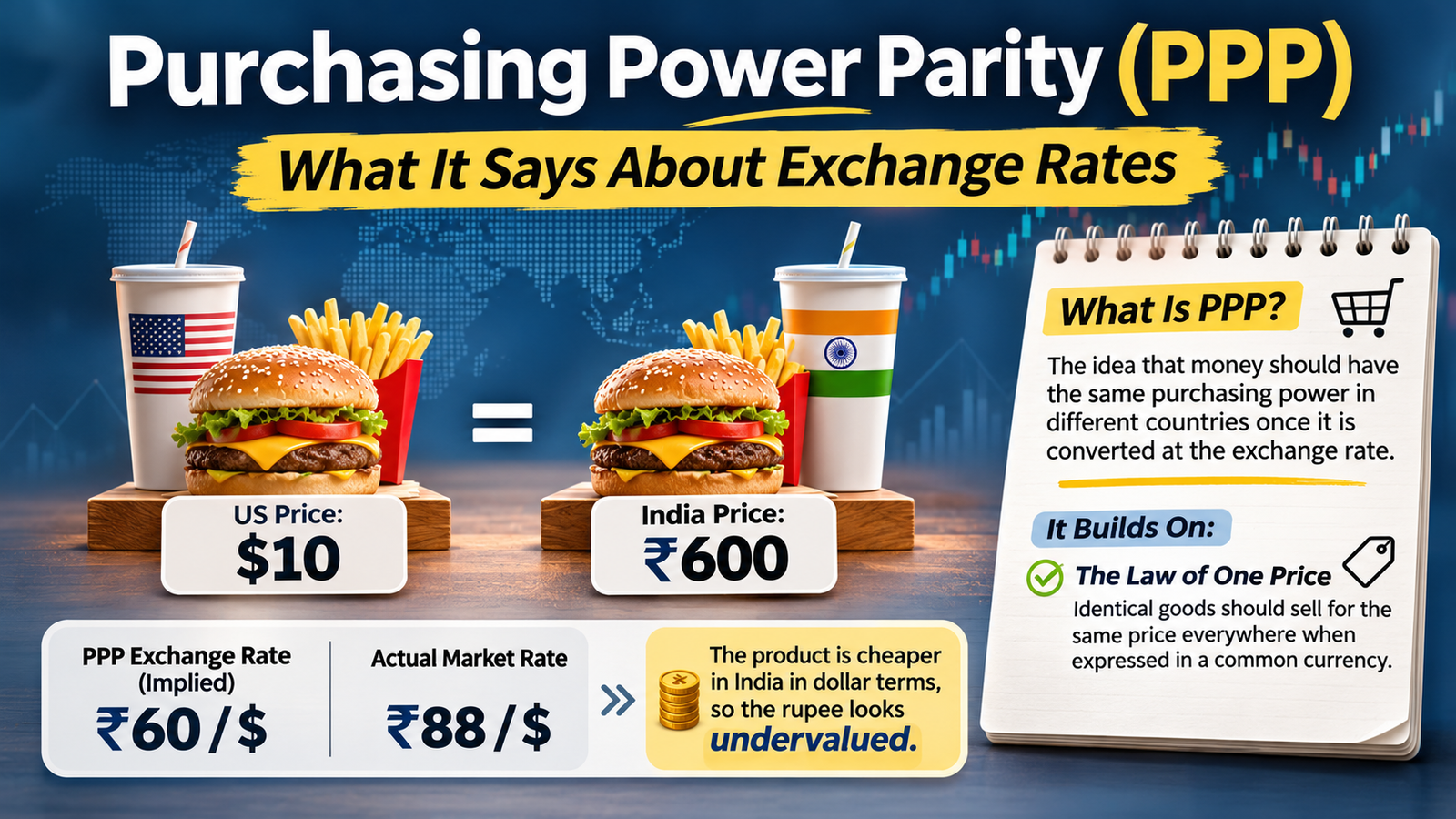
Purchasing power parity is the idea that money should have the same purchasing power in different countries once it is converted at the exchange rate. It builds on the law of one price: in a world without transport costs, trade barriers or taxes, identical goods should sell for the same price everywhere when expressed in a common currency.
If a product costs $10 in the US and ₹600 in India, the law of one price implies an exchange rate of ₹60 per dollar. If the actual market rate is ₹88, the product is cheaper in India in dollar terms, and by this measure the rupee looks undervalued.
Absolute vs Relative PPP
| Version | What it says | Formula (simplified) | Use in forex |
|---|---|---|---|
| Absolute PPP | Exchange rate equals the ratio of price levels | Exchange rate = domestic price level ÷ foreign price level | Judging over- or undervaluation |
| Relative PPP | Changes in exchange rates reflect inflation differences | % change in exchange rate ≈ domestic inflation − foreign inflation | Estimating long-term trends |
Absolute PPP
Absolute PPP compares the price of the same basket of goods in two countries. It is the version used to say a currency is overvalued or undervalued, and it is the basis of most purchasing power parity forex comparisons.
Relative PPP
Relative PPP focuses on changes rather than levels. If India’s inflation is 4% and US inflation is 2%, relative PPP suggests the rupee should depreciate by roughly 2% a year against the dollar over time to keep purchasing power aligned. Many traders find relative PPP more practical, because it does not require identical baskets of goods.
Purchasing Power Parity Forex Example: Relative PPP
This example is illustrative and uses hypothetical inflation rates and prices.
Suppose USD/INR is 88.00 today. Expected inflation is 4% in India and 2% in the US.
- Inflation differential = 4% − 2% = 2%.
- Relative PPP estimate after one year ≈ 88.00 × (1.04 ÷ 1.02) ≈ 89.73.
- After five years, if the gap stays the same: 88.00 × (1.04 ÷ 1.02)5 ≈ 97.0.
This does not mean USD/INR will reach these levels. Capital flows, interest rates, RBI action and global events can push the rate far from any purchasing power parity forex estimate. But it explains why currencies of higher-inflation countries tend to weaken over long periods.
The Big Mac Index
The best-known everyday application of PPP is the Big Mac Index, created by The Economist in 1986. It compares the price of a McDonald’s Big Mac in different countries to estimate whether currencies are over- or undervalued against the dollar.
- If a Big Mac costs more in dollar terms in a country than in the US, that currency looks overvalued.
- If it costs less, the currency looks undervalued.
The index was designed as a light-hearted guide, not a trading tool. In India, the comparison typically uses a chicken-based burger, since beef is not widely served, which shows one of the practical problems with comparing “identical” goods. Even so, it remains a popular way to introduce purchasing power parity forex ideas to new traders.
PPP Exchange Rates vs Market Exchange Rates
International organisations such as the World Bank and IMF calculate PPP conversion factors to compare living standards and economic size across countries. For countries like India, the PPP rate is far lower than the market exchange rate. In recent World Bank estimates, India’s PPP conversion factor has been roughly a quarter of the market USD/INR rate.
This means a rupee buys much more locally than its market exchange rate suggests. It is one reason India’s economy ranks higher in global comparisons when measured in PPP terms than at market exchange rates.
For purchasing power parity forex analysis, this gap is not a signal that the rupee will suddenly quadruple in value. Large and persistent differences are normal between emerging and advanced economies.
Why PPP Fails in the Short Run
- Non-traded goods: haircuts, rent and local services cannot be shipped across borders, so their prices do not equalise.
- Transport costs and tariffs: trade barriers stop prices from converging.
- Capital flows: most currency trading relates to investment and financial flows, not trade in goods. The global currency market averaged about $9.6 trillion a day in April 2025, far more than the value of goods traded.
- Interest rates: higher rates can attract capital and keep a currency strong despite higher inflation.
- Sticky prices: goods prices adjust slowly, while exchange rates move every second.
- Central bank intervention: the RBI and other central banks may limit currency moves.
The PPP puzzle
Economists have found that deviations from PPP tend to fade only slowly, with research commonly citing a half-life of roughly three to five years. Kenneth Rogoff called this the “purchasing power parity puzzle” in a well-known 1996 paper: exchange rates are very volatile in the short run, yet deviations from PPP fade surprisingly slowly. For anyone using purchasing power parity forex estimates, that means patience is essential.
The Balassa-Samuelson Effect
Why are prices generally lower in developing countries? The Balassa-Samuelson effect offers one explanation. Productivity grows faster in traded sectors such as manufacturing in fast-growing economies. That raises wages across the economy, including in services, and pushes up the overall price level.
As a result, fast-growing emerging economies may see their real exchange rates appreciate over time, even if their market exchange rates weaken against the dollar. This helps explain why purchasing power parity forex estimates for emerging markets can stay far from market rates for decades.
Real Exchange Rates and India’s REER
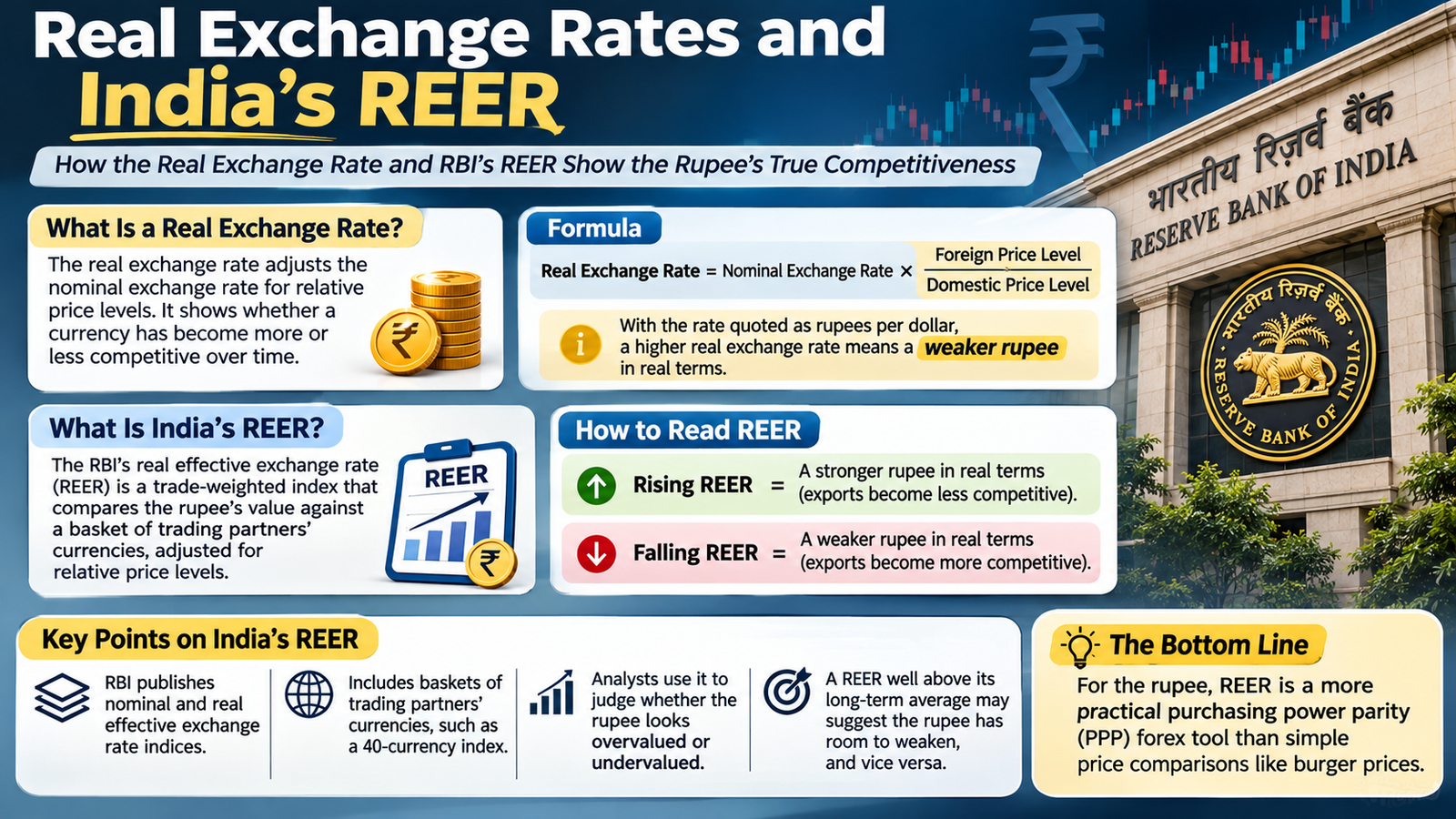
The real exchange rate adjusts the nominal exchange rate for relative price levels. It shows whether a currency has become more or less competitive over time.
- Real exchange rate = nominal exchange rate × (foreign price level ÷ domestic price level).
- With the rate quoted as rupees per dollar, a higher real exchange rate means a weaker rupee in real terms.
- The RBI’s real effective exchange rate (REER) indices are built the other way round: a rising REER means the rupee has become stronger in real terms, making exports less competitive.
The RBI publishes nominal and real effective exchange rate indices for the rupee against baskets of trading partners’ currencies, including a 40-currency index. Analysts use these indices to judge whether the rupee looks overvalued or undervalued in real terms. A REER well above its long-term average is sometimes seen as a sign that the rupee has room to weaken, and vice versa. For the rupee, REER is a more practical purchasing power parity forex tool than burger prices.
How Traders Use Purchasing Power Parity Forex Analysis
PPP is not a short-term trading signal, but it has practical uses:
- Long-term valuation: identify currencies that look very overvalued or undervalued over a multi-year horizon.
- Trend context: inflation differentials help explain the long-term direction of pairs such as USD/INR.
- Hedging decisions: businesses with multi-year exposures may use PPP-based estimates in planning.
- Mean reversion ideas: extreme deviations from PPP may eventually narrow, though timing is uncertain.
- Combining with other factors: purchasing power parity forex views work best alongside interest rates, current account balances, capital flows and positioning.
Limitations to Remember
Before relying on any purchasing power parity forex estimate, keep these limits in mind:
- PPP says nothing reliable about where a currency will trade next week or next month.
- Different price indices (CPI, producer prices, GDP deflators) can give different results.
- Base-year choice affects whether a currency looks over- or undervalued.
- Structural changes, such as productivity growth or trade reforms, can shift fair value.
- Currencies can stay “mispriced” for longer than a trader can stay solvent.
Purchasing Power Parity Forex Models Used by Professionals
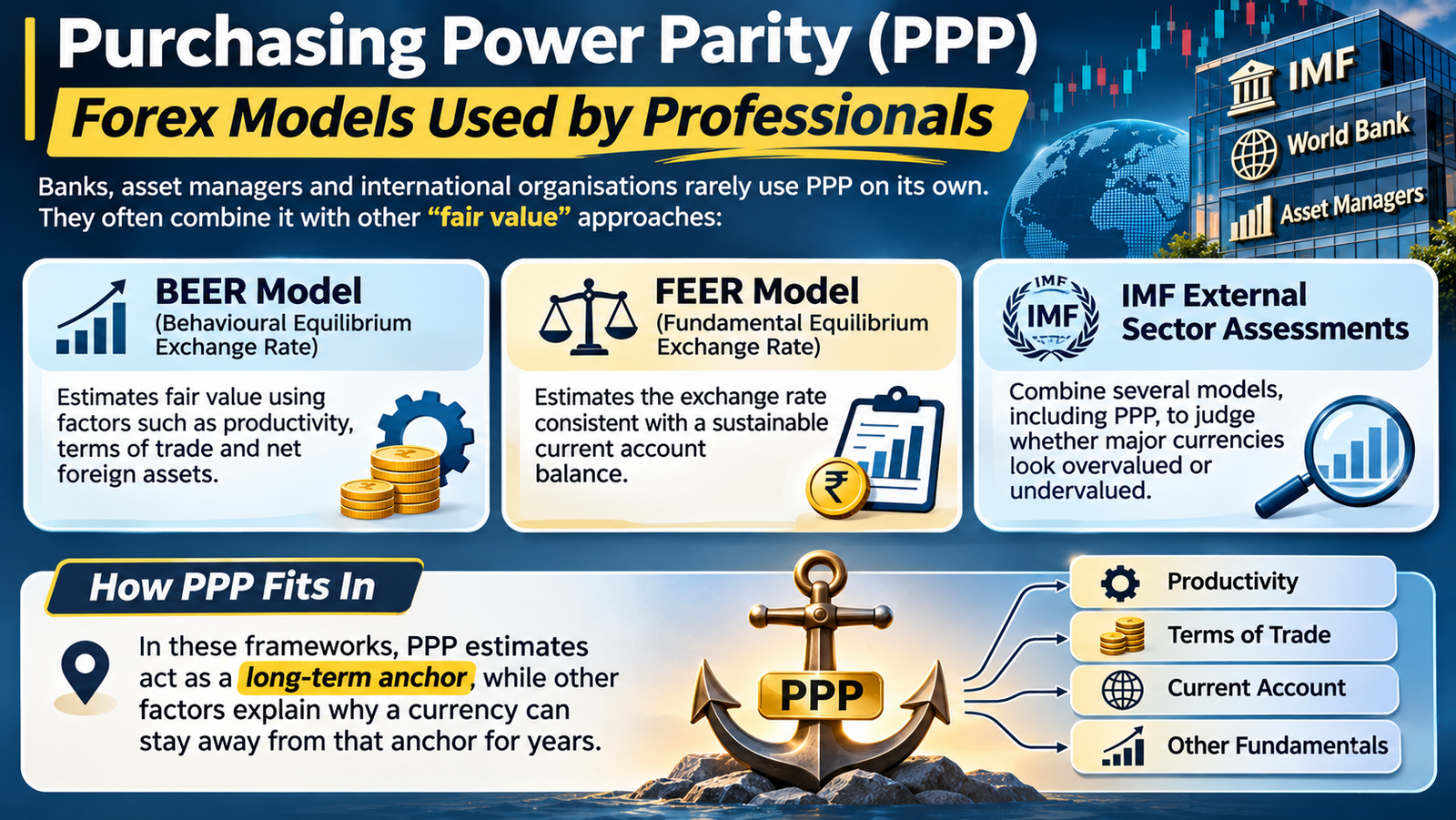
Banks, asset managers and international organisations rarely use PPP on its own. They often combine it with other “fair value” approaches:
- Behavioural equilibrium exchange rate (BEER) models: estimate fair value using factors such as productivity, terms of trade and net foreign assets.
- Fundamental equilibrium exchange rate (FEER) models: estimate the exchange rate consistent with a sustainable current account balance.
- IMF external sector assessments: combine several models to judge whether major currencies look over- or undervalued.
In these frameworks, purchasing power parity forex estimates act as a long-term anchor, while other factors explain why a currency can stay away from that anchor for years.
A Simple PPP Checklist for Traders
- What is the inflation gap between the two countries, and is it expected to persist?
- How far is the real exchange rate from its long-term average?
- Do interest rates or capital flows explain the gap?
- Is the central bank resisting the move?
- Is my time horizon long enough for PPP to matter?
Trading Currency Views from India
Indian residents who want to act on long-term currency views can use exchange-traded currency derivatives on NSE and BSE through SEBI-registered brokers. Contracts include USD/INR, EUR/INR, GBP/INR and JPY/INR, along with EUR/USD, GBP/USD and USD/JPY. Leveraged forex through offshore brokers is not permitted for Indian residents under FEMA. Because PPP is a long-horizon tool, it is often more useful for hedging decisions than for short-term trading.
Quick Reference
| Concept | Key idea |
|---|---|
| Law of one price | Identical goods should cost the same everywhere in a common currency |
| Absolute PPP | Exchange rate equals ratio of price levels |
| Relative PPP | Exchange rate changes reflect inflation differences |
| Big Mac Index | Informal PPP comparison using burger prices |
| REER | Inflation-adjusted, trade-weighted exchange rate |
| Balassa-Samuelson | Productivity growth raises price levels in fast-growing economies |
FAQs
What is purchasing power parity in forex?
It is the theory that exchange rates should adjust so that the same goods cost the same across countries. In purchasing power parity forex analysis, it is used to judge long-term over- or undervaluation.
What is the difference between absolute and relative PPP?
Absolute PPP compares price levels; relative PPP links exchange rate changes to inflation differences.
Does PPP predict short-term currency moves?
No. Deviations can last for years. PPP is a long-term guide.
Is the rupee undervalued according to PPP?
On a simple PPP comparison, the rupee’s market rate is far weaker than its PPP rate, but this is normal for emerging economies and does not imply a rapid change.
What is REER?
The real effective exchange rate: a trade-weighted exchange rate adjusted for inflation. The RBI publishes REER indices for the rupee.
Is the Big Mac Index reliable?
It is a useful illustration, not a precise measure, because local costs, taxes and menus differ.
Conclusion
Purchasing power parity explains why currencies of high-inflation countries tend to weaken over time and gives a rough sense of long-term fair value. Absolute PPP compares price levels, relative PPP focuses on inflation differences, and real exchange rates such as India’s REER show changes in competitiveness.
But PPP is a slow-moving anchor, not a trading signal. Use purchasing power parity forex insights for long-term context and hedging, and combine them with interest rates, capital flows, central bank policy and sound risk management.