Introduction
Ask a group of people “is forex trading gambling?” and you will get very different answers. Some say it is no different from a casino, with flashing prices, quick wins and big losses. Others say it is a skill-based profession practiced by banks, funds and corporate treasuries every day.
The honest answer is that it depends on how you trade. The currency market itself is a real market with a real economic purpose. But the way many retail traders approach it, with no plan, huge leverage and decisions driven by emotion, can look exactly like betting.
This guide explores the question “is forex trading gambling?” in detail. It covers what gambling actually is, how trading differs, where the two overlap, what the numbers say about retail traders, how Indian law and tax treat each, and the warning signs that your trading has turned into gambling.
What Is Gambling?
Gambling generally means staking money on an uncertain outcome, mainly decided by chance, in the hope of winning more. Three features stand out:
- Chance dominates: in games like roulette or slot machines, no amount of skill changes the odds.
- The house has an edge: the rules are designed so the operator wins over time. In European roulette, for example, the single zero gives the house an edge of about 2.7%.
- No underlying economic purpose: the bet exists only for the wager itself.
Over a large number of bets, a player facing a fixed negative edge will almost certainly lose. That is the mathematical core of gambling, and it is the benchmark to keep in mind whenever someone asks “is forex trading gambling?”
What Is Forex Trading?
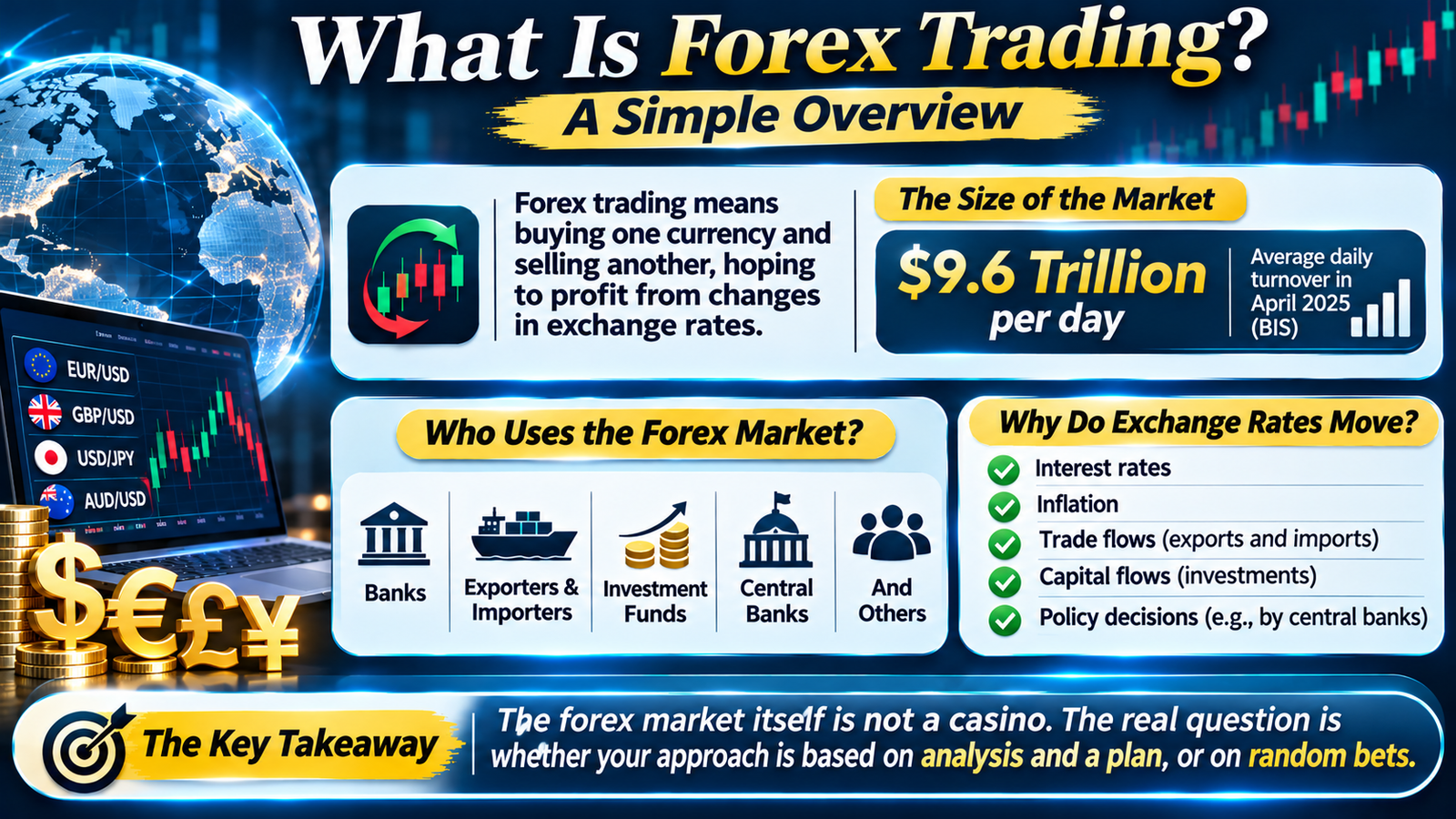
Forex trading means buying one currency and selling another, hoping to profit from changes in exchange rates. The global currency market averaged about $9.6 trillion a day in April 2025, according to the Bank for International Settlements.
Most of that activity is not speculation by individuals. Banks, exporters, importers, investment funds and central banks use the market to pay for goods, hedge risk, invest abroad and manage reserves. Prices move because of interest rates, inflation, trade flows, capital flows and policy decisions, all of which can be studied and analysed.
So when people ask “is forex trading gambling?”, the market itself is clearly not a casino. The real question is whether an individual trader’s approach is closer to investing in an informed view or to placing random bets.
Is Forex Trading Gambling? The Key Differences
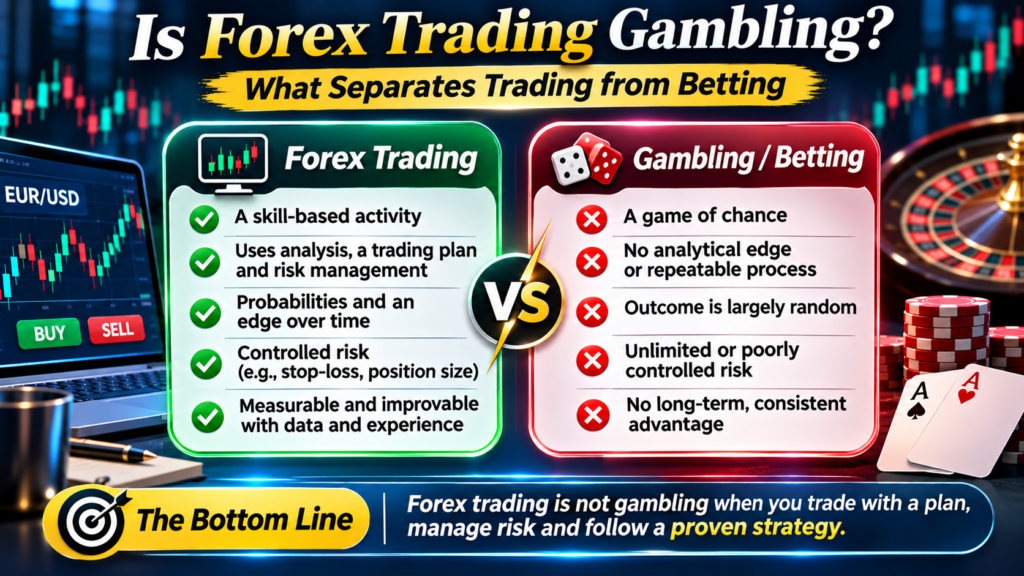
| Feature | Gambling | Disciplined forex trading |
|---|---|---|
| What decides the outcome | Mostly chance | Mix of analysis, risk control and chance |
| Edge | Fixed in favor of the house | Can be positive, zero or negative depending on skill and costs |
| Economic purpose | Entertainment only | Price discovery, hedging, payments, investment |
| Control over losses | Stake is usually lost entirely | Stop-losses and position sizing limit losses |
| Information | Past outcomes do not change odds | Economic data and price behaviour can inform decisions |
| Regulation in India | Gambling and betting largely restricted | Exchange-traded currency derivatives regulated by SEBI and RBI |
| Time horizon | Each bet is usually a one-off | Results judged over many trades |
1. Edge and expected value
The biggest difference is edge. A casino game has a built-in negative expected value for the player. A trading strategy has no fixed edge: it can be positive if the trader has a tested method and keeps costs low, or negative if the trader acts randomly and pays spreads and commissions on every trade. When traders ask “is forex trading gambling?”, edge is usually the deciding factor.
2. Risk control
A gambler who bets ₹1,000 on red usually risks the full ₹1,000. A trader can decide in advance to risk only 1% of capital, place a stop-loss and size the position accordingly. That control is one of the clearest answers to “is forex trading gambling?”: disciplined risk management is not part of most gambling.
3. Analysis and information
In roulette, the previous spin tells you nothing about the next one. In currency markets, interest rate differentials, inflation trends, central bank guidance and market structure can provide useful information, even though prices remain uncertain. This is another reason the answer to “is forex trading gambling?” is not simply yes.
4. Purpose
Hedgers such as exporters use currency futures to protect their business from rupee moves. That is the opposite of gambling: they are using the market to reduce risk, not add it.
Where Forex Trading and Gambling Overlap
It would be misleading to say trading has nothing in common with gambling. There are real similarities:
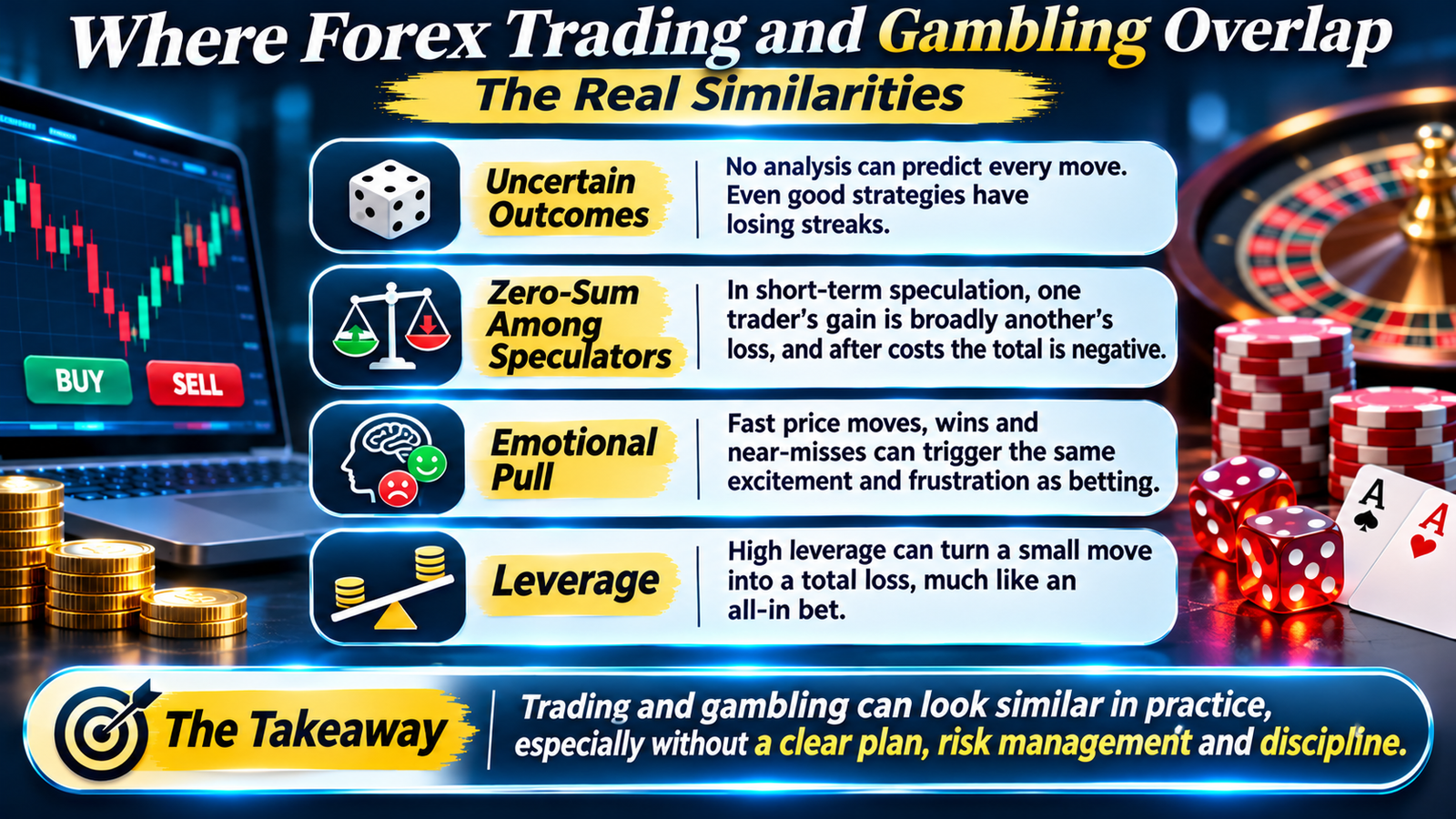
- Uncertain outcomes: no analysis can predict every move. Even good strategies have losing streaks.
- Zero-sum among speculators: in short-term speculation, one trader’s gain is broadly another’s loss, and after costs the total is negative.
- Emotional pull: fast price moves, wins and near-misses can trigger the same excitement and frustration as betting.
- Leverage: high leverage can turn a small move into a total loss, much like an all-in bet.
This is why the question “is forex trading gambling?” keeps coming up. For a trader without a plan, the overlap can be almost complete.
What the Numbers Say About Retail Traders
Data from regulators shows how often retail speculation ends in losses:
- A SEBI study published in September 2024 found that about 9 in 10 individual traders in equity futures and options lost money between FY22 and FY24.
- Brokers regulated in Europe and the UK must disclose the share of retail CFD accounts that lose money, and these disclosures commonly show a majority of accounts losing.
These figures do not prove that trading is gambling. They show that most retail traders behave in ways that produce gambling-like results: overtrading, using too much leverage, ignoring costs and trading without a tested edge. So, is forex trading gambling for most retail traders? In practice, their results often look like it.
Worked Example: Trading with an Edge vs Betting
This example is illustrative and uses hypothetical numbers.
The gambler
A player bets ₹1,000 on red in European roulette 100 times. With a house edge of about 2.7%, the expected loss is about ₹2,700 over those 100 bets. No decision the player makes can change that edge.
The disciplined trader
A trader uses a tested strategy that wins 40% of the time, with an average win of 2R and an average loss of 1R (where R is the amount risked per trade, say ₹1,000).
- Expected value per trade = (0.40 × 2R) − (0.60 × 1R) = 0.8R − 0.6R = +0.2R.
- Over 100 trades, that is +20R, or about ₹20,000, before costs.
- If costs average 0.05R per trade, the net expectation is about +0.15R, or roughly ₹15,000.
The undisciplined trader
Another trader enters on tips and feelings. Their win rate is 45%, but they cut winners at 0.8R and let losers run to 1.5R.
- Expected value = (0.45 × 0.8R) − (0.55 × 1.5R) = 0.36R − 0.825R = −0.465R per trade.
So is forex trading gambling? For the second trader, it is worse than roulette. For the first, it is a structured activity with a positive expected value, though results will still vary and losing streaks will happen.
How Indian Law Treats Trading and Gambling
Indian law separates regulated financial markets from gambling and betting, which are restricted under central and state laws.
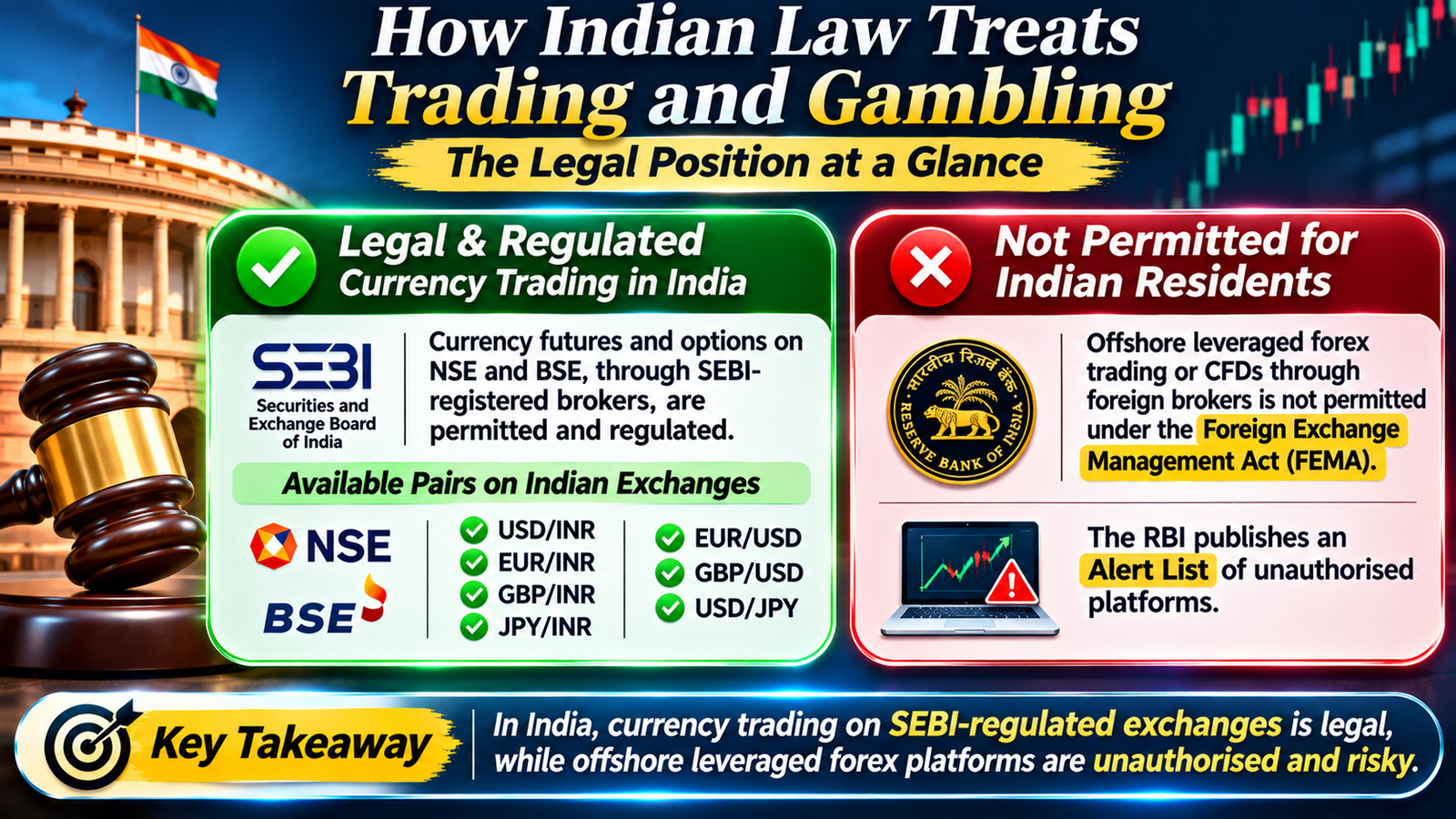
- Legal currency trading: currency futures and options on NSE and BSE, through SEBI-registered brokers, are regulated and permitted. Pairs include USD/INR, EUR/INR, GBP/INR and JPY/INR, plus EUR/USD, GBP/USD and USD/JPY.
- Offshore leveraged forex: under the Foreign Exchange Management Act (FEMA), Indian residents are not permitted to trade leveraged forex or CFDs through offshore brokers. The RBI publishes an Alert List of unauthorized platforms.
Many offshore apps use game-like designs, bonuses and very high leverage. From a legal and practical point of view, answering “is forex trading gambling?” in India starts with which route you use: the regulated exchange route or an unauthorized platform.
How Tax Treats Trading and Gambling in India
Tax rules also treat the two very differently:
- Exchange-traded currency derivatives: income is generally treated as non-speculative business income, taxed at slab rates, with expenses deductible and losses eligible for set-off and carry-forward, subject to the rules.
- Betting and gambling winnings: generally taxed at a flat 30% rate (plus surcharge and cess), with no deduction for expenses and no set-off of losses.
The new Income-tax Act, 2025 applies from 1 April 2026, so section numbers may differ from older guides. Consult a chartered accountant for your situation. From a tax point of view, then, is forex trading gambling? No: the law treats the two as separate activities.
Signs Your Forex Trading Has Become Gambling
A better question than “is forex trading gambling?” may be “is my trading gambling?” Watch for these warning signs:
- You trade without a written plan or defined entry, exit and stop-loss rules.
- You increase position size after losses to “win it back” (revenge trading).
- You use martingale-style doubling after each loss.
- You risk large parts of your account on a single trade.
- You trade for excitement, boredom relief or to change your mood.
- You follow tips from social media or messaging groups without checking them.
- You hide losses from family or borrow money to trade.
- You cannot explain why your strategy should make money over time.
If several of these apply, your trading has moved closer to betting. If trading feels compulsive or is causing financial or personal harm, talk to someone you trust or a qualified professional.
How to Make Sure Trading Is Not Gambling
If you want the answer to “is forex trading gambling?” to be a clear no in your own case, follow these steps:
- Use the legal route: trade currency derivatives on NSE or BSE through a SEBI-registered broker.
- Define your edge: write down why your strategy should work and under what conditions.
- Backtest and forward-test your strategy before risking real money.
- Risk a small amount per trade, often 1% or less of capital.
- Always use stop-losses and decide your exit before you enter.
- Track costs: brokerage, exchange charges, GST and stamp duty all reduce your edge.
- Keep a journal of every trade, including your reasoning and emotions.
- Review results over many trades, not one win or loss.
- Set limits: a maximum daily loss and a maximum number of trades per day.
Is Forex Trading Gambling for Hedgers?
For businesses and individuals with genuine currency exposure, the answer is clearly no. An importer paying for goods in dollars in three months faces a real risk if the rupee weakens. Buying USD/INR futures locks in a rate and reduces that risk. Whether the market rises or falls, the hedge is doing its job. This is the opposite of gambling, which creates risk that did not exist before.
FAQs
Is forex trading gambling?
Not inherently. The currency market has a real economic purpose, and disciplined trading with a tested edge and strict risk management differs from gambling. But trading without a plan, with high leverage and emotional decisions, can produce gambling-like results.
Is forex trading gambling in India legally?
No. Exchange-traded currency derivatives on NSE and BSE through SEBI-registered brokers are regulated financial products. Offshore leveraged forex, however, is not permitted for residents under FEMA.
Why do most traders lose money?
Common reasons include overtrading, excessive leverage, poor risk management, high costs and trading without a tested strategy.
Can forex trading be a skill?
Yes. Skill shows up in analysis, risk management and discipline over many trades, though no skill removes uncertainty.
Is forex trading gambling when you day trade?
Very short-term trading increases costs and emotional pressure, so it can drift towards gambling more easily if not done with strict rules.
How is trading income taxed differently from gambling winnings?
Exchange-traded currency derivative income is generally treated as business income, while betting winnings are generally taxed at a flat rate without deductions. Consult a chartered accountant.
Conclusion
So, is forex trading gambling? The market itself is not: it is a vast, regulated system used for payments, investment and hedging. But an individual’s trading can become gambling when it lacks a plan, an edge and risk control.
The difference lies in behaviour. Disciplined traders define their edge, size positions carefully, use stop-losses, track costs and judge results over many trades. Gamblers chase excitement, bet big and hope. For Indian traders, staying on the regulated NSE and BSE route and treating trading as a structured activity, not a bet, is the best way to make sure the answer for you is no.