Key Takeaways
- Gold import duty in India is 15% as of early November 2026: 10% basic customs duty plus 5% AIDC, in force since 13 May 2026.
- IGST of 3% is charged on top of the duty-inclusive value, so the combined levy works out to roughly 18.45%.
- Duty is calculated on a CBIC-notified tariff value in US dollars, not on the invoice price, and the tariff value is revised roughly every fortnight.
- A weaker rupee raises the landed price even when international gold is flat, because duty and GST apply to the rupee value.
- MCX gold prices already include import duty, which is why they sit well above the simple USD-to-INR conversion of the global price.
India imports almost all the gold it consumes, which makes gold import duty in India one of the biggest reasons the rupee price of gold differs from the international dollar price you see on a XAU/USD chart. This guide is for Indian retail traders and buyers who want to understand the gap. You will learn the current duty components, how AIDC and the tariff value work, how USD/INR feeds into the landed cost, and how to run a quick estimate yourself.
What is the gold import duty in India right now?
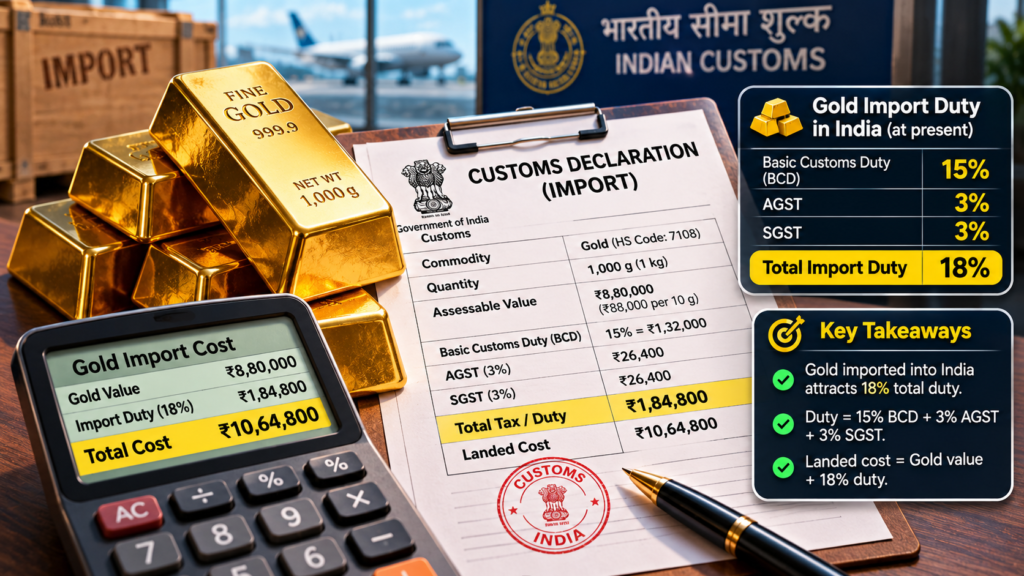
The effective customs duty on gold imported into India is 15%, made up of 10% basic customs duty (BCD) and 5% Agriculture Infrastructure and Development Cess (AIDC). The rates took effect on 13 May 2026. IGST of 3% then applies on the duty-paid value, so the total government levy on imported gold is about 18.45%.
This is a recent change. The July 2024 Union Budget cut gold duty to 6% (5% BCD plus 1% AIDC), and the 1 February 2026 Budget left it unchanged. Customs notifications issued on 12 May 2026 then reversed that cut.
Notification No. 15/2026-Customs raised BCD on the relevant Chapter 71 entries from 5% to 10%. Notification No. 16/2026-Customs amended the AIDC notification and set AIDC at 5% on the main gold entries. AIDC (Agriculture Infrastructure and Development Cess) is a cess collected with customs duty, and for the importer it adds to cost exactly like duty.
Since August 2026, news reports have said a cut back to 6% is under consideration, but no decision had been announced as of 5 November 2026. Until a new notification appears, use 15%.
How the duty components stack up
Here is each component, its rate and what it is charged on.
| Component | Current rate (Nov 2026) | Charged on | Rate before 13 May 2026 |
|---|---|---|---|
| Basic customs duty (BCD) | 10% | Assessable value (tariff value × customs exchange rate) | 5% |
| AIDC | 5% | Assessable value | 1% |
| Effective customs duty | 15% | Assessable value | 6% |
| IGST | 3% | Assessable value + customs duty | 3% |
| Approximate total levy | about 18.45% | Compounded | about 9.2% |
The total is compounded, not added, because GST is charged on a value that already includes duty: 1.15 × 1.03 = 1.1845. That is why some reports quote 18.4% or 18.45%.
We could not confirm from the notification text how the Social Welfare Surcharge applies to each gold entry; the reported 15% is BCD plus AIDC. Commercial importers should check the CBIC notification for their exact tariff heading.
What is the gold tariff value and why does it matter?
The tariff value is a fixed US dollar value per 10 grams that CBIC notifies, and customs duty is calculated on it instead of the invoice price. It is set under Section 14(2) of the Customs Act, 1962, and is usually revised every fortnight to track international prices.
The latest revision we verified is Notification No. 89/2026-Customs (N.T.), dated 30 October 2026 and effective from 31 October 2026. It fixed the tariff value of gold bars and gold coins (99.5% purity and above) at US$1,295 per 10 grams, and silver at US$1,711 per kilogram.
To get the assessable value in rupees, customs multiplies the tariff value by the customs exchange rate, which CBIC also notifies periodically. When CBIC cuts the tariff value, duty per 10 grams falls even though the rate stays at 15%. Our news report on the tariff value cut covers one such revision.
Because it is revised fortnightly, the tariff value can lag the live price. In a sharp rally, duty paid may be slightly below 15% of the live price, and above it in a falling market.
How USD/INR changes the landed cost of gold
The rupee matters as much as the gold price. International gold is quoted in dollars, so a weaker rupee raises the rupee value before duty, and duty and GST then multiply that larger figure.
A 1% fall in the rupee raises the landed price by roughly 1%, the same as a 1% rise in dollar gold, which is why Indian gold can hit a record in rupees while XAU/USD is flat. Traders who follow our gold price outlook often watch USD/INR alongside the dollar price for this reason.
You can check the conversion step with our free currency converter before adding duty and GST.
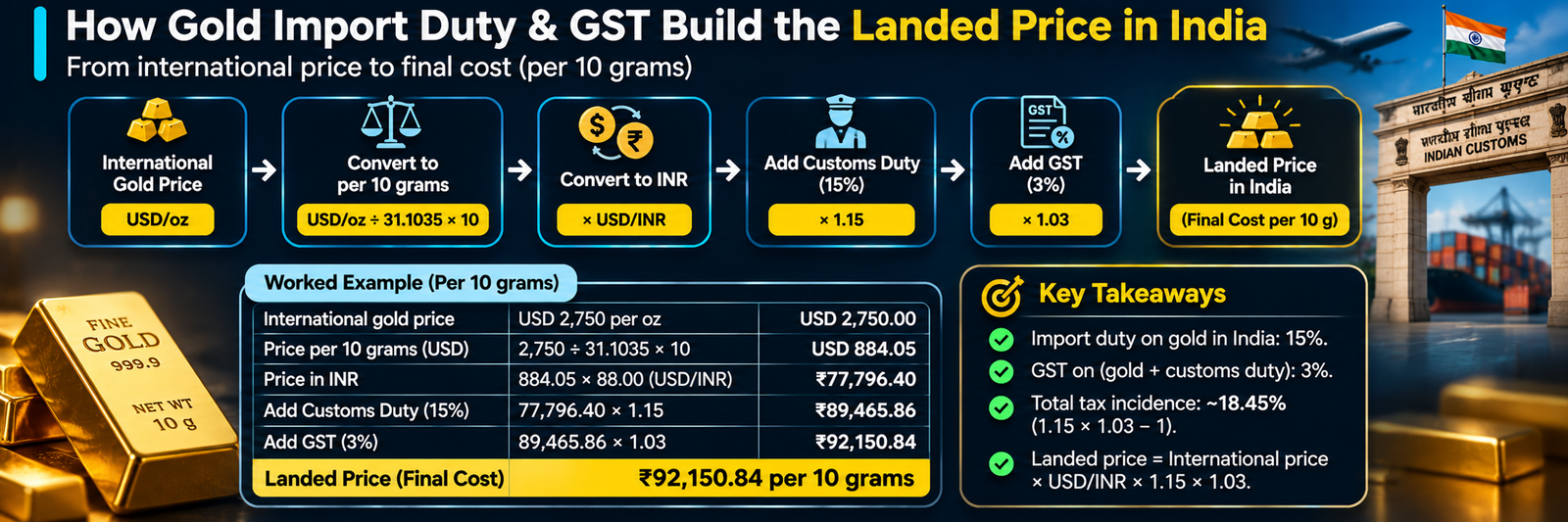
How to estimate the landed price of gold in India
This gives a rough estimate. It leaves out bank charges, dealer margins, making charges and the local premium or discount.
- Note the international price in US dollars per troy ounce from a live XAU/USD quote.
- Convert to 10 grams. One troy ounce is 31.1035 grams, so multiply the price by 10 and divide by 31.1035.
- Convert to rupees by multiplying by the current USD/INR rate.
- Add customs duty at 15% (10% BCD plus 5% AIDC). For a stricter estimate, apply it to the CBIC tariff value multiplied by the customs exchange rate.
- Add 3% IGST on the duty-inclusive figure.
- Compare with the MCX or bullion rate. The gap that remains is the local premium or discount plus dealer costs.
Worked example (hypothetical)
All prices here are hypothetical, not current market rates.
- International gold: US$4,000 per ounce
- USD/INR: 88.00
- Per 10 grams in USD: 4,000 × 10 ÷ 31.1035 = US$1,286.03
- In rupees: 1,286.03 × 88 = ₹1,13,170.54
- Customs duty at 15%: ₹16,975.58, giving ₹1,30,146.13
- IGST at 3%: ₹3,904.38
- Estimated landed price: about ₹1,34,050.51 per 10 grams
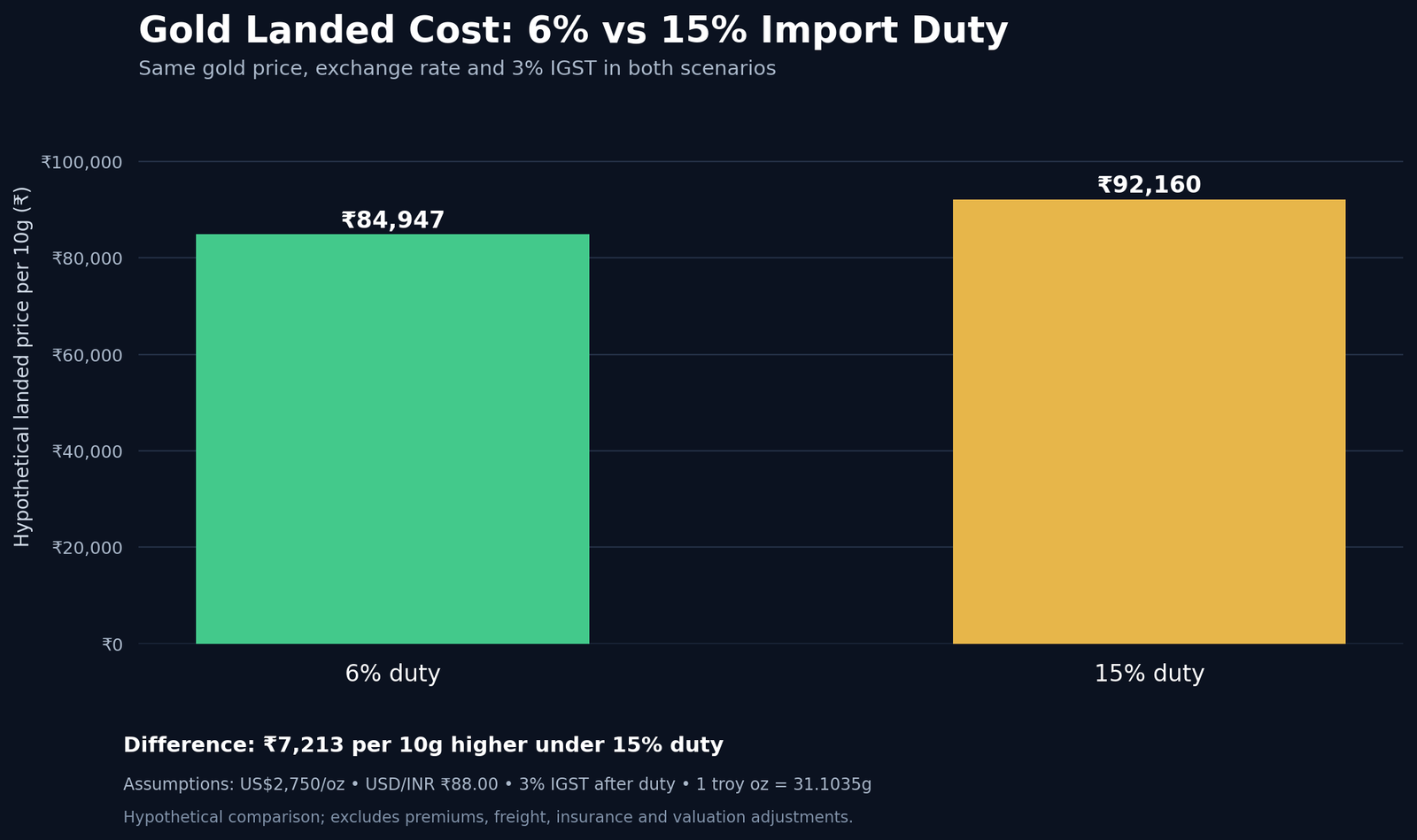
Under the old 6% duty, the same inputs give about ₹1,23,559.60, so the hike alone adds roughly ₹10,490 per 10 grams.
If the rupee weakens to 90.00 with gold unchanged, the landed price rises to about ₹1,37,097, roughly ₹3,047 more.
Example (hypothetical): a buyer with ₹1,00,000. At the hypothetical 15% landed price of ₹13,405 per gram, ₹1,00,000 buys about 7.46 grams. At the 6% duty landed price, the same amount bought about 8.09 grams. That 0.63-gram difference is the cost of the duty hike for this buyer.
Why does Indian gold trade at a premium or discount to international prices?
Indian gold trades at a premium when local demand outstrips the supply arriving through official channels, and at a discount when demand is weak or cheaper unofficial supply is available. The gap is measured against the landed price, that is, the international price plus duty and GST.
The May 2026 hike produced a sharp discount. The World Gold Council’s India market update reported that the average discount widened from US$14 per ounce in the week before the hike to nearly US$150 per ounce. The same report found that the MCX spot price rose only about 4% to 6% after the change, because seasonally weak demand and supply from old-jewellery exchange limited the pass-through.
Higher duty also encourages smuggling: the WGC noted unofficial imports rose after the 2022 hike and fell to almost zero after the 2024 cut. Smuggled gold avoids duty and GST, so it sells below the official price. For how demand has responded since, see India’s Q3 2026 gold demand figures.
MCX gold prices embed the duty
MCX gold contracts are quoted in rupees per 10 grams inclusive of import duty and related levies, so they are not comparable with a plain USD-to-INR conversion of XAU/USD. When duty changes, MCX prices can gap as the market reprices the landed cost.
A note on venues: Indian residents can trade gold futures on MCX through SEBI-registered brokers. Margin trading of XAU/USD or currency pairs on overseas online platforms, including through LRS remittances, is not permitted, and the RBI keeps an Alert List of unauthorised platforms. Read our guide on what is legal for Indian residents before opening any account.
Common mistakes when reading gold prices in India
- Adding GST to the dollar price only. GST is charged on the duty-inclusive value, so 15% plus 3% is about 18.45%, not 18%.
- Assuming the rate is still 6%. Articles from July 2024 to May 2026 quote the old rate.
- Using the live price instead of the tariff value. Customs charges duty on the CBIC tariff value.
- Ignoring the rupee. A rally in rupee gold can be mostly currency.
- Treating the MCX price as the global price. MCX already includes duty, so the gap against XAU/USD is not an arbitrage.
- Forgetting jewellery costs. Making charges carry separate GST.
- Trading on duty rumours. Until a notification is published, a reported cut is only a report.
FAQs
What is the current gold import duty in India?
As of November 2026, the effective customs duty on gold is 15%: 10% basic customs duty and 5% AIDC, applied since 13 May 2026 under Notification Nos. 15/2026 and 16/2026-Customs. IGST of 3% is added on the duty-paid value, making the total levy about 18.45%.
Did Budget 2026 change customs duty on gold?
No. The Union Budget of 1 February 2026 left gold duty unchanged at 6%. The increase to 15% came through customs notifications issued on 12 May 2026, effective the next day. A cut has been reported as under consideration since August, but none had been announced by early November 2026.
What is AIDC on gold?
AIDC stands for Agriculture Infrastructure and Development Cess, a levy charged with basic customs duty on imports and earmarked for farm infrastructure. For gold it is currently 5% of the assessable value, up from 1% before May 2026. It adds to cost exactly like customs duty.
What is the gold tariff value?
The tariff value is a US dollar value per 10 grams, notified by CBIC, on which customs duty is calculated instead of the invoice price. It is usually revised every fortnight. Notification No. 89/2026-Customs (N.T.), effective 31 October 2026, set it at US$1,295 per 10 grams for gold bars and qualifying gold coins.
Does the gold import duty affect MCX prices?
Yes. MCX gold contracts are quoted in rupees per 10 grams including import duty and related levies, so a duty change feeds directly into the price. After the May 2026 hike, the World Gold Council noted that the MCX spot price rose about 4% to 6%, less than the 9-point duty increase, as weak demand limited the pass-through.
How does the rupee affect the price of gold in India?
Gold is priced globally in US dollars, so a weaker rupee raises the rupee value before duty and GST, which scale up with it. A 1% fall in the rupee raises the landed price by about 1%, even if international gold does not move.
Conclusion
Gold import duty in India is now 15%, split into 10% BCD and 5% AIDC, with 3% IGST on top. Together with the CBIC tariff value and the USD/INR rate, it explains most of the gap between the dollar gold price and what you pay in rupees. The rest is the local premium or discount, which swung widely after May 2026. Before comparing Indian and global prices, run the numbers yourself: convert the dollar price with our free currency converter, then add duty and GST using the steps above.