Key Takeaways
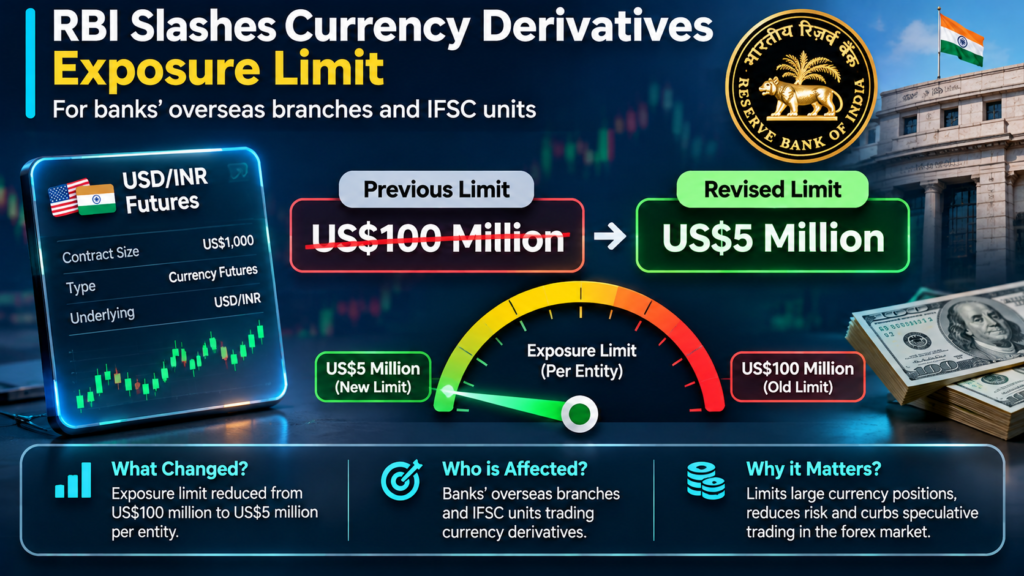
- From 10 October 2026, the threshold for exchange-traded INR currency derivative positions without establishing underlying exposure is US$5 million (was US$100 million), across all exchanges combined.
- The threshold is a documentation relief, not a speculation allowance: every user must still have a genuine underlying contracted exposure.
- One USD/INR lot on NSE is US$1,000, so US$5 million is about 5,000 USD/INR lots.
- The new 20% Foreign Exchange Risk Reserve (FERR) applies to banks on certain OTC contracts above US$2 million, not to retail margins.
- Leveraged forex on overseas platforms via LRS remains not permitted, and RBI keeps an Alert List of unauthorised platforms.
The RBI currency derivatives exposure limit changed sharply this October, and many Indian traders are unsure what it means for their USD/INR futures and options. Some read it as a ban. Others think anything under the limit is free for all. Neither is right.
This guide is for retail traders and working professionals who trade currency derivatives on NSE or BSE. You will learn what the US$5 million threshold is, who it applies to, what “underlying exposure” means, what your broker may ask you to confirm, what happens if you cross the line, and how to check your own position size in lots and rupees.
What is the RBI currency derivatives exposure limit now?
The RBI currency derivatives exposure limit is the maximum notional position a user can hold in INR-involving exchange-traded currency derivatives without being asked to establish the underlying exposure. Since 10 October 2026, it is US$5 million equivalent, combined across all INR pairs and all recognised stock exchanges, down from US$100 million.
That comes from RBI A.P. (DIR Series) Circular No. 25 of 10 October 2026, which amended the Master Direction on Risk Management and Inter-Bank Dealings with immediate effect. RBI announced it in its press release RBI Announces Regulatory Measures for the Foreign Exchange Market.
Notional value is the full face value of the contract, not the margin you post.
What changed on 10 October 2026
RBI’s package had four parts; only the threshold cut directly touches exchange traders.
| Measure (10 Oct 2026) | Before | After | Who it mainly affects |
|---|---|---|---|
| Positions without establishing underlying exposure, exchange-traded INR pairs (all exchanges combined) | US$100 million | US$5 million | Exchange users, including retail traders |
| Hedging contracted exposure without establishing it, OTC (all Authorised Dealers combined) | US$100 million | US$5 million | Importers, exporters, corporates |
| Rebooking of cancelled INR forex derivative contracts | Permitted | Not permitted (rollover on maturity still allowed) | OTC users of bank contracts |
| Foreign Exchange Risk Reserve (FERR) | Did not exist | 20% of INR notional, held in cash with RBI | Authorised Dealer banks, on certain contracts above US$2 million |
The US$100 million framework was issued on 5 January 2024 and took effect on 3 May 2024.
Who does the US$5 million exposure limit apply to?
The threshold applies to users. Under RBI’s January 2024 directions, a user is any person, resident or non-resident, other than an Authorised Dealer. That includes you as an individual trader.
It is not a limit for Authorised Dealer banks acting as market makers. Banks have separate rules, including a US$100 million end-of-day net open position cap on the onshore deliverable market, announced on 27 March 2026. Do not confuse that bank figure with the user threshold.
Your broker (the trading member) follows exchange circulars and SEBI membership rules.
Is the limit per exchange or combined?
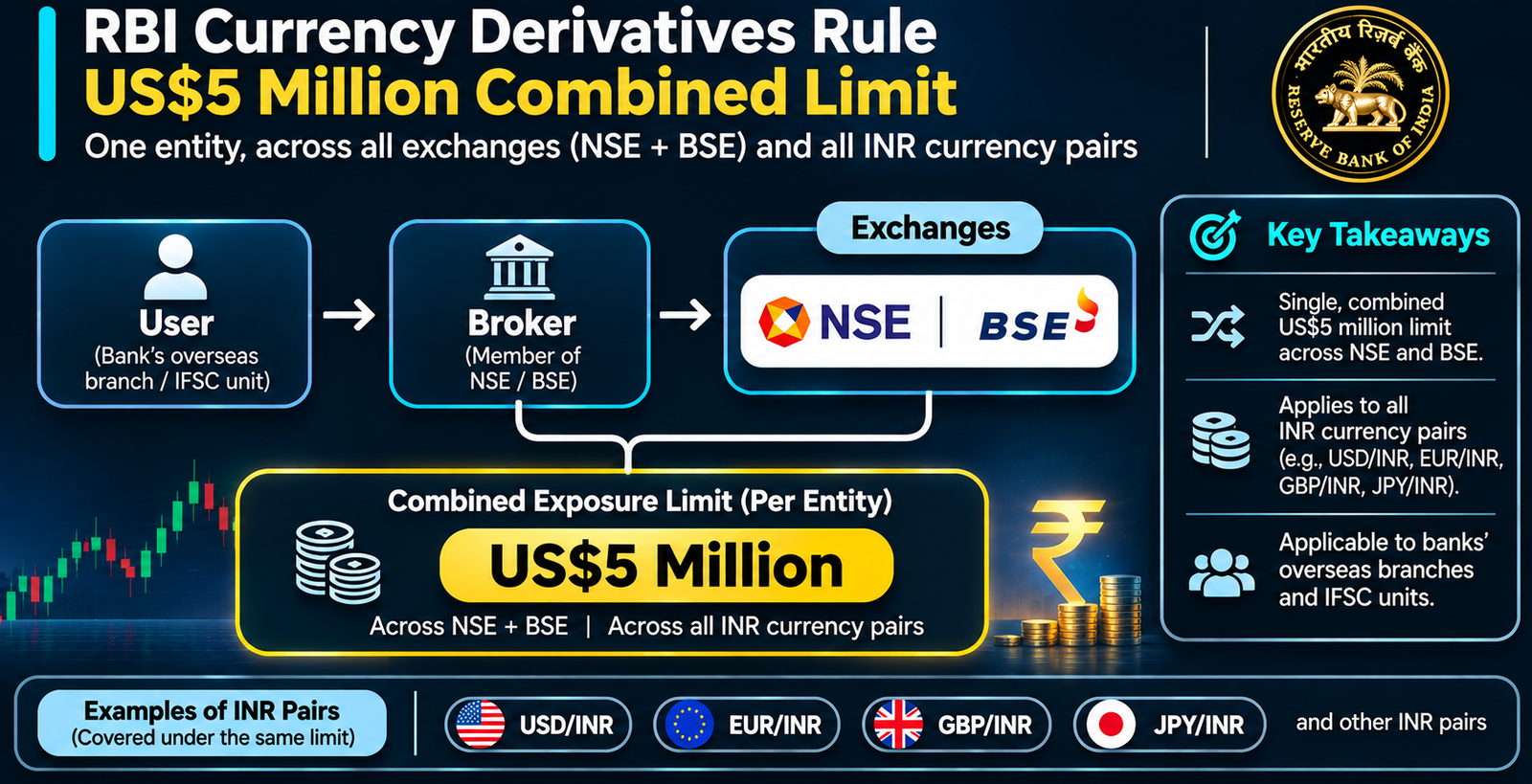
Combined, across all INR pairs and exchanges. Example (hypothetical): US$4 million of USD/INR futures on NSE plus US$2 million of EUR/INR on BSE equals US$6 million, which is above the threshold.
What does “without underlying exposure” actually mean?
The threshold lets you take positions without producing documents for the underlying exposure. It does not let you take positions without having one.
RBI’s April 2024 press release said these contracts are “permitted only for the purpose of hedging of exposure to foreign exchange rate risks”. That principle did not change in October 2026. Only the documentation-free window shrank.
Contracted vs anticipated exposure
RBI’s January 2024 directions define two kinds of exposure:
- Contracted exposure is currency risk from a permissible current or capital account transaction that has already been entered into, such as a signed dollar import order.
- Anticipated exposure is currency risk from a permissible transaction proposed for the future, such as expected export receipts.
For exchange-traded positions, users must hold a valid contracted exposure not hedged through another derivative, and be able to establish it if asked. A vague plan to pay a foreign fee “someday” is not a confirmed obligation.
Allowed currency pairs and contract sizes
RBI permits exchange-traded futures and European-style options on USD/INR, EUR/INR, GBP/INR, JPY/INR, EUR/USD, GBP/USD and USD/JPY, with tenors up to 12 months. INR contracts are cash-settled in rupees, generally at the FBIL Reference Rate. The US$5 million threshold counts only INR-involving pairs.
NSE lot sizes for INR pairs (futures and options):
- USD/INR: US$1,000 per lot
- EUR/INR: €1,000 per lot
- GBP/INR: £1,000 per lot
- JPY/INR: ¥1,00,000 per lot
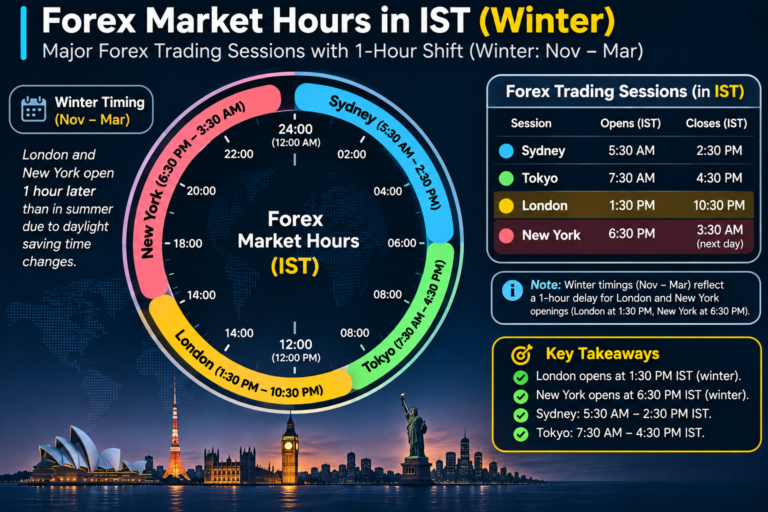
NSE trades them 9:00 am to 5:00 pm IST, Monday to Friday. If you are new to the pair, our guide on how to trade USD/INR on Indian exchanges covers the basics.
India worked example: how many lots is US$5 million?
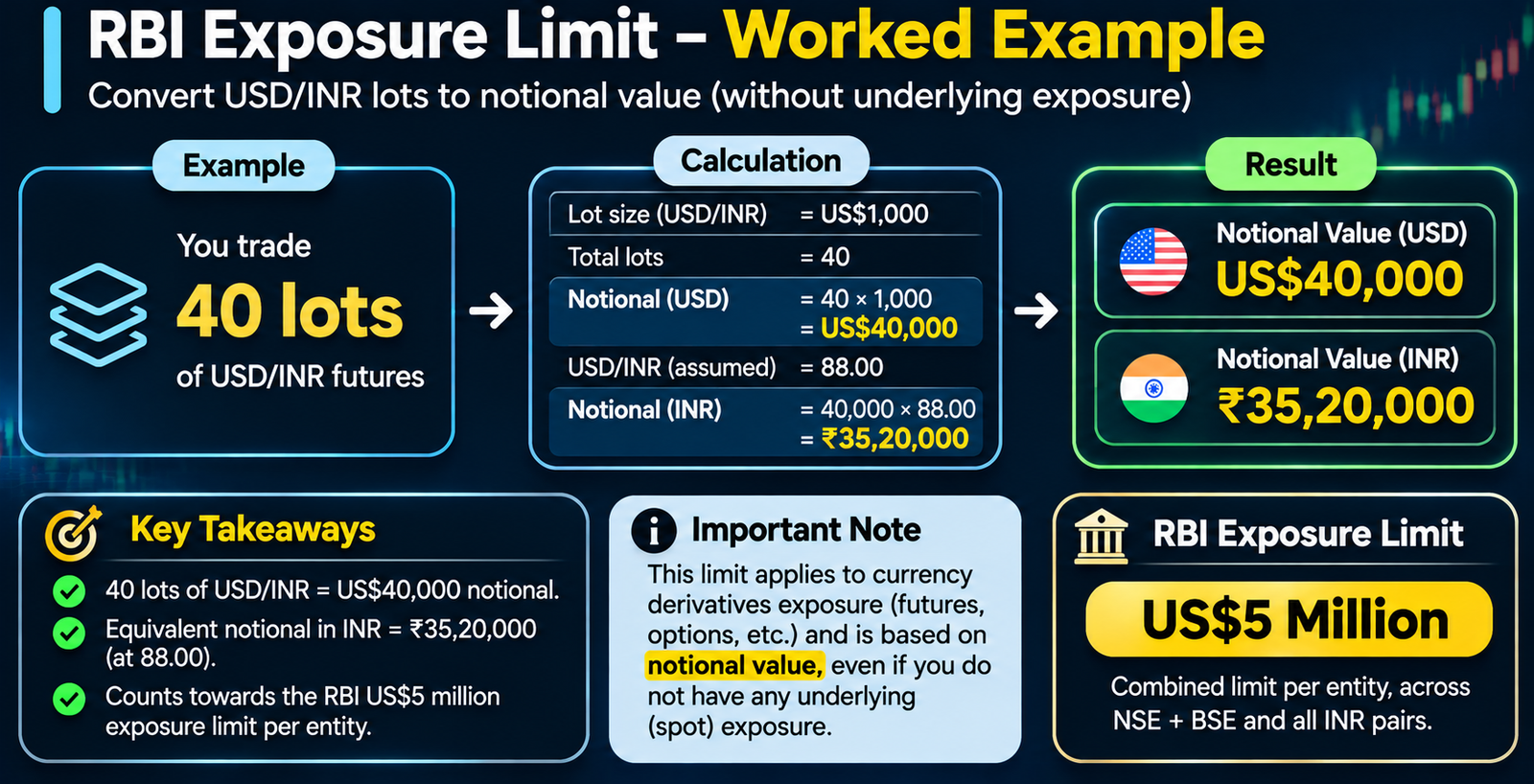
Example (hypothetical): Rohan, a Pune-based trader with ₹1,00,000 in capital, holds 40 lots of USD/INR futures on NSE. Assume a USD/INR rate of ₹88.00 purely for illustration.
- Notional in dollars: 40 lots × US$1,000 = US$40,000.
- Notional in rupees: US$40,000 × ₹88.00 = ₹35,20,000.
- Threshold in lots (USD/INR only): US$50,00,000 ÷ US$1,000 = 5,000 lots.
- Share of threshold used: 40 ÷ 5,000 = 0.8%.
Rohan is far below the threshold, yet ₹1,00,000 of capital controls ₹35,20,000 of notional, so a 1% move against him costs about ₹35,200.
Being below the threshold only means Rohan need not produce documents up front. If he has a confirmed dollar payment due, he has a basis to hedge. If he is only betting on direction, he has none. You can check the rupee margin on a position like this with our forex margin calculator.
How to check you are within the RBI exposure limit
Use these steps before you add to any INR-pair position.
- Identify your exposure. Write down the contracted transaction: amount, currency and due date.
- Confirm it is not hedged elsewhere, for example with a bank forward.
- Add up notional across INR pairs in US$ equivalent (USD/INR lots × US$1,000).
- Add up across brokers and exchanges. NSE and BSE positions count together.
- Match notional and tenor to the exposure.
- Keep invoices or contracts ready in case anyone asks.
- Adjust the hedge when the exposure changes.
Expect your broker to ask you to confirm a valid underlying exposure before fresh INR-pair positions. Read that declaration rather than clicking through it.
What happens if you exceed the US$5 million threshold?
Above the threshold, RBI’s 2024 directions require positions to be backed by contracted exposure and matched in notional and tenor, and exchanges must let users designate an Authorised Dealer bank or custodian to monitor them. In practice, you need a bank relationship and documents.
The October circular did not announce new margins or automatic square-offs. RBI did say that users who split transactions across Authorised Dealers to avoid a threshold are treated as violating the directions. The directions are issued under Sections 10(4) and 11(1) of FEMA, 1999, and RBI has warned that non-permitted forex transactions may attract penal action under FEMA.
What is the FERR reserve, and does it affect retail traders?
The Foreign Exchange Risk Reserve (FERR) was introduced by A.P. (DIR Series) Circular No. 26 on 10 October 2026. Authorised Dealer banks must keep a cash reserve with RBI equal to 20% of the INR notional of specified contracts. These are INR derivative contracts above US$2 million equivalent that hedge current account exposures where the user buys foreign currency against the rupee.
It is a bank-level requirement on OTC contracts, not a margin on your NSE USD/INR futures.
The legal framework: FEMA, RBI, SEBI and the exchanges
Four layers sit behind the threshold:
- FEMA, 1999 is the parent law.
- RBI writes the product rules: permitted pairs, hedging-only use and the US$5 million threshold. Our RBI forex rules guide explains the wider framework.
- SEBI regulates exchanges and brokers. See our explainer on SEBI forex trading rules in India.
- NSE, BSE and MSE list contracts and set margins.
Indian residents may trade currency derivatives only on these exchanges, in permitted pairs. Leveraged forex on overseas platforms is not permitted, and RBI has said margin remittances abroad are not allowed under the Liberalised Remittance Scheme (LRS). RBI also maintains an Alert List of unauthorised platforms. Check names against our RBI Alert List guide before you fund any account.
Common mistakes traders make with the exposure limit
- Treating the threshold as a speculation quota. Traders often assume anything under US$5 million needs no justification. Hedging-only applies from the first lot.
- Counting one exchange only. The limit is combined across exchanges and INR pairs.
- Confusing margin with notional. The threshold is measured on notional value.
- Mixing up the bank cap and the user threshold. The 2026 US$100 million bank cap is not your limit.
- Double hedging the same import bill with a bank forward and on the exchange.
- Moving to offshore apps. LRS cannot be used for margin trading abroad.
FAQs
What is the new RBI limit for currency derivatives without underlying exposure?
From 10 October 2026, users can hold exchange-traded INR currency derivative positions of up to US$5 million equivalent, combined across all INR pairs and recognised stock exchanges, without establishing the underlying exposure. The earlier threshold was US$100 million. Users must still have a genuine underlying contracted exposure, because these contracts are permitted only for hedging.
Can I trade USD/INR futures for speculation below US$5 million?
RBI has said exchange-traded currency derivatives involving the rupee are permitted only for hedging exposure to foreign exchange rate risk. The US$5 million threshold only means you need not produce documents up front. It does not remove the requirement to have a valid underlying exposure, so pure directional speculation does not fit the framework.
How many USD/INR lots equal US$5 million?
On NSE, one USD/INR futures or options lot is US$1,000. So US$5 million equals about 5,000 USD/INR lots. If you also hold EUR/INR, GBP/INR or JPY/INR positions, convert them to US$ equivalent and add them, because the threshold is combined across all INR pairs and all recognised stock exchanges.
What is FERR in RBI’s October 2026 rules?
FERR is the Foreign Exchange Risk Reserve. Authorised Dealer banks must keep 20% of the INR notional in cash with RBI on INR derivative contracts above US$2 million equivalent that hedge current account exposures where the user buys foreign currency against the rupee. It is a bank requirement, not an exchange margin for retail traders.
Is the US$5 million limit per exchange?
No. The threshold is combined across all recognised stock exchanges and all INR-involving currency pairs. A position on NSE and another on BSE count together. RBI’s October 2026 directions also say that users who split transactions across Authorised Dealers to avoid a threshold are treated as violating the directions.
Can I use LRS to trade forex on an overseas platform instead?
No. RBI has stated that remittances for margins to overseas exchanges or overseas counterparties are not permitted under the Liberalised Remittance Scheme. Indian residents should trade currency derivatives only through SEBI-registered brokers on NSE, BSE or MSE, and should check RBI’s Alert List of unauthorised forex trading platforms before trusting any app.
Conclusion
The October 2026 change is easy to misread. The RBI currency derivatives exposure limit for positions without establishing underlying exposure is now US$5 million, combined across INR pairs and exchanges. For most retail traders the size barely bites. The real message is the one RBI has repeated since 2024: these contracts are for hedging, and the exposure must be real.
Before your next trade, convert your lots to US$ notional, list the exposure you are hedging and check the rupee margin. Our forex margin calculator is a quick place to start.