
Introduction
When you sign up with a forex broker, one of the first choices you face is which account to open. Brokers usually offer several forex account types, often with names like Standard, ECN, Raw Spread, Pro, Zero or Cent. The names vary from broker to broker, but the differences come down to a few practical points: how you pay for trades, how your orders are executed, how much you need to deposit and how large your positions can be.
Choosing an account is not about finding the “best” account. It is about matching the cost structure and trade size to how you actually trade. A scalper placing dozens of trades a day has very different needs from a beginner placing a few small trades a week.
This guide explains the main forex account types, how their costs work, a side-by-side comparison, a worked cost example, how to choose and what Indian traders need to know about the legal route for currency trading.
Why Forex Account Types Matter
Every trade has a cost. That cost is paid either through the spread (the gap between the buy and sell price), through a commission, or through both. Different forex account types package these costs differently:
- Spread-only pricing: the broker’s fee is built into a wider spread, with no separate commission.
- Raw spread plus commission: you get spreads close to the interbank market and pay a fixed commission per lot.
Account choice also affects execution model, minimum lot size, available leverage and sometimes access to platforms or tools. Over hundreds of trades, small differences in cost per trade add up to a meaningful amount.

The Main Forex Account Types at a Glance
| Account type | Pricing | Typical EUR/USD spread* | Commission* | Best suited to |
|---|---|---|---|---|
| Standard | Spread only | About 1.0–1.5 pips | None | Beginners, swing traders |
| ECN | Raw spread + commission | About 0.0–0.3 pips | About $6–7 per lot round turn | Active traders, scalpers |
| Raw Spread | Raw spread + commission | About 0.0–0.3 pips | About $6–7 per lot round turn | Day traders, algorithmic traders |
| Cent | Usually spread only, in cents | Often similar to standard | Usually none | Small accounts, testing strategies |
*Typical ranges only. Actual spreads and commissions vary by broker, market conditions and time of day.
Standard Account
The standard account is the most common of all forex account types and is usually the default option.
How it works
- You pay no separate commission.
- The broker’s fee is built into the spread, which is wider than the raw market spread. On EUR/USD, a typical standard account spread might be around 1.0 to 1.5 pips.
- Many standard accounts use a market maker or STP (straight-through processing) model. A market maker may take the other side of your trade, while an STP broker passes orders to liquidity providers.
Pros
- Simple cost structure: the spread is the only trading cost apart from overnight swaps.
- Often lower minimum deposits.
- Easy to calculate costs.
Cons
- Higher total cost per trade for active traders.
- Spreads may widen during news or low-liquidity periods.
ECN Account
ECN stands for electronic communication network. Among forex account types, the ECN account is designed to give traders access to prices drawn from multiple liquidity providers, such as banks and other market makers.
How it works
- Your orders are matched with prices from a pool of liquidity providers.
- Spreads are “raw”, often close to zero on major pairs during liquid sessions.
- The broker charges a commission, commonly quoted per lot per side (for example, $3 to $3.50 per side, or $6 to $7 per round turn).
- Some ECN brokers show market depth, letting you see available volume at different prices.
Pros
- Lower total costs for frequent traders.
- Transparent pricing.
- Often faster execution, suitable for scalping and automated strategies.
Cons
- Commission must be included in your cost calculations.
- Spreads are variable and can widen sharply in thin markets.
- Minimum deposits may be higher.
Raw Spread Account
A raw spread account is very similar to an ECN account. Many brokers use “Raw”, “Zero”, “Razor” or “Pro” as marketing names for their low-spread accounts.
How it works
- You receive spreads close to the underlying market price, often from 0.0 pips on EUR/USD.
- You pay a fixed commission per lot traded.
- Execution may be ECN, STP or a hybrid model; the label does not always tell you which.
Raw spread vs ECN: the practical difference
For most retail traders, raw spread and ECN accounts work the same way: tight spread plus commission. The difference is usually in how the broker routes orders behind the scenes, which you can check in the broker’s order execution policy. When comparing accounts with similar names, focus on the total cost per trade, not the label.
Cent Account
A cent account shows your balance in cents rather than dollars. If you deposit $10, your account shows 1,000 cents. This makes the cent account one of the most beginner-friendly options.
How it works
- One “lot” in a cent account is usually 1,000 units of the base currency, equivalent to a micro lot (0.01 standard lot) in a regular account. Check your broker’s contract specifications, as definitions vary.
- On EUR/USD, a pip is worth about 10 cents per cent lot, or $0.10.
- Pricing is usually spread only, often similar to a standard account.
Pros
- Very small position sizes, so real-money risk is low.
- Useful for testing strategies or expert advisors with real execution.
- Helps beginners experience real-money psychology without large losses.
Cons
- Spreads are often wider than ECN or raw spread accounts.
- Not all brokers offer cent accounts, and those that do may be less heavily regulated.
- Small amounts can make it tempting to over-leverage.
Other Forex Account Types You May See
- Micro account: similar to a cent account, allowing micro lots (0.01) with small deposits.
- Swap-free (Islamic) account: no overnight swap charges or credits. Brokers may charge an administration fee instead.
- Demo account: uses virtual money and is useful for learning a platform, although fills may differ from live trading.
- Professional account: available to traders who meet certain experience and wealth criteria, sometimes with higher leverage but fewer regulatory protections.
- Managed or PAMM/MAM accounts: a money manager trades on behalf of investors.
Comparing Forex Account Types: Cost Example
This example is illustrative and uses hypothetical spreads and commissions.
Suppose you trade 1 standard lot (100,000 units) of EUR/USD, where 1 pip is worth $10.
| Account | Spread | Spread cost | Commission | Total cost per trade |
|---|---|---|---|---|
| Standard | 1.2 pips | $12 | $0 | $12 |
| ECN | 0.2 pips | $2 | $7 | $9 |
| Raw Spread | 0.1 pips | $1 | $7 | $8 |
| Cent (1 cent lot = 1,000 units) | 1.3 pips | $0.13 | $0 | $0.13 |
In this example, the raw spread account costs $4 less per lot than the standard account. For a trader placing 100 trades of 1 lot a month, that is a difference of about $400 a month. For a trader placing 5 trades a month, the difference is only about $20.
A useful shortcut is to convert commission into pips. A $7 round-turn commission on a $10-per-pip pair equals 0.7 pips. So an ECN account with a 0.2-pip spread has an “all-in” cost of about 0.9 pips, which you can compare directly with a standard account’s spread.
Execution Models Behind Forex Account Types
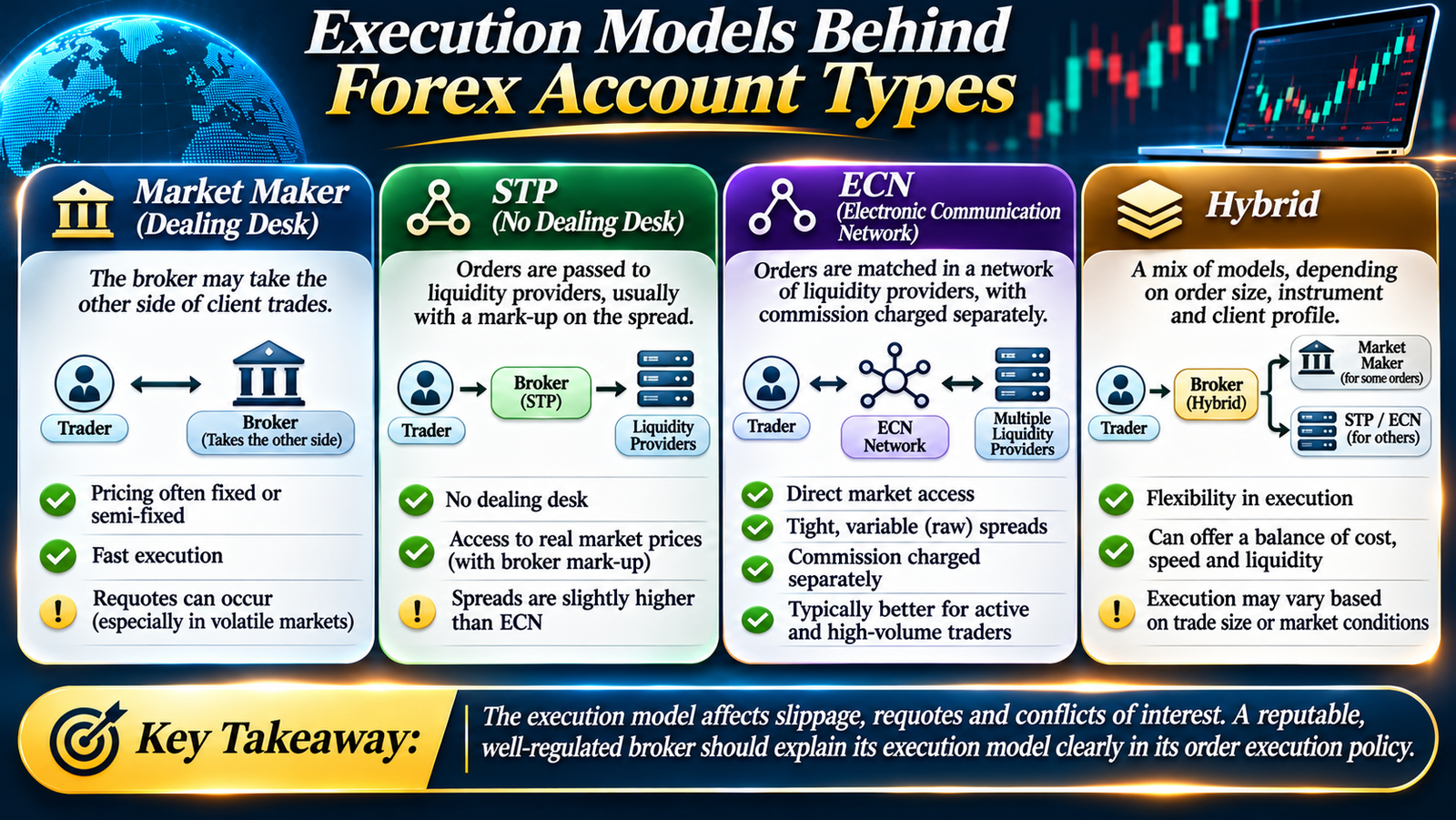
- Market maker (dealing desk): the broker may take the other side of client trades. Pricing is often fixed or semi-fixed, and requites can occur.
- STP (no dealing desk): orders are passed to liquidity providers, usually with a mark-up on the spread.
- ECN: orders are matched in a network of liquidity providers, with commission charged separately.
- Hybrid: many brokers use a mix, depending on order size and client profile.
The execution model affects slippage, requote and conflicts of interest. A reputable, well-regulated broker should explain its execution model clearly in its order execution policy.
How to Choose Between Forex Account Types
- Count your trades. If you trade frequently, ECN or raw spread accounts usually work out cheaper. If you trade rarely, a standard account may be simpler.
- Consider your strategy. Scalpers and algorithmic traders benefit from tight spreads and fast execution. Swing traders holding positions for days care more about swaps.
- Check the all-in cost. Add spread and commission together, in pips or money.
- Look at minimum deposits. Some ECN accounts require larger deposits.
- Check regulation. The regulator matters far more than the account label.
- Test first. Use a demo or cent account to check execution and platform features before committing larger funds.
Forex Account Types and Prop Firms
Proprietary trading firms do not usually let you choose between broker forex account types in the same way. Instead, they provide an evaluation account with set rules, trading costs and leverage. Many prop firms use raw spread pricing with commission, so understanding how these costs work helps you plan trades within the firm’s drawdown limits.
What Indian Traders Need to Know
For traders in India, the discussion of offshore forex account types comes with an important legal warning. Under the Foreign Exchange Management Act (FEMA), Indian residents are not permitted to trade leveraged forex or forex CFDs through offshore brokers, and remitting money abroad for margin trading is not permitted under the Liberalized Remittance Scheme. The Reserve Bank of India publishes an Alert List of entities not authorised to deal in forex.
The legal route is exchange-traded currency derivatives on NSE and BSE through SEBI-registered brokers. Here, there are no “standard” or “ECN” forex account types. Instead:
- You open a trading account with a SEBI-registered broker and activate the currency derivatives segment.
- You can trade futures and options on USD/INR, EUR/INR, GBP/INR and JPY/INR, plus crosses such as EUR/USD, GBP/USD and USD/JPY.
- One lot is $1,000 for USD/INR, so a one-paisa move is worth ₹10 per lot.
- Costs include brokerage, exchange transaction charges, GST, SEBI fees and stamp duty.
- Margin is set by the exchange’s risk management system rather than by broker leverage offers.
- Rupee pairs trade from 9am to 5pm IST on trading days.
Brokerage plans in India may differ, for example flat-fee per order or percentage-based, but these are pricing plans rather than the account structures offered by international brokers.

Common Mistakes When Choosing Forex Account Types
- Ignoring commission: a “zero spread” account is not free if it charges $7 per lot.
- Choosing by label: “ECN” or “Pro” names do not guarantee better execution.
- Overlooking swaps: overnight charges can matter more than spread for longer trades.
- Picking based on leverage: higher leverage increases risk, not opportunity.
- Ignoring regulation: no account type compensates for an unregulated broker.
- Not checking legality: Indian residents should avoid offshore leveraged forex entirely.
Quick Comparison Checklist
- What is the typical spread on the pairs I trade?
- Is there a commission, and how much per round turn?
- What is the all-in cost in pips?
- What is the minimum deposit and minimum lot size?
- What execution model does the broker use?
- Who regulates the broker?
- Is this route legal in my country?
FAQs
What are the main forex account types?
The most common are standard, ECN, raw spread and cent accounts. Brokers also offer micro, swap-free, demo, professional and managed accounts.
Which of the forex account types is best for beginners?
Many beginners start with a demo account, then a cent or small standard account, because position sizes and costs are simple to understand.
Is an ECN account cheaper than a standard account?
Often yes for active traders, once spread and commission are added together. But compare the all-in cost for the pairs you trade.
What is the difference between raw spread and ECN accounts?
In practice, both offer tight spreads plus commission. The difference is usually how the broker routes orders.
What is a cent account used for?
Trading very small positions with real money, testing strategies or expert advisors with live execution.
Can Indian residents open offshore forex account types?
Indian residents are not permitted under FEMA to trade leveraged forex through offshore brokers. The legal route is currency derivatives on NSE or BSE through SEBI-registered brokers.
Conclusion
The main forex account types differ in how you pay for trading and how your orders are executed. Standard accounts build costs into the spread, ECN and raw spread accounts offer tight spreads plus commission, and cent accounts let you trade very small positions. The right choice depends on how often you trade, your strategy and the all-in cost on the pairs you use.
Whatever you choose, prioritize regulation and legality over account labels. For Indian residents, that means using exchange-traded currency derivatives through SEBI-registered brokers rather than offshore forex account types.