Introduction
Forex trading is often marketed in India as an easy way to earn extra income: trade from your phone, use high leverage and make money from currency moves around the clock. The reality is more complicated. The global currency market is the largest financial market in the world, but it is also fast-moving, highly leveraged and, for Indian residents, tightly regulated.
Before you open an account, it helps to weigh the advantages and disadvantages of forex trading honestly. Some benefits are real, such as deep liquidity and low trading costs. Some risks are serious, such as leverage losses and the legal problems that come with trading on offshore platforms.
This guide explains the advantages and disadvantages of forex trading from an Indian perspective, the legal route through Indian exchanges, how tax works in broad terms, and a checklist to help you decide whether currency trading suits you.
First, What Does Forex Trading Mean in India?
For Indian residents, “forex trading” can mean two very different things:
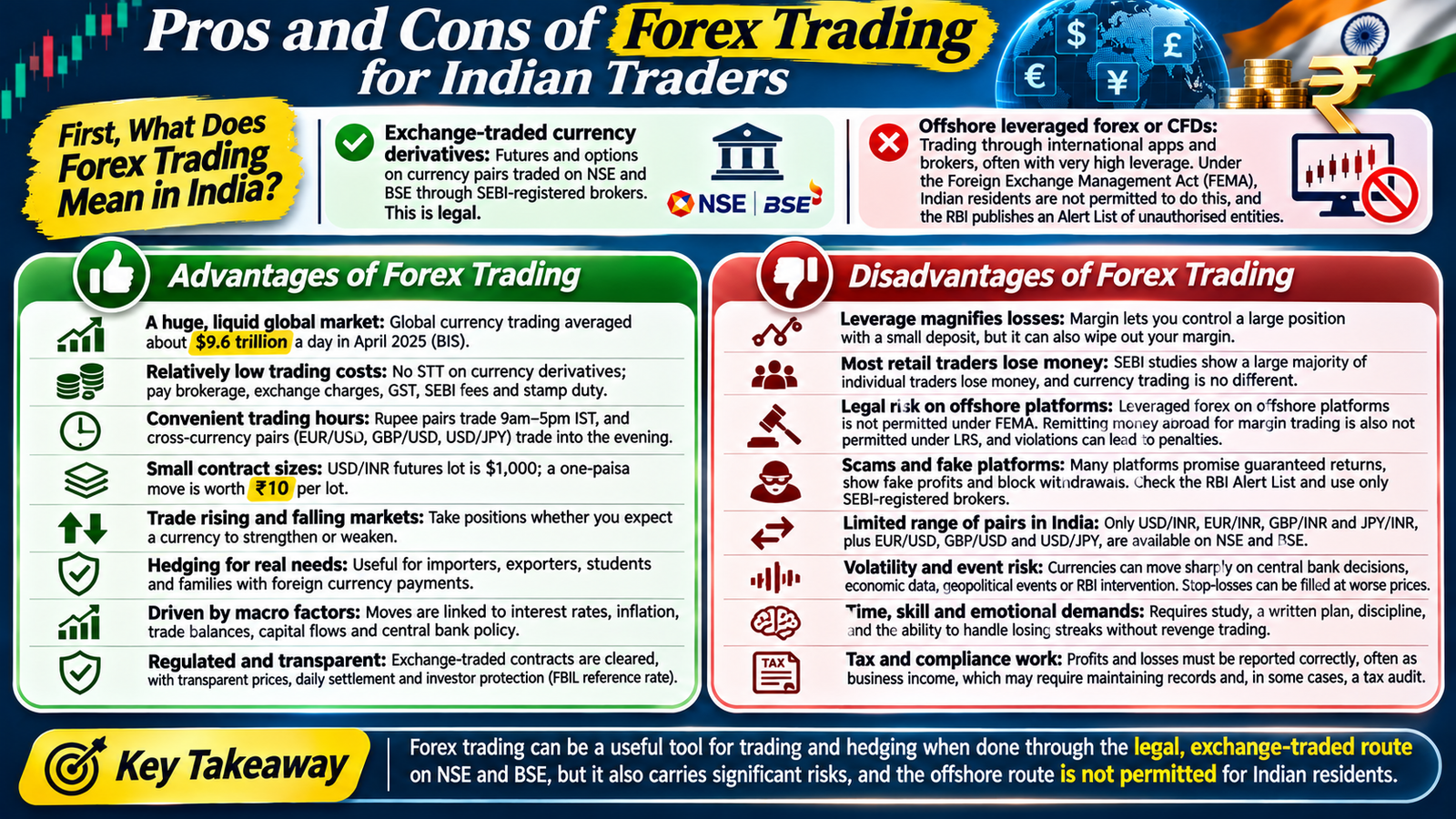
- Exchange-traded currency derivatives: futures and options on currency pairs traded on NSE and BSE through SEBI-registered brokers. This is legal.
- Offshore leveraged forex or CFDs: trading through international apps and brokers, often with very high leverage. Under the Foreign Exchange Management Act (FEMA), Indian residents are not permitted to do this, and the RBI publishes an Alert List of unauthorized entities.
Any honest discussion of the advantages and disadvantages of forex trading for Indian traders has to start with this distinction, because many of the risks come from the illegal route.
Advantages of Forex Trading
1. A huge, liquid global market
According to the Bank for International Settlements’ 2025 survey, global currency trading averaged about $9.6 trillion a day in April 2025. Major pairs such as EUR/USD trade in enormous volumes, which usually means tight prices and the ability to enter and exit easily. On Indian exchanges, USD/INR is the most actively traded currency contract.
2. Relatively low trading costs
Currency derivatives on Indian exchanges have relatively low costs. Brokerage is often a flat fee per order, and currency derivatives do not attract securities transaction tax (STT), unlike equity derivatives. You still pay exchange charges, GST, SEBI fees and stamp duty.
3. Convenient trading hours
Rupee pairs trade on NSE and BSE from 9am to 5pm IST, and cross-currency pairs such as EUR/USD, GBP/USD and USD/JPY trade for longer, into the evening. This overlaps with the London session, one of the most active periods in the global market.
4. Small contract sizes
One USD/INR futures lot is $1,000, so a one-paisa move is worth ₹10 per lot. This makes position sizes manageable compared with many other derivatives.
5. You can trade rising and falling markets
With futures and options, you can take positions whether you expect a currency to strengthen or weaken.
6. Hedging for businesses and individuals
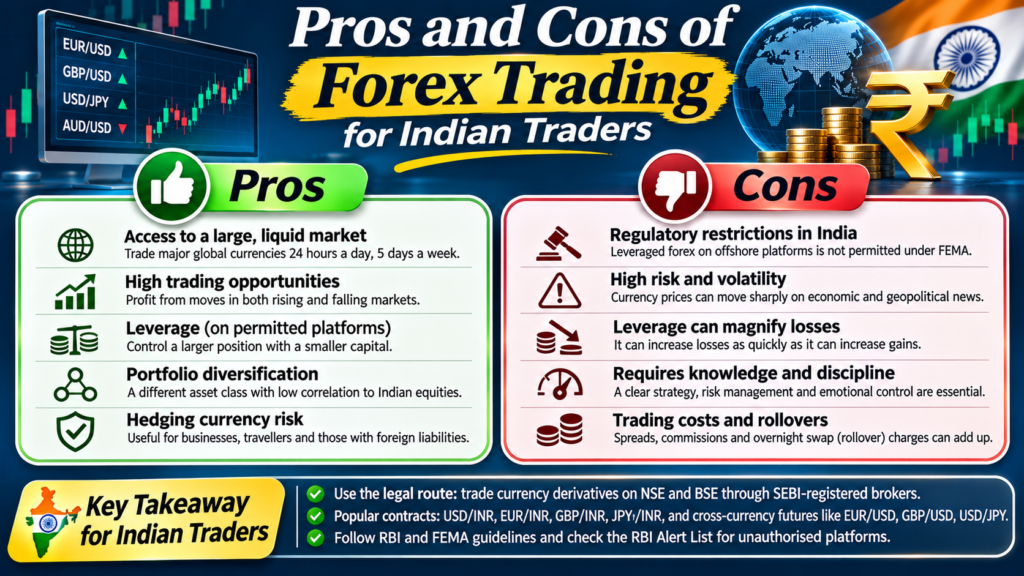
Importers, exporters, students paying overseas fees and families with foreign currency needs can use currency futures and options to hedge against exchange rate moves. Among the advantages and disadvantages of forex trading, hedging is one of the clearest real-world benefits.
7. Driven by understandable macro factors
Currency moves are linked to interest rates, inflation, trade balances, capital flows and central bank policy. Traders who follow economic news can build a structured view of the market.
8. Regulated and transparent on exchanges
Exchange-traded contracts are cleared through a clearing corporation, with transparent prices, daily settlement and investor protection mechanisms. Contracts are settled using the FBIL reference rate.
Disadvantages of Forex Trading
The other side of the advantages and disadvantages of forex trading is just as important. These are the risks that cause most problems for Indian traders.
1. Leverage magnifies losses
Margin lets you control a large position with a small deposit. This magnifies gains, but it also magnifies losses. A move of just a few percent against a leveraged position can wipe out your margin. Offshore platforms offering leverage of 1:500 or more make this risk extreme.
2. Most retail traders lose money
SEBI studies of individual traders in equity derivatives have found that the large majority lose money. Currency trading is not immune to the same patterns: overtrading, poor risk management and emotional decisions. Weighing the advantages and disadvantages of forex trading means accepting that losses are common.
3. Legal risk on offshore platforms
Trading leveraged forex through offshore brokers or apps is not permitted for Indian residents under FEMA. Remitting money abroad for margin trading is not permitted under the Liberalized Remittance Scheme. Violations can lead to penalties, and funds sent to unregulated platforms may be difficult or impossible to recover.
4. Scams and fake platforms
Many forex scams target Indian investors through social media, messaging groups and “signal” services, promising guaranteed returns. Some platforms show fake profits and block withdrawals. Checking the RBI Alert List and using only SEBI-registered brokers helps avoid these traps.
5. Limited range of pairs on Indian exchanges
Indian residents can trade only the currency pairs listed on NSE and BSE: USD/INR, EUR/INR, GBP/INR and JPY/INR, plus EUR/USD, GBP/USD and USD/JPY. Exotic pairs and commodities CFDs offered by offshore platforms are not part of the legal route.
6. Volatility and event risk
Currencies can move sharply on central bank decisions, economic data, geopolitical events or RBI intervention. Stop-losses can be filled at worse prices during fast moves.
7. Time, skill and emotional demands
Consistent trading requires study, practice, a written plan and discipline. Watching screens, handling losing streaks and avoiding revenge trades can be mentally demanding.
8. Tax and compliance work
Profits and losses from currency derivatives must be reported correctly, often as business income, which may require maintaining records and, in some cases, a tax audit.
Advantages and Disadvantages of Forex Trading: Summary Table
| Advantages | Disadvantages |
|---|---|
| Deep, liquid global market | Leverage magnifies losses |
| Low trading costs, no STT on currency derivatives | Most retail traders lose money |
| Convenient hours for Indian traders | Offshore leveraged forex not permitted under FEMA |
| Small lot sizes ($1,000 per USD/INR lot) | Scams and fake platforms |
| Profit from rising or falling prices | Limited range of pairs on Indian exchanges |
| Useful for hedging currency exposure | Volatility and event risk |
| Driven by understandable macro factors | Time, skill and emotional demands |
| Regulated, transparent exchange route | Tax reporting and compliance work |
Legal Route vs Offshore Route
The advantages and disadvantages of forex trading look very different depending on which route you take. This comparison shows why the exchange route is the only sensible choice for Indian residents.
| Feature | NSE/BSE currency derivatives | Offshore forex apps |
|---|---|---|
| Legal status for Indian residents | Permitted | Not permitted under FEMA |
| Regulator | SEBI and RBI | Foreign or none |
| Pairs | INR pairs and three crosses | Dozens of pairs and CFDs |
| Leverage | Exchange-set margins | Often very high |
| Fund safety | Clearing corporation, segregated funds | Depends on platform; often uncertain |
| Dispute resolution | SEBI, exchange grievance systems | Limited or none for Indian residents |
Tax on Currency Trading in India: The Basics
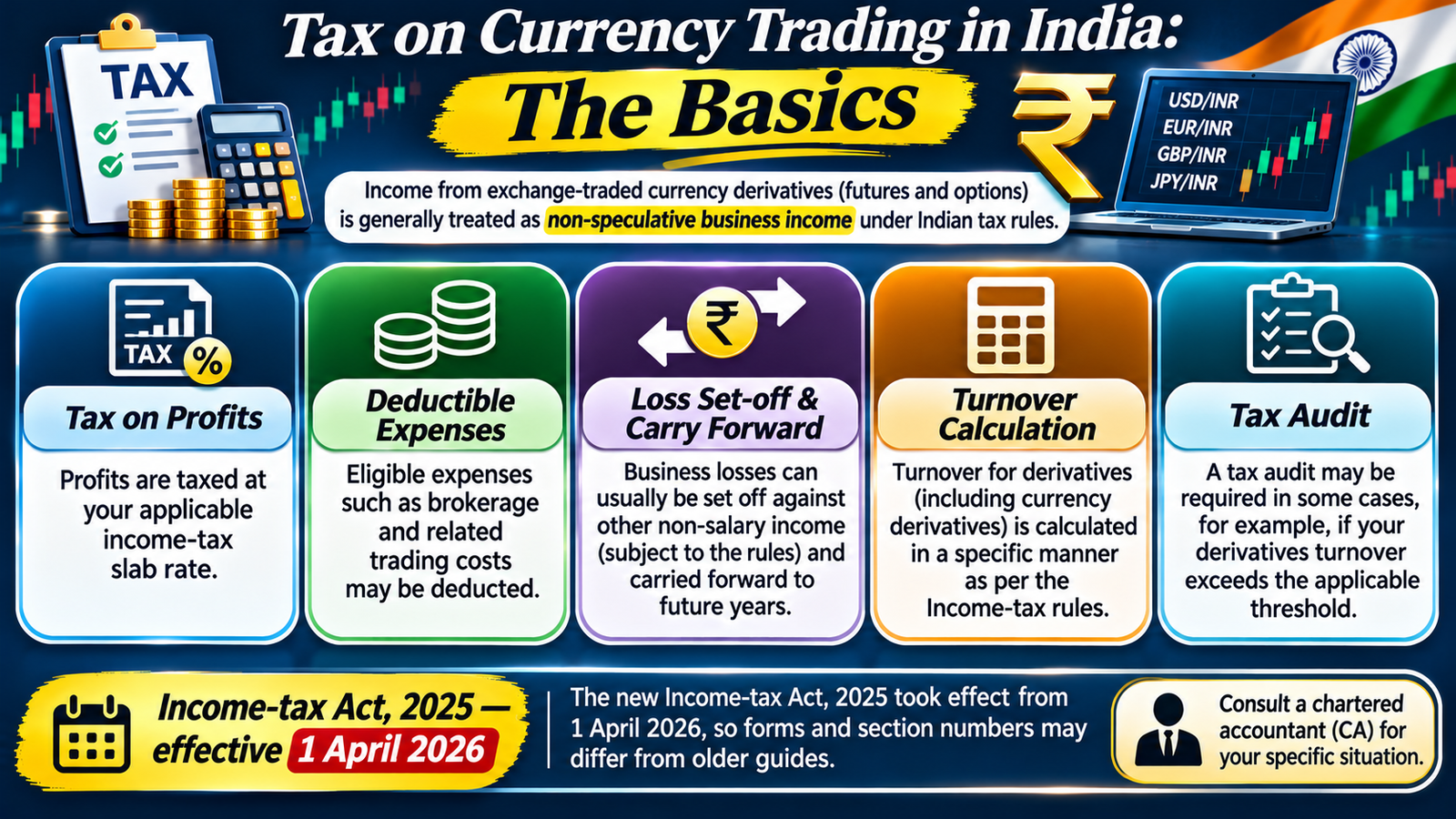
Income from exchange-traded currency derivatives is generally treated as non-speculative business income under Indian tax rules. In broad terms:
- Profits are taxed at your applicable slab rate.
- Expenses such as brokerage and related costs may be deductible.
- Losses can usually be set off against other non-salary income and carried forward, subject to the rules.
- Turnover is calculated in a specific way for derivatives, and a tax audit may be required in some cases.
The new Income-tax Act, 2025 took effect from 1 April 2026, so forms and section numbers may differ from older guides. Tax is one of the less discussed advantages and disadvantages of forex trading, so speak to a chartered accountant about your situation.
Worked Example: How Leverage Cuts Both Ways
This example is illustrative and uses hypothetical prices and margins.
Suppose you buy 10 lots of USD/INR futures at 88.50. Each lot is $1,000, so your position is $10,000, worth about ₹8,85,000. Assume the margin required is around ₹25,000.
- If USD/INR rises 50 paise to 89.00, your profit is 50 × ₹10 × 10 = ₹5,000, a 20% return on margin.
- If USD/INR falls 50 paise to 88.00, your loss is ₹5,000, a 20% loss on margin.
- If it falls ₹2.50, your loss is ₹25,000, roughly your entire margin.
A 0.6% move in the currency created a 20% swing in your capital. This simple calculation captures the core of the advantages and disadvantages of forex trading: leverage creates opportunity and danger at the same time.
Advantages and Disadvantages of Forex Trading vs Other Markets
It also helps to compare currency trading with other options Indian investors commonly use.
| Feature | Currency derivatives | Equity shares (delivery) | Equity F&O |
|---|---|---|---|
| Leverage | Yes, through margin | No | Yes, through margin |
| STT | Not applicable | Applicable | Applicable |
| Typical volatility | Lower for INR pairs | Moderate to high | High |
| Long-term wealth building | Not designed for it | Yes | Not designed for it |
| Hedging use | Strong for currency exposure | Limited | Strong for equity exposure |
Looked at this way, the advantages and disadvantages of forex trading are clearer. Rupee pairs usually move less than individual stocks, so traders use margin to make moves meaningful, which brings back the leverage risk. Currency trading also produces no dividends or company growth, so it is a trading or hedging activity rather than a long-term investment. For most people building wealth, it should sit beside a core portfolio, not replace it.
Who Might Find Forex Trading Suitable?
Your personal situation shapes the advantages and disadvantages of forex trading more than any market feature.
- People with real currency exposure who want to hedge, such as importers, exporters or families paying overseas fees.
- Traders willing to study, practise and follow strict risk management.
- People with risk capital they can afford to lose.
Who should avoid it?
- Anyone looking for guaranteed or quick income.
- People trading with borrowed money or essential savings.
- Anyone tempted by offshore apps promising high leverage or bonuses.
 How to Manage the Disadvantages
You cannot remove risk, but you can tilt the advantages and disadvantages of forex trading in your favor with good habits.
- Use only the legal route: NSE and BSE through SEBI-registered brokers.
- Check the RBI Alert List before trusting any platform.
- Risk a small percentage per trade, often 1% or less of your capital.
- Use stop-losses and plan exits before entering.
- Start small with one or two lots.
- Keep a trading journal to learn from mistakes.
- Track economic events such as RBI policy and US data releases.
- Keep tax records from the start.
Checklist Before You Start
- Do I understand the advantages and disadvantages of forex trading for my situation?
- Am I using a SEBI-registered broker and an Indian exchange?
- Can I afford to lose the money I plan to trade?
- Do I have a written trading plan with risk limits?
- Do I understand margin, lot size and the value of a paisa move?
- Do I know how my profits and losses will be taxed?
FAQs
What are the main advantages and disadvantages of forex trading?
Advantages include a liquid market, low costs, convenient hours, small lot sizes and hedging. Disadvantages include leverage risk, frequent losses, scams, legal limits on offshore trading and tax complexity.
Is forex trading legal in India?
Trading exchange-traded currency derivatives on NSE and BSE through SEBI-registered brokers is legal. Leveraged forex through offshore brokers is not permitted for residents under FEMA.
Can I trade EUR/USD from India?
Yes, through EUR/USD futures and options on Indian exchanges, along with GBP/USD and USD/JPY.
Is forex trading good for beginners?
It can be learned, but beginners face high risk. Start with education, small positions and the legal route.
How is forex trading taxed in India?
Income from exchange-traded currency derivatives is generally treated as non-speculative business income. Consult a chartered accountant.
Do currency derivatives attract STT?
No, currency derivatives do not attract securities transaction tax, though other charges such as stamp duty and GST apply.
Conclusion
The advantages and disadvantages of forex trading are both real. The market offers liquidity, low costs, convenient hours and useful hedging tools. But leverage, frequent losses, scams and strict legal limits make it risky, especially for beginners chasing quick returns.
Weighing the advantages and disadvantages of forex trading carefully is the first step. For Indian traders, the key decision is simple: stick to the legal route on NSE and BSE, trade small, manage risk carefully and understand your tax obligations before you begin.