Introduction
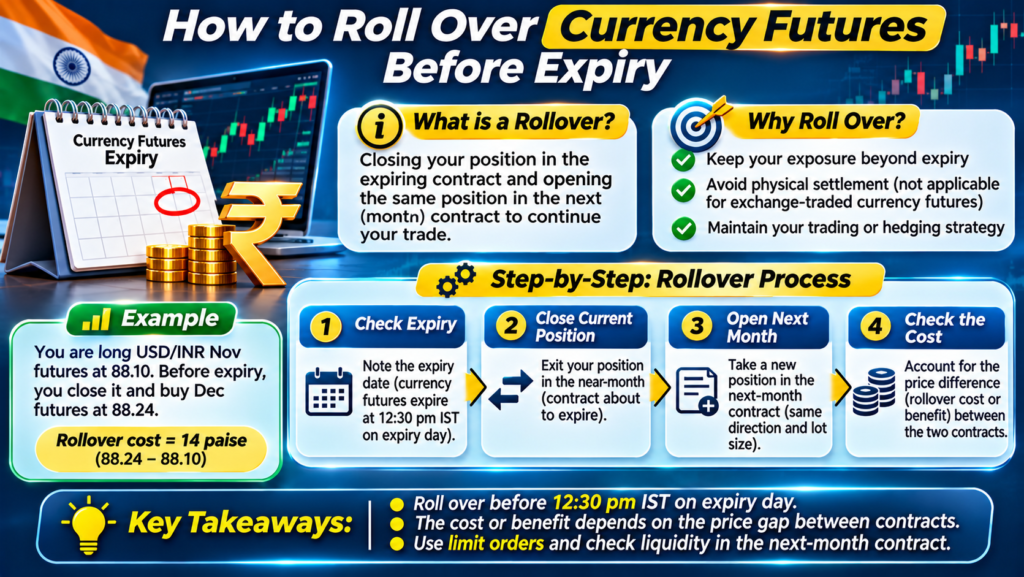
Currency futures do not last forever. Every USD/INR, EUR/INR, GBP/INR or JPY/INR futures contract on NSE and BSE has a fixed expiry date. If your hedge or trading view extends beyond that date, you need to move your position from the expiring contract to a later one. This process is called a rollover.
A well-planned currency futures rollover keeps your hedge in place, avoids automatic settlement at the reference rate and lets you control the cost of moving forward. A poorly timed one can mean unnecessary slippage, thin liquidity or an unwanted final settlement.
This guide explains why traders roll, when to do it, how to calculate the cost, how to place the orders, how margins are affected, worked examples and the mistakes to avoid.
Why Roll Over Currency Futures?
There are several common reasons for a currency futures rollover:
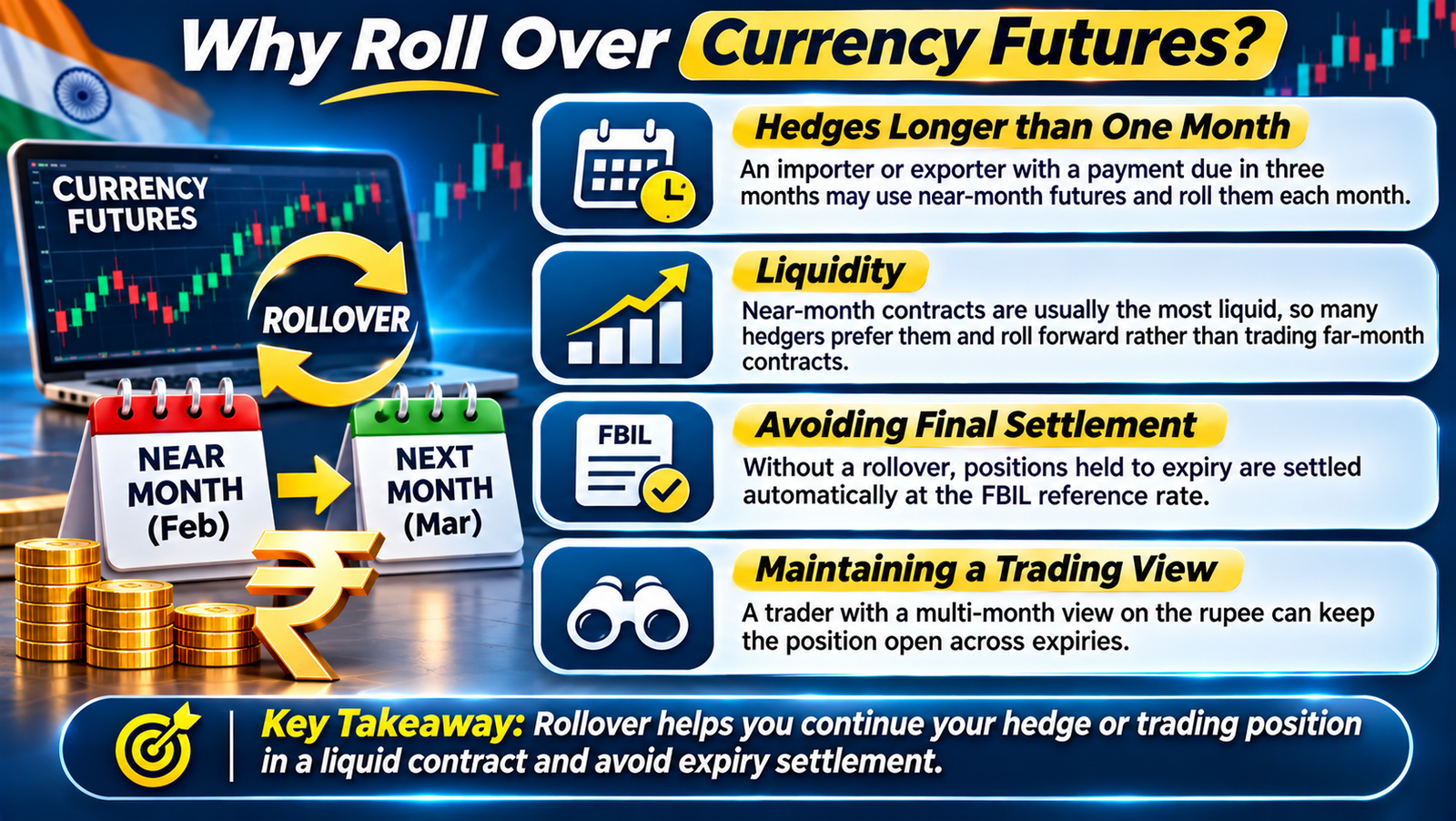
- Hedges longer than one month: an importer or exporter with a payment due in three months may use near-month futures and roll them each month.
- Liquidity: near-month contracts are usually the most liquid, so many hedgers prefer them and roll forward rather than trading far-month contracts.
- Avoiding final settlement: without a rollover, positions held to expiry are settled automatically at the FBIL reference rate.
- Maintaining a trading view: a trader with a multi-month view on the rupee can keep the position open across expiries.
Key Expiry Facts for Currency Futures
| Item | Detail |
|---|---|
| Expiry day | Two working days before the last working day of the month |
| Last trading time on expiry day | 12:30pm IST for the expiring contract |
| Final settlement | Cash-settled at the FBIL reference rate, published around 1:00pm IST |
| Lot size (USD/INR) | $1,000; one paisa = ₹10 per lot |
| Trading hours for rupee pairs | 9am to 5pm IST on normal days |
Because trading in the expiring contract stops at 12:30pm on expiry day, any currency futures rollover must be completed before then.
What Is a Currency Futures Rollover?
A rollover has two legs:
- Close the position in the expiring (near-month) contract.
- Open the same position in a later (usually next-month) contract.
If you are long 10 lots of November USD/INR futures, you sell 10 lots of November and buy 10 lots of December. If you are short, you do the opposite.
Understanding Roll Cost: The Forward Premium
Later-month USD/INR futures usually trade above near-month futures. This difference reflects the interest rate gap between the rupee and the dollar, known as the forward premium.
- Long positions: rolling forward usually costs money, because you sell the cheaper near-month contract and buy the more expensive next-month contract.
- Short positions: rolling forward usually benefits you, because you buy back the cheaper contract and sell the more expensive one.
The roll cost or benefit is simply the spread between the two contracts at the time you roll:
Roll cost (₹) = (next-month price − near-month price) × ₹1,000 × number of lots
This is a normal part of every currency futures rollover and reflects interest rate parity, not a fee charged by the exchange.
Worked Example 1: Rolling a Long Hedge
This example is illustrative and uses hypothetical prices.
An importer is long 5 lots of November USD/INR futures to hedge a December payment. Three days before expiry:
- November futures: 88.55
- December futures: 88.75
- Spread: 20 paise
The importer sells 5 lots of November at 88.55 and buys 5 lots of December at 88.75.
- Roll cost: 20 paise × ₹10 × 5 lots = ₹1,000.
- This cost reflects the forward premium and is part of the price of hedging over a longer period.
Worked Example 2: Rolling a Short Hedge
This example is illustrative and uses hypothetical prices.
An exporter is short 8 lots of November USD/INR futures. At the same prices:
- The exporter buys back 8 lots of November at 88.55 and sells 8 lots of December at 88.75.
- Roll benefit: 20 paise × ₹10 × 8 lots = ₹1,600.
For exporters selling dollars forward, the forward premium works in their favour with each roll.
When Should You Roll?
Timing a currency futures rollover is about balancing liquidity, spreads and convenience.
- A few days before expiry: many traders roll in the last three to five trading days, when liquidity starts shifting from the near-month to the next-month contract.
- Watch open interest: when open interest in the next-month contract begins rising and the near-month contract’s falls, liquidity is moving.
- Avoid the final minutes: rolling just before 12:30pm on expiry day can mean wider spreads and rushed execution.
- Avoid major events: rolling during an RBI announcement or a major US data release can increase slippage.
- Consider the spread: if the spread between months is unusually wide or narrow compared with recent days, you might adjust timing slightly.
How to Place a Currency Futures Rollover
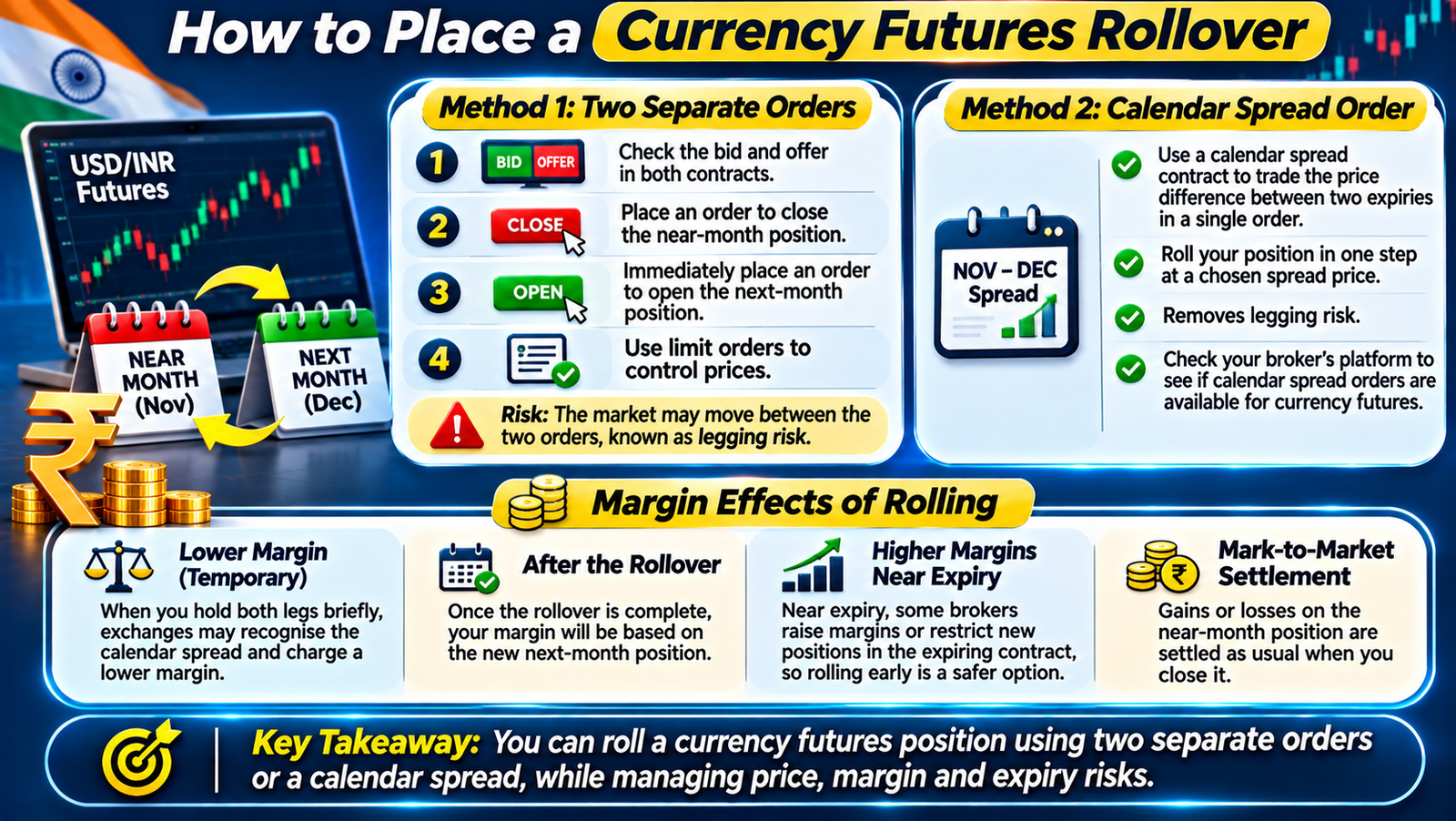
Method 1: Two separate orders
- Check the bid and offer in both contracts.
- Place an order to close the near-month position.
- Immediately place an order to open the next-month position.
- Use limit orders to control prices.
The risk is that the market moves between the two orders, a problem known as legging risk.
Method 2: Calendar spread order
Exchanges offer calendar spread contracts that let you trade the difference between two expiries as a single order. If your broker supports spread orders, you can roll in one step at a chosen spread price, removing legging risk. Check your broker’s platform to see whether calendar spread orders are available for currency futures.
Margin Effects of Rolling
- When you hold both legs briefly, exchanges may recognize the calendar spread and charge a lower margin than for two separate positions.
- After the rollover is complete, your margin will be based on the new next-month position.
- Near expiry, some brokers raise margins or restrict new positions in the expiring contract, which is another reason to roll early.
- Mark-to-market gains or losses on the near-month position are settled as usual when you close it.
 Currency Futures Rollover vs Holding to Expiry
| Choice | What happens | Best when |
|---|---|---|
| Roll over | Close near month, open next month | Your hedge or view continues beyond expiry |
| Hold to expiry | Position is settled at the FBIL reference rate | Your exposure ends around the expiry date |
| Close without rolling | Position is exited before expiry | Your hedge or view is no longer needed |
Rolling Longer-Term Hedges
For a hedge lasting several months, you have two choices:
- Use a far-month contract directly: no need to roll, but liquidity may be lower and spreads wider.
- Use near-month contracts and roll monthly: better liquidity, but you repeat the currency futures rollover process each month and pay brokerage each time.
Over a three-month hedge, the total forward premium paid or received is broadly similar either way, because each monthly roll reflects the interest rate gap. The main differences are liquidity, transaction costs and the effort of managing rolls.
Costs of Rolling
Every currency futures rollover carries a few distinct costs:
- Forward premium: the spread between months, as explained above.
- Brokerage: each roll involves two orders, so brokerage applies twice.
- Exchange charges, SEBI fees, stamp duty and GST: apply to both legs.
- Bid-ask spread and slippage: wider spreads in less liquid contracts add to costs.
Currency Futures Rollover for Exporters and Importers
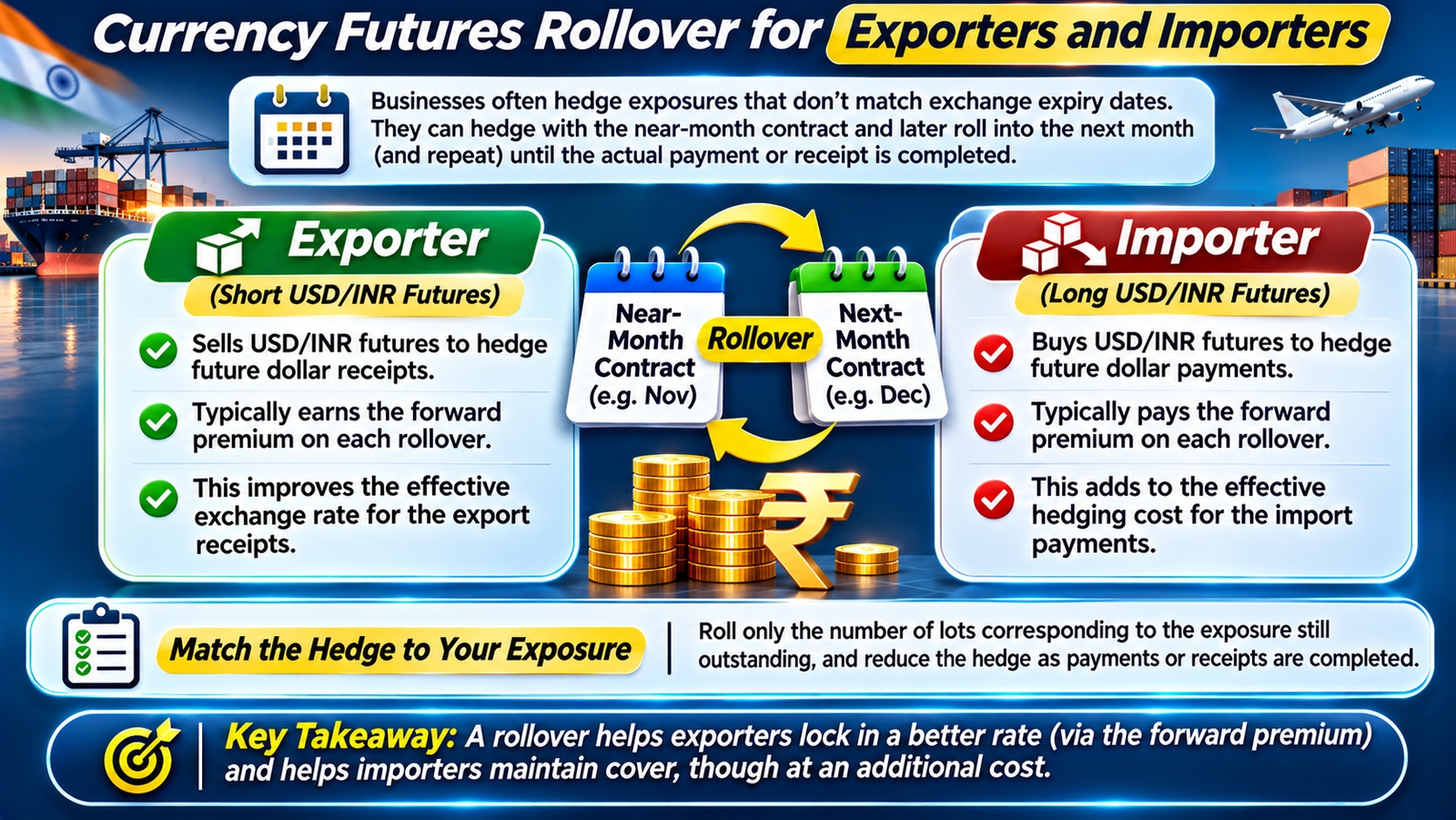
Businesses often hedge exposures that do not line up neatly with exchange expiry dates. An exporter expecting dollar receipts on the 10th of the month, for example, may hedge with the contract expiring before that date and then hold a small unhedged gap, or roll into the next month and close the position when the money arrives.
- Exporters (short USD/INR futures) usually earn the forward premium on each currency futures rollover, which improves their effective rate.
- Importers (long USD/INR futures) usually pay the forward premium, which adds to their effective hedging cost.
- Both should match the number of lots rolled to the exposure still outstanding, reducing the hedge as payments or receipts are completed.
Tracking Roll Costs Over Time
Keeping a simple record of each roll helps you understand the true cost of a hedge. Note the date, the near-month and next-month prices, the spread, the number of lots and the charges paid. Over several months, you can compare the total cost of rolling with the cost of using a far-month contract directly. Tracking the spread also shows how the forward premium changes as interest rate expectations in India and the US shift, which is useful context for every future currency futures rollover.
Currency Futures Rollover Checklist
- Do I know the exact expiry date and the 12:30pm cut-off?
- Has liquidity started shifting to the next-month contract?
- What is the current spread, and how does it compare with recent days?
- Will I use a calendar spread order or two separate limit orders?
- Do I have enough margin for the new position?
- Are any major events scheduled during my planned roll window?
- Have I confirmed the trades on my contract note?
Common Mistakes
- Forgetting the expiry date: positions are settled automatically if not rolled or closed.
- Rolling at the last minute: spreads can widen and liquidity can thin just before 12:30pm.
- Ignoring legging risk: placing two market orders in a fast market can result in poor prices.
- Misjudging roll cost: long hedgers pay the forward premium; short hedgers receive it.
- Over-rolling: roll only the amount of exposure you still need to hedge.
- Forgetting other pairs: EUR/INR, GBP/INR and JPY/INR follow the same expiry rules but may be less liquid.
Regulatory Reminder
Exchange-traded rupee currency derivatives on NSE and BSE are meant mainly for hedging genuine foreign currency exposures under RBI rules, and brokers ask clients to sign a declaration. In October 2026, the RBI announced a cut in the limit for positions without documented underlying exposure from US100milliontoUS5 million equivalent. Indian residents should trade only through SEBI-registered brokers; leveraged forex through offshore brokers is not permitted under FEMA.
FAQs
What is a currency futures rollover?
Closing a position in the expiring contract and opening the same position in a later contract, so the hedge or trade continues.
Can I do a currency futures rollover on BSE as well as NSE?
Yes. Both exchanges offer currency futures with similar expiry rules, but liquidity may differ, so check volumes and spreads before rolling.
When should I roll USD/INR futures?
Usually in the last few trading days before expiry, and always before 12:30pm IST on expiry day.
Why does rolling a long position cost money?
Because later-month USD/INR futures usually trade at a premium, reflecting the interest rate gap between the rupee and the dollar.
What happens if I don’t roll?
Your position is settled at the FBIL reference rate on expiry day.
What is a calendar spread order?
A single order to trade the price difference between two expiries, which lets you roll without legging risk if your broker supports it.
Is the roll cost an exchange fee?
No. It is the market spread between contracts. Brokerage and other charges are separate.
Conclusion
A currency futures rollover lets hedgers and traders keep positions open beyond a contract’s expiry. Plan ahead, roll in the last few days when liquidity shifts, use limit or calendar spread orders, and always finish before the 12:30pm cut-off on expiry day.
Understand that long positions usually pay the forward premium and short positions usually earn it, factor in brokerage and charges, and keep your hedge sized to your real exposure. With a simple routine, rolling becomes a smooth, predictable part of managing currency risk.