
Introduction
Indian residents who want to hedge or trade currency movements on NSE and BSE have two main tools: currency futures and currency options. Both are based on pairs such as USD/INR, both are cash-settled in rupees, and both use the same lot size. Yet they behave very differently.
The currency futures vs options choice affects how much money you need upfront, how much you can lose, how you pay for protection and how your position behaves when the market moves sharply. Picking the wrong instrument can turn a sensible hedge into an expensive mistake.
This guide compares the two side by side: how they work, margins and premiums, risk and payoff, costs, liquidity, worked hedging examples for importers and exporters, and a simple framework for choosing between them.
What Are Currency Futures?
A currency futures contract is an agreement to buy or sell a currency at a fixed price on a future date.
- Obligation: both buyer and seller are obliged to settle at expiry.
- Payoff: linear; every paisa move produces the same gain or loss.
- Margin: both sides deposit initial margin and settle gains and losses daily (mark-to-market).
- Lot size: USD/INR is $1,000, so a one-paisa move is worth ₹10 per lot.
- Settlement: cash-settled against the FBIL reference rate on expiry.
What Are Currency Options?
A currency option gives the buyer the right, but not the obligation, to buy (call) or sell (put) a currency at a fixed strike price.
- Buyer: pays a premium upfront; maximum loss is limited to that premium.
- Seller: receives the premium but takes on potentially large losses and must post margin.
- Payoff: non-linear; the buyer benefits from favorable moves but is protected from unfavorable ones.
- Style: European, exercisable only at expiry.
- Settlement: cash-settled in rupees against the FBIL reference rate.

Currency Futures vs Options: Side-by-Side Comparison
| Feature | Currency futures | Currency options (buyer) |
|---|---|---|
| Right or obligation | Obligation | Right, not obligation |
| Upfront cost | Margin (refundable, plus or minus daily gains and losses) | Premium (paid and not refunded) |
| Maximum loss | Potentially large | Limited to premium paid |
| Maximum gain | Potentially large | Potentially large (calls), large but capped at strike minus premium (puts) |
| Payoff shape | Linear | Non-linear |
| Time decay | None | Works against the buyer |
| Volatility sensitivity | Little direct effect | Premium rises with volatility |
| Daily mark-to-market | Yes | No for buyers (premium paid upfront) |
| Best for | Locking in a rate | Protection with upside participation |
Margins vs Premiums
A key part of the currency futures vs options decision is how much money you need and how it behaves.
Futures margin
- Exchanges set initial margin using risk models, typically a small percentage of the contract value.
- Gains are credited and losses debited daily. If losses reduce your margin, you may need to add funds quickly.
- Margin is returned when the position is closed, adjusted for profits and losses.
Option premium
- The buyer pays the premium once. There are no margin calls for option buyers.
- If the option expires out of the money, the premium is lost.
- Option sellers must post margin, similar to futures, because their risk is large.
Risk and Payoff Profiles
Futures
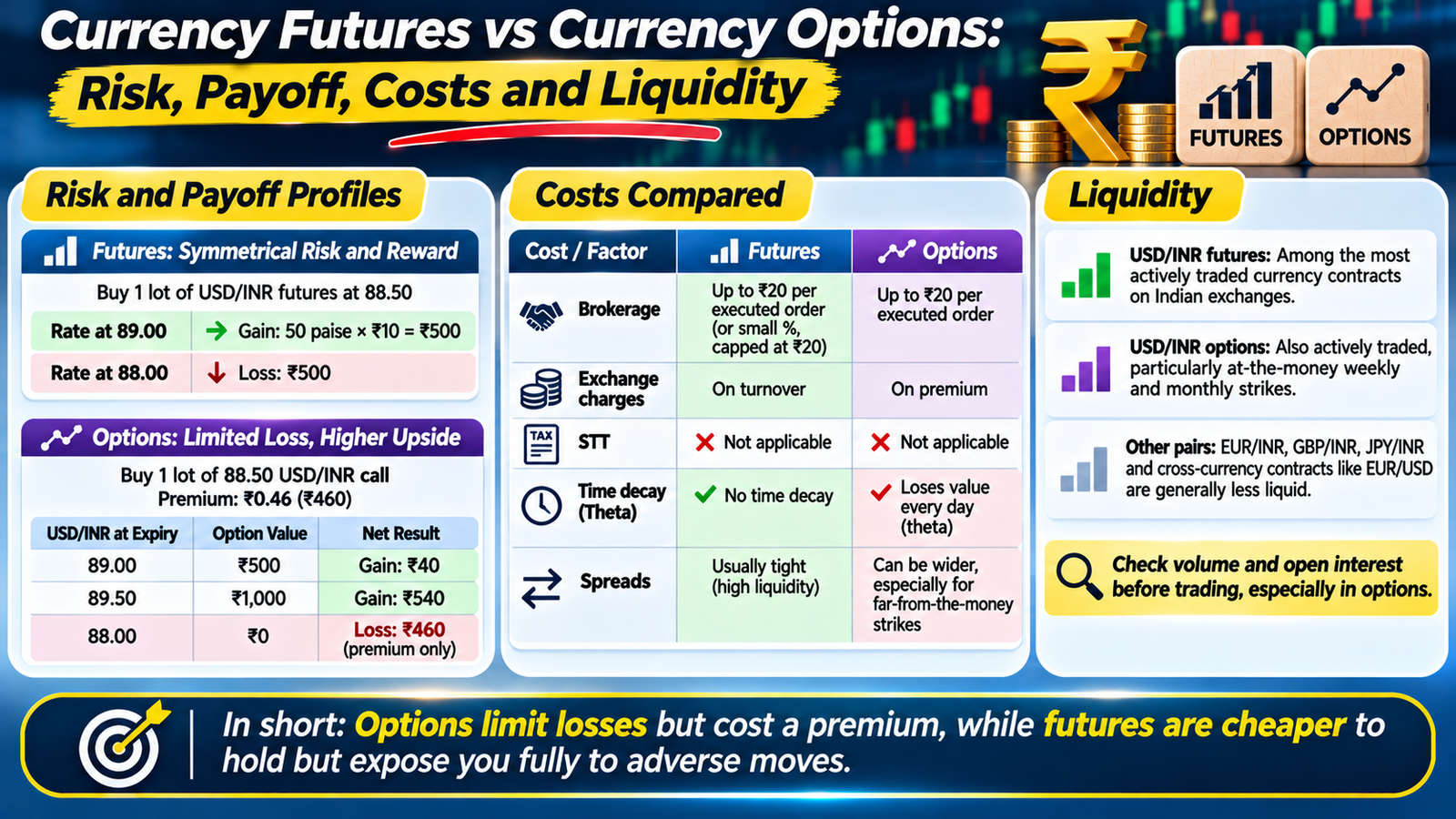
If you buy one lot of USD/INR futures at 88.50 and the rate rises to 89.00, you gain 50 paise × ₹10 = ₹500. If it falls to 88.00, you lose ₹500. Gains and losses are symmetrical.
Options
If you buy one lot of an 88.50 USD/INR call for a premium of ₹0.46 (₹460):
- At 89.00 on expiry, the option is worth 50 paise (₹500); net gain ₹40.
- At 89.50, it is worth ₹1,000; net gain ₹540.
- At 88.00, it expires worthless; loss limited to ₹460.
This asymmetry is the heart of the currency futures vs options trade-off: options limit losses but cost a premium, while futures are cheaper to hold but expose you fully to adverse moves.
Costs Compared
- Brokerage: many discount brokers charge up to ₹20 per executed order for both. For futures, some charge a small percentage capped at ₹20.
- Exchange charges: futures transaction charges apply to turnover; option charges apply to premium.
- STT: neither currency futures nor options attract STT.
- Hidden costs: futures have no time decay, while option buyers lose value every day through theta.
- Spreads: USD/INR near-month futures are usually very liquid; option spreads can be wider, especially for strikes far from the money.
For small option trades, flat brokerage can be a large share of the premium, so cost is an important factor in currency futures vs options decisions.
Liquidity
Liquidity is an often overlooked factor in currency futures vs options choices. USD/INR near-month futures are among the most actively traded currency contracts on Indian exchanges. USD/INR options are also actively traded, particularly at-the-money weekly and monthly strikes. Other pairs, such as EUR/INR, GBP/INR and JPY/INR, and cross-currency contracts like EUR/USD, are generally less liquid. Check volume and open interest before trading, especially in options.
Currency Futures vs Options for Traders (Not Hedgers)
Hedgers start with an exposure; traders start with a view. For short-term traders, the currency futures vs options question usually comes down to the kind of move expected:
- Steady, gradual move: futures often work better, because there is no time decay eating into profits.
- Sharp move around an event: buying options can work if the move is large enough to beat the premium, but volatility often rises before events and falls afterwards.
- Range-bound market: option sellers may collect premium, but they face large losses if the range breaks.
Remember that RBI rules mean exchange-traded rupee derivatives are meant mainly for hedging genuine exposures, so check that your use fits the declaration you have signed.
Worked Example 1: Exporter Hedging
This example is illustrative and uses hypothetical prices.
An exporter expects to receive $10,000 in one month. Spot USD/INR is 88.50, and the exporter fears the rupee will strengthen (USD/INR falls).
Futures hedge
- Sell 10 lots of USD/INR futures at 88.60.
- If USD/INR falls to 87.80 at expiry: futures gain 80 paise × ₹10 × 10 = ₹8,000, offsetting the lower rupee value of the receipts.
- If USD/INR rises to 89.40: futures lose ₹8,000, but the exporter’s dollar receipts are worth more. The effective rate is locked near 88.60.
Options hedge
- Buy 10 lots of an 88.50 USD/INR put at ₹0.40 (₹4,000 premium).
- If USD/INR falls to 87.80: puts are worth 70 paise × ₹10,000 = ₹7,000; net gain ₹3,000 after premium.
- If USD/INR rises to 89.40: puts expire worthless; the exporter loses ₹4,000 in premium but benefits fully from the higher rate on its receipts.
The futures hedge locks in a rate; the option hedge sets a floor while keeping upside, at the cost of the premium.
Worked Example 2: Importer Hedging
This example is illustrative and uses hypothetical prices.
An importer must pay $10,000 in a month and fears the rupee will weaken (USD/INR rises).
- Futures: buy 10 lots at 88.60. If USD/INR rises to 89.40, futures gain ₹8,000; if it falls to 87.80, futures lose ₹8,000, but dollars cost less.
- Options: buy 10 lots of an 88.50 call at ₹0.46 (₹4,600). If USD/INR rises to 89.40, calls are worth ₹9,000, a net gain of ₹4,400; if it falls to 87.80, the importer loses the ₹4,600 premium but buys dollars more cheaply.
Currency Futures vs Options: When to Use Futures
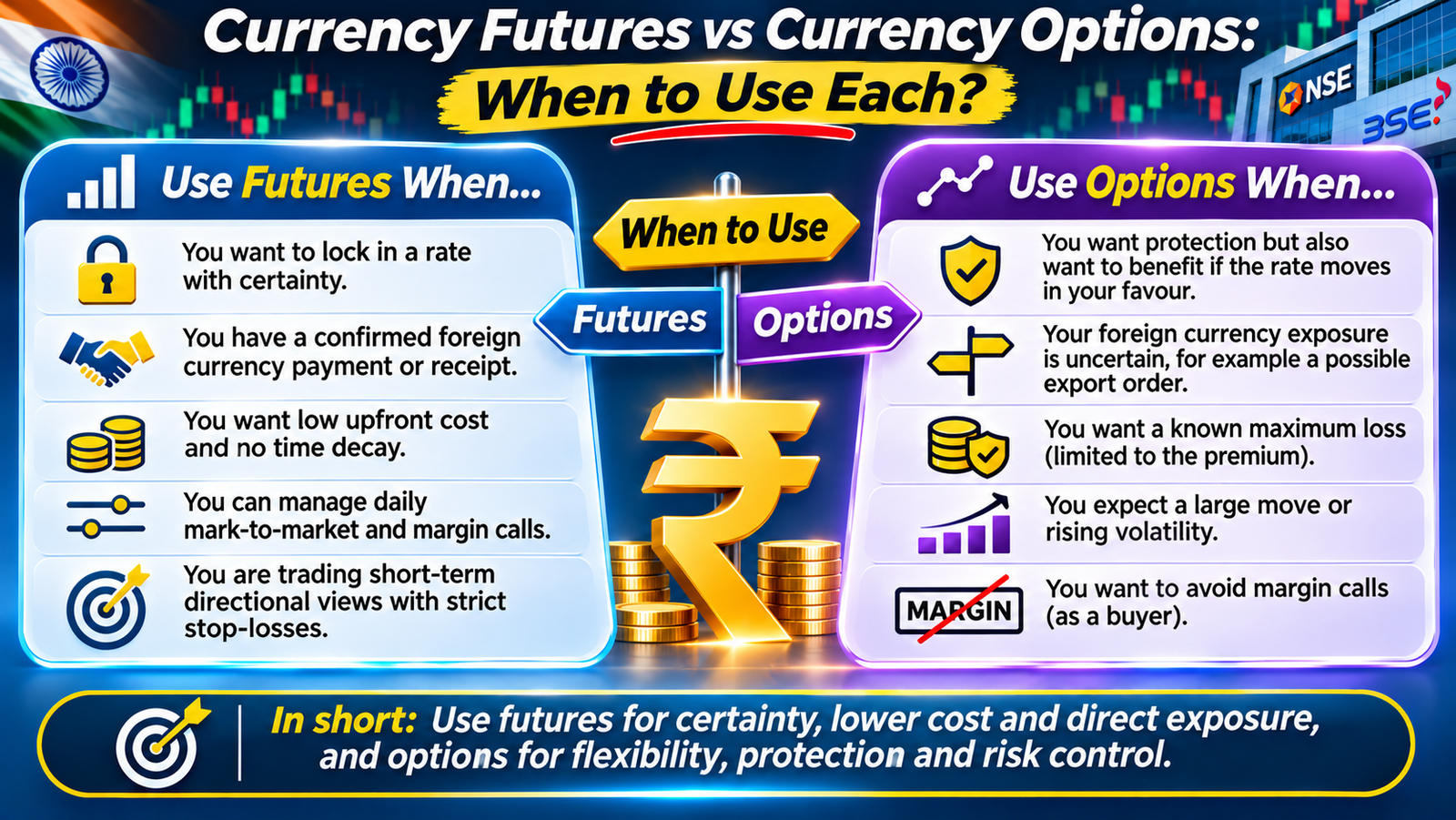
- You want to lock in a rate with certainty.
- You have a confirmed foreign currency payment or receipt.
- You want low upfront cost and no time decay.
- You can manage daily mark-to-market and margin calls.
- You are trading short-term directional views with strict stop-losses.
Currency Futures vs Options: When to Use Options
- You want protection but also want to benefit if the rate moves in your favour.
- Your foreign currency exposure is uncertain, for example a possible export order.
- You want a known maximum loss.
- You expect a large move or rising volatility.
- You want to avoid margin calls as a buyer.
Combining Futures and Options
You do not always have to pick one side. Some hedgers and traders use both. For example, an exporter might hedge half of expected receipts with futures to lock in a base rate and the other half with puts to keep some upside. Others use option spreads, such as buying one option and selling another, to reduce premium costs. Combining instruments lets you tailor the currency futures vs options trade-off to your situation.
Currency Futures vs Options: Decision Checklist
- Is my exposure certain or uncertain?
- Do I want to lock in a rate, or keep upside?
- Can I handle daily margin calls?
- Am I comfortable paying a premium that may expire worthless?
- How liquid are the contracts I plan to use?
- What will brokerage and other charges be relative to my position size?
Regulatory Reminder
Under RBI rules, exchange-traded rupee currency derivatives are meant mainly for hedging genuine foreign currency exposures, and brokers ask clients to sign a declaration. In October 2026, the RBI announced a cut in the limit for positions without documented underlying exposure from US100milliontoUS5 million equivalent. Indian residents should trade only through SEBI-registered brokers on NSE and BSE; leveraged forex through offshore brokers is not permitted under FEMA.
Common Mistakes
These are the errors Indian traders most often make when weighing currency futures vs options:
- Choosing options only because losses are limited: premiums and time decay can make options expensive.
- Choosing futures without planning for margin calls: sharp moves can require extra funds quickly.
- Selling options for “easy income”: option sellers face large potential losses.
- Ignoring liquidity: illiquid strikes can be costly to exit.
- Over-hedging: hedge only the exposure you actually have.
FAQs
What is the main difference in currency futures vs options?
Futures create an obligation with linear gains and losses. Options give the buyer a right, with losses limited to the premium.
Is currency futures vs options a choice I make once?
No. Many hedgers switch between them, or combine them, depending on how certain their exposure is, current volatility and the cost of premiums.
Which is cheaper, futures or options?
Futures have no premium or time decay, but require margin and daily settlement. Options require an upfront premium that may be lost.
Which is better for exporters?
Futures lock in a rate; buying puts sets a floor while keeping upside. The choice depends on how certain the exposure is and how much upside the exporter wants.
Can I lose more than my premium when buying options?
No. As a buyer, your maximum loss is the premium plus charges.
Do currency futures and options attract STT?
No. Neither attracts STT, but brokerage, exchange charges, SEBI fees, stamp duty and GST apply.
Are USD/INR futures more liquid than options?
Near-month futures are usually very liquid; options are liquid near the money but can be thinner at other strikes.
Conclusion
There is no single winner in the currency futures vs options debate. Futures are simple, cost-efficient and ideal for locking in a rate when exposure is certain. Options cost a premium but offer protection with upside, making them useful when exposure is uncertain or when you want a known maximum loss.
Match the instrument to your exposure, budget and risk tolerance, check liquidity and costs, and stay within RBI rules. For many Indian hedgers, a mix of futures and options provides the best balance between certainty and flexibility.