Introduction
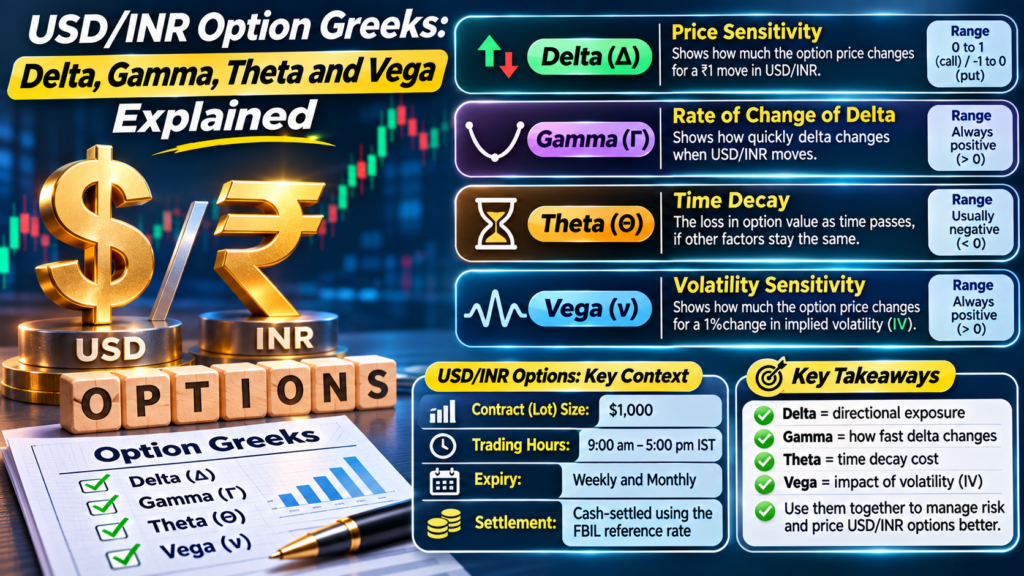
When you trade USD/INR options on NSE or BSE, the premium you pay or receive does not move one-for-one with the exchange rate. It changes with the spot price, the time left to expiry, market volatility and even interest rates. The tools that measure these sensitivities are called the option Greeks.
Understanding option Greeks USD/INR traders rely on helps you answer practical questions: how much will my option gain if the rupee weakens by 10 paise, how much value will it lose overnight, and what happens if volatility jumps after an RBI policy announcement? Without Greeks, options can behave in surprising ways.
This guide explains delta, gamma, theta, Vega and rho in plain language, with rupee examples per lot, shows how the Greeks change near expiry and explains how traders and hedgers use them.
USD/INR Options: The Basics
- Underlying: the USD/INR exchange rate.
- Lot size: $1,000, so a one-paisa move in the rupee is worth ₹10 per lot.
- Style: European options, exercisable only at expiry.
- Settlement: cash-settled in rupees against the FBIL reference rate.
- Premium: quoted in rupees per dollar; a premium of ₹0.40 means ₹400 per lot.
- Expiries: monthly and weekly contracts are available.
Because one lot is $1,000, you can convert any Greek into rupees per lot by multiplying by 1,000. This makes option Greeks USD/INR calculations straightforward.
How Currency Options Are Priced
Currency options are usually priced with the Garman-Kohlhagen model, an adaptation of the Black-Scholes model for foreign exchange. It uses:
- The spot exchange rate
- The strike price
- Time to expiry
- Implied volatility
- The domestic interest rate (rupee)
- The foreign interest rate (dollar)
The Greeks are simply the sensitivities of the option price to each of these inputs. Most trading platforms and option chains calculate option Greeks USD/INR traders need automatically, but understanding what they mean is essential.
The Example Used in This Guide
This example is illustrative. Figures are calculated with the Garman-Kohlhagen model using hypothetical inputs and rounded.
| Input | Value |
|---|---|
| USD/INR spot | 88.50 |
| Days to expiry | 30 |
| Implied volatility | 4% a year |
| Rupee interest rate | 5.5% |
| Dollar interest rate | 4.0% |
| Call option strike | Premium (₹ per $) | Delta | Gamma | Vega (per 1 vol point) | Theta (per day) |
|---|---|---|---|---|---|
| 88.00 (in the money) | 0.776 | 0.73 | 0.33 | 0.084 | −0.0081 |
| 88.50 (at the money) | 0.460 | 0.54 | 0.39 | 0.100 | −0.0086 |
| 89.00 (out of the money) | 0.239 | 0.35 | 0.36 | 0.094 | −0.0075 |
Delta: Sensitivity to the Exchange Rate
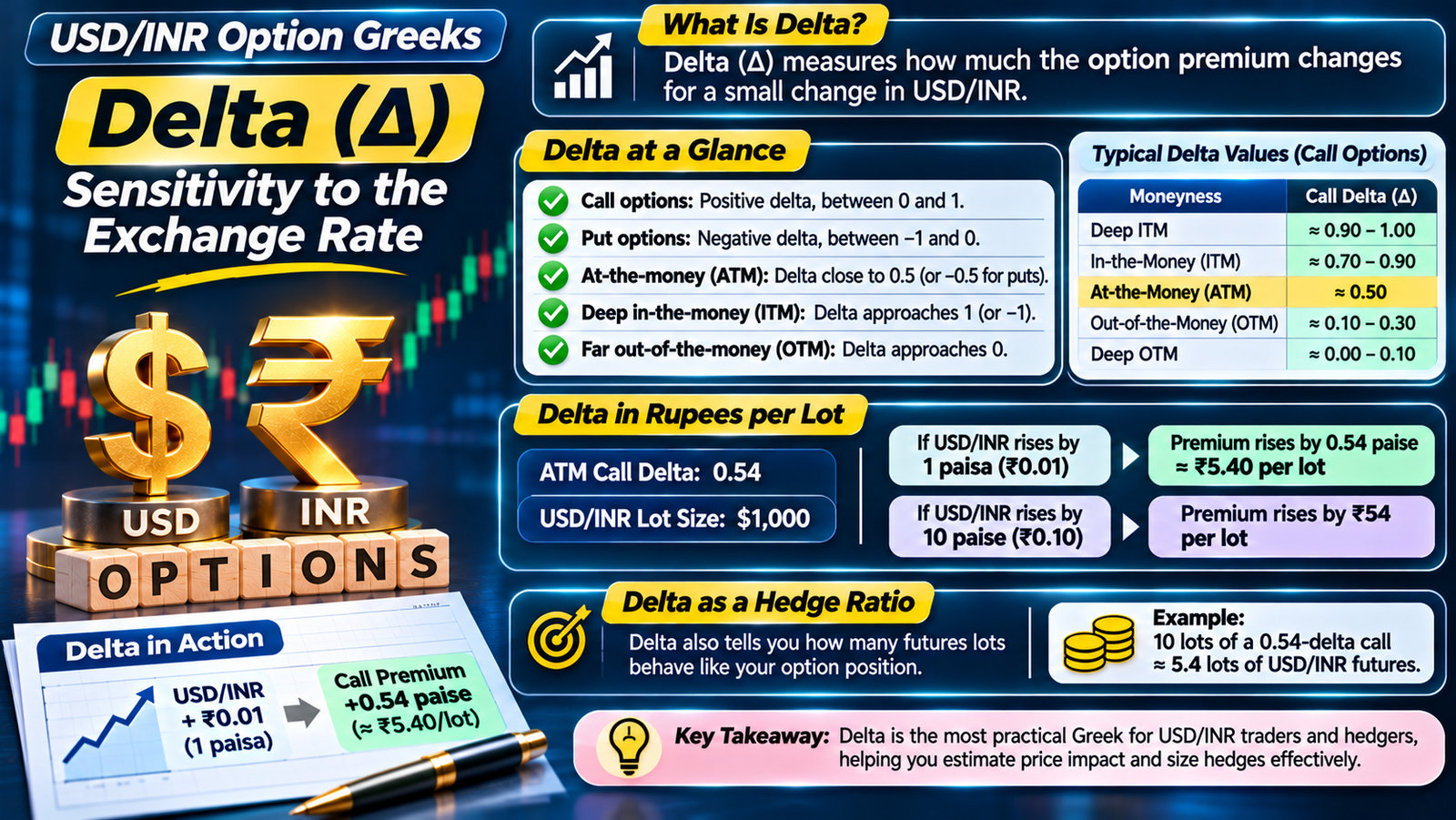
Delta is the first of the option Greeks USD/INR traders check. Delta measures how much the option premium changes for a small change in USD/INR.
- Call options have positive delta, between 0 and 1.
- Put options have negative delta, between −1 and 0.
- At-the-money options have delta close to 0.5 (or −0.5 for puts).
- Deep in-the-money options approach 1 (or −1); far out-of-the-money options approach 0.
Delta in rupees per lot
The at-the-money call above has delta of about 0.54. If USD/INR rises by 1 paisa, the premium rises by about 0.54 paise, which is about ₹5.40 per lot. If USD/INR rises by 10 paise, the premium rises by roughly ₹54 per lot.
Delta as a hedge ratio
Delta also tells you how many futures lots behave like your option position. Ten lots of a 0.54-delta call behave roughly like 5.4 lots of USD/INR futures. Among the option Greeks USD/INR hedgers use, delta is the most practical for sizing hedges.
Gamma: How Fast Delta Changes
Gamma measures how much delta changes when the exchange rate moves.
- Gamma is highest for at-the-money options.
- Gamma rises sharply as expiry approaches for at-the-money options.
- Option buyers are “long gamma”; option sellers are “short gamma”.
Gamma example
The at-the-money call has gamma of about 0.39 per one-rupee move. If USD/INR rises by 10 paise, delta rises by about 0.039, from 0.54 to roughly 0.58. Large moves change delta quickly, which helps option buyers and hurts option sellers.
Theta: Time Decay
Theta measures how much an option loses in value each day, assuming everything else stays the same.
- Theta is usually negative for option buyers and positive for sellers.
- Time decay accelerates as expiry approaches, especially for at-the-money options.
Theta in rupees per lot
The 30-day at-the-money call has theta of about −0.0086 per day, or about −₹8.60 per lot per day. With only 7 days left, the same at-the-money option’s theta rises to about −₹15.80 per lot per day, even though its premium has fallen.
For buyers, theta is a daily cost of holding the option. For sellers, it is the income they collect for taking on risk. Watching theta is one of the most important uses of option Greeks USD/INR traders make near expiry.
Vega: Sensitivity to Volatility
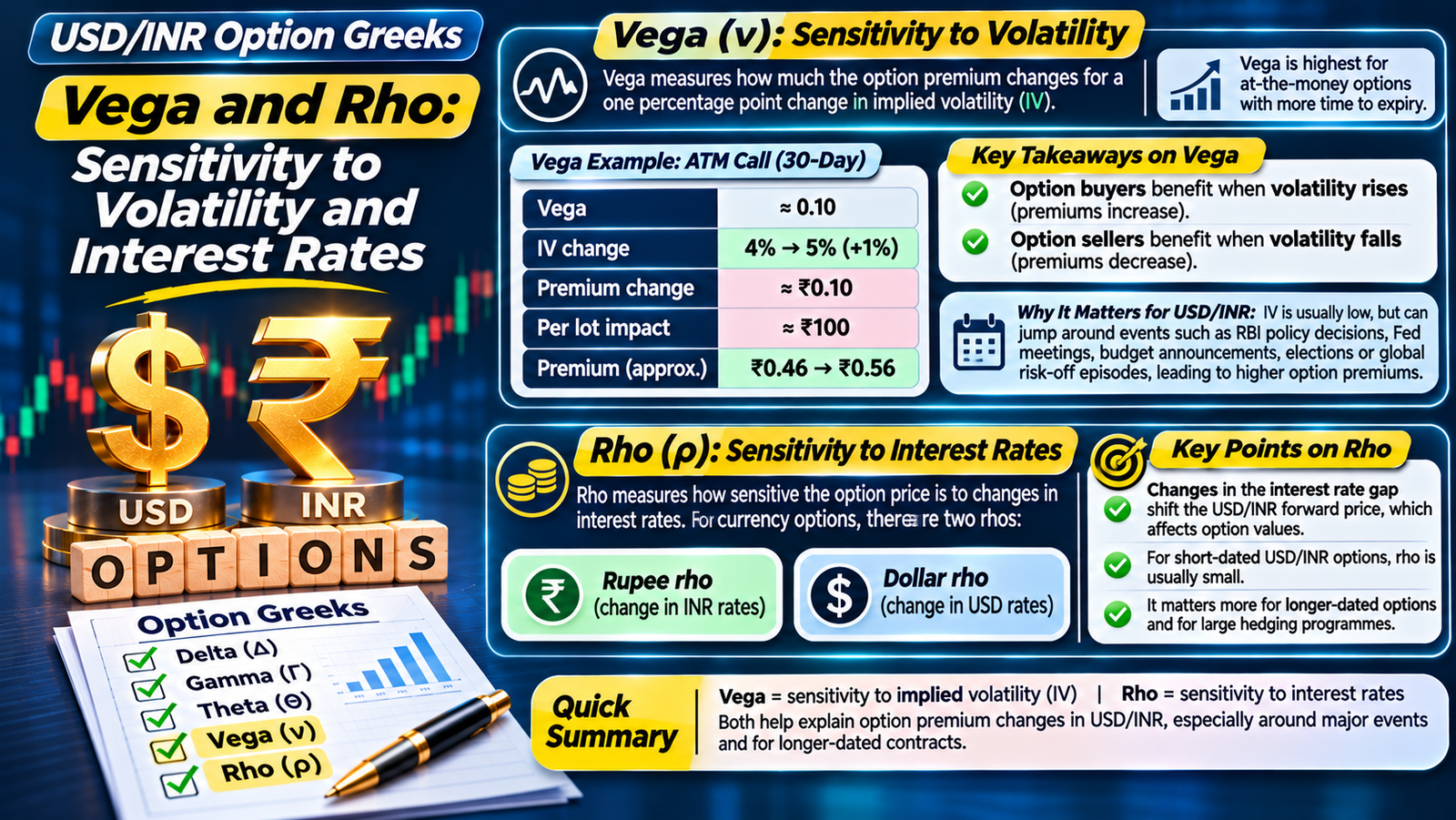
Vega is often the most overlooked of the option Greeks USD/INR traders face. Vega measures how much the premium changes for a one percentage point change in implied volatility.
- Vega is highest for at-the-money options with more time to expiry.
- Option buyers benefit when volatility rises; sellers benefit when it falls.
Vega example
The 30-day at-the-money call has vega of about 0.10. If implied volatility rises from 4% to 5%, the premium rises by about ₹0.10, or ₹100 per lot, from ₹0.46 to about ₹0.56, even if USD/INR does not move.
Why Vega matters for USD/INR
USD/INR implied volatility is usually low compared with many other currency pairs, partly because the RBI manages excessive volatility. But it can jump around events such as RBI policy decisions, Fed meetings, budget announcements, elections or global risk-off episodes. A sudden volatility spike can lift option premiums sharply; a quiet market can erode them.
Rho: Sensitivity to Interest Rates
Rho measures sensitivity to interest rates. For currency options there are effectively two rhos: one for the rupee interest rate and one for the dollar interest rate. Changes in the interest rate gap shift the forward price of USD/INR, which affects option values.
For short-dated USD/INR options, rho is usually small compared with delta, gamma, theta and Vega. It matters more for longer-dated options and for large hedging programmes.
Option Greeks USD/INR: Summary Table
| Greek | Measures sensitivity to | Long call | Long put | Highest when |
|---|---|---|---|---|
| Delta | Exchange rate | Positive | Negative | Deep in the money |
| Gamma | Change in delta | Positive | Positive | At the money, near expiry |
| Theta | Time | Negative | Negative | At the money, near expiry |
| Vega | Implied volatility | Positive | Positive | At the money, longer expiry |
| Rho | Interest rates | Depends on rate | Depends on rate | Longer expiry |
How the Greeks Change Near Expiry
| At-the-money call (88.50 strike) | 30 days to expiry | 7 days to expiry |
|---|---|---|
| Premium | ₹0.46 (₹460 per lot) | ₹0.21 (₹208 per lot) |
| Delta | 0.54 | 0.52 |
| Gamma | 0.39 | 0.81 |
| Vega (per vol point) | ₹100 per lot | ₹49 per lot |
| Theta (per day) | −₹8.60 per lot | −₹15.80 per lot |
Illustrative figures from the same model inputs.
As expiry approaches, gamma and theta grow while Vega shrinks. Near expiry, at-the-money options become very sensitive to small spot moves and lose value quickly each day. This is why expiry week can be both rewarding and dangerous.
Using Option Greeks USD/INR in Practice
For option buyers
- Check theta to understand the daily cost of holding the position.
- Prefer buying when implied volatility is relatively low, to reduce vega risk.
- Remember that you need a big enough move, soon enough, to beat time decay.
For option sellers
- Theta works in your favour, but negative gamma means large moves can cause fast losses.
- Be careful around events that can spike volatility.
- Use defined-risk structures such as spreads rather than naked selling.
For hedgers
- Exporters can buy USD/INR puts to protect against rupee strength; importers can buy calls to protect against rupee weakness.
- Delta shows how much protection each option provides at current levels.
- Theta and vega help compare the cost of option hedges with futures hedges.
Worked Example: Hedging an Import Payment
This example is illustrative and uses the model figures above.
An importer must pay $10,000 in a month and worries the rupee will weaken. Spot is 88.50. The importer buys 10 lots of the 30-day 88.50 call at ₹0.46, paying ₹4,600 in premium.
- Delta: about 0.54 × 10 lots, so the position initially behaves like about 5.4 lots of futures.
- If USD/INR rises to 89.20 at expiry: the call is worth 70 paise, or ₹7,000, a net gain of ₹2,400 after premium, offsetting the higher cost of dollars.
- If USD/INR falls to 88.00: the call expires worthless, and the importer loses ₹4,600 of premium but buys dollars more cheaply.
- Theta: the hedge costs about ₹86 per day in time decay at the start.
Using option Greeks USD/INR this way helps the importer understand both the protection and the cost.
Where to Find Option Greeks USD/INR Data
- Broker option chains: many Indian brokers show delta, gamma, theta, vega and implied volatility alongside currency option prices.
- Exchange data: NSE and BSE publish option prices, open interest and settlement data for currency options.
- Option calculators: online Garman-Kohlhagen or Black-Scholes calculators let you enter spot, strike, expiry, volatility and interest rates.
- Spreadsheets: traders can build their own models to test scenarios.
Different sources may show slightly different option Greeks USD/INR values because they use different volatility or interest rate inputs, so compare like with like.

Common Mistakes
These are the errors traders most often make with option Greeks USD/INR:
- Ignoring theta: buyers often underestimate how fast short-dated options lose value.
- Selling options without respecting gamma: a sudden move can cause losses far larger than the premium collected.
- Ignoring volatility: buying options just before a known event can mean paying for inflated volatility that collapses afterwards.
- Forgetting the lot size: always convert Greeks into rupees per lot to understand real risk.
- Relying on one Greek: all the Greeks interact, especially near expiry.
Trading USD/INR Options from India
Indian residents can trade USD/INR options on NSE and BSE through SEBI-registered brokers. Under RBI rules, exchange-traded rupee currency derivatives are meant mainly for hedging genuine foreign currency exposures, and brokers ask clients to sign a declaration. In October 2026, the RBI announced a cut in the limit for positions without documented underlying exposure from US 100 million to US5 million equivalent. Leveraged forex through offshore brokers is not permitted for Indian residents under FEMA.
FAQs
What are option Greeks USD/INR traders use?
Delta, gamma, theta, vega and rho, which measure how USD/INR option premiums respond to changes in the exchange rate, time, volatility and interest rates.
Do option Greeks USD/INR values stay constant?
No. They change continuously as spot, time, volatility and interest rates change, so check them regularly, especially near expiry.
How do I convert delta into rupees?
Multiply delta by ₹10 for each paisa move per lot. A delta of 0.5 means about ₹5 per lot for a 1-paisa move.
Why is theta higher near expiry?
Time decay accelerates as expiry approaches, especially for at-the-money options.
What model is used to price currency options?
Usually the Garman-Kohlhagen model, which adapts Black-Scholes for two interest rates.
Is USD/INR volatility high?
It is usually low compared with many currency pairs, but it can jump around major events.
Which Greek matters most for hedgers?
Delta, because it shows how much protection an option provides. Theta and vega help compare costs.
Conclusion
The Greeks turn USD/INR options from guesswork into measurable risk. Delta shows exposure to the exchange rate, gamma shows how quickly that exposure changes, theta shows the daily cost of time, Vega shows sensitivity to volatility and rho captures interest rate effects.
Whether you are hedging import or export payments or trading options on NSE and BSE, using option Greeks USD/INR traders rely on, converted into rupees per lot, helps you size positions, choose strikes and expiries, and avoid unpleasant surprises near expiry.