Introduction
Every currency futures or options trade in India comes with a set of costs. Some are obvious, like brokerage. Others, such as exchange transaction charges, SEBI fees, stamp duty and GST, appear only on your contract note. Together they decide how far the market has to move before you break even.
Understanding currency trading charges India traders pay is especially important because currency moves are small. A USD/INR futures trade that gains 5 paise earns just ₹50 per lot before costs, so charges can make the difference between a small profit and a small loss.
This guide breaks down each charge, compares futures and options, works through real-style examples, explains why there is no STT on currency derivatives and shares practical ways to keep costs under control.
Overview of Currency Trading Charges India Traders Pay
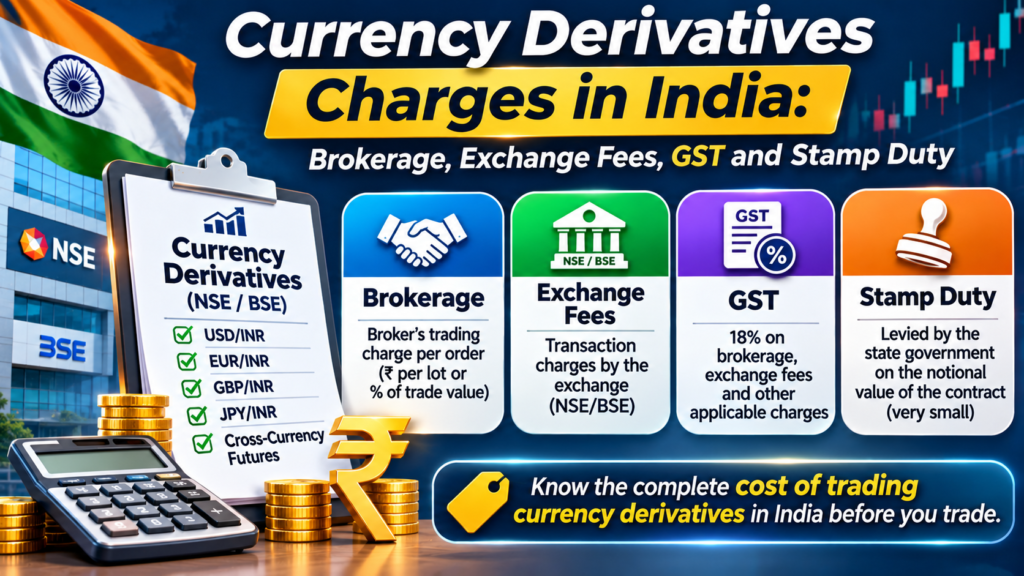
| Charge | Who collects it | Currency futures | Currency options |
|---|---|---|---|
| Brokerage | Your broker | Varies by broker; often 0.03% or ₹20 per order, whichever is lower | Often a flat ₹20 per executed order |
| Exchange transaction charges | NSE or BSE | NSE: 0.00035% of turnover; BSE: 0.00045% | NSE: 0.0311% of premium; BSE: 0.001% of premium |
| STT / CTT | Government | Not applicable | Not applicable |
| SEBI turnover fees | SEBI | ₹10 per crore | ₹10 per crore |
| Stamp duty | State governments (collected centrally) | 0.0001% on buy side | 0.0001% on buy side |
| IPFT (NSE) | NSE Investor Protection Fund Trust | ₹0.05 per lakh of turnover | ₹2 per lakh of premium |
| GST | Government | 18% on brokerage, transaction and SEBI charges | 18% on brokerage, transaction and SEBI charges |
Rates as listed on Zerodha’s and Angel One’s charge pages in November 2026. Some brokers’ pages show different stamp duty figures for currency options; check your contract note.
1. Brokerage
Brokerage is the fee your broker charges for executing each order. It is the largest single item in currency trading charges India traders pay on small trades.
- Zerodha: currency futures, 0.03% or ₹20 per executed order, whichever is lower; currency options, ₹20 per executed order.
- Angel One: ₹20 per executed order for currency futures and options, after an introductory offer for new customers.
- Upstox: up to ₹20 per order on currency trades.
- Full-service brokers: may charge a percentage of turnover or premium, often higher than discount brokers.
Because brokerage is usually charged per order, not per lot, trading more lots in a single order spreads the cost.
2. Exchange Transaction Charges
NSE and BSE charge a transaction fee on every trade.
- Futures: charged on turnover (price × quantity).
- Options: charged on the premium value, not the notional value.
- NSE’s currency options charge (0.0311% of premium) is higher in percentage terms than BSE’s, but because premiums are small, the rupee amount is usually modest.
3. No STT or CTT on Currency Derivatives
Unlike equity derivatives, currency derivatives do not attract securities transaction tax (STT), and commodity transaction tax (CTT) does not apply either. This is one reason currency trading charges India traders pay are lower than equity F&O costs for similar notional values.
4. SEBI Turnover Fees
SEBI charges ₹10 per crore of turnover. On a typical retail currency trade, this is only a few paise.
5. Stamp Duty
Stamp duty is charged on the buy side of each trade under the Indian Stamp Act, and is collected centrally through the exchanges. For currency derivatives, Zerodha’s charges page lists 0.0001% (₹10 per crore) on the buy side for both futures and options. Some other brokers’ pages list a different rate for currency options, so it is worth checking how your broker applies it on your contract note.
6. IPFT Charges
NSE collects a small contribution for its Investor Protection Fund Trust: ₹0.05 per lakh of turnover for currency futures and ₹2 per lakh of premium for currency options, plus GST.
7. GST
GST at 18% is charged on brokerage, exchange transaction charges and SEBI fees. It is not charged on stamp duty. Because brokerage is the biggest fee, GST on brokerage is usually the second-largest item in currency trading charges India traders pay on small trades.
Worked Example 1: One Lot of USD/INR Futures
This example is illustrative, uses hypothetical prices and Zerodha’s published rates for an NSE trade, and rounds figures.
You buy 1 lot of USD/INR futures at 88.00 and sell it at 88.10. One lot is $1,000.
- Buy value: ₹88,000; sell value: ₹88,100; total turnover: ₹1,76,100.
- Gross profit: 10 paise × ₹10 = ₹100.
| Charge | Amount |
|---|---|
| Brokerage (₹20 × 2 orders, as 0.03% of each order exceeds ₹20) | ₹40.00 |
| NSE transaction charges (0.00035% of turnover) | ₹0.62 |
| SEBI fees (₹10 per crore) | ₹0.18 |
| Stamp duty (0.0001% on buy side) | ₹0.09 |
| IPFT (₹0.05 per lakh) | ₹0.09 |
| GST (18%) | ₹7.36 |
| Total charges | about ₹48.33 |
Net profit is about ₹51.67. The breakeven move is about 4.8 paise, almost entirely because of brokerage and GST on brokerage.
Worked Example 2: Ten Lots in One Order
This example is illustrative and uses the same rates and prices.
You buy 10 lots at 88.00 and sell at 88.10 in single orders. Turnover is ₹17,61,000, and gross profit is ₹1,000.
- Brokerage stays at ₹40 (₹20 per order).
- Transaction charges rise to about ₹6.16; SEBI fees about ₹1.76; stamp duty and IPFT about ₹0.88 each.
- GST is about ₹8.78.
- Total charges: about ₹58.47, or under ₹6 per lot.
Breakeven falls to well under 1 paisa per lot. This shows how currency trading charges India traders pay become much less significant per lot when brokerage is spread across more lots in each order.
Worked Example 3: Currency Options
This example is illustrative and uses hypothetical premiums.
You buy 1 lot of a USD/INR call option at a premium of ₹0.20 (₹200) and sell it at ₹0.30 (₹300). Gross profit is ₹100.
- Brokerage: ₹20 × 2 = ₹40.
- NSE transaction charges on ₹500 of premium turnover: about ₹0.16.
- SEBI, stamp duty and IPFT: a few paise in total.
- GST: about ₹7.23.
- Total charges: about ₹47.40, nearly half the gross profit.
For small option trades, flat brokerage dominates. Option buyers need larger premium moves, or more lots per order, to make costs worthwhile.
A Simple Breakeven Formula
To turn currency trading charges India traders pay into a number you can use before every trade, calculate the breakeven move:
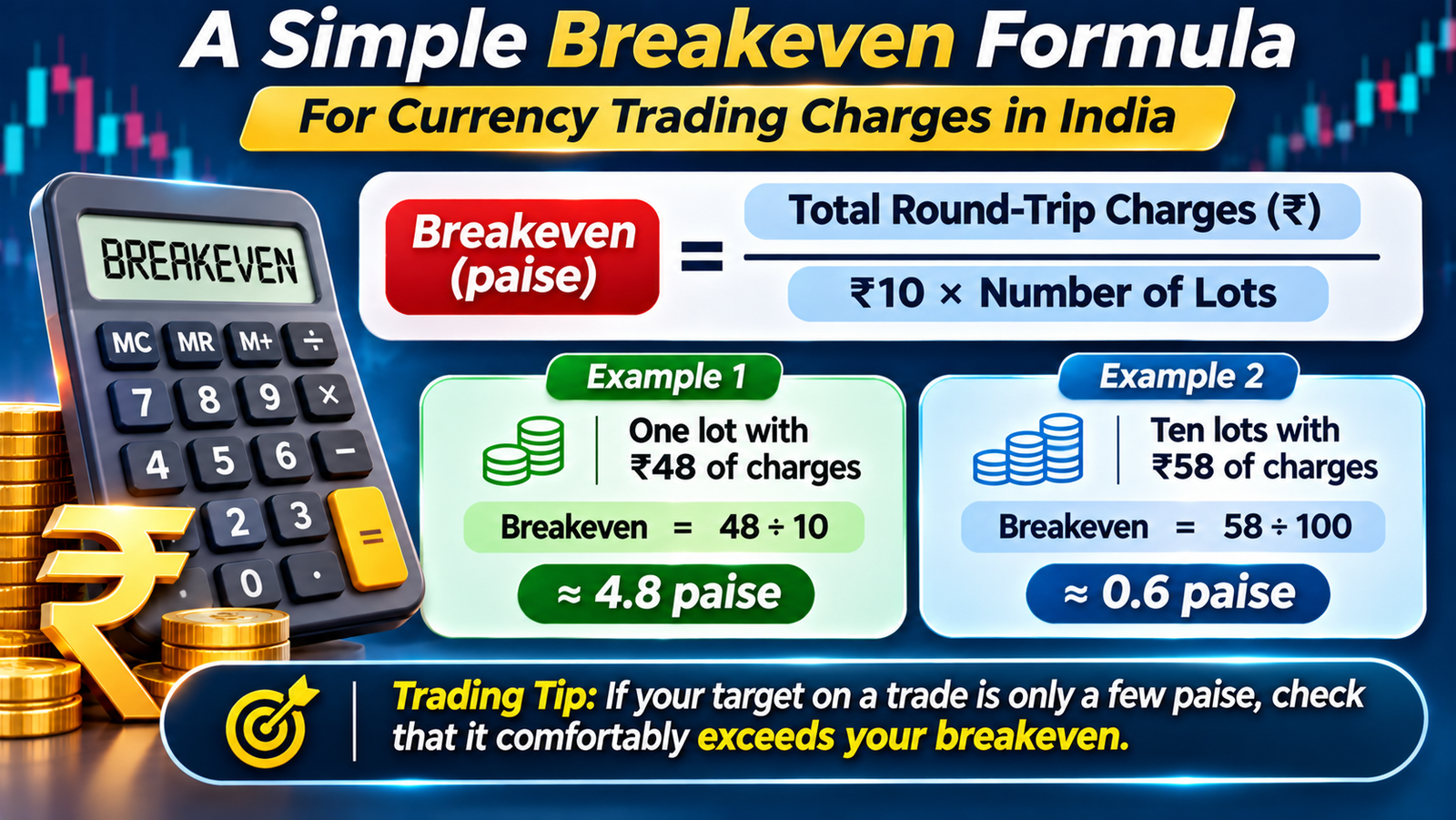
Breakeven (paise) = total round-trip charges ÷ (₹10 × number of lots)
- One lot with ₹48 of charges: 48 ÷ 10 ≈ 4.8 paise.
- Ten lots with ₹58 of charges: 58 ÷ 100 ≈ 0.6 paise.
If your target on a trade is only a few paise, check that it comfortably exceeds your breakeven.
Futures vs Options: How Charges Compare
| Feature | Futures | Options |
|---|---|---|
| Brokerage basis | Often percentage, capped at a flat fee | Usually flat per order |
| Transaction charges basis | Turnover | Premium |
| Impact of brokerage on small trades | Significant | Very significant, because premiums are small |
| STT | None | None |
Currency Trading Charges India vs Equity F&O
| Charge | Currency derivatives | Equity derivatives |
|---|---|---|
| STT | None | Charged on sell side (and on exercise for options) |
| Exchange transaction charges | Very low percentage rates | Higher percentage rates |
| Stamp duty | Very low rate on buy side | Higher rates on buy side |
| Brokerage | Often ₹20 per order at discount brokers | Often ₹20 per order at discount brokers |
For similar notional values, currency trading charges India traders pay are generally lower than equity F&O charges, mainly because there is no STT. But currency contracts are smaller and move less, so brokerage still matters.
Discount vs Full-Service Brokers
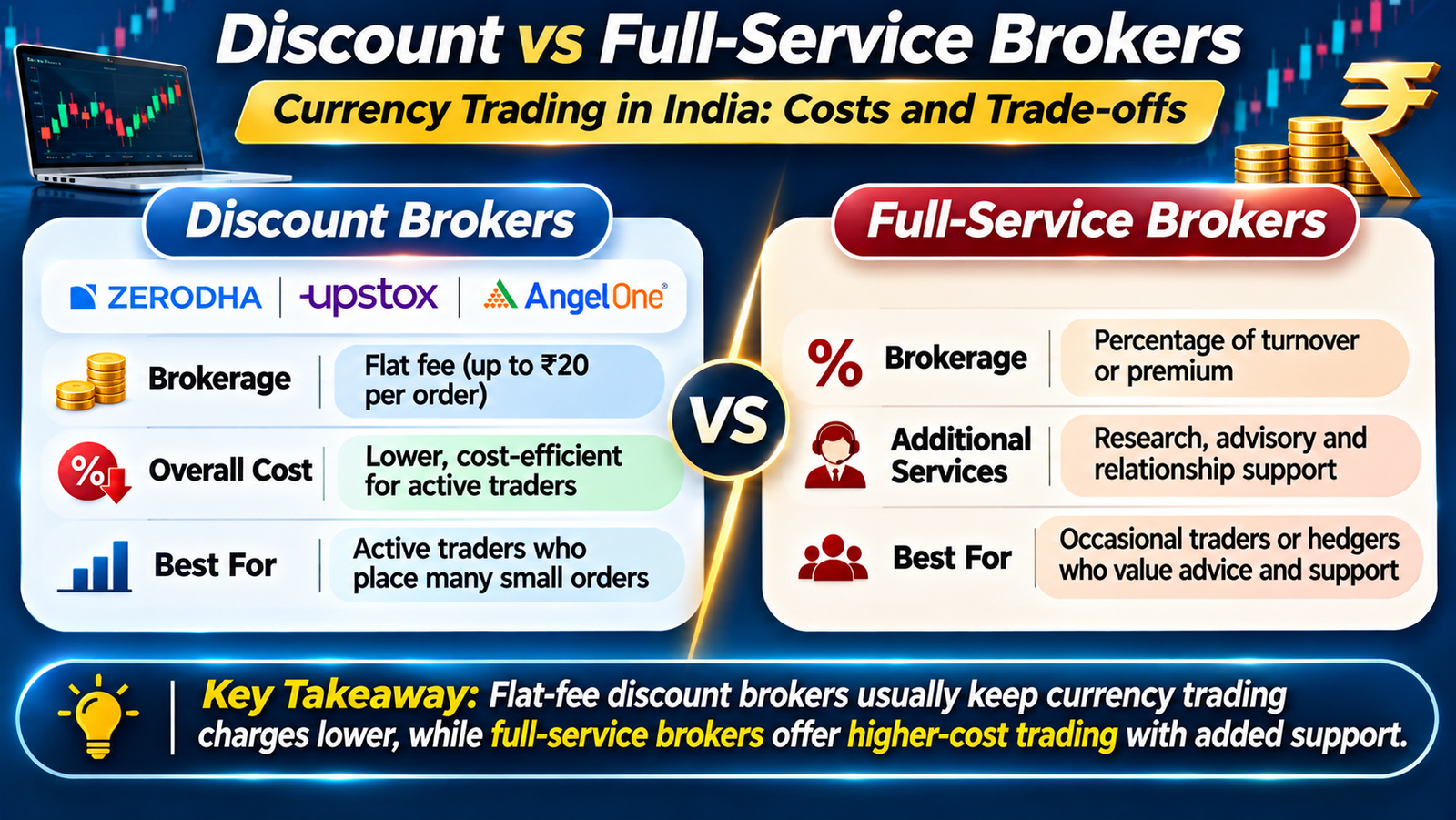
Discount brokers such as Zerodha, Upstox and Angel One mostly charge flat brokerage of up to ₹20 per order on currency trades. Full-service brokers may charge a percentage of turnover or premium, along with research, advisory and relationship services. For active traders placing many small orders, flat-fee pricing usually keeps currency trading charges India traders pay much lower. For occasional hedgers who value advice, a full-service broker’s higher costs may be acceptable.
Other Costs to Consider
Beyond the charges on your contract note, several hidden costs add to currency trading charges India traders face:
- Bid-ask spread: the difference between buying and selling prices is an implicit cost, especially in less liquid contracts and far-month expiries.
- Slippage: fast markets can fill orders at worse prices than expected.
- Call-and-trade fees: placing orders through a broker’s dealing desk often costs extra.
- Interest on margin shortfall: some brokers charge penalties or interest if margin falls short.
- No DP charges: currency derivatives are cash-settled, so there are no demat delivery charges.
Tax Is Separate From Charges
Charges are deducted on each trade, but tax is calculated on your annual result. Income from exchange-traded currency derivatives is generally treated as non-speculative business income in India, and trading charges are typically treated as business expenses. The Income-tax Act, 2025 applies from 1 April 2026, so consult a chartered accountant about your situation.
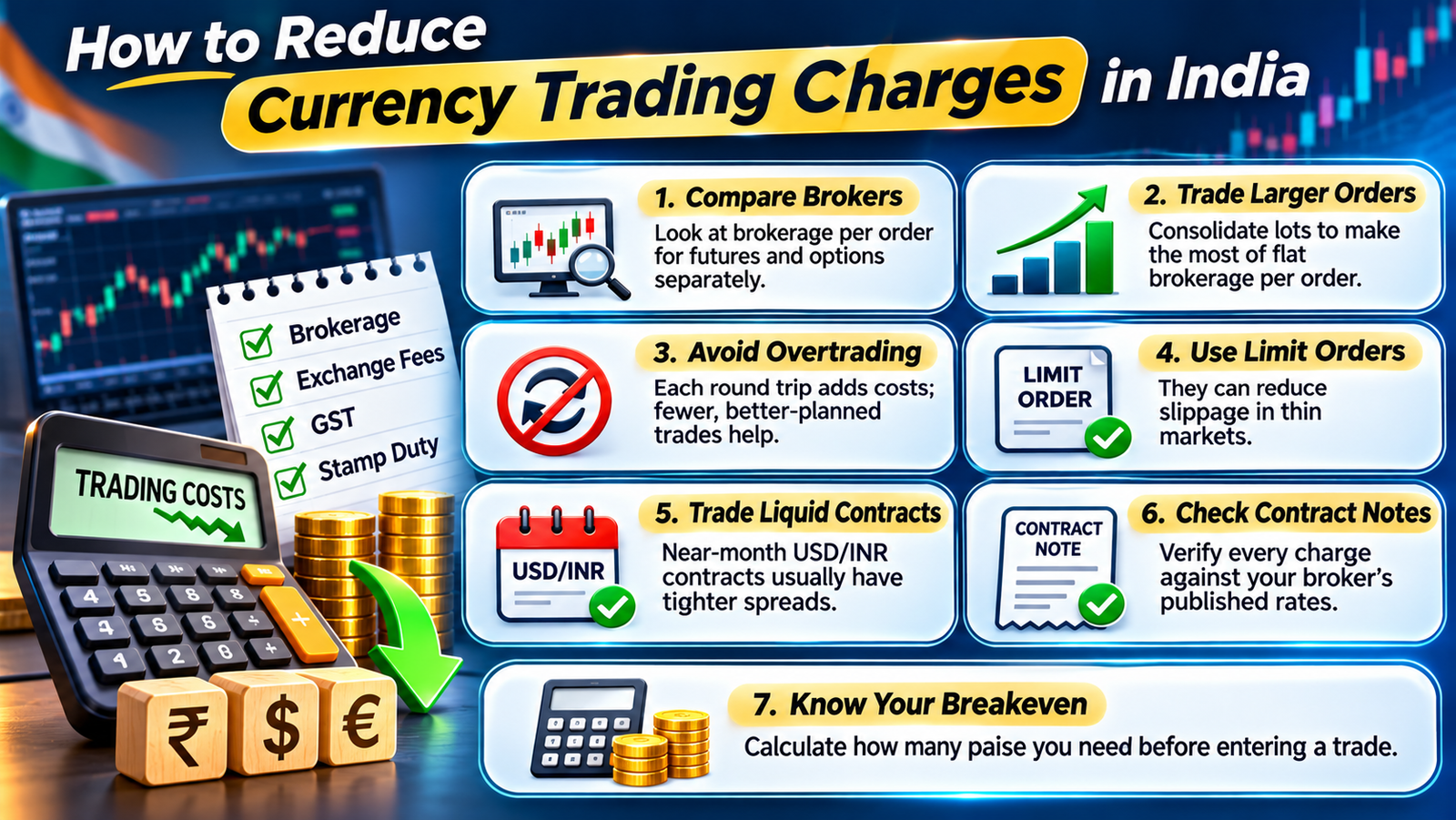
How to Reduce Currency Trading Charges in India
- Compare brokers: look at brokerage per order for futures and options separately.
- Trade fewer, larger orders: flat brokerage per order rewards consolidating lots.
- Avoid overtrading: each round trip adds costs; fewer, better-planned trades help.
- Use limit orders: they can reduce slippage in thin markets.
- Trade liquid contracts: near-month USD/INR contracts usually have tighter spreads.
- Check contract notes: verify every charge against your broker’s published rates.
- Know your breakeven: calculate how many paise you need before entering a trade.
Regulatory Reminder
Indian residents can trade currency futures and options on NSE and BSE through SEBI-registered brokers. Under RBI rules, these products are meant mainly for hedging genuine foreign currency exposures, and brokers ask clients to sign a declaration. In October 2026, the RBI announced a cut in the limit for positions without documented underlying exposure from US100milliontoUS5 million equivalent. Leveraged forex through offshore brokers is not permitted for residents under FEMA.
Quick Reference
| Item | Key point |
|---|---|
| Biggest cost on small trades | Brokerage plus GST |
| STT on currency derivatives | None |
| Futures transaction charges | Based on turnover |
| Options transaction charges | Based on premium |
| GST | 18% on brokerage, transaction and SEBI charges |
| Stamp duty | Buy side only |
FAQs
What are the main currency trading charges India traders pay?
Brokerage, exchange transaction charges, SEBI fees, stamp duty, IPFT charges and 18% GST. There is no STT on currency derivatives.
Do currency trading charges India brokers apply differ between NSE and BSE?
Yes. Exchange transaction charges differ, for example 0.00035% on NSE and 0.00045% on BSE for currency futures turnover, as listed by brokers. Brokerage is usually the same.
Is there STT on currency futures and options?
No. Currency derivatives do not attract STT or CTT.
How much does one lot of USD/INR futures cost to trade?
With ₹20 brokerage per order, a round trip on one lot costs about ₹48 in total charges, so you need roughly a 5-paise move to break even.
Why are currency option charges high for small trades?
Because brokerage is usually a flat fee per order, while option premiums are small.
Is GST charged on stamp duty?
No. GST applies to brokerage, exchange transaction charges and SEBI fees.
Where can I see my actual charges?
On the contract note your broker sends after each trading day.
Conclusion
Currency trading charges India traders pay are low compared with many other markets, especially because there is no STT. But since currency moves are small, brokerage and GST can still take a large share of profits on one-lot trades. Know each charge, calculate your breakeven, consolidate orders where sensible and check your contract notes regularly.