Introduction
Opening a trading account with a broker does not automatically let you trade currency futures and options. The currency derivatives segment has to be activated separately, and since 2024 Indian brokers also ask you to sign a declaration linked to RBI rules on exchange-traded currency derivatives.
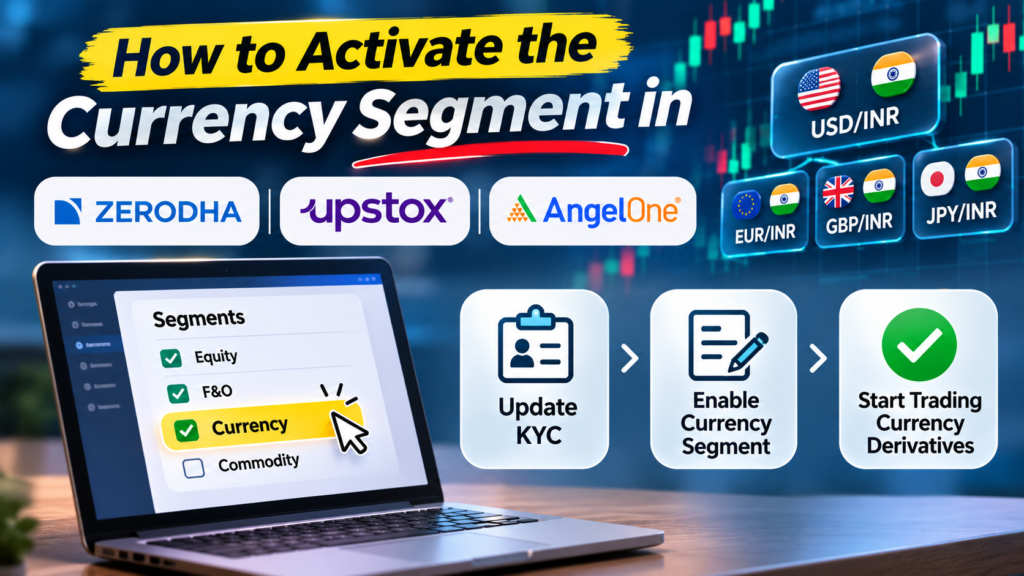
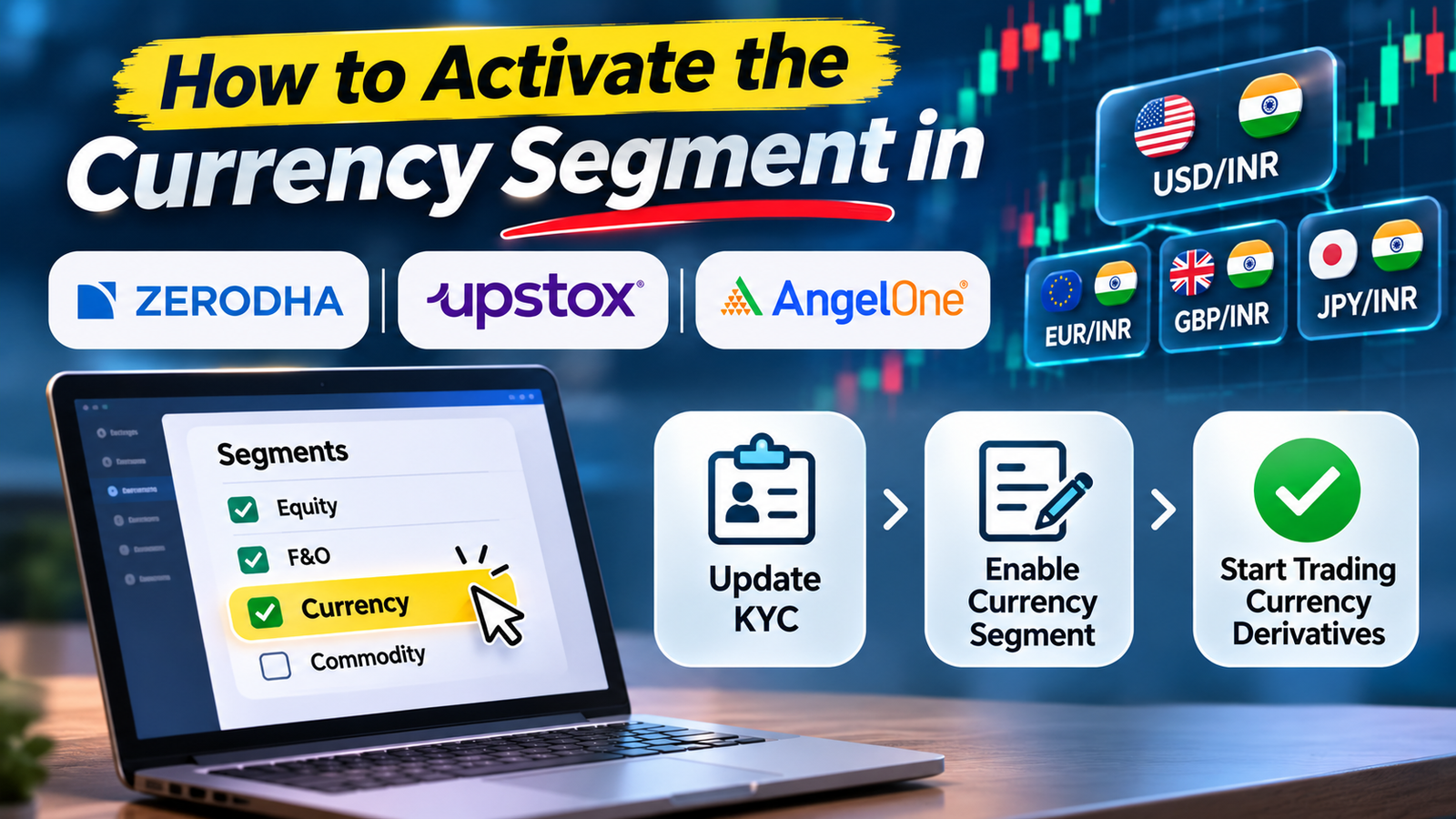
This guide walks you through how to activate currency segment Zerodha accounts step by step, then covers Upstox and Angel One. It also explains the documents you need, the RBI declaration, the October 2026 change to the RBI limit, typical timelines and the most common reasons activation fails.
Before You Start: Eligibility and the RBI Rules
Who can activate the currency segment?
- Resident individuals aged 18 or over with a trading account at a SEBI-registered broker.
- An active equity segment is usually required first.
- Your mobile number should be linked to Aadhaar for online e-signing.
- Brokers may not allow segment activation for minor accounts, and NRI accounts have separate rules.
The RBI requirement: underlying exposure
Under RBI directions, residents can use exchange-traded currency derivatives involving the rupee mainly to hedge a genuine foreign currency exposure, such as import or export payments, foreign income, overseas education or other transactions permitted under FEMA. Brokers therefore ask clients to sign a declaration about this underlying exposure before enabling or re-enabling the currency segment.
Users could take positions up to a set limit without having to prove the exposure with documents. On 10 October 2026, the RBI announced that this limit for exchange-traded INR currency derivatives would be cut from US 100 million to US5 million equivalent, measured across all recognized exchanges together. For most retail traders the US$5 million figure is still well above their position size, but the requirement to have a genuine underlying exposure remains. Read your broker’s declaration carefully and sign it only if it is true for you.
Documents you will need
Before you activate currency segment Zerodha, Upstox or Angel One access, keep these ready:
- PAN and Aadhaar already linked to your trading account.
- Financial proof, if not already on record: commonly a bank statement for the last six months, an ITR acknowledgement, Form 16, a salary slip or a demat holdings statement.
- Access to the mobile number linked to Aadhaar for OTP-based e-signing.
How to Activate Currency Segment Zerodha: Online Steps
According to Zerodha’s support pages, the RBI declaration is collected during activation, and the process is done through the Zerodha account (Console) section:
- Log in at account.zerodha.com using your Kite credentials and open the segment activation section.
- Toggle on the currency segment and apply the changes.
- Select your income range.
- Submit financial proof: choose the option to submit a bank statement via OTP, request the OTP, select your bank and proceed.
- Verify: enter the OTP, link your account and verify the OTP again.
- Accept the terms and sign the RBI currency declaration.
- E-sign: enter your Aadhaar number, accept and verify the eSign OTP.
Once you activate currency segment Zerodha requests online by 8pm on a trading day, Zerodha says you can generally trade currencies from the next trading day.
Offline route for Zerodha
If your mobile number is not linked to Aadhaar, or you hold a joint account, Zerodha asks you to print and sign the RBI declaration form and courier it to its customer support centre in Bengaluru. Couriered requests can take up to 48 working hours to process.
Key Zerodha rules to remember
- The equity segment must be active before you can activate currency segment Zerodha access.
- Currency and commodity segments cannot be enabled in the same request; submit them separately.
- For non-individual accounts, an authorised signatory can e-sign with their own Aadhaar.
How to Activate the Currency Segment in Upstox
Upstox has added a “Declaration for Currency Segment” option to its app, linked to the RBI’s January 2024 circular on currency derivatives. According to Upstox’s help centre, the app steps are:
- Log in to the Upstox app with your PIN or biometrics.
- Tap the Upstox icon at the top left.
- Go to My account, then Profile.
- Find Declaration for Currency Segment.
- Tap Continue, then eSign for currency derivatives reactivation.
- Agree to the terms of service.
- Enter your Aadhaar number or VID and the OTP sent to your Aadhaar-linked mobile.
Upstox says the segment should become active within about 24 hours of submission. If your derivatives segment is not yet active, you may also need to submit income proof, which Upstox allows through an automatic bank statement fetch.
How to Activate the Currency Segment in Angel One
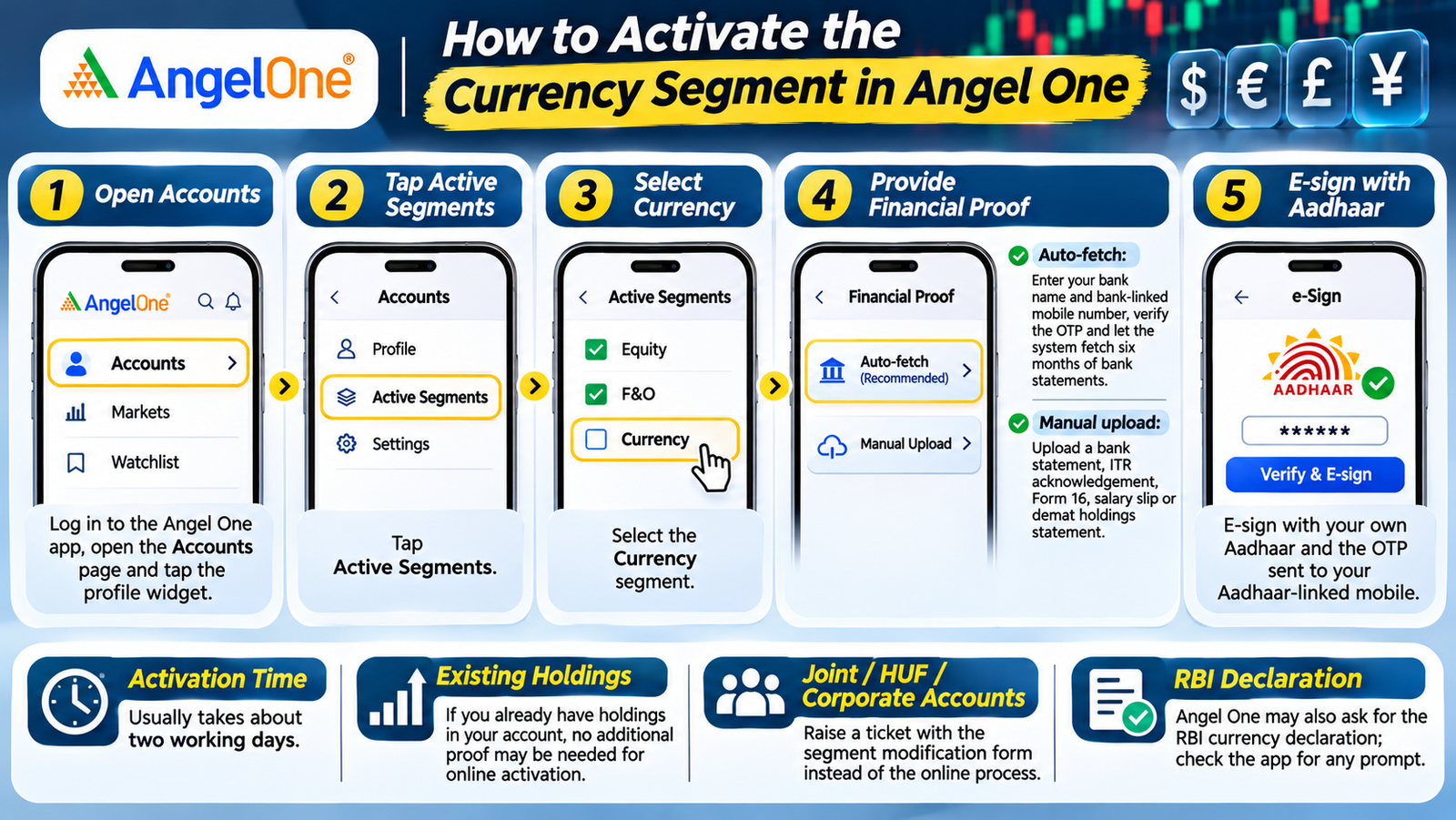
Angel One’s knowledge centre describes this process in the app:
- Log in to the Angel One app, open the Accounts page and tap the profile widget.
- Tap Active Segments.
- Select the currency segment.
- Provide financial proof, either by:
- Auto-fetch: entering your bank name and bank-linked mobile number, verifying the OTP and letting the system fetch six months of bank statements; or
- Manual upload: uploading a document such as a bank statement, ITR acknowledgement, Form 16, salary slip or demat holdings statement.
- E-sign with your own Aadhaar and the OTP sent to your Aadhaar-linked mobile.
Angel One says activation usually takes about two working days. If you already have holdings in your account, it says no additional proof may be needed for online activation. Joint, HUF and corporate accounts must raise a ticket with the segment modification form instead of using the online process. Angel One may also ask for the RBI currency declaration; check the app for any prompt.
Comparison: Zerodha vs Upstox vs Angel One
If you are deciding where to trade, or comparing how to activate currency segment Zerodha accounts with the other two brokers, this summary helps:
| Feature | Zerodha | Upstox | Angel One |
|---|---|---|---|
| Where to start | account.zerodha.com (Console), segment activation | App: My account → Profile → Declaration for Currency Segment | App: Accounts → Profile → Active Segments |
| Financial proof | Bank statement via OTP or other proof | Automatic bank statement fetch or upload | Auto-fetch or manual upload |
| RBI declaration | Collected during activation | Separate declaration with eSign | Check app for prompt |
| Typical timeline | Next trading day if done by 8pm | About 24 hours | About 2 working days |
| Offline option | Courier signed form | Check support | Ticket with form for non-individual accounts |
Based on each broker’s support pages as of November 2026. Processes can change.
Checking Status and Deactivating the Segment
After you activate currency segment Zerodha access, you can check whether it is live in the segments section of your Zerodha account or in your Kite profile. Upstox and Angel One show active segments in the profile area of their apps.
If you later decide you no longer need currency trading, most brokers let you deactivate a segment from the same section. Deactivation can be useful if you no longer have an underlying exposure to hedge, or simply want to reduce the number of products enabled on your account. Close all open positions before deactivating.
Tips Before You Start
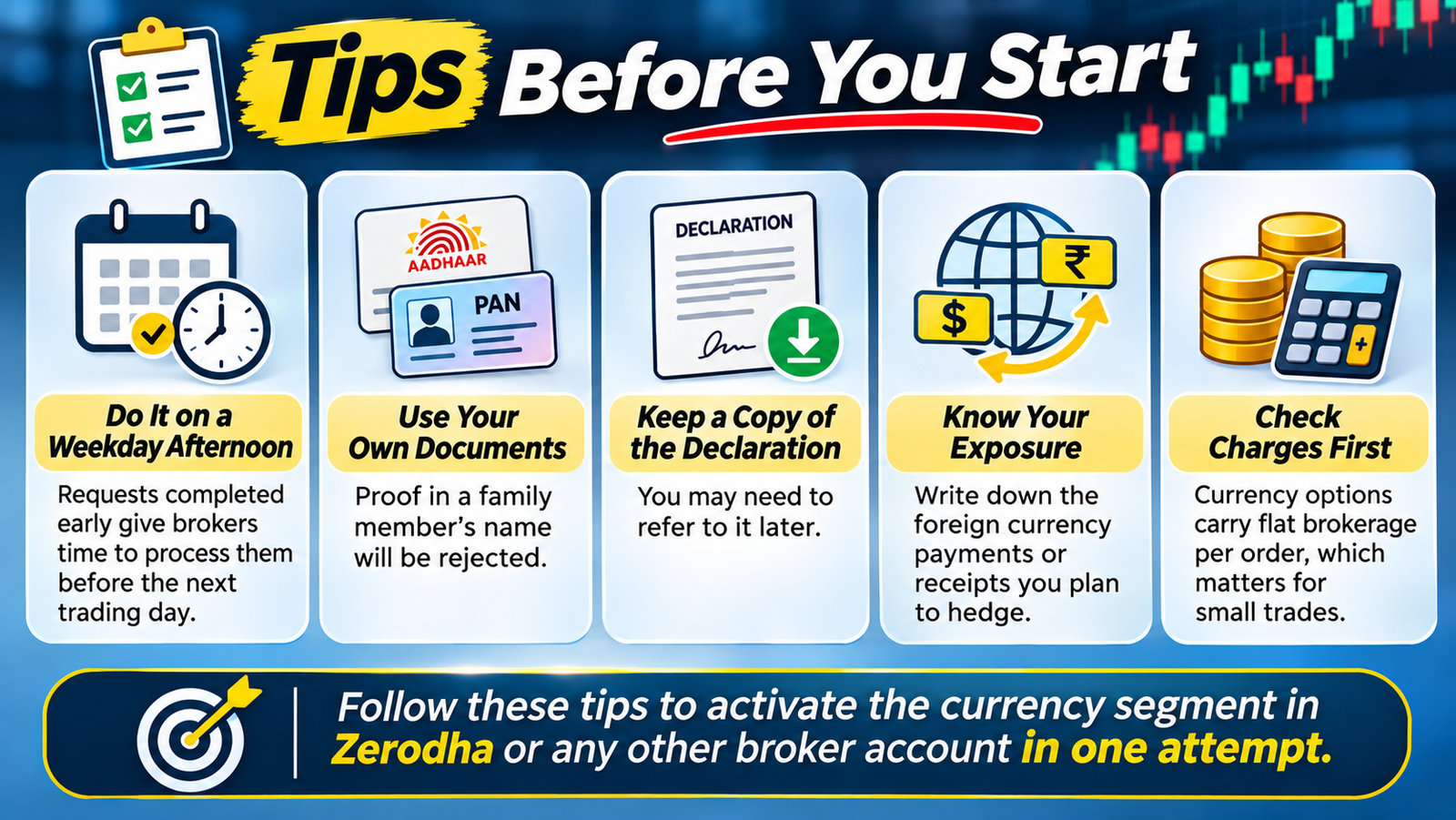
- Do it on a weekday afternoon: requests completed early give brokers time to process them before the next trading day.
- Use your own documents: proof in a family member’s name will be rejected.
- Keep a copy of the declaration: you may need to refer to it later.
- Know your exposure: write down the foreign currency payments or receipts you plan to hedge.
- Check charges first: currency options carry flat brokerage per order, which matters for small trades.
Following these tips makes it easier to activate currency segment Zerodha or other broker accounts in one attempt.
Common Reasons Activation Fails
- Aadhaar not linked to mobile: online e-signing needs an Aadhaar-linked mobile number.
- Insufficient income proof: bank statements must usually show regular transactions and be in your own name.
- Password-protected or unclear documents: upload clear files and enter passwords where required.
- Equity segment not active: some brokers require it first.
- Name mismatch: your name on documents must match your trading account.
- Declaration not signed: the currency segment may stay disabled until the RBI declaration is completed.
If you try to activate currency segment Zerodha or another broker’s version and see an error, check the broker’s support page for the specific message before resubmitting.
After Activation: Your First Steps
- Check the segment status in your profile to confirm it is active.
- Learn the contracts: USD/INR, EUR/INR, GBP/INR and JPY/INR, plus EUR/USD, GBP/USD and USD/JPY.
- Understand lot sizes: one USD/INR lot is $1,000, so a one-paisa move is worth ₹10 per lot.
- Check trading hours: rupee pairs trade from 9am to 5pm IST; cross-currency pairs trade longer.
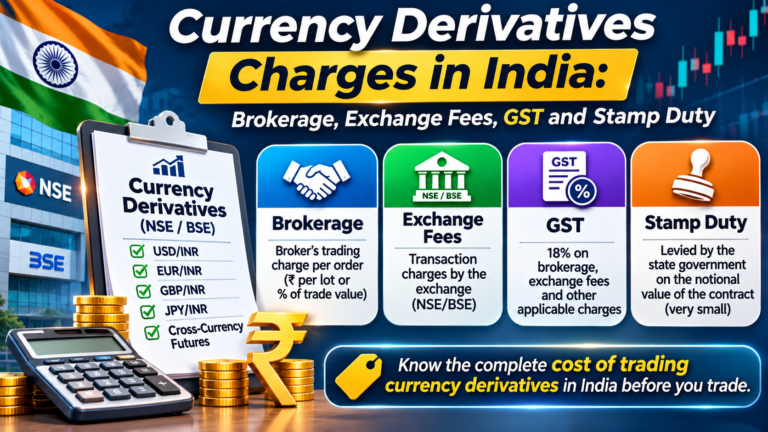
- Review charges: brokerage, exchange transaction charges, GST, SEBI fees and stamp duty all apply.
- Start small: trade one lot with a stop-loss while you learn the platform.
Worked Example: From Activation to First Trade
This example is illustrative and uses hypothetical prices.
Arjun, a freelance software developer, earns in US dollars from overseas clients. He wants to hedge the rupee value of an expected $5,000 payment due next month.
- He follows the steps to activate currency segment Zerodha access, submits six months of bank statements by OTP and signs the RBI declaration, which is true for him because he has a genuine foreign currency receivable.
- The next trading day, he sells 5 lots of USD/INR futures at 88.60 to lock in a rate for his expected dollar receipts.
- If the rupee strengthens to 88.20 by expiry, his futures position gains 40 paise × ₹10 × 5 = ₹2,000, offsetting the lower rupee value of his payment.
This is the kind of hedging use the RBI framework is designed for.
Important Legal Reminders
- Exchange-traded currency derivatives on NSE and BSE through SEBI-registered brokers are the legal route for residents.
- Leveraged forex through offshore brokers and apps is not permitted for Indian residents under FEMA, and the RBI publishes an Alert List of unauthorised platforms.
- Sign the RBI currency declaration only if it accurately reflects your situation. If unsure, ask your broker or a registered adviser.
FAQs
How do I activate currency segment Zerodha accounts?
Log in to account.zerodha.com, open segment activation, enable currency, select your income range, submit financial proof, sign the RBI currency declaration and complete Aadhaar eSign.
What if I cannot activate currency segment Zerodha online?
Use Zerodha’s offline route by printing, signing and couriering the RBI declaration form, or contact Zerodha support for help with the specific error.
How long does activation take?
Zerodha says requests completed by 8pm usually allow trading the next trading day; Upstox says about 24 hours; Angel One says about two working days.
Why do brokers ask for a currency declaration?
Because of RBI rules requiring residents to use exchange-traded rupee currency derivatives mainly to hedge genuine foreign currency exposures.
What changed in October 2026?
The RBI announced a cut in the limit for positions without documented underlying exposure in exchange-traded INR currency derivatives from US100milliontoUS5 million equivalent.
What income proof is accepted?
Common options include six months of bank statements, ITR acknowledgement, Form 16, salary slips and demat holdings statements. Requirements vary by broker.
Can I activate the currency segment without Aadhaar-linked mobile?
Usually only through an offline process, such as Zerodha’s courier option.
Conclusion
Activating the currency segment takes only a few minutes online, as long as your Aadhaar is linked to your mobile, your income proof is ready and you understand the RBI declaration. To activate currency segment Zerodha users go through account.zerodha.com, Upstox users through the app’s profile section and Angel One users through Active Segments.
Above all, use currency derivatives in line with RBI rules, especially after the October 2026 changes. Trade small, understand costs and lot sizes, and stick to the regulated NSE and BSE route.