

Introduction
Every day, the price of one currency in terms of another changes. The rupee may weaken against the dollar one week and strengthen the next. But what actually sets that price? Understanding how exchange rates are determined starts with two things: the economic forces of demand and supply, and the rules a country chooses for its currency, known as its exchange rate regime.
Countries make very different choices about how exchange rates are determined. Some let the market decide almost entirely, using a floating exchange rate. Others fix their currency to another, using a fixed exchange rate system. Many, including India, sit in between with a managed float, where the market sets the rate but the central bank steps in to smooth sharp moves.
This guide explains how exchange rates are determined, the main types of regime, how the rupee exchange rate regime has evolved and works today, and what it all means for traders, businesses and investors.
What Is an Exchange Rate?
An exchange rate is the price of one currency expressed in another. If USD/INR is 88.50, one US dollar costs ₹88.50. When the rate rises, the rupee has weakened (depreciated); when it falls, the rupee has strengthened (appreciated).
Like any price, an exchange rate reflects demand and supply. The more people want rupees compared with dollars, the stronger the rupee. The question is how much a government or central bank allows, or prevents, that market price from moving. That balance between market forces and policy is at the heart of how exchange rates are determined.
How Exchange Rates Are Determined by Demand and Supply
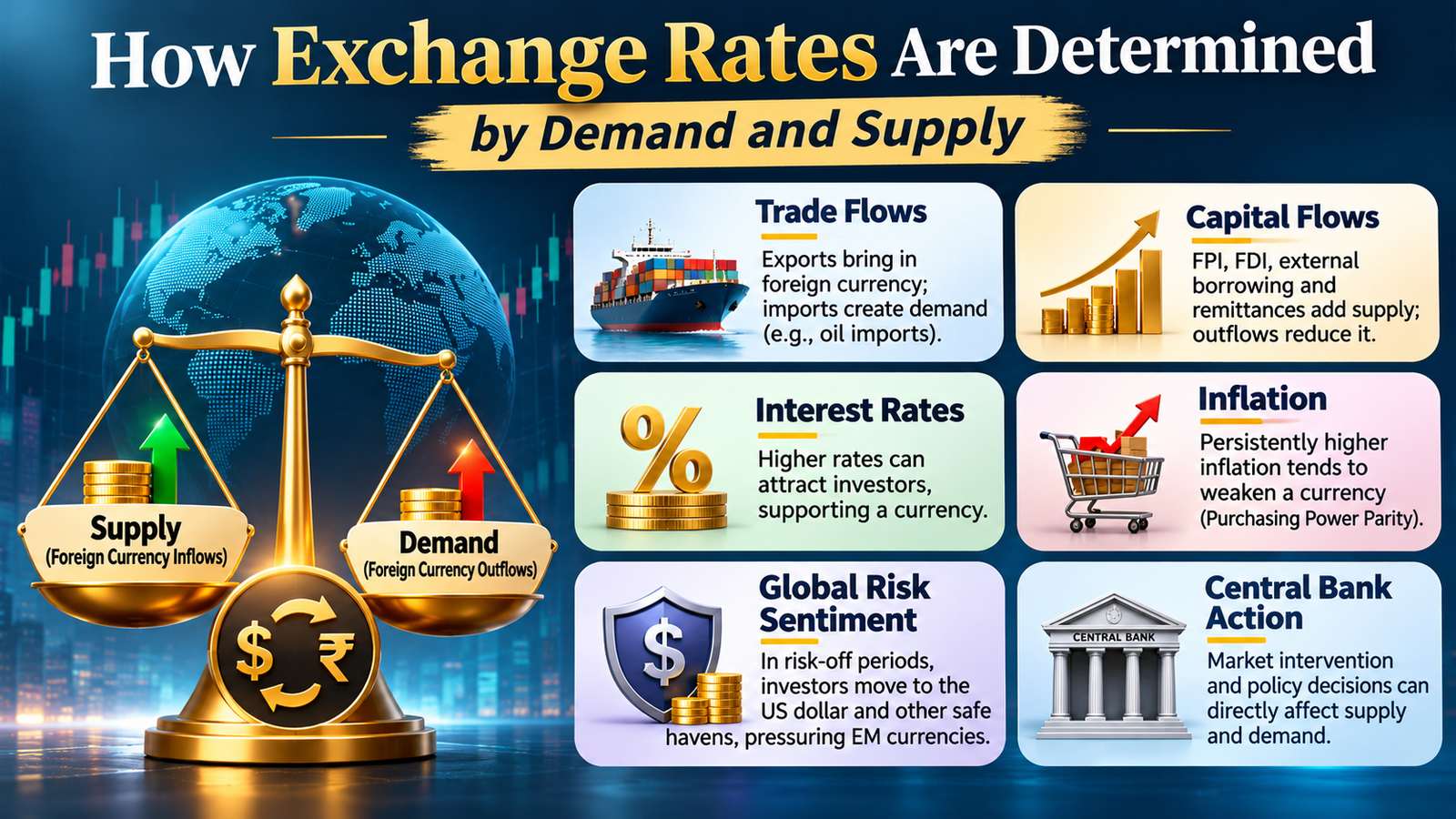
In a market-based system, how exchange rates are determined comes down to the flow of money into and out of a currency. The main forces are:
- Trade flows: exporters earn foreign currency and sell it for rupees; importers buy foreign currency. A large trade deficit, such as India’s dependence on oil imports, adds demand for dollars.
- Capital flows: foreign portfolio investment (FPI), foreign direct investment (FDI), external borrowing and remittances bring in foreign currency. Outflows do the opposite.
- Interest rates: higher interest rates can attract investors seeking returns, supporting a currency.
- Inflation: countries with persistently higher inflation tend to see their currencies weaken over time, as described by purchasing power parity (PPP).
- Global risk sentiment: in “risk-off” periods, investors often move to the US dollar and other safe havens, pressuring emerging-market currencies.
- Central bank action: intervention in the currency market and policy decisions can directly affect supply and demand.
Theories of How Exchange Rates Are Determined
- Purchasing power parity: over the long run, exchange rates tend to move to equalize the prices of similar goods across countries.
- Interest rate parity: the difference between two countries’ interest rates is reflected in the gap between spot and forward exchange rates. That is why USD/INR futures usually trade above spot.
- Balance of payments approach: a country’s current account and capital account together determine the net demand for its currency.
The Main Types of Exchange Rate Regime
Countries choose from a spectrum of regimes, from fully fixed to fully floating. The regime decides how exchange rates are determined in practice: by the market, by the central bank, or by both.
| Regime | How the rate is set | Examples |
|---|---|---|
| No separate currency | Uses another country’s currency | Countries that use the US dollar or the euro without issuing their own |
| Currency board / hard peg | Fixed by law, backed fully by reserves | Hong Kong dollar, held in a narrow band against the US dollar |
| Conventional fixed peg | Fixed to one currency or a basket, defended by the central bank | UAE dirham and Saudi riyal, pegged to the US dollar |
| Crawling peg or crawl-like arrangement | Adjusted in small, gradual steps | Several emerging economies |
| Managed float | Market-determined, with central bank intervention to limit volatility | India and many emerging markets |
| Free float | Set almost entirely by the market | US dollar, euro, Japanese yen, British pound |
The Fixed Exchange Rate System
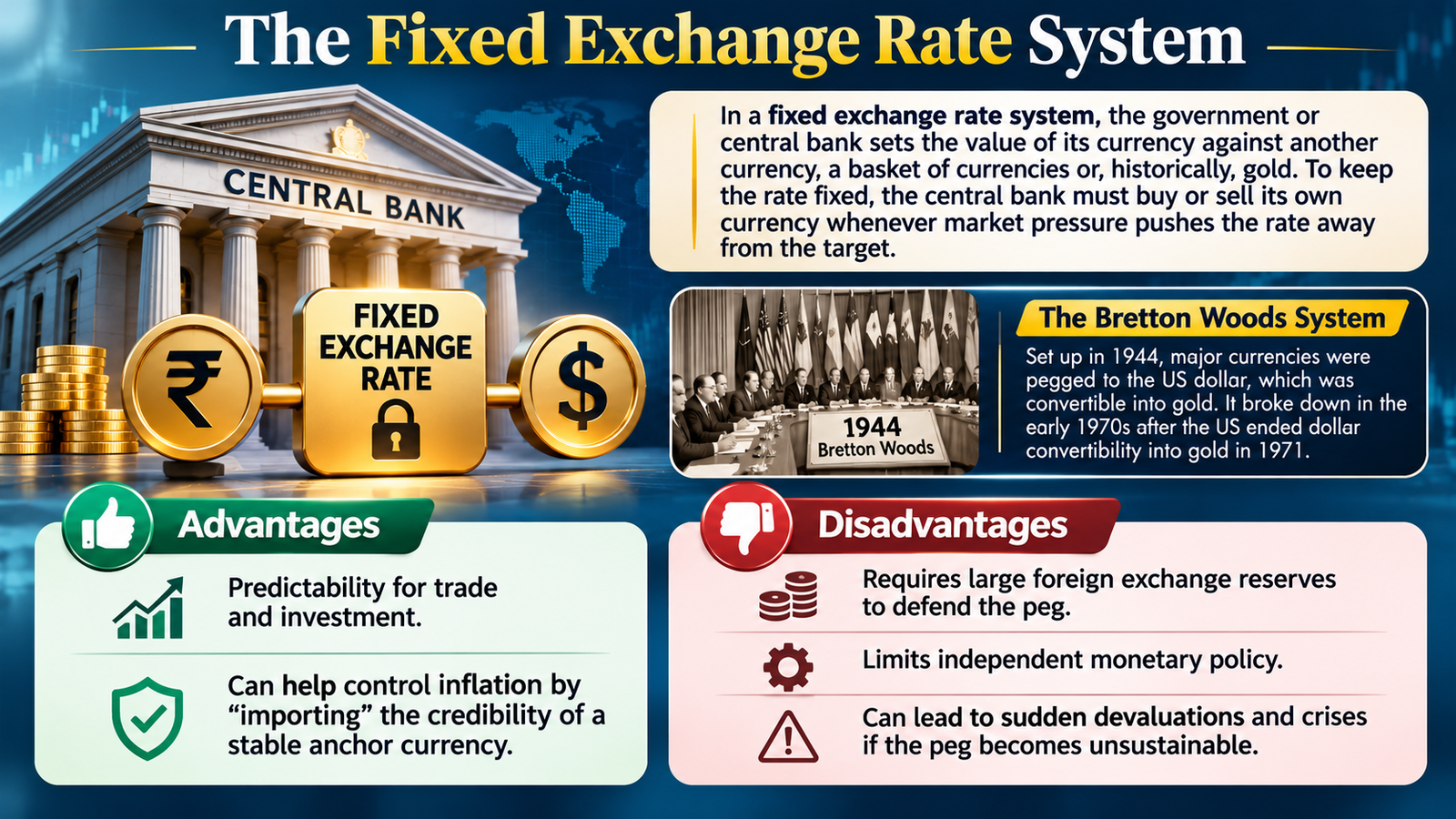
In a fixed exchange rate system, the government or central bank sets the value of its currency against another currency, a basket of currencies or, historically, gold. To keep the rate fixed, the central bank must buy or sell its own currency whenever market pressure pushes the rate away from the target. Under this system, how exchange rates are determined is largely a policy decision rather than a market outcome.
The best-known example is the Bretton Woods system, set up in 1944. Major currencies were pegged to the US dollar, which was convertible into gold. The system broke down in the early 1970s after the US ended dollar convertibility into gold in 1971, and most major economies moved to floating rates.
Advantages
- Predictability for trade and investment.
- Can help control inflation by “importing” the credibility of a stable anchor currency.
Disadvantages
- Requires large foreign exchange reserves to defend the peg.
- Limits independent monetary policy.
- Can lead to sudden devaluations and crises if the peg becomes unsustainable.
The Floating Exchange Rate
Under a floating exchange rate, the currency’s value is determined by market forces of demand and supply, with little or no official intervention. The US dollar, euro, Japanese yen and British pound all operate under floating regimes. Here, how exchange rates are determined is left almost entirely to the market.
Advantages
- Automatically adjusts to economic shocks.
- Allows the central bank to focus on domestic goals such as inflation.
- No need to hold huge reserves to defend a fixed level.
Disadvantages
- Can be volatile, creating uncertainty for businesses.
- Sharp swings can feed into inflation, especially for import-dependent economies.
The Managed Float
A managed float, sometimes called a “dirty float”, combines market pricing with central bank involvement. The exchange rate is mainly determined in the market, but the central bank intervenes, by buying or selling foreign currency, to reduce excessive volatility or disorderly moves. It usually does not defend a specific announced level. In other words, how exchange rates are determined is a mix of market forces and official action.
This approach aims to capture the flexibility of a floating exchange rate while avoiding the extreme swings that can damage trade, inflation and financial stability. Many emerging economies prefer this middle path.
How Exchange Rates Are Determined Under Each System
| Feature | Fixed peg | Managed float | Free float |
|---|---|---|---|
| Who sets the rate | Central bank or government | Market, with intervention | Market |
| Volatility | Low, until the peg breaks | Moderate | Can be high |
| Need for reserves | Very high | Moderate to high | Low |
| Monetary policy independence | Limited | Partial to high | High |
| Shock absorption | Weak | Moderate | Strong |
| Crisis risk | Sudden devaluation | Lower, if reserves are strong | Gradual adjustment, but possible overshooting |
The Evolution of the Rupee Exchange Rate Regime
India’s history shows that how exchange rates are determined can change as an economy opens up.
- 1947 to the early 1970s: the rupee was linked to the pound sterling within the Bretton Woods framework, effectively a fixed peg.
- 1975: India moved to a peg against a basket of currencies of its major trading partners.
- July 1991: during the balance of payments crisis, the rupee was devalued in two steps as part of wide-ranging economic reforms.
- 1992: the Liberalized Exchange Rate Management System (LERMS) introduced a dual rate, with part of export earnings converted at a market rate.
- March 1993: the dual rates were unified, and the rupee moved to a market-determined exchange rate.
- Since 1993: the market has set the trend, with the RBI intervening to manage volatility.
How the Rupee Exchange Rate Regime Works Today
For the rupee, how exchange rates are determined today centres on the interbank market, with the RBI as an active participant. Officially, India’s rupee exchange rate regime is market-determined. The RBI has long said that it does not target a specific level for the rupee but intervenes to curb excessive volatility and maintain orderly market conditions.
In practice, the RBI intervenes regularly in the spot, forward and futures markets, buying dollars when inflows are strong and selling dollars when outflows put pressure on the rupee. India’s large foreign exchange reserves give the RBI significant capacity to do this.
De jure vs de facto classification
The International Monetary Fund (IMF) classifies exchange rate regimes in two ways: de jure, what a country officially says, and de facto, how the currency actually behaves.
- India’s de jure regime is floating.
- In 2023, the IMF reclassified India’s de facto regime from “floating” to a “stabilised arrangement”, reflecting how tightly the rupee had been managed.
- In its 2025 staff report, published in November 2025, the IMF reclassified India’s de facto regime as a crawl-like arrangement, reflecting a more gradual, controlled weakening of the rupee.
Both stabilised and crawl-like arrangements fall within the IMF’s “soft peg” categories, rather than its floating categories. The RBI, for its part, continues to describe the rupee as market-determined. This difference in labels shows that the line between market-led management and a soft peg depends on how actively the central bank intervenes.
Worked Example: How Exchange Rates Are Determined During a Shock
This example is illustrative and uses hypothetical figures.
Suppose global investors become nervous and foreign portfolio investors sell Indian assets, taking $5 billion out of the country in two weeks. At the same time, oil prices rise, increasing importers’ demand for dollars.
- Under a pure free float: the rupee might fall quickly, for example from 88.00 to 89.50, until the weaker rupee attracts buyers and discourages imports.
- Under a managed float: the RBI sells some dollars from its reserves to slow the fall. The rupee might weaken more gradually, perhaps to 88.80, giving businesses time to adjust.
- Under a fixed peg: the central bank would have to sell enough dollars to hold the rate at 88.00. If outflows continued and reserves fell too far, it might eventually be forced into a sudden devaluation.
The example shows why many emerging economies prefer this middle path: it allows adjustment without disorderly moves, provided the central bank has enough reserves. It also shows how exchange rates are determined differently under each system.
What This Means for Traders and Businesses
Knowing how exchange rates are determined helps you anticipate how a currency may react to news and policy.
- Lower volatility in USD/INR: because of RBI intervention, the rupee usually moves less sharply than freely floating currencies. This affects option prices and the size of moves traders can expect.
- Watch RBI behaviour: intervention can slow or reverse sharp moves, so trend-following strategies on USD/INR may behave differently from those on EUR/USD.
- Interest rate differences matter: the forward premium on USD/INR futures reflects the gap between Indian and US interest rates.
- Hedging is still important: even a managed currency can weaken steadily over time, so importers and exporters should plan for currency risk.
Indian residents can trade or hedge currency risk through USD/INR and other currency futures and options on NSE and BSE via SEBI-registered brokers. Leveraged forex trading on offshore platforms is not permitted under the Foreign Exchange Management Act (FEMA).

Common Misunderstandings
- “The RBI fixes the rupee.” India does not run a fixed exchange rate system; the market sets the rate, with intervention to limit volatility.
- “Only the central bank decides.” In most major economies, how exchange rates are determined depends mainly on millions of market transactions every day.
- “A weaker rupee is always bad.” It hurts importers but helps exporters and can improve competitiveness.
- “A floating exchange rate means no central bank involvement.” Even floating currencies can see occasional intervention in extreme conditions.
FAQs
How are exchange rates determined?
Put simply, how exchange rates are determined depends on the demand for and supply of currencies, driven by trade, capital flows, interest rates, inflation, growth and sentiment, within the rules set by each country’s exchange rate regime.
What is the difference between a floating exchange rate and a fixed exchange rate system?
A floating rate is set by the market, while a fixed rate is set by the central bank and defended through buying and selling currency.
What is a managed float?
A regime where the market mainly sets the exchange rate, but the central bank intervenes to reduce excessive volatility.
What is India’s rupee exchange rate regime?
Officially market-determined and floating. In practice it is a managed float, which the IMF classified in November 2025 as a de facto crawl-like arrangement.
Why does it matter how exchange rates are determined?
It affects import costs, export earnings, inflation, foreign investment and the returns on currency trades, so it matters to businesses, investors and traders alike.
Why does the RBI intervene in the currency market?
To curb excessive volatility, maintain orderly market conditions and protect financial stability, rather than to target a specific level.
Conclusion
In short, how exchange rates are determined comes down to the constant interaction of demand and supply, shaped by trade, capital flows, interest rates, inflation and sentiment. How freely that price can move depends on the regime: a fixed exchange rate system ties the currency to an anchor, a floating exchange rate leaves it to the market, and a managed float combines market pricing with central bank smoothing.
The rupee exchange rate regime has evolved from a sterling-linked peg to a basket peg and, since 1993, to a market-determined regime. Today the RBI lets the market set the trend while intervening to limit volatility, a balance that the IMF most recently described, in November 2025, as a crawl-like arrangement. For traders and businesses, understanding how exchange rates are determined is essential for anticipating how the rupee is likely to behave.