Introduction
FTMO is one of the best-known proprietary trading firms in the world, and it is very popular with Indian traders. The idea is attractive: pay a one-time fee, prove your skill in an evaluation, and then trade a simulated account of up to $200,000 while keeping up to 90% of the profits you make.
But Indian traders face extra questions that most global reviews ignore. What do the fees cost? How do payouts reach an Indian bank account? How are rewards taxed? And where does FTMO sit under Indian foreign exchange rules?
This FTMO India guide answers those questions. It covers the 2-Step and 1-Step Challenge rules, fees, payouts, the tax position, FEMA considerations, a worked example and practical tips to improve your chances of passing.
What Is FTMO?
FTMO is a prop trading firm based in Prague, Czech Republic, founded in 2015. It offers traders an evaluation process. If you pass, you become an FTMO Trader and trade an FTMO Account, earning a share of the simulated profits as a “reward”.
An important point for FTMO India traders to understand is that the accounts are simulated. You do not trade your own money in the live market, and you do not deposit trading capital. You pay a fee for the evaluation, and FTMO pays you rewards based on your performance under its rules.
FTMO offers trading in forex pairs, indices, commodities, metals, stocks and cryptocurrencies, mainly as CFDs, through platforms such as MetaTrader 4, MetaTrader 5, cTrader and DXtrade.

FTMO Challenge Types: 2-Step vs 1-Step
FTMO offers two main evaluation models. Here is how the rules compare:
| Rule | 2-Step Challenge | 1-Step Challenge |
|---|---|---|
| Phases | FTMO Challenge, then Verification | One phase |
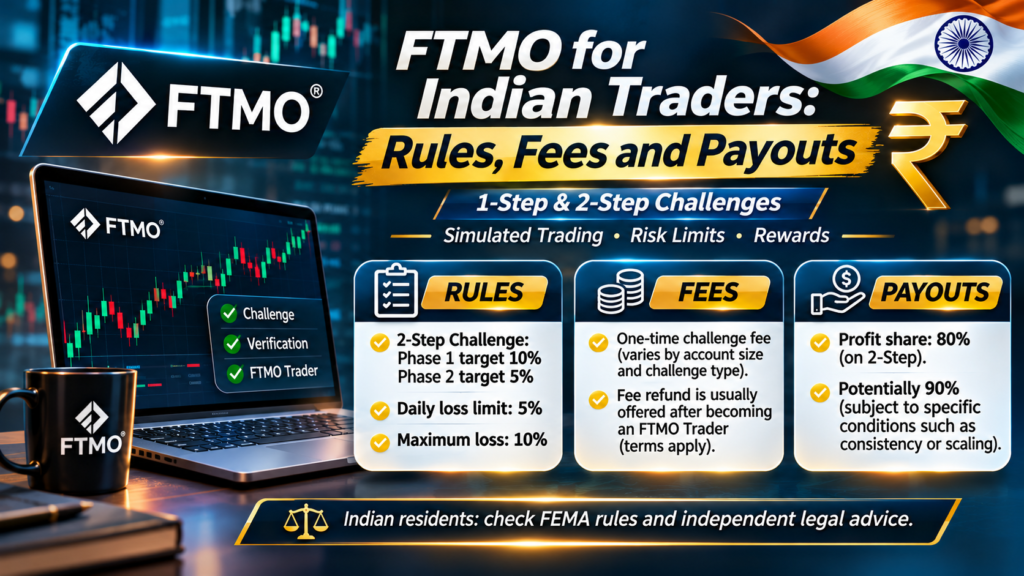
| Profit target | 10% in Phase 1, 5% in Phase 2 | 10% |
| Maximum daily loss | 5% of initial balance | 3% of initial balance |
| Maximum loss | 10% of initial balance (static) | 10%, trailing on end-of-day balance |
| Minimum trading days | 4 per phase | Governed mainly by the Best Day Rule |
| Time limit | None | None |
| Best Day Rule | Not applied | Best day’s profit cannot exceed 50% of total positive-day profit |
| Profit split | 80%, rising to 90% via the Scaling Plan | 90% from the first reward |
| Fee refund | Refunded with the first reward | Not refunded |
The 2-Step model gives more room for daily losses and a static drawdown, which many beginners find easier to manage. The 1-Step model is faster and pays a higher split from the start, but its 3% daily loss limit and trailing drawdown are stricter.
FTMO India Fees: How Much Does a Challenge Cost?
FTMO lists its CFD Challenge fees in euros. Recent published prices are:
| Account size | 2-Step fee | 1-Step fee |
|---|---|---|
| $10,000 | €89 | €79 |
| $25,000 | €250 | €199 |
| $50,000 | €345 | €319 |
| $100,000 | €540 | €499 |
| $200,000 | €1,080 | €999 |
For FTMO India buyers, the final rupee cost depends on the EUR/INR exchange rate, your card’s foreign currency markup and any bank charges. Check the final amount at checkout. FTMO also runs occasional offers, so the price you see may differ from the table.
Remember that the 2-Step fee is refunded with your first reward if you pass and get paid. The 1-Step fee is not refunded.
Key FTMO Rules Every Indian Trader Must Know
The rules are the same worldwide, but FTMO India traders need to convert the key times into IST and plan their trading day around them.
Maximum daily loss
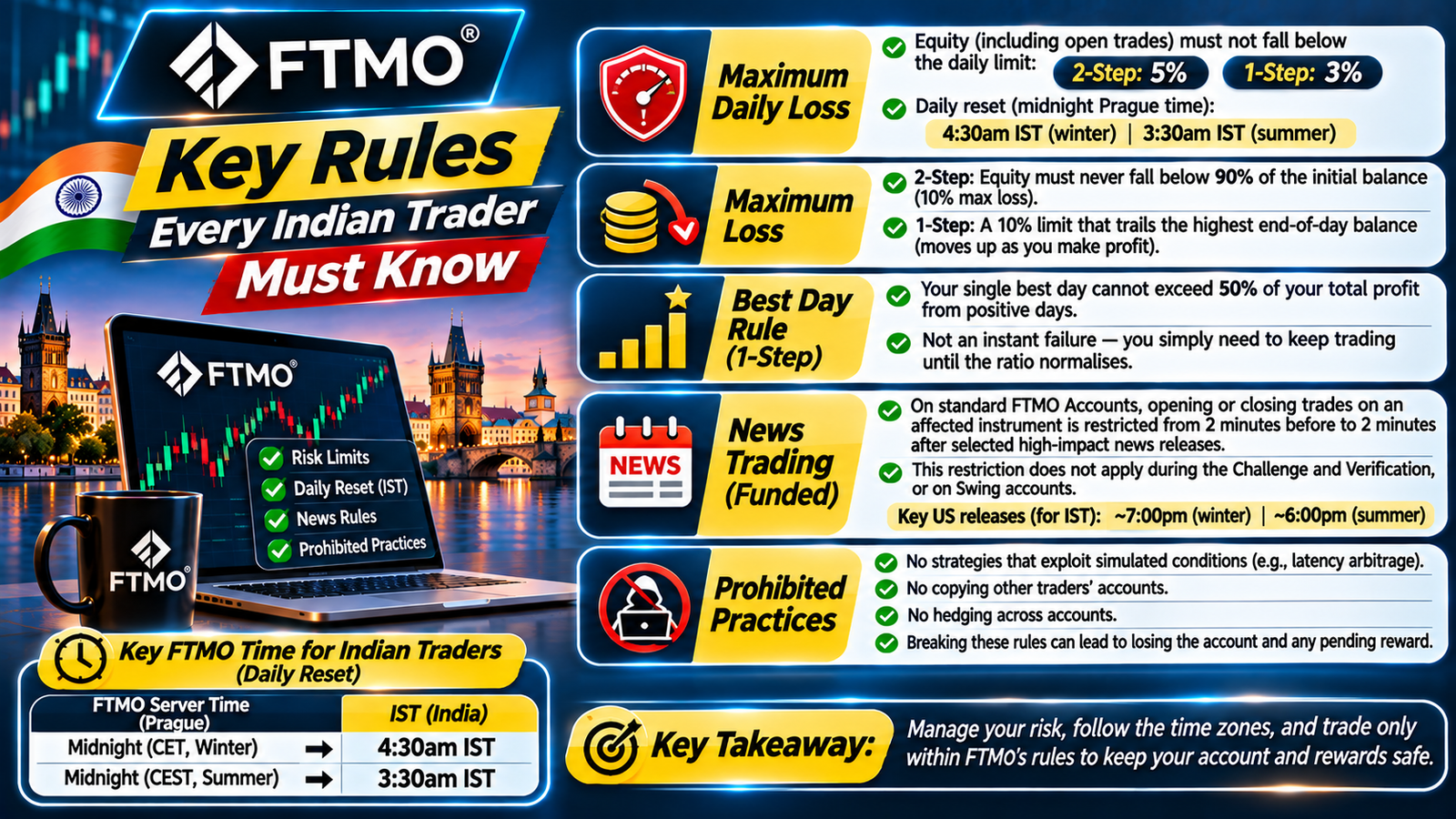
Your account equity, including open trades, must not fall below the daily limit, which is 5% (2-Step) or 3% (1-Step) of the initial balance, measured from the day’s starting balance. FTMO resets the day at midnight Prague time (CET/CEST). For FTMO India traders, that means the daily reset falls at 4:30am IST in winter and 3:30am IST in summer.
Maximum loss
On the 2-Step model, your equity must never fall below 90% of the initial balance. On the 1-Step model, the 10% limit trails the highest end-of-day balance, so it moves up as you make profit.
Best Day Rule (1-Step)
On the 1-Step model, your single best day cannot exceed 50% of your total profit from positive days. This stops traders passing with one lucky trade. Breaching the ratio is not an instant failure; you simply need to keep trading until it normalises.
News trading on funded accounts
On standard FTMO Accounts, opening or closing trades on an affected instrument is restricted from two minutes before to two minutes after selected high-impact news releases. This restriction does not apply during the Challenge and Verification, or on Swing accounts. For Indian traders, the key US releases usually fall around 7:00pm IST in winter and 6:00pm IST in summer.
Prohibited practices
FTMO prohibits strategies that exploit simulated trading conditions, such as latency arbitrage, copying other traders’ accounts and hedging across accounts. Breaking these rules can lead to losing the account and any pending reward.
FTMO India Payouts: How You Get Paid
Once you are an FTMO Trader, rewards work like this:
- First reward: You can usually request it 14 days after your first trade on the FTMO Account. Some third-party summaries mention a longer wait, so confirm the current rule on FTMO’s site.
- Later rewards: Can generally be requested on demand, with no fixed cycle.
- Profit split: 80% on 2-Step accounts (rising to 90% via the Scaling Plan) and 90% on 1-Step accounts.
- Payout methods: Bank transfer, cryptocurrency and, depending on availability, card transfers or e-wallets.
- Minimums: Bank transfers generally need at least $20 of closed profit and crypto at least $50.
- Fees: FTMO does not charge a withdrawal fee, but intermediary or receiving banks may deduct charges on international wires.
Receiving FTMO India payouts in your bank account
Most FTMO India traders choose a bank wire to their Indian savings account. The payment arrives as a foreign inward remittance, and your bank converts it to rupees. A few practical points:
- Keep the account in your own name, matching your FTMO profile.
- Your bank may ask for the purpose of the remittance. Describe it accurately, for example as payment for trading performance services.
- Download the Foreign Inward Remittance Certificate (FIRC) or advice from your bank for your records.
- Compare the bank’s exchange rate and charges, as these can reduce what you receive.
A note on crypto payouts
Taking rewards in crypto adds complexity in India. Transfers of virtual digital assets are taxed at 30% on gains, with 1% TDS on transfers above certain thresholds, and losses cannot be set off. Converting a crypto payout into rupees can therefore trigger extra tax and reporting. Most FTMO India traders find a bank transfer simpler.
Is FTMO Legal in India?
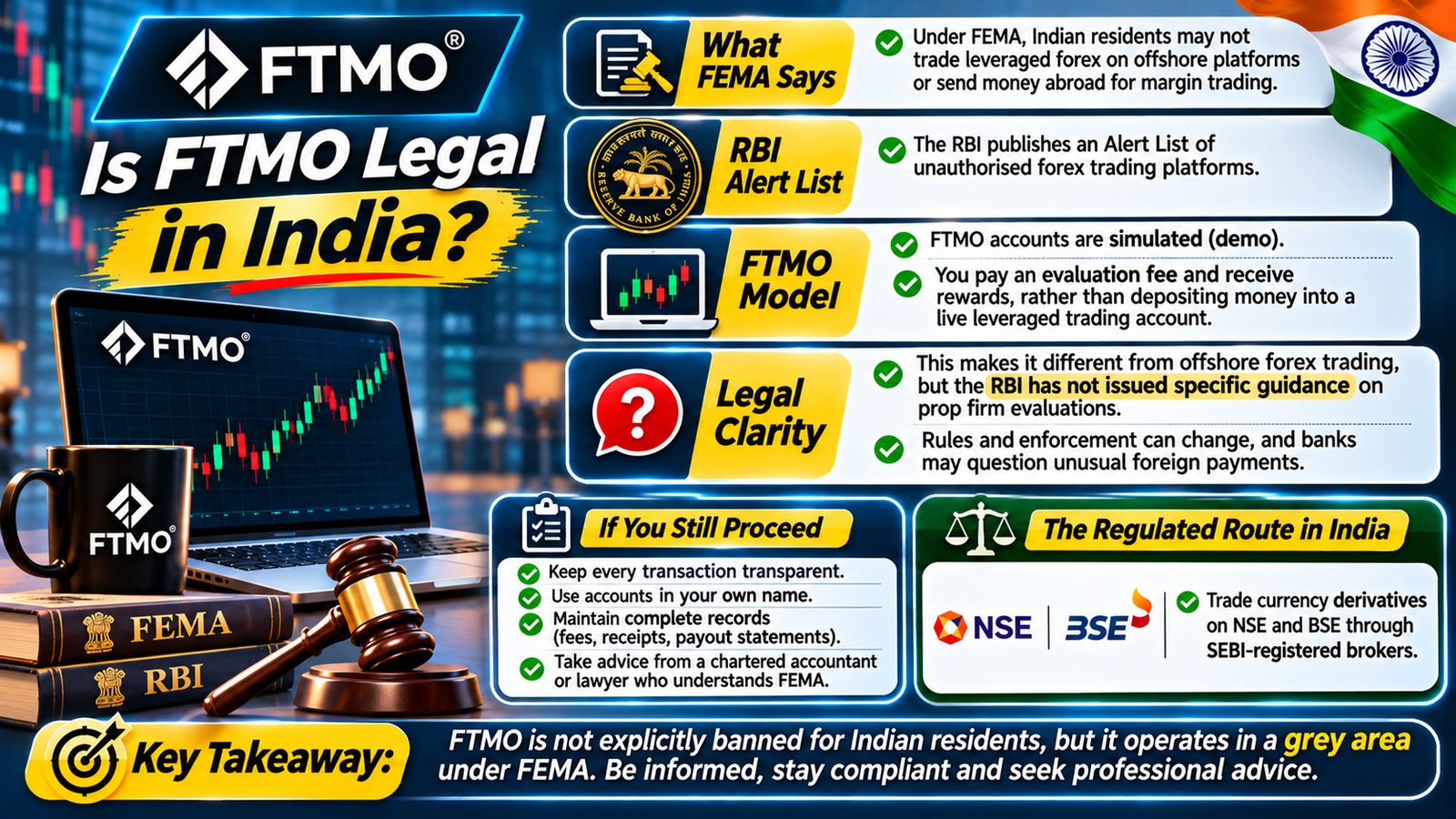
This is the most common FTMO India question, and the honest answer is that the position is not clearly settled.
- Under the Foreign Exchange Management Act (FEMA), Indian residents may not trade leveraged forex on offshore platforms or send money abroad for margin trading. The RBI publishes an Alert List of unauthorised forex trading platforms.
- FTMO’s accounts are simulated. You pay an evaluation fee and receive rewards, rather than depositing money into a live leveraged trading account. Many commentators argue this makes it different from offshore forex trading, but the RBI has not issued specific guidance on prop firm evaluations.
- Rules and enforcement can change, and banks may question unusual foreign payments.
If you go ahead, keep every transaction transparent, use accounts in your own name, maintain records and take advice from a chartered accountant or lawyer who understands FEMA. The fully regulated route for currency trading in India remains exchange-traded currency derivatives on NSE and BSE through SEBI-registered brokers.
How FTMO Rewards Are Taxed in India
Tax professionals commonly treat FTMO India rewards as business income, because they come from trading activity using a firm’s capital. In practice this usually means:
- Filing ITR-3 and reporting the income under business or profession.
- Claiming related expenses, such as Challenge fees, data subscriptions and a share of internet costs, where they are genuinely for the business.
- Reporting foreign income in Schedule FSI, and any foreign wallet or account balances in Schedule FA where required.
- Paying advance tax if your total tax liability for the year is ₹10,000 or more.
- Checking whether a tax audit applies, depending on turnover and profit.
Some may argue for other income heads, so FTMO India traders should get advice from a chartered accountant, keep their FTMO reward statements and bank records, and reconcile every payout.
Worked Example: An FTMO India Trader’s Journey
This example is illustrative. Figures are hypothetical and exclude exchange rate effects.
Ravi, a trader in Pune, buys a $100,000 2-Step Challenge for €540.
- Phase 1: He risks 0.5% per trade and reaches the 10% target ($10,000) in 18 trading days, never losing more than 2% in a day.
- Phase 2: He reaches the 5% target ($5,000) in 11 trading days.
- FTMO Account: In his first month he makes $4,000 of simulated profit. After 14 days from his first funded trade, he requests a reward.
- Reward: 80% of $4,000 = $3,200, plus his €540 fee refunded with this first reward.
- Payout: He takes a bank transfer to his Indian account, records the FIRC and reports the income in his ITR-3.
Ravi’s plan worked because he kept risk small. Had he risked 2% per trade, three bad trades on one day could have breached the daily loss limit.
Tips for FTMO India Traders to Pass the Challenge
- Risk 0.25% to 1% per trade. Small risk keeps you far from the daily and maximum loss limits.
- Set your own daily stop. Stop trading for the day at around 2% loss, well before the 5% or 3% limit.
- Trade sessions that suit Indian time. The London open (1:30pm IST in winter) and the London–New York overlap (6:30pm to 10:30pm IST in winter) offer good movement.
- Track the daily reset. Remember it happens around 4:30am IST in winter.
- Avoid overtrading. There is no time limit, so there is no need to rush.
- Use the Free Trial. Practise the rules on FTMO’s free trial before paying.
- Keep a journal. Review every trade and every rule breach, even on the trial.
Common Mistakes FTMO India Traders Make
- Forgetting that the daily loss limit includes open (floating) losses.
- Getting the IST reset time wrong when Europe changes its clocks.
- Taking oversized trades to pass quickly.
- Trading high-impact news on funded accounts without checking the restriction.
- Choosing crypto payouts without understanding Indian crypto tax.
- Not keeping records for tax and FEMA purposes.
FTMO India Checklist
- Have I read FTMO’s current rules and FAQ on its official website?
- Have I chosen 2-Step or 1-Step based on my risk style?
- Do I know the daily reset time in IST?
- Is my risk per trade 1% or less?
- Do I have a bank account in my own name ready for payouts?
- Have I spoken to a chartered accountant about tax and FEMA?
- Am I keeping records of fees, rewards and remittances?
FAQs
Can Indian traders join FTMO?
Yes, FTMO accepts traders from India, and FTMO India sign-ups use the same rules and fees as other countries. However, the legal position under FEMA is not clearly settled, so take professional advice before signing up.
What is the cheapest FTMO Challenge for Indian traders?
The $10,000 1-Step Challenge, listed at €79, is the cheapest. The $10,000 2-Step Challenge is €89, and its fee is refundable with the first reward.
How do FTMO India payouts work?
Most traders receive rewards by bank transfer to their Indian account, usually from 14 days after their first funded trade and on demand after that.
Is FTMO income taxable in India?
Yes. It is commonly treated as business income and reported in ITR-3. Consult a chartered accountant for your situation.
Which FTMO model is better for beginners?
Many beginners prefer the 2-Step model because of its 5% daily loss limit, static maximum loss and refundable fee.
Conclusion
FTMO offers Indian traders a way to trade larger simulated accounts and earn up to 90% of the profits without risking their own trading capital. But FTMO India success requires respecting strict rules, especially the daily and maximum loss limits, and handling the Indian side properly: payouts, tax and FEMA compliance.
Use this FTMO India guide as a starting point. Practise on the free trial, keep risk small, choose a payout method that is simple to report, keep clean records and get professional advice on the legal and tax position before you begin.