
Introduction
Forex trading comes with its own language. Pips, lots, swaps, margin calls and kill zones can make the market feel confusing before you place a single trade. This forex glossary explains 100 of the most important terms in plain English, grouped by topic so you can learn them step by step.
Use this forex glossary as a reference while you study charts, read analysis or follow economic news. Bookmark it and come back whenever you meet an unfamiliar word.
How to Use This Forex Glossary
- Beginners should start with the basics, pricing and orders sections.
- Intermediate traders can focus on technical, fundamental and risk terms.
- Indian traders should read the final section on local rules.
Forex Glossary: Basic Terms
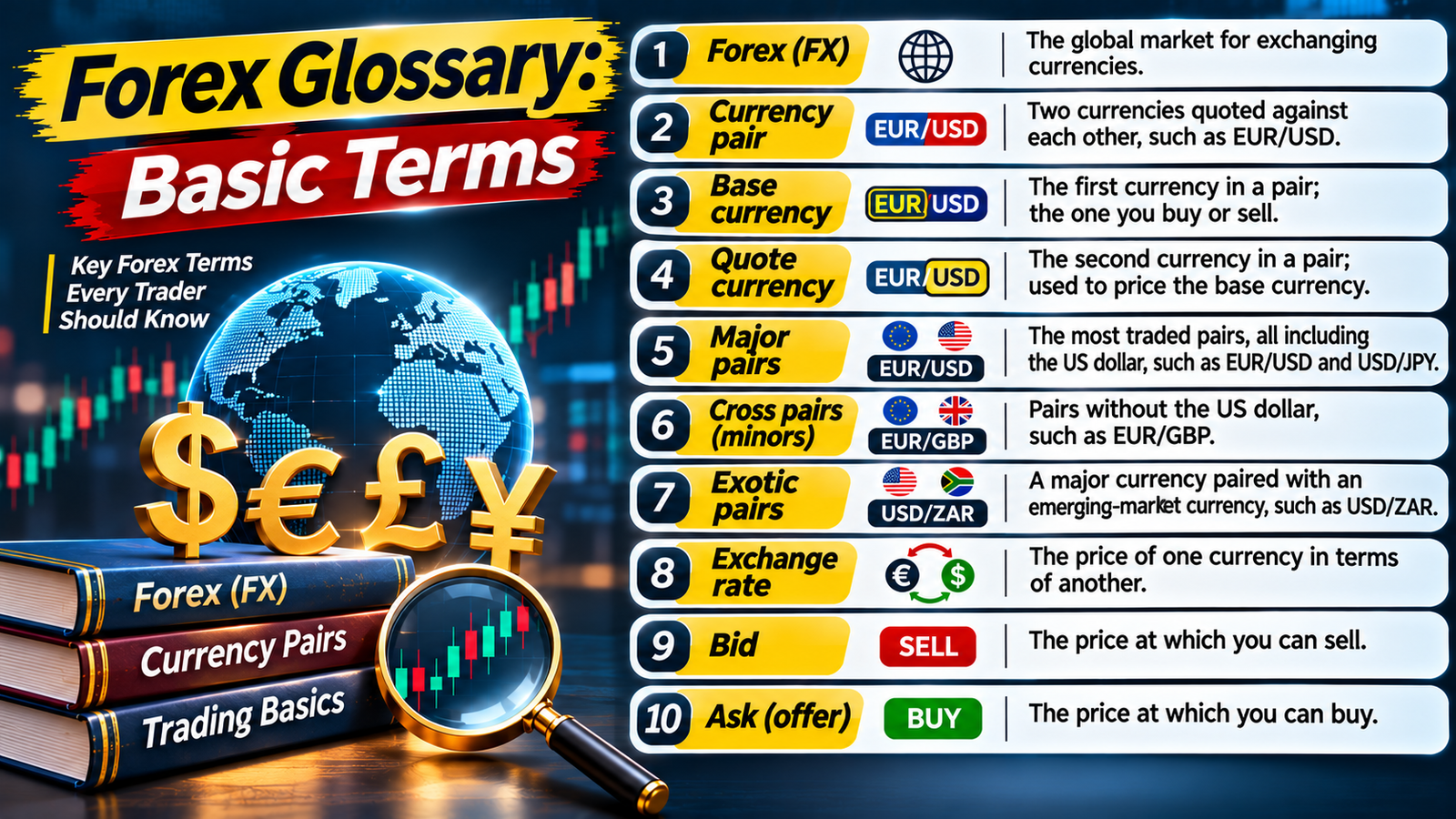
- Forex (FX): The global market for exchanging currencies.
- Currency pair: Two currencies quoted against each other, such as EUR/USD.
- Base currency: The first currency in a pair; the one you buy or sell.
- Quote currency: The second currency in a pair; used to price the base currency.
- Major pairs: The most traded pairs, all including the US dollar, such as EUR/USD and USD/JPY.
- Cross pairs (minors): Pairs without the US dollar, such as EUR/GBP.
- Exotic pairs: A major currency paired with an emerging-market currency, such as USD/ZAR.
- Exchange rate: The price of one currency in terms of another.
- Bid: The price at which you can sell.
- Ask (offer): The price at which you can buy.
Forex Glossary: Pricing and Costs
- Spread: The difference between the bid and ask price; a key trading cost.
- Pip: The standard unit of price movement, usually 0.0001 (0.01 for yen pairs).
- Pipette: One-tenth of a pip, shown as the fifth decimal place.
- Lot: A standard trade size of 100,000 units of the base currency.
- Mini lot: 10,000 units of the base currency.
- Micro lot: 1,000 units of the base currency.
- Commission: A fee charged per trade, usually on raw-spread accounts.
- Swap (rollover): Interest paid or charged for holding a position overnight.
- Slippage: The difference between the expected price and the actual fill price.
- Liquidity: How easily a pair can be bought or sold without moving the price.
Forex Glossary: Order Types
- Market order: An order to buy or sell immediately at the best available price.
- Limit order: An order to buy below or sell above the current price.
- Stop order: An order to buy above or sell below the current price, often used for breakouts.
- Stop-loss: An order that closes a trade at a set price to limit losses.
- Take-profit: An order that closes a trade at a set price to lock in profit.
- Trailing stop: A stop-loss that moves with price as the trade becomes profitable.
- Pending order: Any order waiting to be triggered at a future price.
- OCO (one cancels the other): Two linked orders where filling one cancels the other.
- Good till cancelled (GTC): An order that stays active until filled or cancelled.
- Fill: The execution of an order.
Forex Glossary: Leverage and Margin
- Leverage: Borrowed exposure that lets you control a large position with small capital.
- Margin: The deposit required to open and maintain a leveraged position.
- Free margin: Equity not tied up in open positions.
- Margin level: Equity divided by used margin, shown as a percentage.
- Margin call: A warning that your equity has fallen close to the minimum required.
- Stop out: Automatic closing of positions when margin falls below a set level.
- Equity: Account balance plus or minus open profits and losses.
- Balance: Account value excluding open positions.
- Floating P&L: Unrealised profit or loss on open trades.
- Drawdown: A decline from a peak in account value.
Forex Glossary: Positions and Trading Styles
- Long: Buying a pair, expecting the base currency to rise.
- Short: Selling a pair, expecting the base currency to fall.
- Open position: A trade that has not yet been closed.
- Closed position: A completed trade with realised profit or loss.
- Hedging: Taking a position to offset risk in another position.
- Scalping: Very short-term trading for small, quick profits.
- Day trading: Opening and closing trades within the same day.
- Swing trading: Holding trades for days to weeks to capture larger moves.
- Position trading: Holding trades for weeks to months based on long-term trends.
- Carry trade: Buying a high-interest currency against a low-interest one to earn the rate difference.
Forex Glossary: Technical Analysis
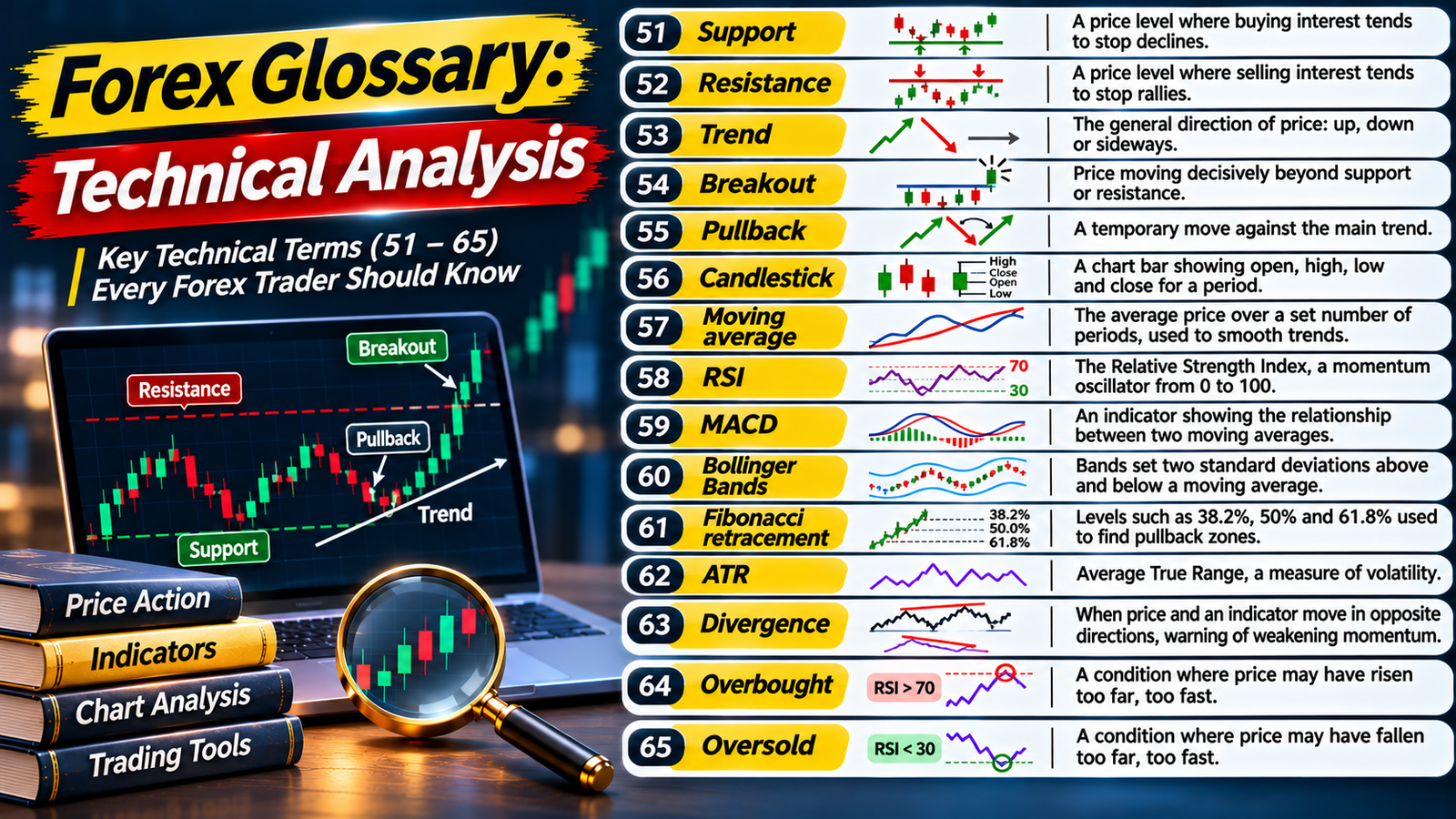
- Support: A price level where buying interest tends to stop declines.
- Resistance: A price level where selling interest tends to stop rallies.
- Trend: The general direction of price: up, down or sideways.
- Breakout: Price moving decisively beyond support or resistance.
- Pullback: A temporary move against the main trend.
- Candlestick: A chart bar showing open, high, low and close for a period.
- Moving average: The average price over a set number of periods, used to smooth trends.
- RSI: The Relative Strength Index, a momentum oscillator from 0 to 100.
- MACD: An indicator showing the relationship between two moving averages.
- Bollinger Bands: Bands set two standard deviations above and below a moving average.
- Fibonacci retracement: Levels such as 38.2%, 50% and 61.8% used to find pullback zones.
- ATR: Average True Range, a measure of volatility.
- Divergence: When price and an indicator move in opposite directions, warning of weakening momentum.
- Overbought: A condition where price may have risen too far, too fast.
- Oversold: A condition where price may have fallen too far, too fast.
Forex Glossary: Fundamental Analysis
- Central bank: The institution that sets a country’s interest rates, such as the Fed or RBI.
- Interest rate: The cost of borrowing; a major driver of currency value.
- CPI: Consumer Price Index, the main measure of inflation.
- NFP: US Non-Farm Payrolls, a monthly jobs report that often moves markets.
- GDP: Gross Domestic Product, the total value of a country’s output.
- Economic calendar: A schedule of upcoming data releases and events.
- Hawkish: A stance favouring higher interest rates to fight inflation.
- Dovish: A stance favouring lower rates to support growth.
- Risk-on: A market mood when investors buy riskier assets and currencies.
- Risk-off: A market mood when investors seek safe havens.
Forex Glossary: Market Structure and Participants
- Market maker: A broker or bank that quotes prices and takes the other side of trades.
- ECN: Electronic Communication Network, linking traders directly to liquidity providers.
- Liquidity provider: A bank or institution supplying buy and sell prices.
- Trading sessions: The Sydney, Tokyo, London and New York periods of market activity.
- Volatility: How much and how quickly prices move.
- Correlation: How closely two pairs move together.
- Safe-haven currency: A currency that tends to rise in crises, such as the yen or Swiss franc.
- Commodity currency: A currency linked to commodity exports, such as the Australian dollar.
- Intervention: A central bank buying or selling its currency to influence the exchange rate.
- Gap: A jump in price between one period’s close and the next period’s open.
Forex Glossary: Risk Management and Psychology
- Risk-reward ratio: Potential profit compared with potential loss on a trade.
- Position sizing: Choosing trade size so that risk matches your plan.
- Risk per trade: The percentage of your account you are willing to lose on one trade.
- Win rate: The percentage of trades that are profitable.
- Expectancy: The average amount a strategy is expected to win or lose per trade.
- Trading plan: Written rules for entries, exits, risk and routine.
- Trading journal: A record of trades, reasons and results.
- Backtesting: Testing a strategy on historical data.
- Revenge trading: Impulsive trading to recover losses quickly.
- FOMO: Fear of missing out, leading to chasing moves.
Forex Glossary: Terms for Indian Traders
- FEMA: The Foreign Exchange Management Act, which governs currency transactions in India and restricts offshore leveraged forex trading.
- LRS: The Liberalized Remittance Scheme, which allows residents to send up to US$250,000 abroad each financial year for permitted purposes, not for margin trading.
- RBI Alert List: The RBI’s published list of unauthorized forex trading platforms.
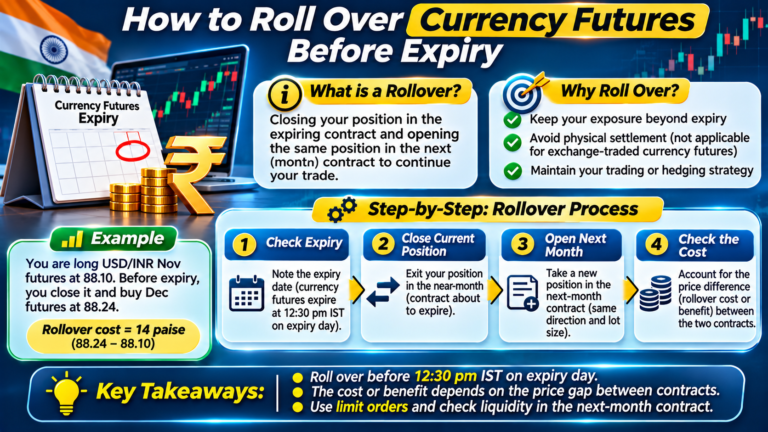
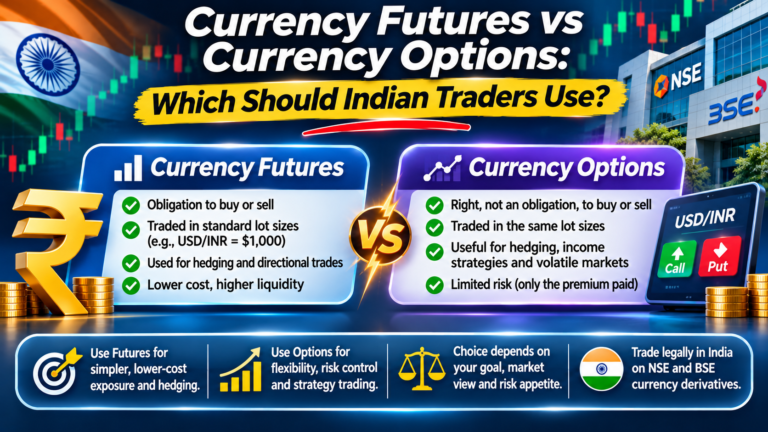
- NSE currency derivatives: Exchange-traded futures and options on INR pairs such as USD/INR, available through SEBI-registered brokers.
- Cross-currency futures: NSE and BSE contracts on EUR/USD, GBP/USD and USD/JPY, cash-settled in rupees.
Commonly Confused Terms in This Forex Glossary
| Terms | The difference |
|---|---|
| Pip vs pipette | A pip is usually 0.0001; a pipette is one-tenth of a pip (0.00001). |
| Balance vs equity | Balance ignores open trades; equity includes their floating profit or loss. |
| Margin vs leverage | Margin is the deposit; leverage is the multiple of exposure it allows. |
| Limit vs stop order | A buy limit is placed below price; a buy stop is placed above price. |
| Spread vs commission | The spread is built into the price; commission is charged separately. |
| Hawkish vs dovish | Hawkish leans towards higher rates; dovish leans towards lower rates. |
| Support vs resistance | Support is a floor below price; resistance is a ceiling above it. |
Mixing up these pairs is a common source of costly mistakes, such as placing the wrong order type or misreading account risk. If you are unsure about any term, check this forex glossary before placing a trade, and confirm how your own broker or platform defines it, because some definitions, such as margin call and stop out levels, vary between providers.
Worked Example: Using the Terms Together
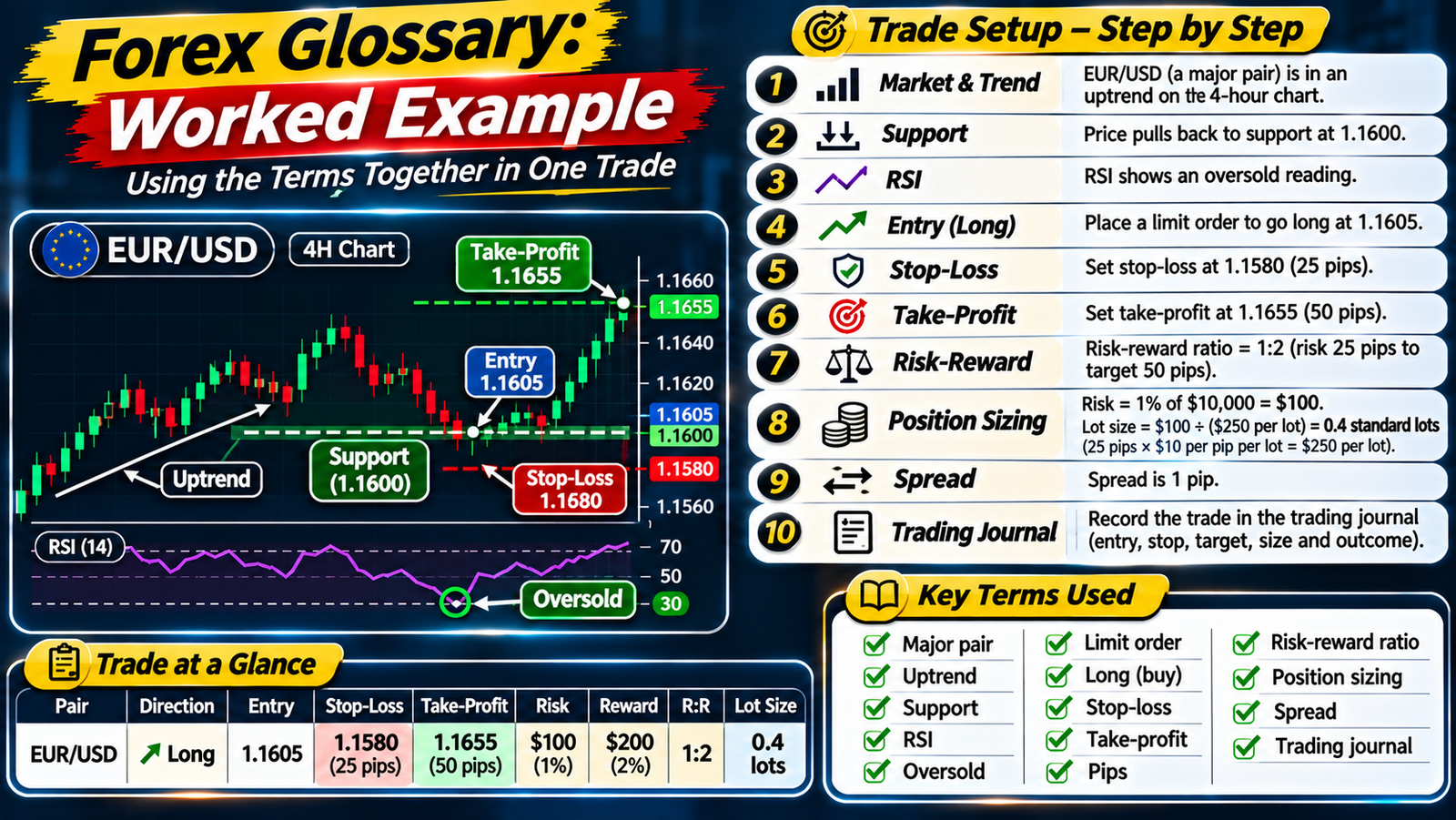
Here is how several terms from this forex glossary fit into one trade:
A trader sees that EUR/USD, a major pair, is in an uptrend on the 4-hour chart. Price pulls back to support at 1.1600 and RSI shows an oversold reading. The trader places a limit order to go long at 1.1605, with a stop-loss at 1.1580 (25 pips) and a take-profit at 1.1655 (50 pips), a risk-reward ratio of 1:2. Using position sizing, they risk 1% of a 10,000account(100), so they trade 0.4 standard lots (25 pips × $10 per pip per lot = $250 per lot). The spread is 1 pip, and the trade is recorded in their trading journal.
This example is illustrative and uses hypothetical prices.
Tips for Learning Forex Terms Faster
- Learn ten terms a day and test yourself with flashcards.
- Use new terms in your trading journal to reinforce them.
- Read daily market commentary and look up unfamiliar words in this forex glossary.
- Practise on a demo account to see terms such as margin, swap and slippage in action.
FAQs
What is a forex glossary?
It is a reference list of the key words and phrases used in currency trading, with simple explanations.
What does pip mean in forex?
A pip is the standard unit of price movement, usually the fourth decimal place (0.0001), or the second decimal place for yen pairs.
What is the difference between leverage and margin?
Leverage lets you control a larger position than your capital; margin is the deposit required to open and hold that leveraged position.
Which forex terms should beginners learn first?
Start with currency pair, bid, ask, spread, pip, lot, stop-loss, take-profit, leverage and margin.
Is forex trading legal in India?
Indian residents can trade currency derivatives on NSE and BSE through SEBI-registered brokers. Leveraged trading on offshore forex platforms is not permitted under FEMA.
Conclusion
Understanding the language of the market is the first step to trading it well. This forex glossary covers 100 essential terms, from basic pricing to technical indicators, economic data, risk management and Indian regulations. Keep it handy, revisit it often and use the terms in your own analysis until they become second nature.
Knowing the words will not make you profitable on its own, but it will help you learn faster, avoid costly misunderstandings and communicate clearly about your trades. Use this forex glossary alongside a solid trading plan and disciplined risk management.